Tag: Money

  • Institutional Realignment

    As I was returning from the Bali vacation, I thought about how we had planned our vacation without the help of a big travel operator. Something that would have been infinitely more difficult, if not impossible a decade back. It’s still early in this decade, but when I begin to think about what it will be known for, the recurring theme that runs in my head is institutional realignment. It’s not really the most original thought I’ve had, and I’ve been influenced by several, most notably Umair Haque. He calls it institutional collapse, and the only couple of reasons I have played semantics are one, that while I don’t see a seamless change, I do think that different parts of society – across geography, industry, demographics will shift at different points in time and the change might be distributed across time and space to prevent a complete collapse so that we fail to see that the institutions are completely different from the earlier era, and two, a sense of optimism. 🙂

    To me, these institutions are across all facets of our current existence – political, societal, economical, professional, cultural, health and so on. From an era where most individuals required ‘props’ for a sense of identity, we are moving to an infinitely more connected era where people are using the web to create their own unique identities.

    The fall of several regimes, the increasing push for better governance and transparency etc are probably advance warnings that the concept of a nation state is up for an overhaul. Think about it, what really does being ‘Indian’ signify? Is it a common identity? Do you need it any more?

    Societal norms on the concept of family and relationships have been shifting for quite a while now. Marriage, parenting, do they mean the same thing as they did until a few years back? Do you even remember an era without marriage portals? As people create their own spaces, nothing is sacrosanct and almost everything is becoming acceptable.

    Businesses and corporations. Industries like music and news media have already seen the disruptive powers of the internet. I have already mentioned how travel has completely changed. More industries will follow. Around me, I see more and more people refusing to be tied down to organisations and wanting to do their ‘own thing’. It’s the thrill, the freedom, the sense of purpose and many other reasons. The rigid structure of organisations will probably give way to project based aggregations of individuals. What does that do to economies?

    One level before that – education. Two words – Khan Academy. Though variations and different versions of it exist, it’s probably the best indicator of what the current structures will give way to – with a better focus on interest, building useful skill sets and the freedom and processes for the student to identify his calling early on in life. Somewhere during this, I hope to see medicine getting an ‘open API’ 🙂

    On culture, Vanessa Miemis gives us a great read, more so because it goes beyond culture per se.

    I see the not-so-hidden hand of the web in all of this. From its elimination of the middle man to its way of bringing out more and more information, it has changed the way we view ourselves, and the operational environment around us. I’m not saying that everything will have changed by 2020, but the seeds will be well and truly sown. Now that I am imagining, my biggest hope is that the current currency of our lives – money, will have a better successor, one that will be better connected with our unique identities, and weave in contexts better. (Nike has a great idea of what I mean 🙂 )

    Job (not the same as work), nationality, education – all indispensable parts of a human identity thus far. Will they be relics in the future as we create new paradigms? When do you think this will all settle, if it ever does?

    until next time, bend of an era

    PS: Bill Gates has aptly said, “We always overestimate the change that will occur in the next two years and underestimate the change that will occur in the next ten.

  • Coincide

    A friend of mine, Soubhagya, is an avid photographer, who, despite my best efforts, still shies away from running his own photoblog. So when he asked me to take part in a writing experiment, I thought it would be a relatively painless way of introducing him to blogging, and hopefully, he’ll like it enough to do it on his own. The idea’s pretty simple – he’s given me a couple of pictures he has shot recently, and wants me to write a few words on each. Here goes

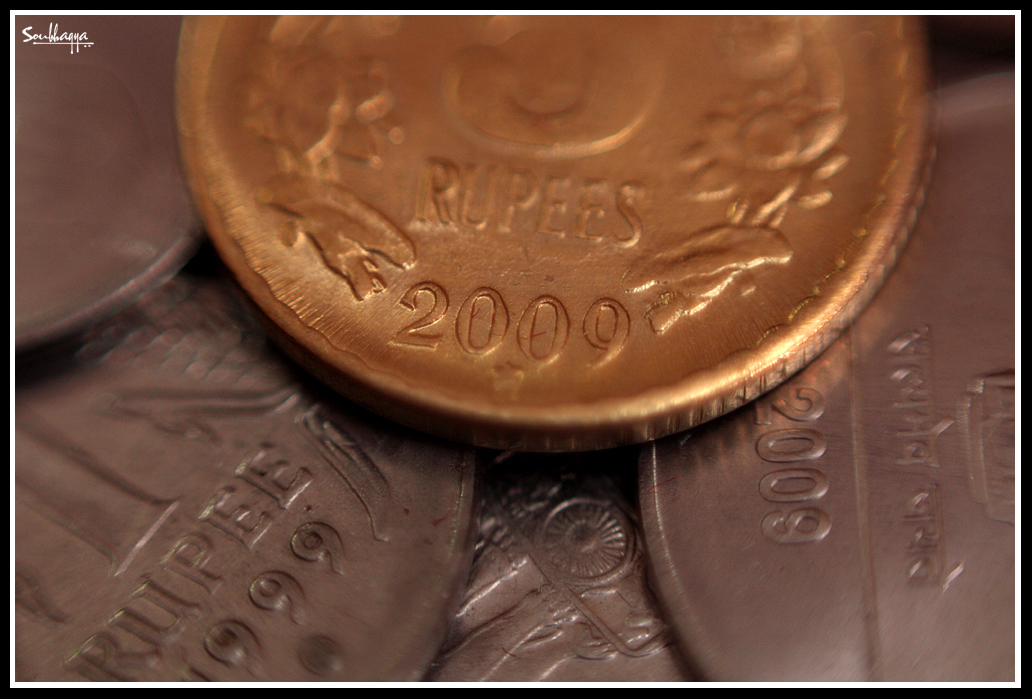
    the face of money‘The face of money’ is what Soubhagya calls it.

    What’s my value? To a politician, I’m a vote that will help him in his quest for power. To my employer, I am a worker who gets paid for the job I do. To the places I eat out in, to the shops I buy things from, I am a source of revenue. To the people who care for me as an individual, these are perhaps not the parameters of calculating their value for me. It’s a different currency. So the question is complete only if I ask “What’s my value to …. ?”  Now, what if I were to pose the question to myself? Do I measure myself by my financial status, or the lack of it? Is it the ‘Likes’ on Facebook or the followers on Twitter? Or is it by the number of lives I have touched, in one way or another? Is it a combination? Is it what I deem as my potential? How much is that dependent on externalities? And doesn’t that change with time? Which brings me to..

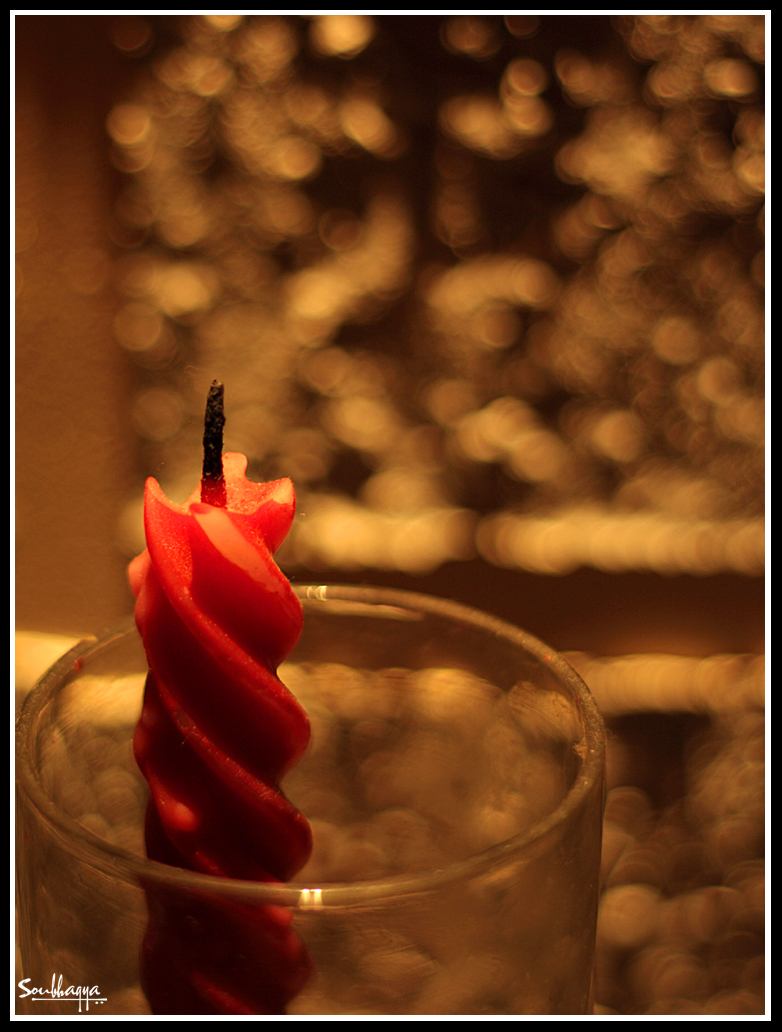
    Burnt out ‘Burnt Out’

    Purpose. I have always been interested in the purpose of our lives. All life forms in general, and of course, specifically us, humans. Generally, at different stages in life, we get stuck with different routines, sometimes by choice, sometimes not – school, college, work and so on. There is a short term purpose to it all, so we rarely look for something beyond. By my definition, ‘purpose’ gives a meaning to what we do, something beyond the money that it brings in, something that really makes us happy just by doing it, as though we are destined to do it. One could rationalise and say that the money then becomes a tool to ‘buy’ the things that give happiness, but that’s arguable.. We prioritise according to our baggage, some are okay with trading an amazing weekend and regular holidays for mind numbing work, some wouldn’t be able to manage it at all, and there are tons of options in between. The candle reminds me of the passion that we bring into what we do, and I believe that depends on our approach to ‘purpose’. Burn brightly or be a shallow flame? In both cases, there is a finite lifetime in which it has to be done. For me, even the task of finding a purpose is a tough one. Whichever way one sees it, there is always the possibility of a burnout. Such is life. So burn you must, and light up the place as much as you can. 🙂

    until next time, wax eloquent 😉

    PS: Now split ‘coin-cide’ and you might figure out a new possibility

  • Time Off

    In an earlier post – “Brood Mode“, I’d written about expectations, and how sometimes, they cannot be met. In the context of that post, Austere had commented thus “Is it the instant-ness demanded of the response that puts one’s brain to a side?” I messaged her on Twitter, that ‘the time construct’ was something I’d planned to write on next.

    Our response time has been shrinking on a continuous basis, twitter, FB etc are a manifestation of that – real time, but the changes have been happening much before that, probably with every advancement we made, not just in communication, but even things like transportation. So, the thought is, if we had more time on our hands, would we be behaving differently with people?

    When I was chatting with Meeta recently, we started discussing this, in the context of relationships with people. It started with me saying that the traffic during the daily commute to work, made me forget all the rules I make for myself, because with all the lane cutting and parking woes, its easily a scenario in which you’re either aggressive or you end up on the road, literally. So I wondered if it would be different if there were no time constraints.

    Despite only a superficial similarity, I was reminded of another construct – money. What started out as a tool of convenience has enslaved many and managed to dictate their actions. Much like the things we create to crunch time. The similarity ended there. Time is not money. Quite obviously, time exists with or without us, though the latter can force one to ask “Who does it exist for then? So let me put it this way, it is a construct that’s still not fully understood, whereas we made the money construct. But for the fun of it, imagine what you would’ve done if your life wasn’t dictated by time. What if you had all the time in the world. Would you be a different person? Would you behave differently with people?

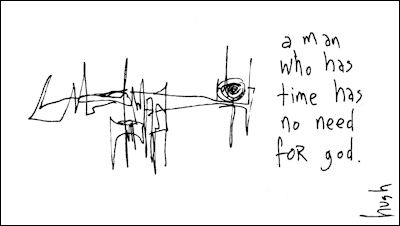
    As it regularly happens these days with me- by sheer coincidence, the day after I had this discussion with Meeta, I came across this work from Hugh MacLeod, which puts it so well

    time

    until next time, timed out for a fortnight 🙂

  • Tea and multiplicity

    We sat in Infinitea, sipping green tea and munching fried momos. It was her first visit to Bangalore, and as my contribution to her introduction to the city, I had given her the experience of navigating the one ways of the city on a two wheeler. It was less than a month since we’d been first introduced to each other, and that turned out to be the subject of the conversation, at least the lion’s share of it. Of how technology had reached a point where one could perhaps land up in any city and have such conversations, because of the connections that pre-exist. No pre-exist for years or even months, but just a few days, thanks to the people we trust, who connect us. We perhaps have nothing in common culturally, but we can still relate to each other in terms of ideas and thought streams. Communication protocols are changing, and with that, relationships too. We discussed the subject of my post a fortnight back – evolution, and she told me the story of a guy who had a camera fitted into his glass eye!!

    She’s traveled a lot and shared anecdotes of places and experiences. Her stories reminded us of how destinations have become like trophies, simply to be collected as part of a journey which we no longer appreciate, much like the beautiful sights that nature has created. We compared notes on clicking images versus capturing it in the mind’s eye. I could totally relate to that as I remembered the Leh trip from earlier this year and told her of how I paused before I took the step into the plane that would take me back, knowing that it perhaps was the last time I’d see the place. After all, there are so many places to see, never mind the trophies, because there may be some I haven’t even heard of yet.

    I think that I might have come across as an absolute anti-capitalist, because at least twice I said that the only thing that stopped us from enjoying life fully was money, because it tends to become an end in itself, and we make the things it can buy, the things that hold value to us. If money wasn’t a constraint, I’d travel all over the world, write about the things I saw and be happy with the five odd people who read it. But it is, and so one has to save up, and choose from destinations, and hope one has made the right choice.

    We debated a bit on what I thought was a paradox of sorts. She said that many people felt lonely when they landed in an alien city (work,not vacation), and they yearned for a taste of their own culture. I said that, with increasing connectivity, we were all moving towards global citizenship, where the individual cultures had blurring boundaries, or rather, the differences seemed to be becoming less important. Typical example being how we were able to converse on a range of subjects without getting bored. (though we have only my word for it) And how with each passing generation, traditional customs were getting packaged to suit lifestyles…until they will become ‘user agnostic’. (much like the platform agnostic technologies) But yes, that is more futuristic than present, though I may have more in common with a London based Twitter user, than my next door neighbour, on several fronts.

    We spoke about the great divide that technology was creating, and how the human race has perhaps yet not identified that as one of our greatest challenges. A real time battle against time. Which made us realise that both of us were getting late for our (respective) next meetings.

    I drop her back at the hotel where she’s staying. We have to take a convoluted route, thanks to the one ways that dot Bangalore. Its funny because in terms of actual distance its really close by. I wonder if the roads are a good metaphor. We bid each other goodbye. Its easy to remain in touch, connected. After all, geographic distances don’t really matter. Sometimes its the divide in the immediate vicinity that is more difficult to bridge.

    until next time, a lot can happen over tea too 🙂

    PS: The day had two wonderful conversations, and as I start out to share the other, I realise I am trying to short change the next one and crunch the content. That’s unfair, so we will do a Part 2 soon 🙂

  • Carp

    The apartment parking slot. The kid saw him parking the two-wheeler, and asked, in all innocence “Uncle, why don’t you have a car?”. He smiled. The kid continued “I have one. All my friends have too. Only you don’t have.”  He knew the kid felt sorry for him. He felt sorry for the kid too.

    until next time, mere pas gaadi hain, bungalow hain….. 🙂