Tag: IoT

  • In an ambient future…

    Digi-Capital claims that by 2020, Virtual and Augmented Reality combined would have hit $150 bn, eclipsing mobile. What is interesting is that a recent Juniper report predicts an $80 bn market for wearables by 2020. (via) If I read that together, by 2020 we would have witnessed three interface cycles – mobile, wearables and AR+VR. The shelf life of interfaces is shrinking, much like other business cycles. In fact, in Trendwatching’s No Interface trend brief, you can get a preview of this. I’d think that by 2020 web access would be much better than what we have now, and with other technology like IoT advancing sufficiently, we would be poised for ambient interfaces to consume and create what we do on the web and mobile now.

    It is widely believed that Google is only a challenger in the  mobile and wearable domains – to Facebook and Apple, despite Android. With Facebook’s Oculus move and Glass’ demise, it would seem that the interface that follows the two above would also see a fight. In an insightful post, Ben Evans asks “What does Google need on mobile?” He notes that all of Google’s play is about reach – to collect and surface data. Mobile, and specifically apps, challenge this and create a world of perfect complexity. He ends with saying that Google needs to win at search,  whatever that means and wherever and however far from PageRank that leads you. Christian Hernandez goes further in his post ‘Into the Age of Context‘. He points out that the glue that connects mobile, social and sensor trends is data, but to take it to the next level, it needs machine learning and AI. He sees Google Now as the perfect example of The Age of Context. (more…)

  • The IoT battlefield

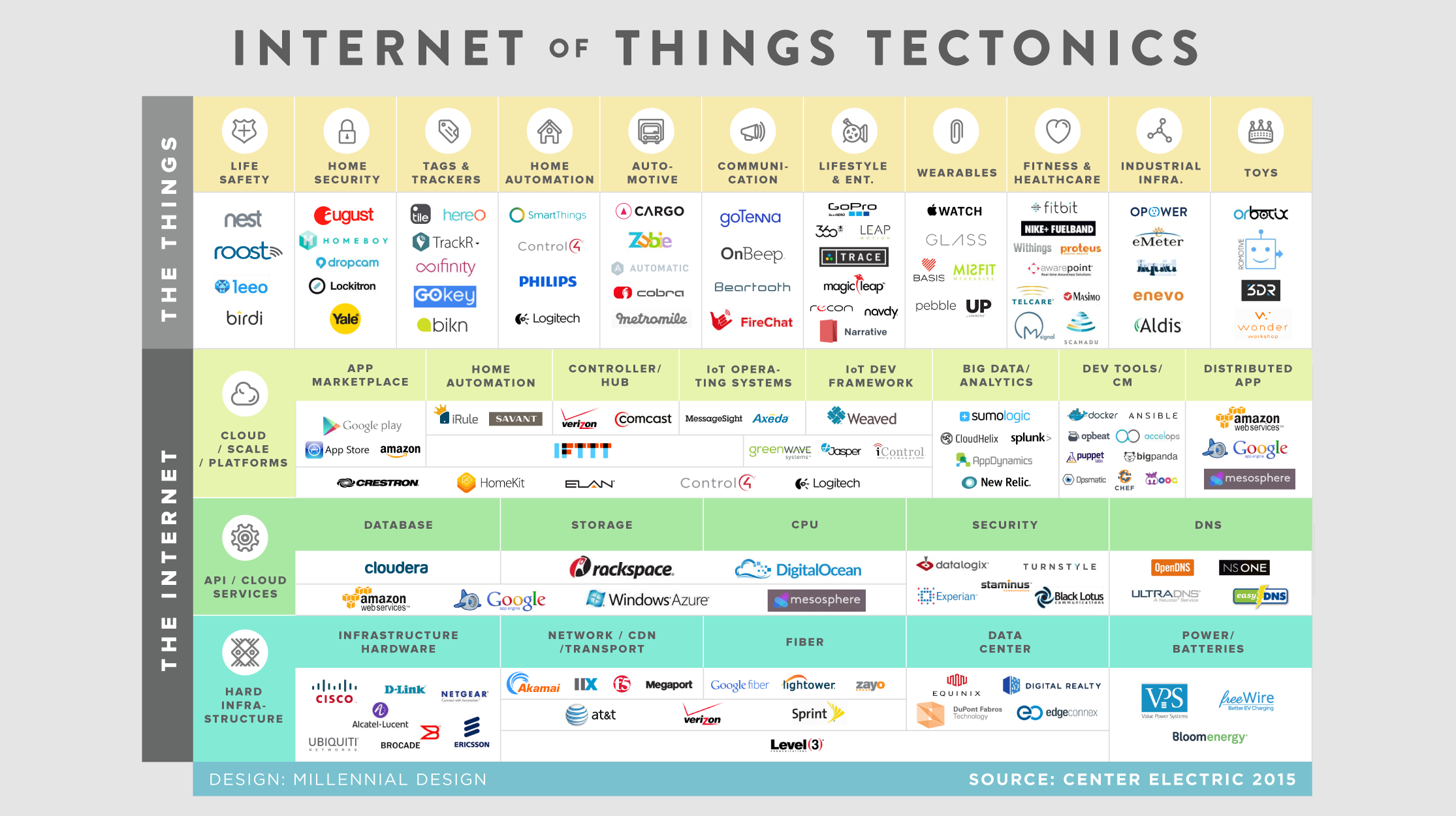
    The last time I wrote about the Internet of Things, I hoped for an application layer that could sense and collect data and convert it into use cases. In fact, the title of the post was Interweb of Things, the nuanced difference between them being connection (IoT) and interoperability. (WoT) (read) In the few months since that post, there has been quite some activity in the space. I saw a very useful classification a few days ago that illustrated both the ‘things’ as well as the infrastructure and showed the possibilities of interoperability. (via)

    IoT

    (more…)

  • An Interweb of Things

    Since the time I wrote An Internet of Things narrative, its trajectory and pace has seen tremendous acceleration, to an extent where TC has claimed that it has reached escape velocity. Indeed, there is a whole lot of activity happening that would back this claim – startups, larger companies getting interested in the space, geographic expansion and so on. In fact, the article has what seems like a comprehensive chart on applications, platforms etc.

    In my earlier post (linked above) I had pointed to the distinction between the Internet of Things and the Web of Things. What was then a nuance seems much more wider now and is even more relevant. Another article on TC, titled The Problem with the Internet of Things is actually about this. One of the products that has fascinated me for a while is Mother, from Sen.se. To me, it aims to solve this problem, and the last two points in their ‘Creating the Internet of Life’ document is proof of it. (Like wearables in 2014, I plan to get a consumer IoT experience in 2015, and this is most likely going to be my preference) Another simplistic but potentially very useful product I have seen is Flic. The last example is Signul, which uses a beacon system to automate things used in daily lives. (both on Indiegogo)

    (more…)

  • The era of wearables

    In the post on the Internet of Things last month, I’d mentioned two narratives on social products that I considered were working in tandem to shape the future of marketing, consumption, and living itself. Both using sensors – one on things (IoT), and the other on humans (Wearables, though I stubbornly use Techsessories!)  This post is on the latter.

    Why I think it matters: Though nowhere remotely close to Chris Dancy levels, I have been interested in this for a while. As I mentioned in my Personal API post, I see it as an evolution of my lifelogging pursuit – from logging in experiences to sensors automatically picking up data – and something that is highly relevant to my area of work – brands. In the big picture, I also see this domain as a key player in the evolution of our species – from our persistent movement towards immortality (physical) as well as, what I hope will be, a more gradual steps towards mindfulness. (mental, emotional)

    What is it? Smartwatches are just the beginning, and at a broad level, wearables can already be categorised into

    (Some statistics, a primer, and a good classification to broaden your perspectives)

    Where is all this going? For the scope of this post, let’s briefly look at the impact/deliverables from three points of view

    Consumer: There are quite a number of views (read concerns) that wearables are probably the first step towards turning us into cyborgs. (what I refer to as the augmented human here) There is another line of thought that wonders if all of this is taking us closer to ‘sofalarity‘. I can argue the Hug Shirt both ways! I wonder if, as we race towards singularity, there is an unconscious adaptation that our species is going through to survive, or continue to thrive. Personally, I like to think that technology is giving me the means to first quantify, and then use that data (converted to information and then to insights) to consistently work towards being a better human. ( a qualified self, so to speak)  I have already taken the first step with Goqii. While there is no dearth of trackers, I found their ecosystem approach interesting. I also envision creation of personal APIs becoming easier in the next few years, allowing us to store, analyse and transmit data and information to others.

    Ecosystem: At one level, there is going to be some effort in making wearables really mainstream. There is definitely going to be resistance. The answer, as always, is in using wearables as a means to address human needs. On another level, while devices are expanding in scope, quality and sheer numbers, as Chris Dancy mentions in the interview (linked earlier) interoperability is still a concern. (just as in the case of IoT) It’s not just wearables talking to each other, but talking to a larger universe of the IoT.

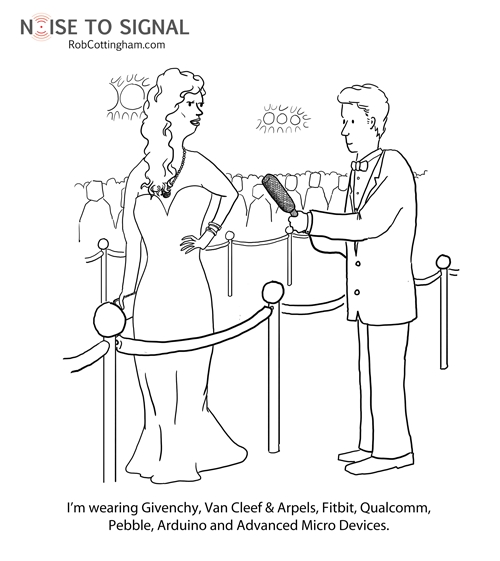
    Brands: This domain has seen its share of brands – standalone ones as well as majors like Apple, Google and Samsung who want in on the action. There are fashion brands too, and I can imagine a near future when technology will be a hygiene factor in many kinds of apparel. While this happens on the device side, the data generated finds application across spheres – think, for example, how this can be applied in the health domain, (from medication to insurance) employment, sports and so on. Thus, there are many roles for brands – a standalone device and ecosystem with minimum connectivity, or devices and/or ecosystems that work in a complementary manner with another set and provide a product/service. As privacy concerns escalate, I believe the role of the consumer will be the key one to watch. This is the opportunity for brands to connect its business purpose to the consumer’s narrative. Brands should work towards gaining the trust of consumers early on and create seamless platforms for connecting devices, data, and users, working towards a common shared purpose.

    Wearables

    (via)

    From not believing that the world needed more than five computers (1943), we have reached more than 1.8 billion smartphones (source) that arguably do more than what a ‘computer’ can. So, a wearable (or a set of them) soon superseding a mobile is very much in the realms of possibility. As functions evolve, form factors will change – that’s inevitable, and on shorter cycles. The last decade in particular  has seen a massive technological evolution, but I think this is just the beginning – we’re at the cusp of a sea change in the way we live and work – about to push beyond the known boundaries of the body and mind. In the context of this evolution, Carl Jung’s profound statement would be a good one to remember – “Who looks outside, dreams. Who looks inside, awakens.

    until next time, wearabouts!

    P.S.  If the subject interest you, do follow my Techsessories and Health boards

    P.P.S. Need a #lulz worthy wearable strategy – Check this out!

  • An Internet of Things narrative

    Towards the end of last year, I’d written a post on the ‘social product‘. Its premise was that given social’s conversion to media, the opportunity for fulfilling social’s initial promise would fall on ‘product’ – using data, network effects, and relationships to connect consumers along a shared purpose. In the last few weeks, I have seen rapid acceleration happening on this front. I can see at least two narratives working in tandem, and I’m sure that at some point they will begin to augment each other really well. In this excellent post on technologies that are shaping the future of design, sensors occupy the top slot, and they are at the basis of both the narratives – one on humans, and one on things. The official classification, roughly, translates into Wearables and Internet Of Things respectively for the scope of discussions here.

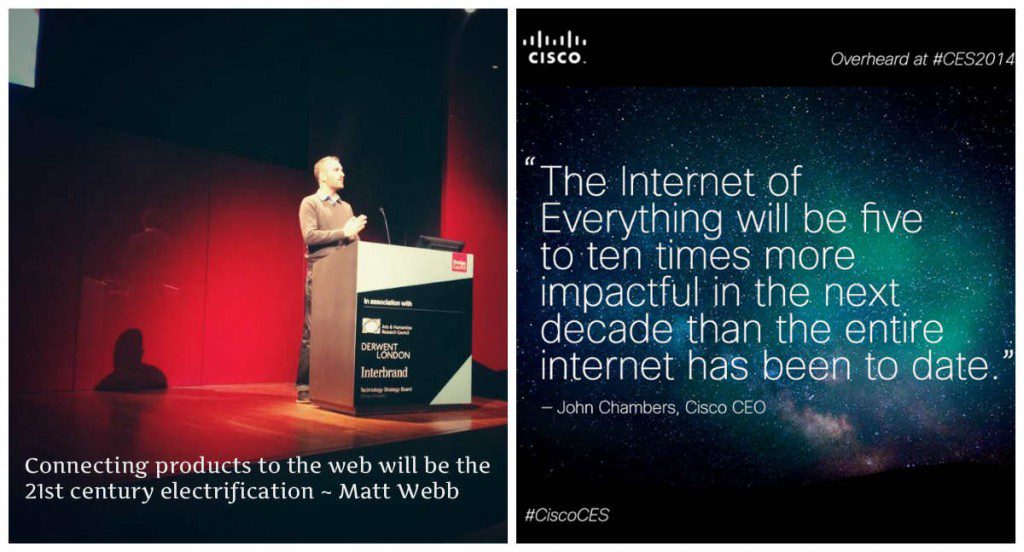
    This post is about the second. So, what is the Internet of things? The wiki definition is simple, but effective –  “The Internet of Things (IoT) refers to uniquely identifiable objects and their virtual representations in an Internet-like structure.” The best primer I have come across would be this infographic, which has everything from a quick technology explanation, applications and challenges to market size, statistics, and interesting use cases. For a really solid perspective, look no further than this deck titled ‘The Internet of Everything‘.

    How does it affect us? For now, it is about convenience. If you’re familiar with Android launchers, imagine an IoT version – it’s almost there, using iBeacon! There’s more – Piper, which works as an IFTTT for your home, the smart fridge that can order groceries from the online store, the smart TV that can learn preferences and help us discover content, the washing machine that can help order detergent, the egg tray that will let you know about the number of eggs it holds and their ‘state’, the automated coffee machine, Philips’ connected retail lighting system, Pixie Scientific’s Smart Diapers, the GE a/c that learns your preferences, the smart bulb that doubles up as a bluetooth speaker, (!) and so on. Some of the products are really useful and solve a need, while some others are more fads and probably not adding the value that reflects the potential of IoT. But that’s just the learning curve in progress, as the market starts separating needs and wants.

    All of this also means that consumption patterns will begin to change, as more purchases become automated, and more importantly data-driven. In my post on the driving forces of 2014, I had brought up technology as the biggest disruption that marketing has seen. This is most definitely one of the manifestations.

    Clipboard02

    What can brands do? For starters, get interested. Think about the tangible benefits that can be offered to consumers. What are the kind of data patterns that devices (or products) can surface to help the consumer make better consumption decisions? What kind of contexts can be relevant? Instead of force feeding advertising on traditional channels and fracking social platforms, can communication to consumers be made seamless using data, contexts and easy processes? While ‘device’ brands might have an initial advantage, ‘product’ brands need not be left behind at all. As the washing machine post (linked earlier) suggests, a Unilever or P&G might subsidise a machine, because it’s pre-sold with 500 washes worth of their detergent. It could even be real time, with SDK, API systems telling a partner brand to push a contextually relevant communication to a consumer. As things start storing and communicating data, privacy will be a major factor that decides whom consumers will share what with. Unlike media, trust cannot be ‘fracked’, it needs to be earned over a time frame.

    Where does it go from here? A common language/protocol/registry is a good start, as is a white label platform – both are trying to connect an assortment of devices and gadgets. While there is value in data at an individual level (more on that in the next narrative) one of the critical factors in the success of this phenomenon is the devices talking to each other – humans acting as middle men to pass on data may not be a smart way ahead!  Digital Tonto has an excellent nuanced perspective that differentiates IoT from the web of things. (WoT sounds cooler!) The difference is in connection and interoperability.

    collage

    Equally important is this phenomenon’s ability to solve human needs. (Internet of Caring Things)

    Collaborative consumption is fast becoming a consumer reality. As always, brands (generalising) are bound to be a few years behind, but the hope is that the web of things will force them to start collaborative creation and distribution and more importantly, focus on consumer needs.

    until next time, #WoTever

    P.S. In a corruption of Scott Adams’  idea, I think #WoT is paving the way for robot domination. 😉

    P.P.S. If the subject interests you, check out my Internet of Things Pinterest board.