
Tag: information

  • Data.Information.Knowledge.Wisdom

    I still remember a time when most social media presentations considered the “One Size doesn’t fit all” slide mandatory. The platforms were new, and brands/practitioners were told that aping was not really the best policy. Yes, there were best practices to learn from, courtesy early adopters, but there were many factors to be considered before they could even be adapted, let alone, cloned.

    I still subscribe to that. Every organisation’s business objectives are different, even if they appear to compete in the same category and fight for the attention of the same audience. This difference could most likely stem from their different visions – from how they would scale over time, geography and even their business domain to the nuances in consumer tastes they want to target. This difference would then translate into how they conduct their business – internally and externally – how much hiring gets done in what function, what and how much of marketing is done, how customer care and operations works, what products and features are shipped first and how, to name a few.

    These would then dictate what the organisation’s metrics are, and how and when they are measured. Considering that social media is the most ‘direct contact’ and ‘mass’ set of platforms, these differences are arguably exaggerated, because audiences can be sliced thinner (compared to traditional media) and some organisations might deliberately do things to keep out certain audiences eg. what they communicate and how and where too.

    Why a repeat of these known perspectives? With more and more data being created by the activities of brands on social platforms, we are seeing tools that are trying to convert all this into usable information. Sometimes these tools are in human form too, and they bring their own perspectives (or lack of it) which essentially means comparison of apples and oranges just because they are fruits. I saw an example last week, which also included the brand I work on – Myntra. To quote Pico Iyer “Where once information had seemed the first step to knowledge, and then to wisdom, now it sometimes seemed their deepest enemy.” Goes for the step before too – data.

    Take a couple of examples – Facebook Page and Post Likes. Thanks to the subtle way in which Sponsored Stories/Page Post Ads work, it’s extremely difficult for any tool to bifurcate organic and inorganic Likes. (I am excluding the Page Admins of course) And yet, comparative analyses are made on Like growths. Or take Engagement – semantic analysis is at such an early stage that many tools would consider 100 comments on a post dissing the brand as high engagement. And yet, ‘insights’ are delivered on Engagement. Uff, engagement! My thoughts on that mother word have been documented earlier. These are operations mind you, I am not even getting started on strategy.

    Does that mean you should not consider this data/information- competitive or not – at all? Of course not! But how you use that is where knowledge and wisdom step in. Like the famous saying goes, “Knowledge is knowing the tomato is a fruit, wisdom is not putting it in a fruit salad.” Sadly, the way information is being used, oranges would soon be passe, apples would be compared to tomatoes because they are both fruits and are red in colour.

    until next time, data diarrhea
  • Until the customer is king..

    Instagram just released v3.0. One of the biggest changes in this version is the introduction of Photo Maps, which quite obviously, plots your photos on a map. The default is opt-in, not opt-out, though they’ve done their bit to give the user control over data.  I updated despite reading this Wired article on the privacy implications and the bug that briefly exposed private photos!

    I’d written my first post that referred to Big Data recently, and the day after that, I read this very interesting post that talked about various applications including an algorithm that can identify cities based on their unique architectural elements and other distinguising characteristics. But a few weeks earlier, WSJ had an interesting post that talked of how large corporations see big data as a means to get personal with customers using information gathered by placing tracking files in people’s browsers and smartphone apps without their knowledge—so they can be stalked wherever they go, with their “experiences” on commercial websites “personalized” for them. The post describes not just its real world analogies but practices as well, and predicts a future where the user will declare your own policies, preferences and terms of engagement—and do it in ways that can be automated both for you and the companies you engage. An entire ecosystem across apps and corporations built in a consumer centric fashion.

    But as the post itself admits, the move toward individual empowerment is a long, gradual revolution. Until then, we need to define our own limits of sharing, fully understanding that it is a give and take. Not just what and where, but whom too – since all it takes a RT or a ‘Share – Public’ for something shared in a close circle to go public. How much of privacy would I give up to open myself to opportunities, or get an experience that is tailored to my needs and convenience. On the other side, a modern corporation needs to understand the choice the consumer is making and use the information to not just provide genuine value, but also make it easier for both entities to adapt to the rapidly changing landscape.

    until next time, kingmakers

  • But what do I know?

    Unlike in my other blog, Seth Godin is rarely referenced here. But when I read this post (rant, he says) from him titled “Deliberately uninformed, relentlessly so“, I sensed some vague connection with something I’d written a while back.

    Unlike other posts of Godin, whose blog I religiously follow for its ‘food for thought’, I found a smugness to this post – perhaps the rant provides the liberty. But as always, he manages to make a point. However, for a second, I wondered about the irony of this post coming from someone who does not allow comments on his blog. And thus this post.

    It is to be noted that he did not switch off comments just like that, he has valid reasons. Even if one just looks at the scale (1858 people retweeted and 2373 ‘Like’s) and considers  only a certain % commenting, it would tend towards chaotic. But whatever the reasons, he has chosen not to use comments as a channel.

    Ok, lets move on to me now. 🙂 I don’t read business books, however I follow several blogs in my line of work and otherwise. I rely on my Twitter, Reader and (occasionally) Facebook connections to point me to interesting reads. I also use Wikipedia extensively, despite the accusation that crowdsourced content can only be so trustworthy. From all this consumption, I have ‘superficial’ information on a lot of subjects, which make good conversation. This is also because I have way too many interests, and I’m forever in awe of things I don’t easily understand. My interest sometimes wears off after I’m able to bring a subject to my horizons of understanding. Sometimes, a more knowledgeable person corrects me/points me to things he/she thinks might interest me further and whenever I need/want to know more about a subject, I try and use the web’s sources to the fullest.

    But here’s the thing. Once upon a time, I could remember websites in context and add to discussions (offline), but increasingly I rely on delicious, among other things. I’m forced to prioritise my memory thanks to the ton of information out there that I process daily. Ok, that, and age.  🙂 And this is not a problem that will end soon, and its something I keep bringing up here. (Read)

    Time is the new currency, and I increasingly feel that people now react mercilessly to an “I don’t know”. Is that an excuse for people to claim knowledge of things they know nothing about? Maybe not, but perhaps like many other things, it is one of the ways for them to feel accepted and have a sense of belonging. So yes, it might be easy to label it as being deliberately uninformed, but in judging people so, without context and more understanding, we might be falling into the same trap ourselves – about people this time, as opposed to subjects.

    until next time, judge mental capabilities?

  • Back to eternity

    Despite being a Star Trek fan, I happen to think that Time is the final frontier, at least in the horizon that I can see. I find it quite intriguing that, though it might be looked on as a tool for tracking, I can perhaps not account for most of my lifetime. I don’t mean the large picture, I haven’t lost it totally yet, but specific minutes. Take for example, the last hour and account for all the thoughts that rushed in. I would find it difficult.

    If you close your eyes, and allow your breath to be the only meter, the perspective of time undergoes a shift. Meditate a bit, and its easy to see. Easy to see that even the measurement of time – years to seconds and beyond is our  construct. But it is so ubiquitous and enmeshed in our lives that it seems as though it is a constant and only we change. It requires dramatic events for us to pause and note the passage of time. Kahlil Gibran has said, ‘Perhaps time’s definition of coal is the diamond”

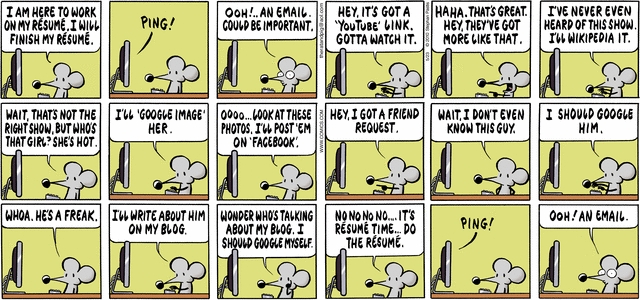
    Meanwhile, I wonder if all the information about those unaccounted for minutes is stored somewhere in my brain, and is just not deemed enough to be of any priority for me, and hence seems inaccessible. The tools that consume me these days – most specifically Twitter, and more recently, Foursquare, also help me keep track of what I’ve been up to, and when it works the same way for everyone is when there is an information deluge, and that seems to be something we find difficult to handle. Something that we have discussed before. There is a toon I found (here) that correctly describes the way a lot of us seem to be functioning now

    Clipboard01

    And in another example of how man is shaping his own evolution, I read about companies like Lifenaut, which  ultimately aim to create humanoid robots powered by a backup of the original human’s brain. (via @pkaroshi) The first step is to create a digitised version – an avatar, and give it enough data for it to mimic the original human. It makes me wonder whether we will be able to create ‘consciousness’.

    And that makes me think a bit more – by the time, we are technologically advanced to create it, will we have forgotten what consciousness is? Which also begs the question whether we have ever understood it at all, when we are not even mindful of the minutes of our lives? How does one define it? So many reactions which seem pre-programmed when one thinks of it, actions and reactions more out of habit than any conscious choice being exercised.

    So yes, with all of the work happening at a rapid pace, (do read) I think its more ‘when’ than ‘if’ – that we will become immortal, and time, from a future point of view, will become immaterial, because the future will be infinite. But we still may not be able to undo what we did a minute back. Where does that leave us? To quote Pico Iyer (from Abandon) “God has to be understood in the context of everything that is not Him”. But that is a different discussion, I guess. Its only that with every advancement that humanity makes, and in that process also usurps things once attributed to divinity, I begin to wonder where that leaves our versions of God?

    until next time, time.ly links 🙂

    PS. I tweeted sometime back, even if you never read an Asimov work, or never plan to, this is one that you should read. The Last Question.

  • Services, Information, People

    Even as the first trailer of ‘The Social Network‘ was released last week, and even as fresh rounds of humour/angst on Facebook’s privacy algo (Google’s too) are unleashed regularly, I found that the amount of things I share on Facebook has vastly increased, though the time spent hasn’t increased in proportion. Its probably the ease of sharing information, the threaded conversations (none of my usual twitter clients have it) around the shared item, or the lack of (self imposed) constraints that my blogs suffer from, but photos, videos, comments and all sorts of content (my own as well as the ones I find) get shared on FB. Sometimes I even miss not being able to send a quick mail (where is Project Titan?!) to someone on FB from GMail (yes, I have FB friends who I don’t connect with on GTalk) In a recent interview, Mark Zuckerberg also shared his views on credits, and its portability. With search and location coming up as major initiatives, I wonder when my Facebook data will become portable.

    In this context, I saw the three kinds of webs (similar to the ones mentioned in the last post) and more that are almost seamlessly connected now – information, service and people. The need for filters in this information deluge is indeed pressing. While I do see some nifty tools that are being developed (eg. Pivot , Avoidr, specific search engines or even Twitter’s annotations) I sometimes wonder if it can ever catch up with the broadening scope of commonly used services. That’s also the reason why I think Facebook’s Open Graph search engine, which aims for social semantic search, is a big step, even while granting that not everyone’s on Facebook and their execution still has some way to go. Add to this privacy/security concerns (even Twitter was pulled up recently), and it does look complicated. Further layers like location will only add to this. And I wonder what new levels of complexity Google Me will bring. With each new service, the deluge of information increases, many times in the form of repetition, and our consumption changes.

    The increasing usage of these services has meant that the web of ‘friends’ have also increased. In my case, while FB consisted of only real friends earlier, in the last few months, the number of virtual friends – mostly from Twitter, have increased manifold. Since I don’t usually share anything on the web that I don’t want anyone to see, my problems with privacy have been limited. But as the amount of sharing increases, I realise there are things I share that could be taken out of context. There is also the fact that personal and professional lives are no longer silos. (Read) The other take out from the last point is that its not just communication from brands/services that need to be looked at closely, but people too.

    When the three webs are absolutely seamless, we will also see a shift in the kinds of relationship we have shared with brands, services and people. Facebook making payment for advertisers easier, sending me marketplace links, services making it easier for embedding ads, posts from my ‘friends’ plugging services/products with no disclosure, all work as signs for me. I do see a lot of work in setting up new ‘trading currencies’ and even different kinds of social networks (mobile phones – closed network ) and also note that the one factor that all the three entities need to keep in mind is trust. And that’s when I begin to wonder if similar systems are being developed for ‘sharing’ trust and whether they can keep pace with the deluge of information, services and people. Or maybe its already working under the radar – new services (endor.se), recommendations on LinkedIn, Twitter lists etc.

    until next time, SIP investments for mutual benefits 🙂