Tag: Freedom

  • A space-time freedom continuum

    Spoiler 1: This has nothing to do with science! Signs, maybe.

    Spoiler 2: This has a lot of quotes. What can I say, smart people have already framed things so well. 

    I got an interesting response to Change Signalling – Sriks7 asked me what are the values based metrics you are thinking of for yourself? He also mentioned that in his case, they are seen to boil down to where to spend your attention and time. I can relate to that. In the words of Dylan, “A man is a success if he gets up in the morning and goes to bed at night and in between does what he wants to do.” I have noticed that my overall sense of well-being goes up when I allow myself unstructured time. I watch random things, torture D and twitter with bad wordplay, listen to music, and sometimes just watch clouds float. The last one is slightly more dynamic than paint drying. 🙂

    But my answer would have at least one more layer.  Though time is definitely a key element here, I think of it being part of a broader umbrella – freedom. My working definition of freedom is related to one of my favourite quotes â€œBetween stimulus and response, there is a space. In that space is our power to choose our response. In our response lies our growth and our freedom.” ~ Viktor E. Frankl. Freedom, to me, is that space – to be able to choose a response that I can live with, always. Or, to paraphrase a bunch of Jean-Paul Sartre’s quotes, freedom is nothing but the existence of our will.

    As I wrote earlier, one approach that I have used is to reduce the stimuli. But increasingly, I find that there’s a limit to that.”The wide world is all about you: you can fence yourselves in, but you cannot for ever fence it out.” ~J.R.R.Tolkien. My introspection therefore, has been in the direction of the response. I have found that my power to choose a response depends on how secure I feel. I further explored this “security” and realised that it boiled down to money. It seems like when I can afford it, and that’s almost literal, I am nice to those around me. When I feel that our financial independence plan is threatened, I tend to react badly. It doesn’t help that I am blessed with a scarcity mindset.

    My belief is that by the time we are ready to activate the plan, I would have an abundance mindset. That is based on the changes I have seen in myself in the last few years. But I am also reasonably sure, from experience, that though there are these small wins that happen organically on the way, a mindset switch requires effort. A couple of challenges are immediately visible. One, since I do have a few more years of a full-time professional life left, there are trade-offs on a daily basis, and they require a balancing act between knowing who I am and being who I need to be. The challenge is being rooted on the first while executing the second. Two, while the ego might have been reasonably tamed, there is self image which has its own demands. In this dual tussle, there are choices and actions that might derail me.

    When, between changing circumstances and myself, I have learned to increase that space (in my earlier definition) I’d have achieved the freedom I desire. I do wonder about Loki’s (surprisingly) deep thought though – “Freedom is life’s great lie. Once you accept that, in your heart, you will know peace.”
  • Freedom

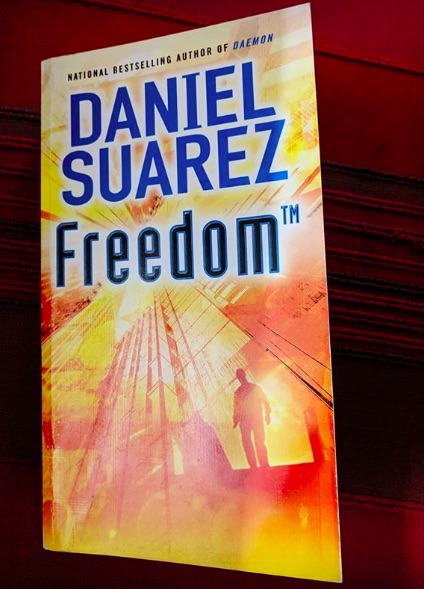
    Daniel Suarez

    If you’ve read Daemon, I suspect it’d be very difficult to not read its sequel. If you haven’t, you know where to start!
    Freedom picks up right where Daemon left off with the kind of intense action that dominated the last portion of the latter. Even as the Daemon systematically tears apart the corporations and financial systems that rule the world, its enemies prepare to launch a counter attack. What makes it all interesting is that the different players in the game have divergent agendas.

    It is also interesting that the book brings to life at least a few concepts that I have read in non-fiction in the context of how unemployment, extreme capitalism and the wealth divide will cause fundamental shifts in civilised society. Neo-feudalism, trust based community networks, and the irrelevancy of state borders are a few examples. In doing that, it also shows the possibility of how new systems could end up just like old systems because the basic human tendencies remain constant.

    The narrative sets a scorching pace, and one is tempted to just zoom forward a few pages just to know how a plot point is going to end. Excellent read!

    P.S. I somehow felt that it was written with a movie or two in mind. Almost like a screenplay.

  • Prisons of happiness

    I read a few articles recently debating whether the purpose of life is happiness or usefulness/leading a worthwhile life. The Aztecs as well as contemporary thinkers favour the latter. I am not convinced though. For starters, I think ‘purpose’s is something our consciousness insists on. The world will go on without us, it is for us to derive a sense of meaning for ourselves. And since it is subjective, I’d optimise for happiness/avoiding discomfort (I’m bunching it together for now) simply because my usefulness/being worthwhile to others around increases when I am happy.

    This is a topic I have been circling for a while now – There is no middle path? was a take on happiness vs avoiding discomfort, for instance. A favorite line of thought from “And the Mountains Echoed” has been coming back to me in various forms from various people in the last fortnight. “..but most people have it backward. They think they live by what they want. But really what guides them is what they’re afraid of. What they don’t want.” That is essentially avoiding discomfort. (more…)

  • There is no middle path?

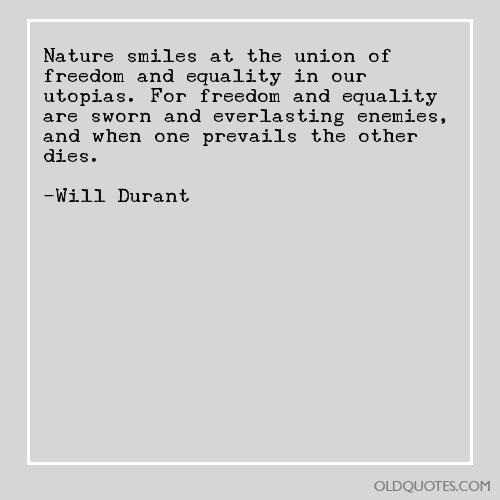
    Will Durant is a pleasure to read, and it has largely to do with the succinct way in which he expresses complex thoughts, be it in history or philosophy. In The Lessons of History (by him and Ariel Durant) I found this idea particularly thought provoking –

    346474

    Very intuitively, I have always thought the ideas of freedom and equality as ends which are allied. But a bit more thought, and helped by the Durants’ arguments, and it is quite evident that they aren’t. This reminded me of something I’d written about five years ago on happiness vs peace of mind. (read the very interesting comments by Surekha on it) (more…)

  • The crowd in my head

    Two wonderful posts I read a while back – one which I could completely identify with, and the other, such a complete antithesis of what I do that it was almost like a mirror I was forced to look into- but something I could utterly understand.

    Amit Varma’s ‘Society, You Crazy Breed‘, which is about many inter-related things -the need to escape the clutter, even of our own thoughts, the want of validation and acceptance, the human interaction that will take us away from “the terror of [our] own singular thoughts.” (from) It also talks about debate on the internet, but while that makes a large part of the ‘clutter’, especially the micro-debates, the ‘must comment’ social obligation is something I’ve written about earlier, so I was more interested in the first part.

    I used to absolutely love solitude earlier, and it was easier to access too. But now what’s easily more accessible is a crowd. It slowly becomes a sort of addiction, despite me wanting to stay away. Its no longer easy to be objective enough to separate a want from a need, and its quite easy to fool the self. When one has never been the particularly confident type and has barely gotten out of a constant validation requirement, its particularly difficult. An RT on Twitter is easy validation, and as I’ve said before, the vicarious ‘living’ is easy and fun. Its good to be connected, and be a carefully moulded version of ourselves that is acceptable to those we would like to be connected to. The trick, of course, is to be a version  true to our own selves, something we are comfortable with, in solitude, or in a crowd. But that’s not easy.

    That brings me to the second post, “One for the time capsule” wonderfully written by The Restless Quill, about living life on one’s own terms, fighting the battles inside, the arguments outside, and ‘inhabiting a life’, which can create a ‘light-band of memories’. Chances are, choices such as those, would be made with minimum validation. Its also, I think, a lot to do with confidence and an understanding that perhaps comes from listening to oneself, in solitude.

    Its easy to guess which post I could identify with, and which one is the anti-thesis. There are times when my destiny stared at me in the face, and I looked away furtively, as though looking would mean acknowledging, and then accepting. I can dimly sense these. The ability to make those ‘difficult’ choices and keep walking, joyous in the consciousness of what one has learned and the comfortable understanding of what one has lost out on, it must be liberating. I have a feeling, and unfortunately, a feeling only, that it must really be wonderful.

    until next time, a crowdsourced time capsule