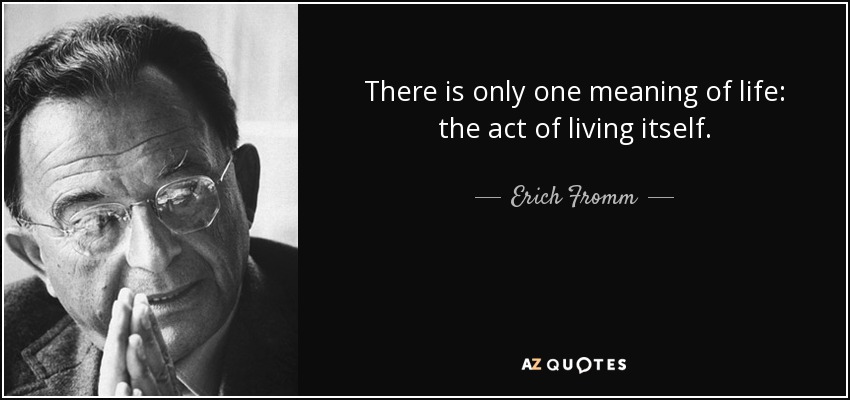
Erich Fromm’s Fear of Freedom (1941) has been my favourite read this year. The book was largely meant as an explanation for the rise of Nazism, but by tracing historical patterns of man’s interaction with society, it ended providing some fantastic perspectives on the self. Specifically, man’s contradictory needs of wanting to conform and wanting to be free. As Fromm points out, across ages, we have attained a variety of ‘freedom from’ (nature’s whims, Church etc) but have also systematically discouraged the expression of emotions, our spontaneity.
He lives in a world to which he has lost genuine relatedness and in which everybody and everything has been instrumentalised, where he has become a part of the machine he has built. He thinks, feels and wills what he us supposed to think, feel and will; in this very process he loses his self upon which all genuine security of a free individual must be built…
By conforming with the expectations of others, by not being different, these doubts about one’s own identity are silenced and a certain security is gained. However the price paid is high. Giving up spontaneity and individuality results in a thwarting of life.
Fromm explains how spontaneous activity is the means by which we can attain “freedom to”. This is positive freedom.
Spontaneous activity is the one way in which man can overcome the terror of aloneness without sacrificing the integrity of his self; for in the spontaneous realisation of his self, man unites himself anew with the world – with man, nature and himself.
The inability to act spontaneously, to express what one genuinely feels and thinks, and the resulting necessity to present a pseudo self to others and oneself, are the root of the feeling of inferiority and weakness.
Somewhere in all this, I sensed the indirect presence of a favourite topic – the abundance mindset. Specifically, in the idea of spontaneity. In my immediate circle, I know three people who are quite spontaneous. Interestingly, they also share an abundance mindset. Yes, correlation, not causation. But maybe…
Let me unpack the connections. One reason to not be spontaneous is conformism. But I have never really been a conformist. (I have recently figured out the probable reason, but that’s a different story.) However, there is a wrinkle, perhaps best explained by this:
If loneliness is to be defined as a desire for intimacy, then included within that is the need to express oneself and to be heard, to share thoughts, experiences and feelings. Intimacy can’t exist if the participants aren’t willing to make themselves known, to be revealed. But gauging the levels is tricky. Either you don’t communicate enough and remain concealed from other people, or you risk rejection by exposing too much altogether: the minor and major hurts, the tedious obsessions, the abscesses and cataracts of need and shame and longing. My own decision had been to clam up, though sometimes I longed to grab someone’s arm and blurt the whole thing out, to pull an Ondine, to open everything for inspection.
To refuse scrutiny is to dodge the possibility of rejection, though also the possibility of acceptance, the balm of love.
The Lonely City, Olivia Laing
I’m still working out the paradox, but while I am nonconformist in most things, I also avoid getting judged. It doesn’t help that I am shy and introverted. My trade-off has been similar to Laing. Rather than conform, I clam up, as a shield against judgement. But it also means that I am forgoing chances of a genuine connection beyond a handful of close friends, and yes, this blog. Clamming up and spontaneity don’t mix well.
“…to be ourselves causes us to be exiled by many others, and yet to comply with what others want causes us to be exiled from ourselves.”
― Clarissa Pinkola Estés, Women Who Run With the Wolves
There’s another factor that works against my being spontaneous – a scarcity mindset. My reaction to it, instinctively to begin with, and by design later, was to create predictability by planning my life. Or, in the insightful way that Khaled Hosseini has framed it,
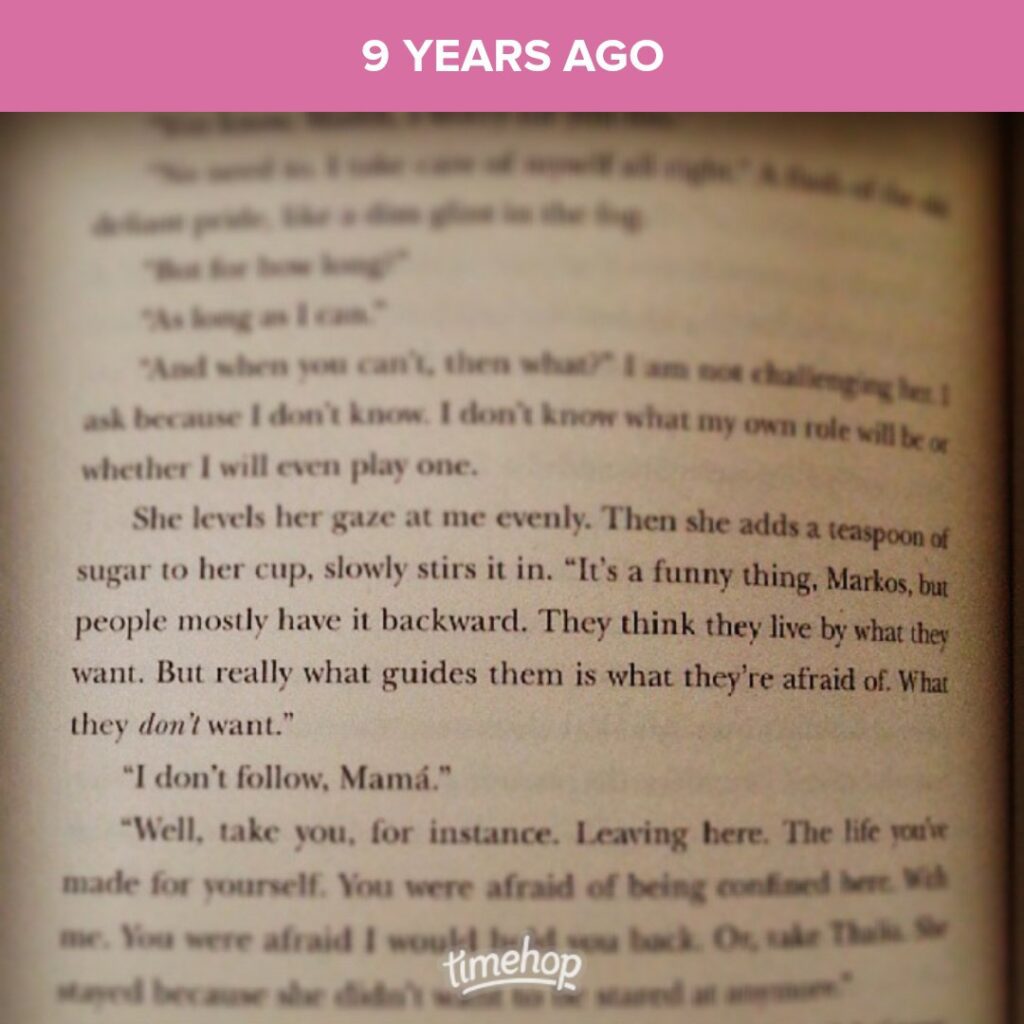
But I had a plan for spontaneity. My thinking was that by making many things routine (clothes, diet, finances) etc, I can use choice avoidance to have the space and the mind space to be spontaneous. (read) But the extreme is a bad place to be, and in my case, I not only became a slave to routine, but also got upset if it didn’t happen in a certain way. As it goes, the neurons that wire together, fire together, and over a period of time, it also led me to seek efficiency in everything.The instrumentalisation of life, in Fromm’s words. Also, the crowding out of spontaneity.
Before we get to possible solutions, a few reasons I need to solve this. At a human level, the combination of non-conformity and the slavery to routine and efficiency is practically a fool-proof way to push people away! Also, the uncertainty in things around us is only rising. Trying to have a plan that covers everything is just hubris. As a species, we will have to draw upon the innate strength that got us here – adaptability. And finally, there is philosophy
People say that what we’re all seeking is a meaning for life. I don’t think that’s what we’re really seeking. I think that what we’re seeking is an experience of being alive, so that our life experiences on the purely physical plane will have resonances with our own innermost being and reality, so that we actually feel the rapture of being alive.
Joseph Campbell
So what’s a possible fix? In Atomic Habits, James Clear argues that we can behave in a certain way until we get to the mindset. Intuitively, and from experience, that seems relatively easier than theoretically changing a scarcity mindset. If one isn’t blessed enough to have an abundance mindset, maybe behaving like one does – spontaneity to begin with, will get one there. So, if spontaneity is the behaviour change, I have to go oxymoronic – force myself to be spontaneous! In other words, use my nonconformism to unlock the ‘freedom to’ be spontaneous. Hopefully, its positive results will temporarily override shyness, introversion and the desire for efficiency, and an abundance mindset might find a way in. The first baby step is to watch myself when killing spontaneity. I also have another clue. Money is a factor that has a disproportionate influence on my mind, and I have discovered that when something doesn’t make a dent there, I am more amenable to spontaneity, and joy.
At a daily level, to quote from this fantastic read on happiness, “any neuroscience article will tell you that the “reward centre” of the brain – the nucleus accumbens – monitors actual reward minus predicted reward.” In my efficiency play, I will have predictable happiness, which will get normalised to practically zero happiness over time. I have found a couple of ways to engineer prediction error – one is not to plan the minutiae of travel, and the second is to spend more time with people who are spontaneous. Or as Venkatesh Rao puts it, ‘differently free people’, in this fantastic post. The good news is that I have three readily available ones and I am now ‘awake’ enough to spot others when I find them. Predictable unpredictability!
Thus the idea is to go from choice avoidance based on efficiency to choice avoidance based on the freedom to be. As Venkat so brilliantly put it, “Detachment does not mean you don’t care what happens. It just means you don’t care whether a specific thing happens or not.” I have solved it in terms of conformity (freedom from) I now need to solve for spontaneity (freedom to). To live for an in-the-moment version of the want in Hosseini’s quote.