• One for the Road

    We’re now in the midst of the not-so-gradual transformation of Seegehalli. After such hits as Aroi and Red Rhino, we were pretty excited when we heard that One for the Road had opened in the neighbourhood. On a Saturday evening, we decided to give it a try.

    The place is reasonably large, and we took a small tour before we decided on a table. The first floor only had a small section open since there was a private party.

    [easy-image-collage id=13577]

    But the ground floor gave us a lot to choose from. There are closed and alfresco sections, with some enclosed spots, and a choice of seating as well – lounge, high stools and bar.

    [easy-image-collage id=13579]

    Early January provides a little chill in the air during late evenings – perfect for a Cream of Chicken soup. Creamy and quite delicious, it was a good start to proceedings. Chill or no chill, cocktails had to be consumed. There was only one rum based cocktail and it did sound funny – What the Fag It is Fig. Fig and dark rum sounded like a good combination on paper, but ended up rather insipid. D tried another signature drink – The Tangerino, vodka based, but that was a disappointment too – the orange flavour was overwhelming.

    The silver lining was that they managed to deliver the Malabar Beef Fry intact. For mains, we tried the Bacon wrapped stuffed chicken with pepper diane. The dish wasn’t bad in terms of flavours, but the chicken was a bit undercooked.

    [easy-image-collage id=13587]

    We’d have liked some dessert, but most items on the menu weren’t available. The bill came to a little over Rs.2000. The service was decent, the ambiance was not bad either, but the food was a mixed bag. Not really a place we’d repeat.

    One for the Road, 87/2A, 35, Seegehalli, Whitefield Ph: 49652780 (map)
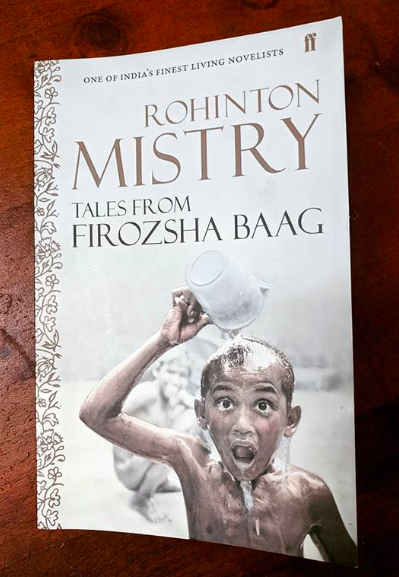
  • Tales From Firozsha Baag

    Rohinton Mistry

    A literally crappy beginning does make you wonder how this book is going to play out, but in a few pages, you understand this was only literally. However, what it also points out is the author’s ability to make the mundane very interesting. Eleven intertwined stories that create a vivid world whose unique characters the reader is able to identify and relate to, though they might be far different from the self or those around.

    A theme that I felt was running strong through all the stories was one of identity – at both collective and individual levels. There is obviously the Parsi way of life, and their interactions with the world at large. Without really resorting to stereotypes or tropes, the author is able to bring out the way of life and the struggle between its past and future through various characters, and their relationships and interactions. At an individual level, for example, Jaakaylee who was Jacqueline identifies herself as the former after 49 years of working among Parsis who called her that. Many stories bring out the tussle between generations as children grow up and understand the need for changes in their way of thinking and living if they are to survive in the world, even as parents cling on to traditions and cannot understand the need for change. The author uses Kersi’s character at both the personal and collective levels to show how life shifts with time.

    Two of my favourite stories are “Of white hairs and cricket” and “Lend me your light”. Both star Kersi and are points in his life that make him realise how the world he inhabits is constantly shifting, and he cannot always hold on to the things he thought were eternal. The last paragraph in the first story is something I could wholly relate to – when one feels precious things slipping through fingers and is powerless to stop it. I think anyone who has had to leave a place they considered home will be able to relate to the second story – the array of mixed feelings when one has to leave, when one has to visit even for a short time, and the idea of being a stranger in one’s own home.

    There is an excellent skill of observation that has been put to good use in all the stories, and a remarkable sensitivity that is evident in the writing. The writing technique somehow feels rich even when writing about the ordinary days of a life, and somehow, despite that, or maybe because of it, one feels that these are people one might actually know already.

  • A plan to be

    One of my first posts this year was Certain, simple frames, in which I had written about my lapse-of-reason episodes, and my methods of overcoming them. I had also mentioned in the post the insight I got about myself – the lapses of reason were triggered by my fear of it upsetting the plan. The Plan is financial freedom for D and me – we shouldn’t have to work for the sake of earning for current or future needs and wants.

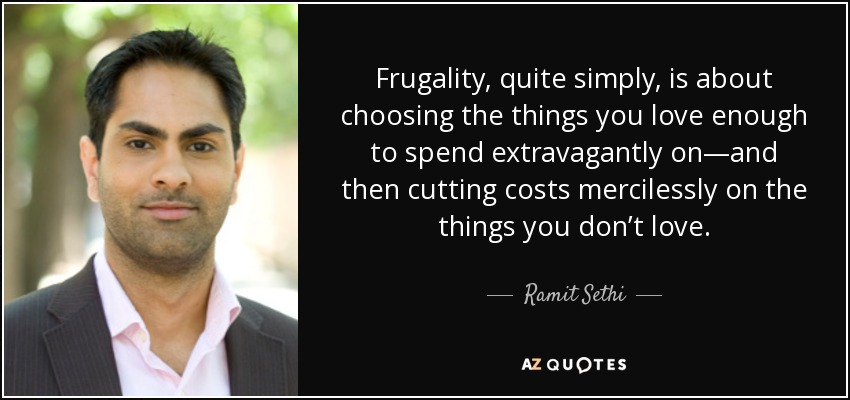
    In this context,  I found a quote by Ramit Sethi that succinctly conveyed a perspective that I have touched upon in at least a couple of my posts – Prisons of Happiness (conscious choices of freedom and understanding the trade offs) and Please Find Detached (on delaying stimuli and minimising lifestyle creep) – a rather distinct definition of frugality.

    quote-frugality-quite-simply-is-about-choosing-the-things-you-love-enough-to-spend-extravagantly-ramit-sethi-64-20-74

    I have been doing this for a while, but the catch, as I have experienced, is in “choosing the things you love enough”, and it exists because of the intent behind that ‘love’. The usage of the word “love” is important. In my view, it is used to distinguish the things that one really wants.

    But it is difficult to be objective about one really wants. Paradoxically, at different points, the intent could be a desire to belong, or a desire to stand out. A fundamental human need to connect and share that drives the first. A basic ego stokes the second. A desired destination here could be a kind of “reflective equilibrium”. Easier said than done!

    The ego first derives from societal benchmarks, the projected self, and then self image. Getting beyond the last one is extremely tough. And if one does get close, there is an immediate realisation that there are no markers, no play books, no goals. There is no unseeing this either. “And once you are awake, you shall remain awake eternally. ”All very difficult to get used to, especially when the mind continues to ask, “Is it going to be ok?”

    To quote Bill Bonner, “There’s the standard of living, which can be measured in dollars, and there’s the quality of your life, which can’t be measured at all.The Plan is built on financials, and is therefore aimed at tackling the first part. The second is indeed an intangible, and speaks probably of a contentment that comes from being comfortable with one’s decisions. That’s why the plan is also an attempt to iron out the terms of one’s interaction with the world, and just be. The hope then, is that belonging will take care of itself because one is actively pursuing the wants that really matter, without money having a real say in it. The desire to stand out? Well, it will be forced to sit out!

  • The Old Fashioned Bar

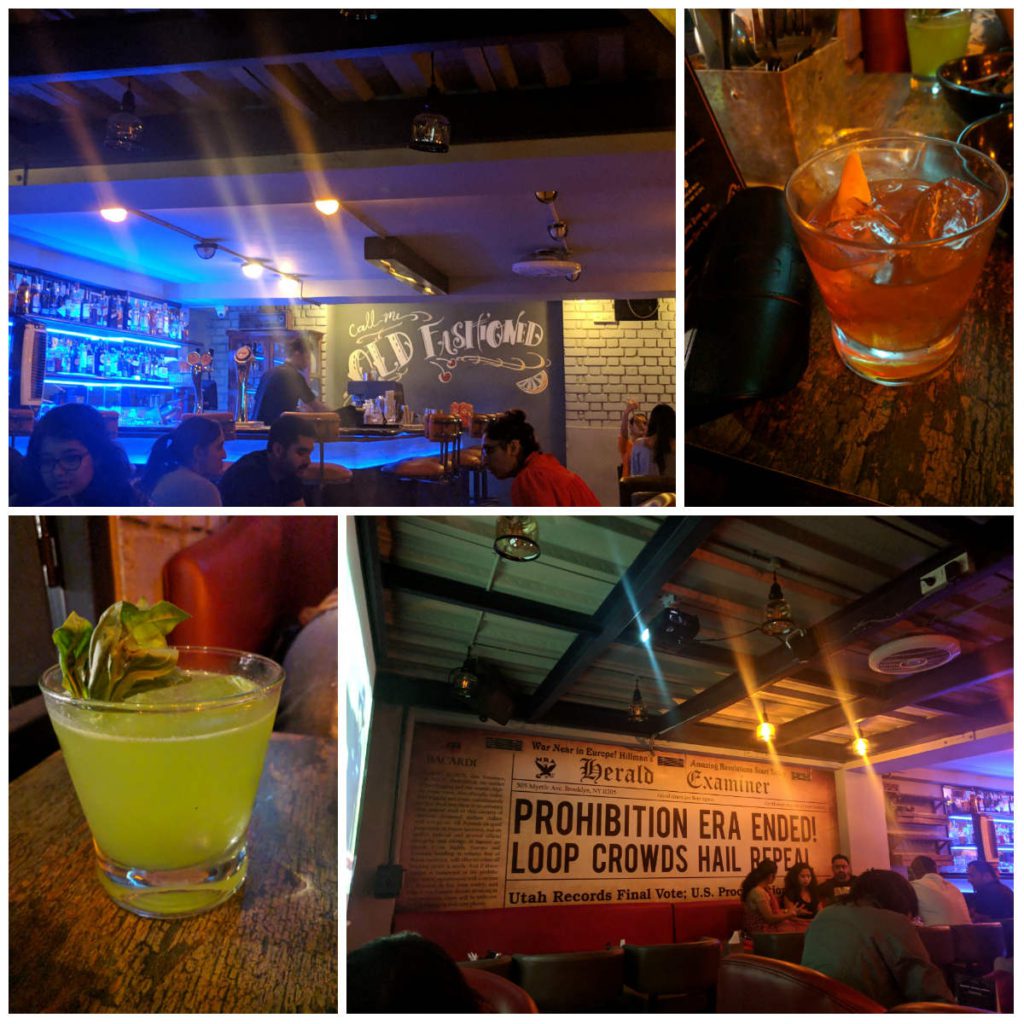
    I have now figured out the right time to travel cross-country in Bangalore – long weekends. So when it was clear that shopping would take us to Koramangala – shopping the good old fashioned way that is – we decided to mix it with our other favourite pastime – eating (and drinking) out. Choosing a place in Koramangala, especially when the number of restaurants in the neighbourhood is inching closer to the number of people living there, wasn’t an easy task. But I liked the name ‘Old Fashioned” and a quick look at the food menu gave me enough choices to suggest it to D.

    It was only on the way that she informed me that they had more than a dozen kinds of Old Fashioned – my favourite drink! She also had her eye on a special Christmas menu they had. They have a typical old-school pub set up – plush seating, dim lights – and unfortunately, a hat tip to current times in the form of a giant screen. I know, I sound old! 😐

    The place has two floors but the upper one would only open at 9, we were told. Towards the end of our visit, we did go upstairs to use the restroom. A few tables were occupied, and it was hardly 7.30! We did get a nice, small table overlooking the road though. Meanwhile, D was miffed because the staff seemed unaware of the Christmas menu (which was on Zomato!) Thankfully, the menu had enough options for us to still make a good meal out of it.

    After much deliberation, I chose the 1881 Old Fashioned. D’s original choice – Buttercups – wasn’t available, so she went into Hulk mode and asked for a Gin Basil Smash. D had told me that the 1881 was the strongest Old Fashioned they had, but my first drink was fairly mild. The second one (thanks to a Zomato Gold 2+2 on drinks) however was strong. D’s drink had lime juice in addition to the obvious ingredients and packed a punch.

    (more…)

  • AI: Artificial Instincts

    In Regression Planning, I wrote on whether we could re-learn the skills we have outsourced if events force us to. I read The Book of M recently, and it led me in a different direction on the same subject. The book is fiction set in a dangerous future, where people lose their shadows. What starts as a curiosity takes a dangerous turn when they realise that with the shadow goes memories. All kinds of memories – from their life thus far to the knowledge that they have to eat to survive. The extreme case is forgetting how to breathe. Imagine feeling suffocated and ultimately dying when all that’s needed is to draw a breath. Yes, it’s extreme and yes, it’s fiction. And isn’t that just instinct, you would ask. Yes, again.

    Yuval Noah Harari writes in”21 lessons from the 21st century” about how in March 2012, three Japanese tourists in Australia drove their car into the Pacific Ocean, thanks to their unwavering trust in the GPS. Apparently it kept saying it would navigate them to a road! You could shake your head and quote Einstein on the infiniteness of human stupidity, but I don’t think it’s that simple. A better question to ask would be why they didn’t trust their intuition.

    We all have intuitions and intelligence that we develop over a period of time. We become smart, or that’s how it’s supposed to work! But is that really so now? The smartphone was only the first step. Devices and even ambient environments are becoming smart. In a few decades we have moved from machines that help in physical tasks to systems that are taking over cognitive tasks, something Kevin Kelly has written about in The Inevitable. We’re increasingly outsourcing intelligence. The silver lining is that we’re at least trying to ensure it stays comprehensible to us!

    Instagram, Facebook, Tinder, Spotify, Netflix, Amazon – everything is a feed of recommendations, whether it be social interactions, music, content or shopping! Once upon a time, these were conscious choices we made. These choices, new discoveries, their outcomes, the feedback loop, and the memories we store of them, all worked towards developing intuition. Beneath the cognitive skills we display externally is the wiring, and as the saying goes, Neurons that fire together, wire together. I think we’re now in the process of firing intuition and outsourcing it to algorithms. I don’t know what will happen first – advances in cognitive neuroscience, or the outsourcing. The hope is that they will happen in parallel and we will make choices about them after conscious reasoning.

    Intelligence, intuition and instincts. The journeys in the first two are what have gotten the third hardwired into our biology and chemistry. When we cut off the pipeline to the first two, what happens to the third, and where does it leave our species? What is the organism that has artificial instincts?