I have to admit, the Agonda vacation was more an “Ok, fine!” reaction to pandemic peer pressure. Having said that, seeing a place after 13 years does evoke a range of emotions!
In fact, Goa is a bundle of memories anyway! Our first visit was in 1997 – a college trip, and we were in Miramar when we heard that Princess Diana had died. I didn’t know then that this would be my home for two years at the dawn of the millennium. Our first vacation after marriage was Goa again, and we dropped in annually for three years from 2006, until we dropped it from our travel list altogether. And then it was 2021, and the world had changed!
Across the world, the gap between the 1% and the remaining continues to widen, and the US is arguably the best example of this. How is society at large allowing this to happen, why aren’t politicians doing something about it? After all, elected representatives of common folks are supposed to work for their welfare, how is that structure failing?
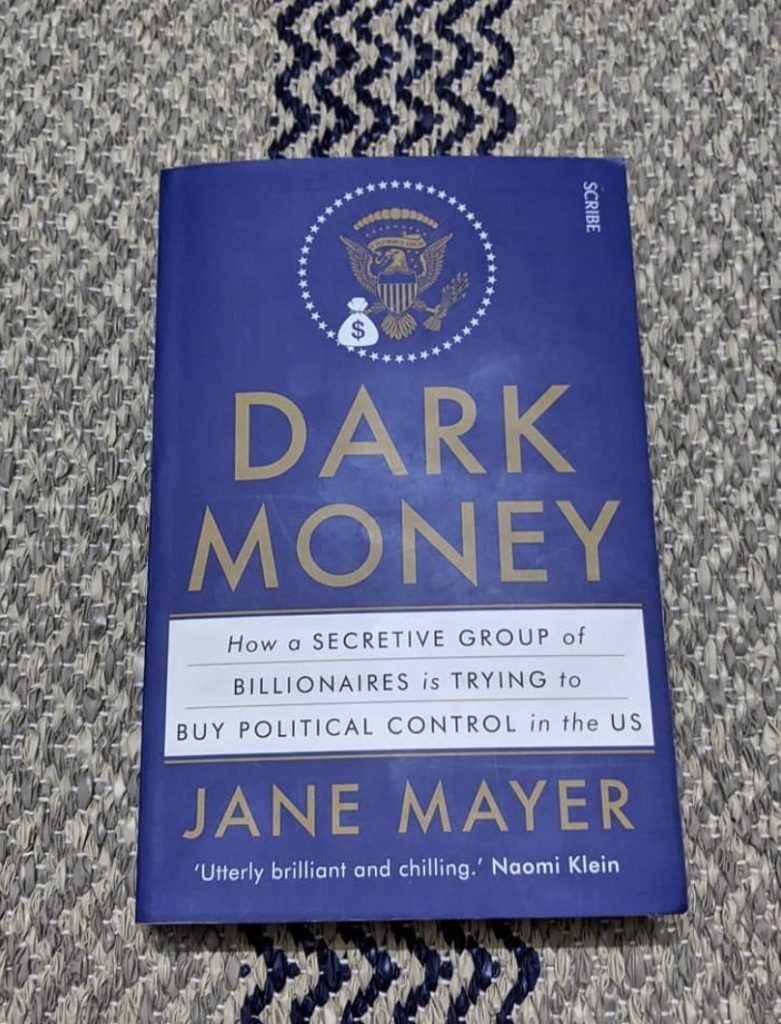
In Dark Money, Jane Mayer provides an insightful and well researched analysis of how libertarian industrialists like the Koch brothers are systematically undermining the effectiveness of the US electoral system by flooding it with what they have in abundance – money! Hundreds of millions of dollars spent to impose their worldview on how government should be run. The “simple” worldview being that government oversight of business is an encroachment of freedom! In this world, social welfare and labour protection are unnecessary expenditure, while taxes on wealth should be minimal. Not that I am a theist, but Godless America!
The narrative starts in the late 40s, during the formative years of the Koch brothers. Influenced by LeFevre’s “government is a disease masquerading as its own cure”, Charles Koch’s political evolution began early, and with help from like-minded and wealthy others, it led to a well oiled machinery that operated outside the world facing political establishment, and yet has now managed to practically take over the Republican Party.
From the 70s, when the rich got a sense that they were being over-regulated, they had started a privately financed war to ensure their philosophy won. A big a-ha moment was the result of an understanding of how to use their riches to preserve their elite status, beyond the obvious means. This was the weaponisation of philanthropy, and the book provides the background on some prominent players like Richard Mellon Scaife, Joh M. Olin and the Bradley Brothers. The steady formation of the Kochtopus machinery is a fascinating read, and one has to admire the strategic brilliance that is at work here.
It’s not just ensuring the preferred candidates win, or even that only preferred candidates would stand for election. It goes well beyond, and starts at the grassroots. Using the anonymity of charitable organisations, they went systematically to the bottom of the value chain and thereby started funding online high school education, academia, think tanks, influencing public policy, lawmaking (including the judiciary via seminars and junkets), creating and stoking political activism – Tea Party agitations for instance, spreading alt truth like “climate change is a myth” by spending millions on media and micro-targeting, changing regulation on candidate funding and thus creating the phenomenon of superPACs, and finally even pushing out moderate Republicans, and in the words of one Republican, “supplanting the party”. Using money, coercion, and every means possible. Essentially they created institutions and networks that would manufactur ideas that follow their philosophy, converted that into action points through think tanks and academia, and got them executed through activist groups, lawmakers and politicians. A system that feeds itself and creates a world in its own image.
The irony of it all? Donald Trump. Firstly, though the machinery was successful in making Obama a lame duck president in his second term, ensuring the Republicans controlled the Congress, and thereby laying the base, he was not their choice of President. In fact, he tweeted in contempt about those Republican candidates who went to the Kochs for assistance. Secondly, he used their exact methods to win the election. However, it isn’t called a system for no reason – it controls the people surrounding him, and is thus, pretty much in charge.
The book is superb in terms of research and pacing of the narrative, with details and context setting that make it a fantastic, absorbing read. It’s not just American politics, I think this will be the narrative of politics and society in many places. A must read, in our own selfish interest!
A while back, someone had joked on Twitter that by 2025, babies will be born outraged. But in 2020, the joke, at least in Indian advertising, is that when the Tanishq brand manager begins to think of a campaign, #BoycottTanishq starts trending. When I was writing the article on brands and empathy for Business Insider, I realised it would need a lot of effort for brands to go beyond signalling.
However, with inequities becoming even more of a pressing topic, and the expectation from brands to be active participants in society – activism to action, is there an inevitable movement that we will see? And hence, this post on brands through the prism of activism and morality, from the perspectives of a consumer and a brand marketer, and the safety of an armchair.
“We are living in an era of woke capitalism in which companies pretend to care about social justice to sell products to people who pretend to hate capitalism.”
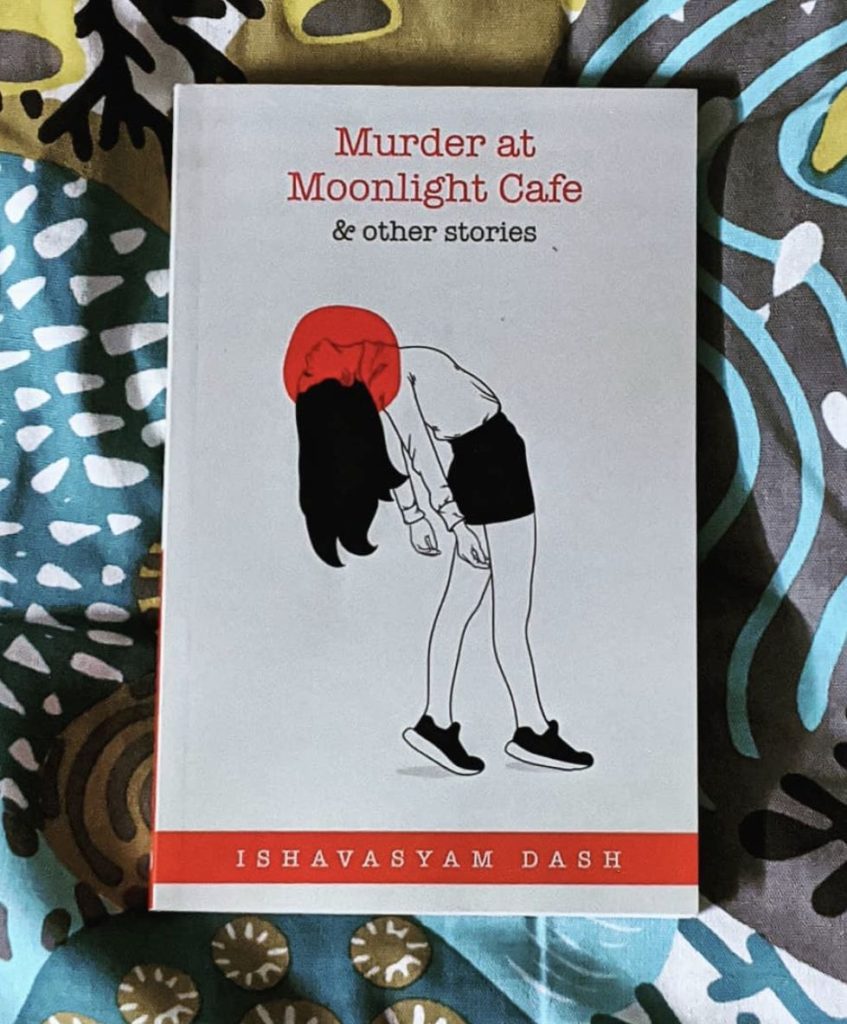
Eleven stories that take you on a rollercoaster ride of myriad emotions. As the blurb promises, the stories provoke and entertain.
The subjects range from mythology, fantasy and social media influencers to murder, sexuality and horror. That last one (The Itch), I thought, had the potential to spin off into a standalone book/series. There’s also a mix of narrative styles – first person, letters, a YouTube monologue. What this achieves for each story is a character, flavour, and mood that is uniquely its own. What also stands out is the complete lack of a pattern, including the pace of the narrative. Some proceed at a leisurely pace, while others pack a lot in within a few pages.
In just around 150 pages, there are worlds and corners that you will discover. I have at least five that I liked a lot. Smoke & Mirrors and The Herpetologist for the insight into the human condition and the empathy, Mariam’s Tears for the absolutely bizarre pop in the middle of the book, The Price of Apples for its innocence and sensitivity, and Kalika for the smart dose of philosophy. Pick it up to find your favourite. 🙂
(I know the author, but though I feel really happy for her, I can safely say there is very little bias in the review)
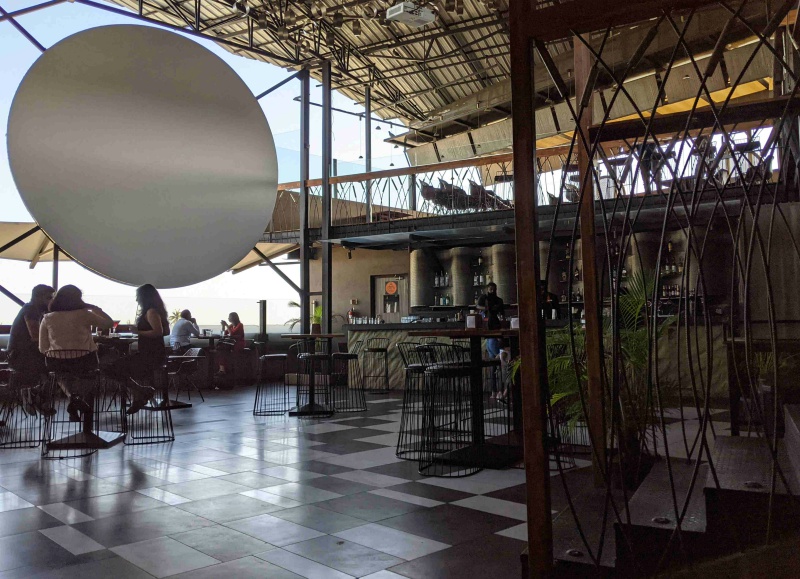
We made the trek to Indiranagar because the first part of the name described the last few months, and the second half was exactly what we needed. Actually, it happened to be midway for all parties, and it was expansive with no air conditioning. Am I justifying too much? Ok. Let’s move on.
The entry to this place is a little tricky. I suspect that we were not the first folks to try the entrance behind the 3M showroom. We saw another couple do the same while we were leaving. But only a few would have climbed up four flights of stairs before realising their mistake! 😐 The tiny gate after the 3M building is the actual entrance, and thankfully, there’s only a lift!
It was surprisingly packed for a Saturday afternoon, and I don’t think they were prepared for it!
It all began sweetly. Actually, a little too sweetly. I can understand the Belgian Chocoholic (dark chocolate ganache and dark rum) and even the Sangria being sweet, but the Old Fashioned needs a balance. And they didn’t get that right. The Sangria was actually not bad, and thanks to the dose of brandy, D was extra happy until late evening!
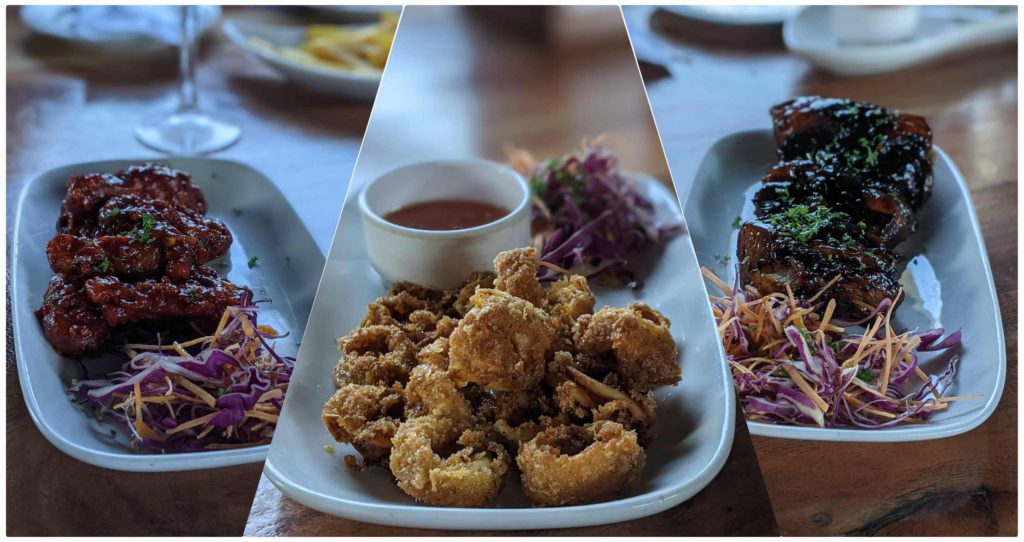
We were famished by the time we got there, ans thankfully, they were able to get the Wings pretty fast. The Bhoot Jholokia version wasn’t available, and we were recommended the Peri Peri (not on the menu). This was spicy enough to make me forget the sweetness of the Old Fashioned for a while. But then began the extensive delay!
We had to remind them about all the dishes we ordered, at least twice. When the twice-cooked pork belly finally arrived, it was half cooked. The insides were frozen! A complete waste of pork. The Calamari was probably fresh – judging by the delay, it had arrived at our table straight from the coast!
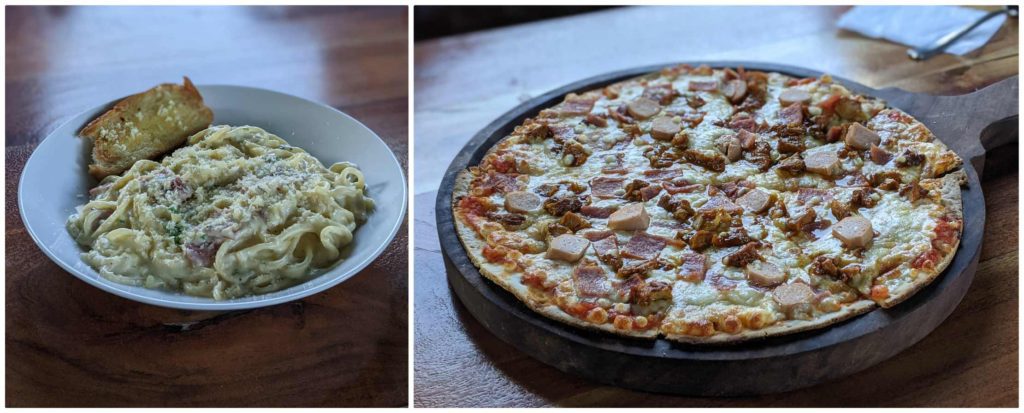
Such were the delays that we worried that the mains would equate to dinner! But we persevered. Unfortunately, it wasn’t worth the wait. Both the dishes we tried – the Spaghetti Carbonara and the Fully Loaded Meat pizza were insipid in terms of flavours. Meanwhile, even by the end of the meal, the Akuri on toast we had ordered a couple of hours ago hadn’t materialised.
But a word of mention for the courtesy of the staff. They tried their best to make up for the inefficiency of the kitchen (I think they were short-staffed). They even got a couple of milkshakes for the kids, though it wasn’t on the menu.
A meal for two with a couple of drinks, and an equal number of starters and mains would set you back by around Rs.2500.