• Abandon : A Romance

    Pico Iyer

    I’m quite a fan of Pico Iyer’s travelogues, so this was a book that had to be checked out. The protagonist is John Macmillan, an Oxford-educated Englishman, in California to study the work of the Sufi poet, Rumi, and complete his thesis under the guidance of his professor Sefadhi. On a trip to Damascus, he happens to meet a reclusive professor, who requests him to carry a package to California, to be handed over to a Kristina Jensen. While doing that, he happens to meet Camilla, Kristina’s sister, who, despite her flighty and fragile nature, makes inroads into his life. And then starts a journey that’s part a search for an Iranian manuscript, part an inward search for John, much like the sufis – “We are even mysterious to ourselves, they believe: a part of us going through the rituals of our daily life, while another part, a deeper part, cries out for whatever it is that can take us back. The stranger whose voice we recognize as our own.“, “..for the true Sufi, the looking is the key. Even if you don’t know what you’re looking for.

    The word ‘Abandon’ too can be seen from different perspectives – from the Sufis’ mystical version of abandoning themselves to a higher power, John’s need to let go of his notions and caution, and Camilla’s seemingly unconscious way of living her life in abandon, even as she fears that John might her leave her because of it. To me, the novel by itself was a kind of ‘abandon’, just like John’s thesis in the book – as though the author worked on a structure for some part before, towards the end, he let the work chart its own course.

    I do think the book might have a lot of subtext that deals with Islam, its interpretations, and its relationships with the rest of the world, but I’m not really qualified to explore those aspects. Even otherwise, its a very good read, in which there seem to be layers hidden beneath each statement, waiting to be uncovered, just like the excellent poetry that is shared within.

  • Reap Benefit

    Reap benefit is an organisation that works with educational institutions as well as corporate entities to make ’going green’ actions a part of their daily lives. In conversation with co-founder Kuldeep Dantewadia

     
    [scribd id=73802819 key=key-1tqj5nwyfk9y8r5hrxkl mode=list]

  • Coffee and brand stories

    One of the best Indian brand stories I have seen in recent times is Chetan Bhagat. He has pretty much nailed the product, price and promotion, and gets better with each release cycle. Place? Bookstores, Twitter, Newspapers…… He has loyalists and haters, online and offline, and most people I know have an opinion on him. I religiously read every book that he brings out, not because I think he is a literary genius, but because he’s a reasonably good storyteller, and like it or not, he has the pulse of the nation’s youth, or at least a significant portion of it. I do avoid his columns because I can’t handle that brand of humour on Monday mornings.

    I read his latest work Revolution 2020, and though it wasn’t quite the ‘Revulsion 2020’ that many made it out to be, I didn’t think it was a great piece of work either. (my review) But that’s not the story here. On page 108, a Cafe Coffee Day wove itself into the story, as the protagonist tells his father, “There is a Cafe Coffee Day opening in Sigra. It is a high-class coffee chain…..” I wouldn’t have thought more about it if I hadn’t remembered a story last year on how Chetan Bhagat had become CCD’s special friend, as part of their rebranding strategy. CCD makes another appearance in Page 116, and then several more later, as it becomes a routine rendezvous.

    Inserting a product into a story is not a new thing. Product placements in movies are now taken for granted. I still remember the time I worked on a project in the early days of this phenomenon – WorldSpace (my employer then) and Lage Raho Munnabhai. But these days they are mostly a force fit and all the brands involved try to one-up each other through their own promos. No one wins.

    But I haven’t seen a product placement in a book yet. To be fair, a few other brands like Frankfinn, Ramada, Taj also make appearances, but CCD gets top billing in Revolution 2020. Ah, billing. Maybe I’m reading too much into it, and it’s the author’s way of making the reader identify a little more with the story. CCDs are now, after all, ubiquitous. But if this is indeed an official tie-up, I think it’s quite a neat job by CCD. In the era of storytelling, when every brand tries to engage their audience via everything from TVCs to social media platforms, getting themselves into a guaranteed bestseller is a coup. CCD has always relied on its own stores than media campaigns for its storytelling, so this fits in. But if it’s indeed an official tie-up, and not a “what’s a few mentions between friends” arrangement, I’d have liked a disclosure from the author. It would’ve done his brand story’s credibility a world of good.

    until next time, a plot can happen over coffee…

  • It’s not just a car..

    He stood watching the children play with the car. The car reminded him of himself. Ravaged by fate, time and humans. He still remembered the day he had left it at the crossroad, trying to escape the cops. Five years ago. Time to start afresh. Maybe he would start with finding the car’s original owners.

    …………………………………………………………………………………………………………………………………………….

    For those unfamiliar with the genre, that was a 55 word story, something I haven’t done in a while. The story behind writing this is probably more interesting. I met Ideasmith for the first time recently, and the first thing she asked was why I no longer wrote them. I could only smile. The 55s were a phase. So this one is specially for her. 🙂

    Later the same day, I met a few other friends for dinner. The conversation somehow moved to how, on a cold morning a long time ago, I had abandoned my first vehicle (the ‘famous’ Kiney that fell in love with the mechanic and found excuses to visit him) in front of the workshop because I couldn’t take it along to our new accommodation. By that time, many of its parts had been spared for the newer vehicle. The conversation thus moved on to abandoned cars. You must’ve come across a few parked on the road – without tyres, insides lined with dust, torn seating, the model usually belonging to an earlier era, and now either ignored or the local kids’ play item . I have always been fascinated by them. For me, they are like snapshots in time. The end of some story. A cross road. A decision. To move on, the car not factoring in the rest of the story. The humans involved and the circumstances that made them abandon the car is always a potential story. Just like the 55 above.

    until next time, it’s a caaaar story 😉

  • Kumarakom

    The review was first published in Bangalore Mirror.

    Thanks to HSR Layout’s proximity to Koeramangala, some would say that it is one of the first areas that have been earmarked for expansion in the Mallu global domination plans. So it’s no surprise that Kumarakom, after opening outlets in Chennai and the international Malayali homeland Dubai, chose to set up shop here. Kumarakom is better known as a tourist destination in Kerala, located near Kottayam, and with the Vembanad Lake as its backdrop.

    Kumarakom in HSR has a the BDA complex as the backdrop, but makes it up with an ambience that immediately transports you to Kerala – a décor that includes a few mural paintings, a charupadi in some areas, a chuttuvilakku, and even right down to the boat-shaped salt’n’pepper holder on the table. The music, though, moved from Malayalam movie soundtracks to 90s pop and then lounge music in the space of two hours.

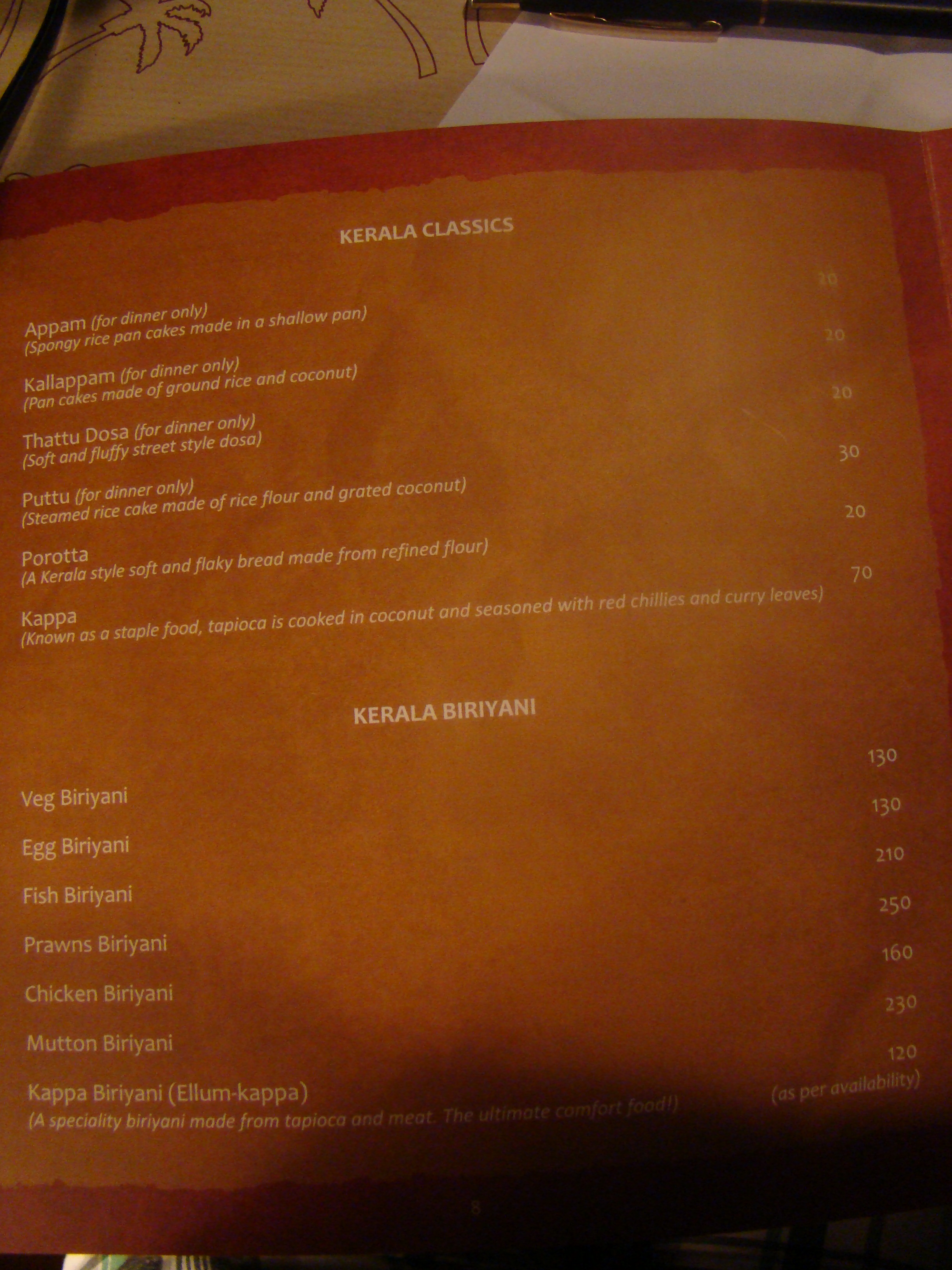
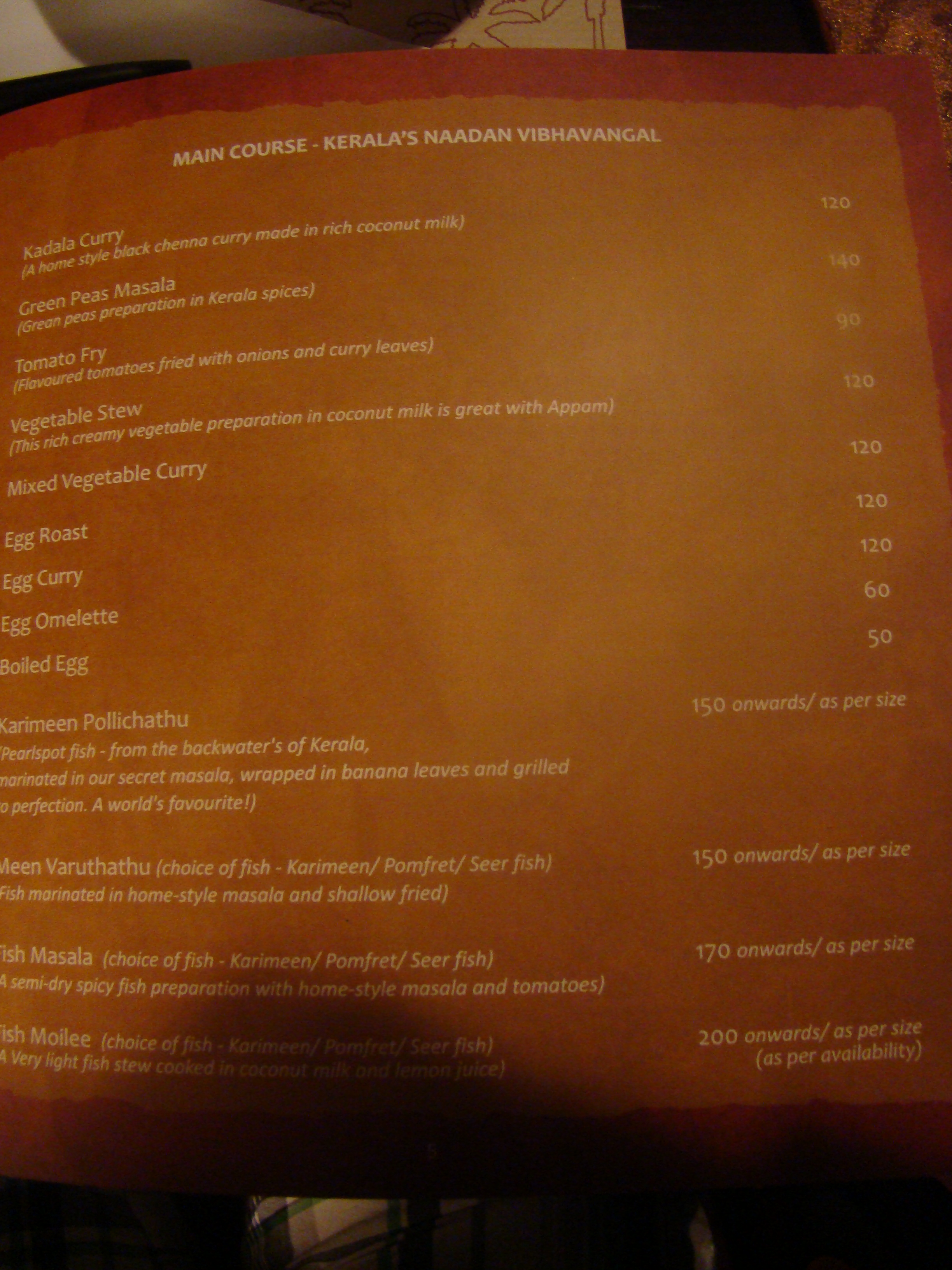
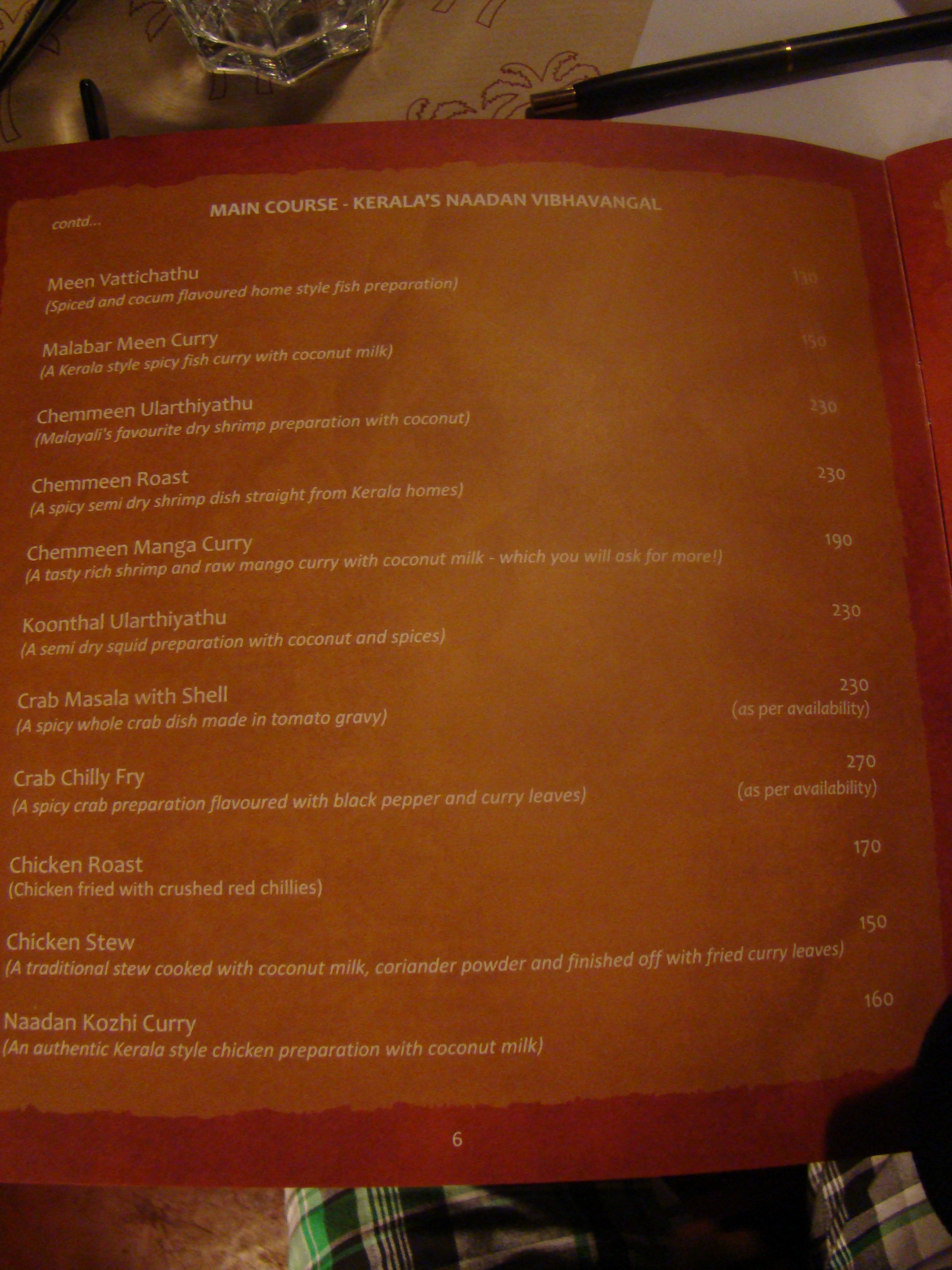
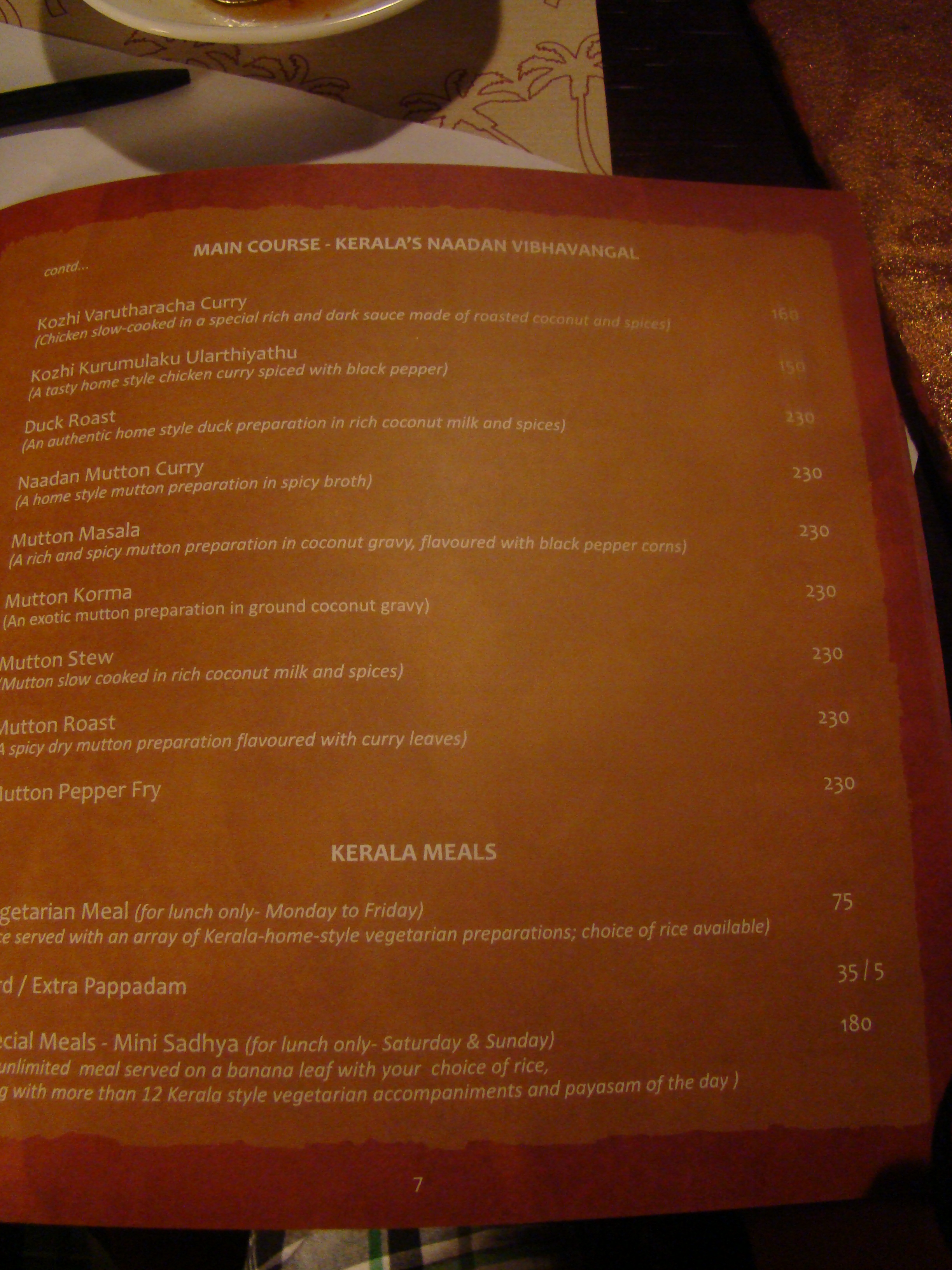
    The menu does provide a range of options from traditional Kerala cuisine, and if for some reason, those fail to impress you much, there are some Tandoori and Chinese options! Here’s the Kerala cuisine part


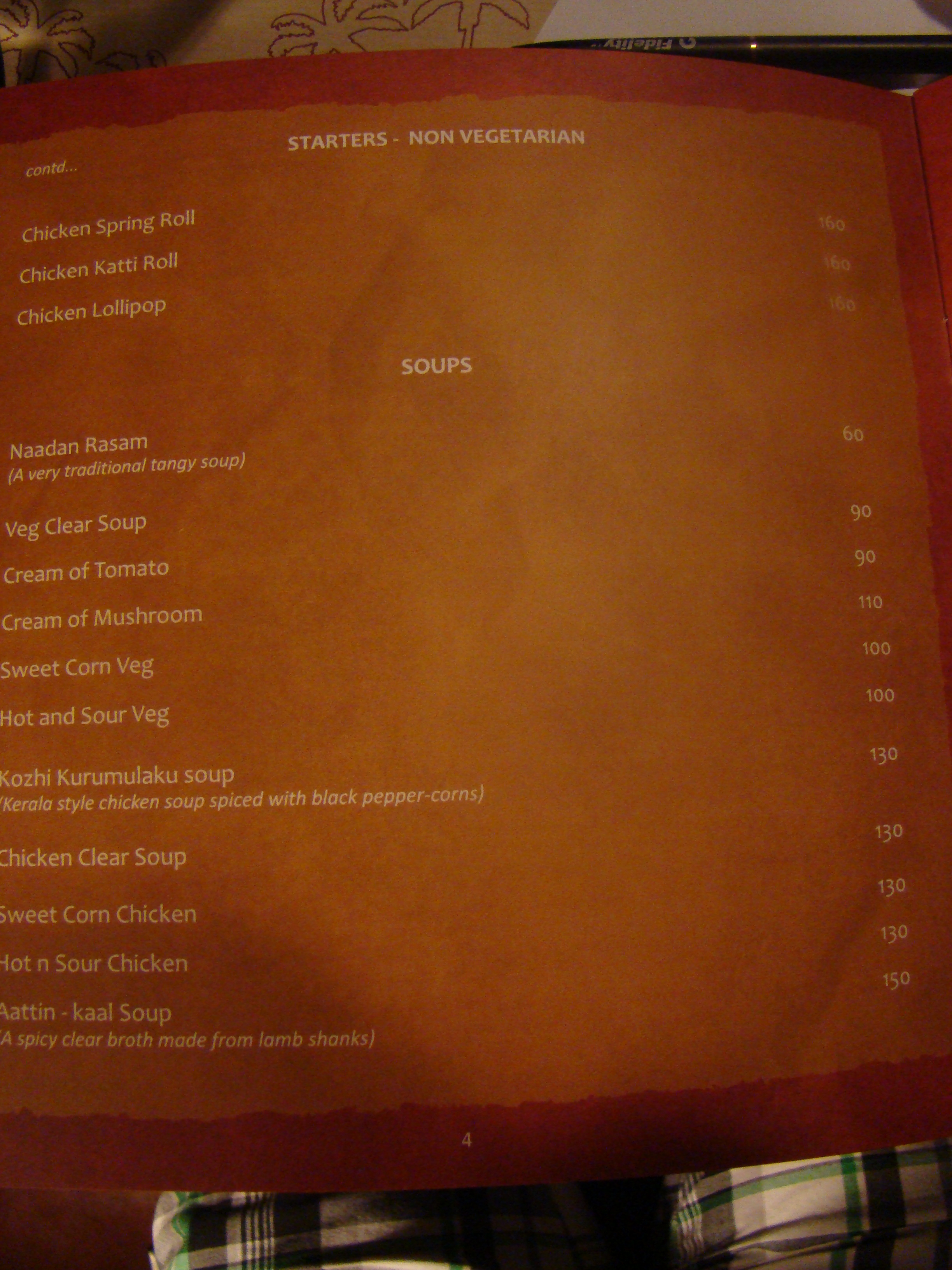
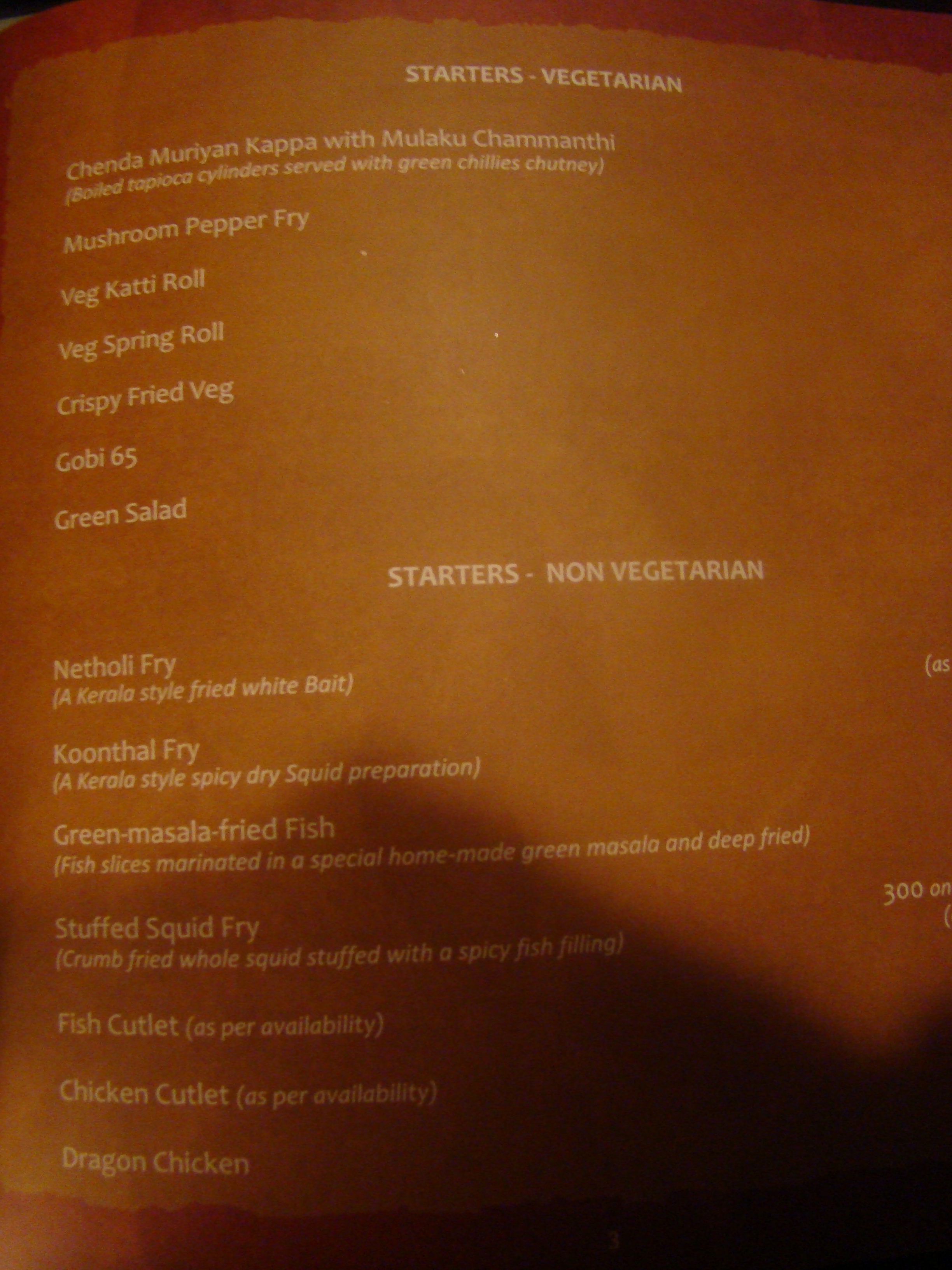
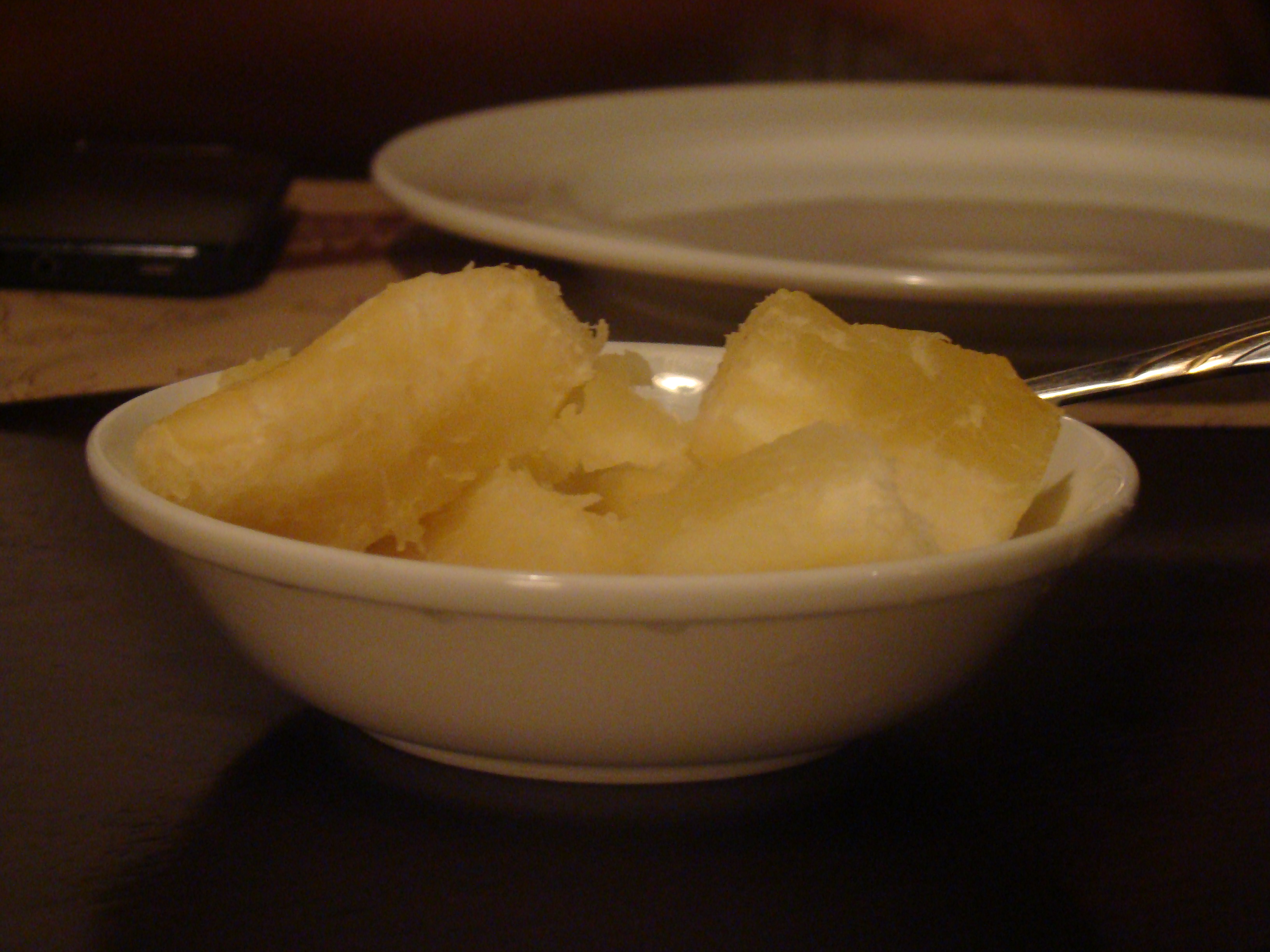
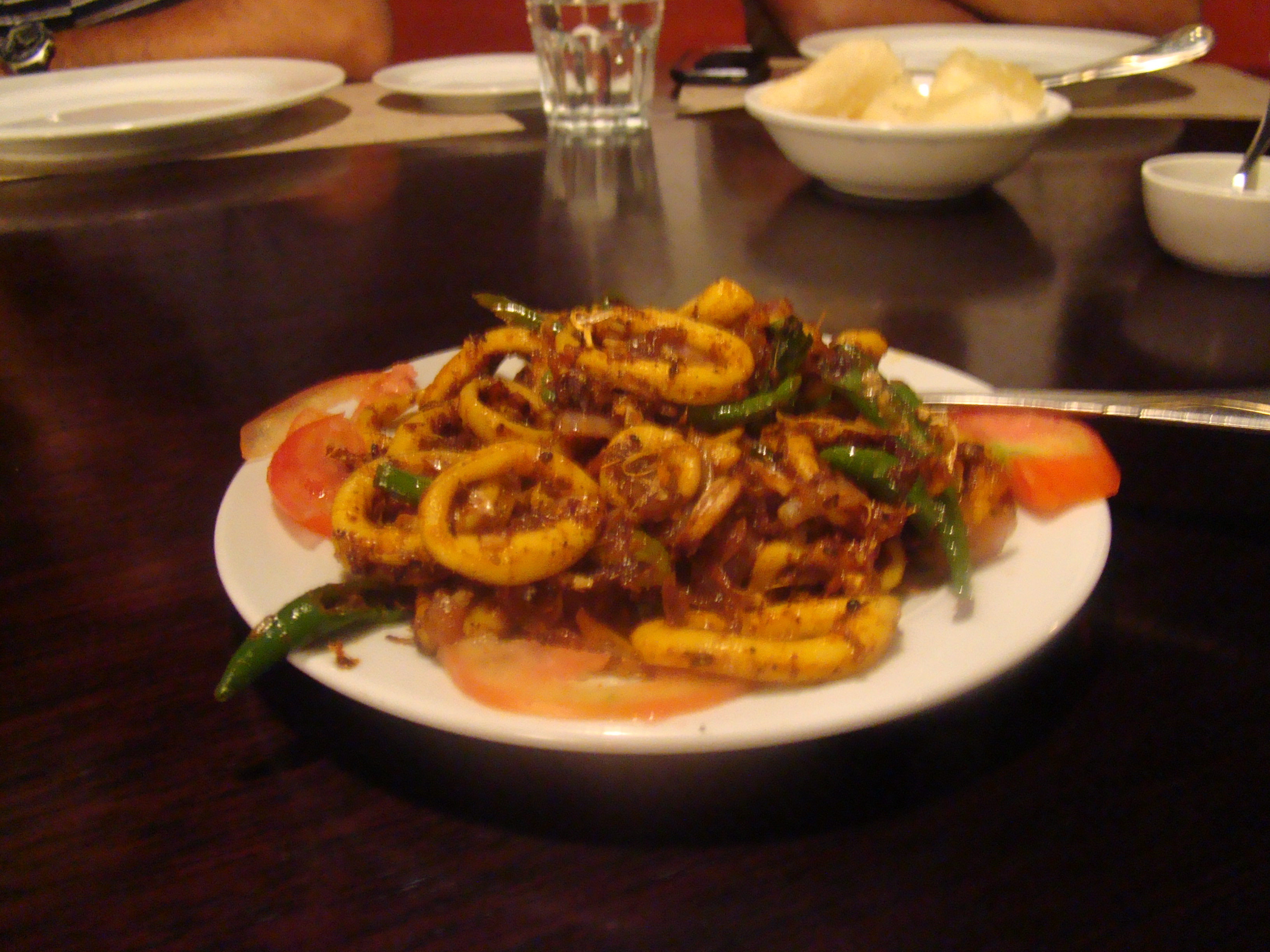
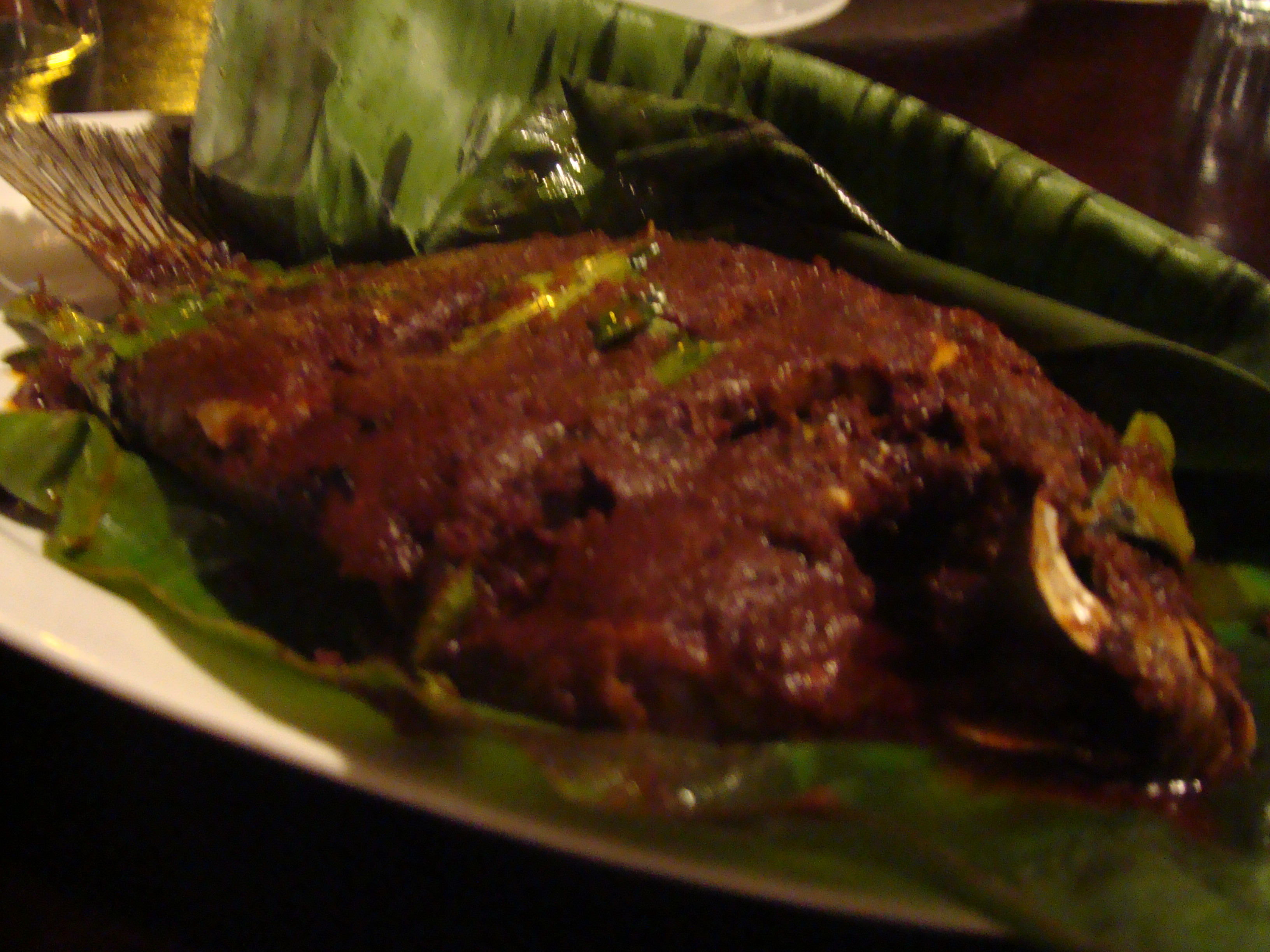
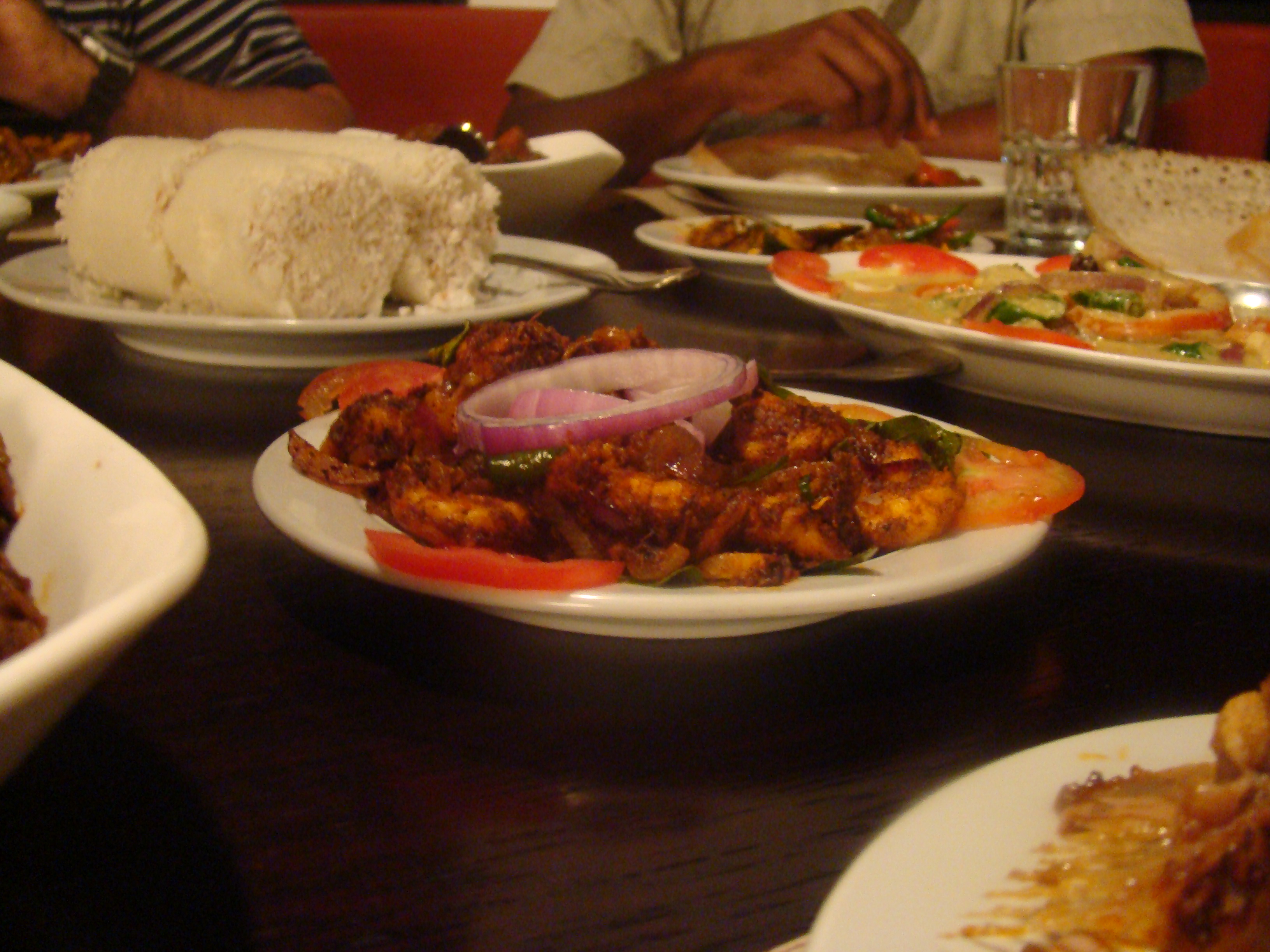
    In case soups work better for you, the mildly spicy Kozhi Kurumulaku soup (chicken and black pepper corn respectively) would be a good bet. We ignored the Veg Spring Rolls, Chicken Lollipops and Katti Rolls and decided to go for the ‘Chenda Muriyan Kappa with Mulaku Chammanthi’ (tapioca with chutney in case you are Malayalam challenged), Stuffed Squid Fry and Green-masala-fried fish. The last two items were not available, so we switched to the more standard Koonthal (squid) Fry and promoted a main course dish ‘Karimeen Pollichathu’ to opener status. I was initially quite dismayed on account of the minuscule Chammanthi (chutney) provided with the Kappa, but soon found that they had perfectly nailed the spicy green chilli-salt flavour, a small quantity of which can last several rounds of Kappa. The tapiocas too had been boiled to perfection. The Karimeen Pollichathu is priced according to size (so ask beforehand) and cost us Rs 400, but the Pearlspot fish grilled perfectly, with a banana leaf wrap, and a spicy sweet and tangy ‘secret masala’ was totally worth it. The squids in the Koonthal Fry were perfectly fried and the masala had permeated enough to make the dish wholesomely flavourful.

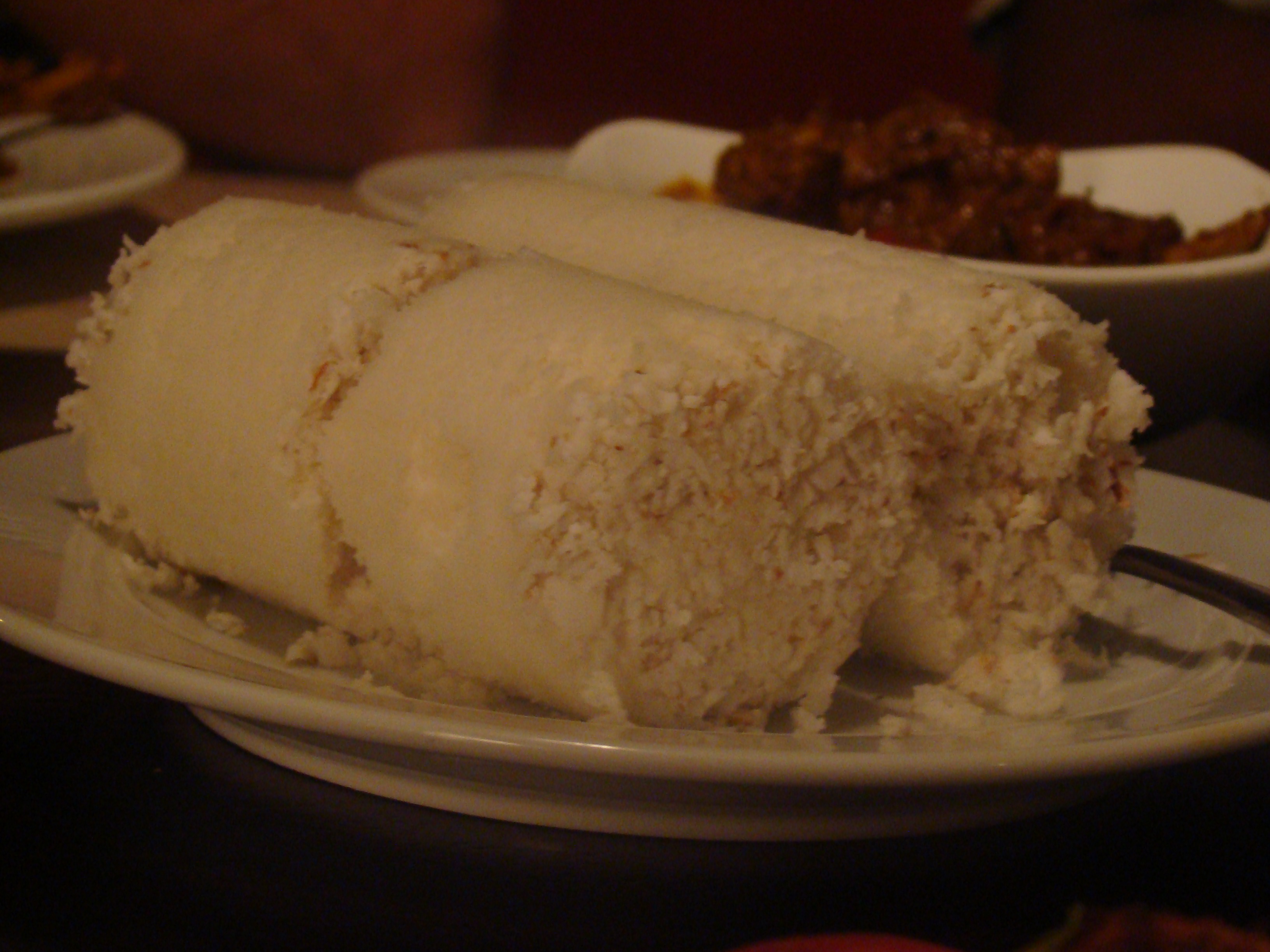
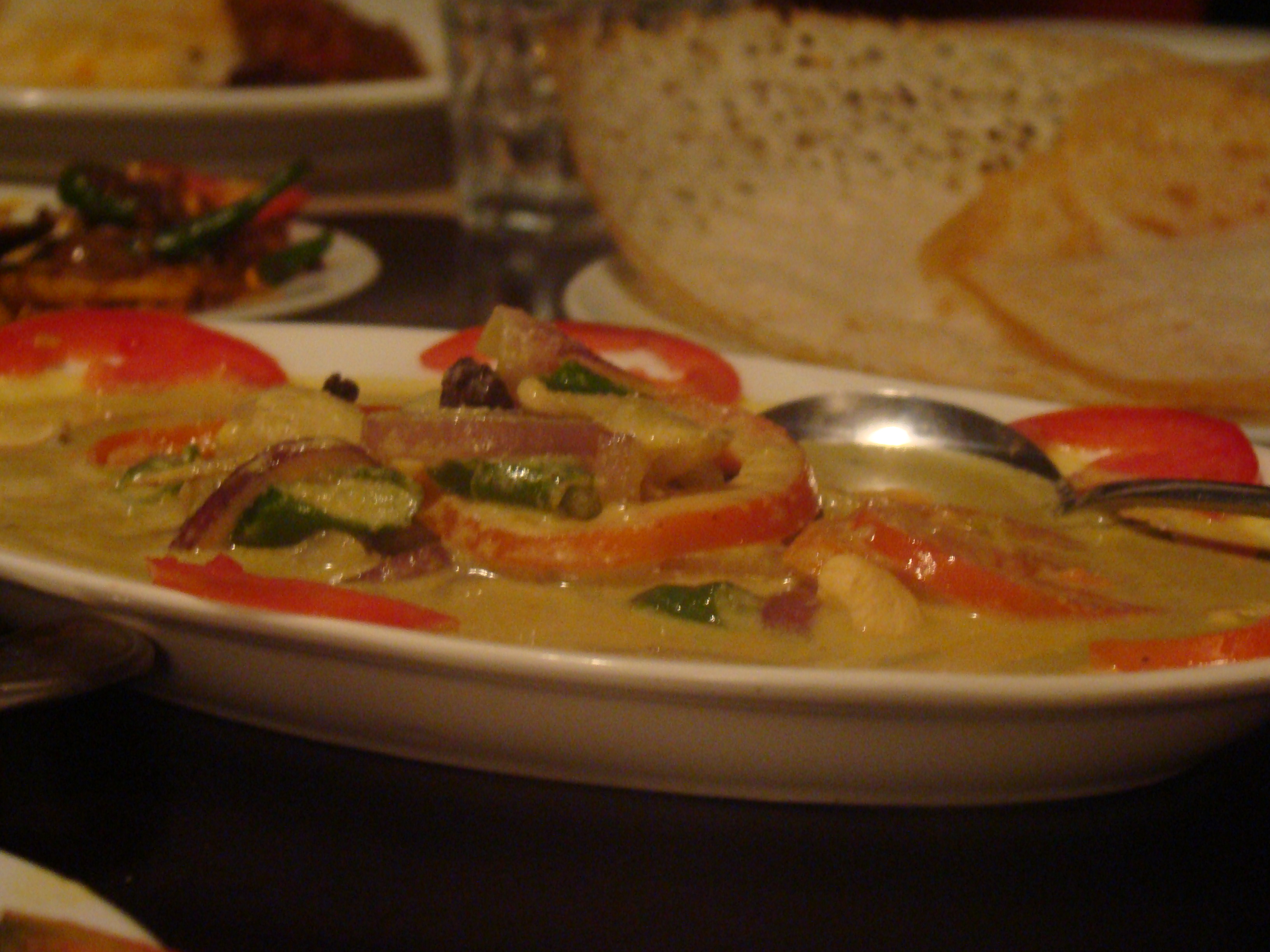
    The main course is easily skewed towards non-vegetarians, though the creamy, coconut milk-based Vegetable Stew would find favour with all. It is difficult to identify a favourite among the non-veg main course dishes, because the masalas involved were only separated by fine nuances. I would pick the Duck Roast, for its coconut milk-based mildly spicy, thick gravy, and meat that was tender. The Mutton Roast, a dry dish with a tasty curry leaves flavour, would be a close second. The Naadan Kozhi curry is also a coconut milk-based preparation and is a thinner version of the Duck Roast. The Meat Roast could’ve been better, as the masala was more fluid than usual, and missed the generous coconut sliver presence that makes the dish special. The Prawns Fry got the frying part right, but lacked the zing that the squid’s masala had provided. The Fish Moilee was a bit of a disappointment on account of its blandness. The soft appams with crispy edges proved to be a favourite, and the amazing pace at which they appeared at the table was only matched by the speed with which they disappeared soon after. The ‘alcoholic’ version – Kallappam (Kallu = toddy) managed to get the flavour, albeit mildly. The Porotta was also perfect with just the right amount of flakiness. The Puttu was a mild disappointment as it was a tad too powdery. The Thattu Dosa was unavailable for comment.

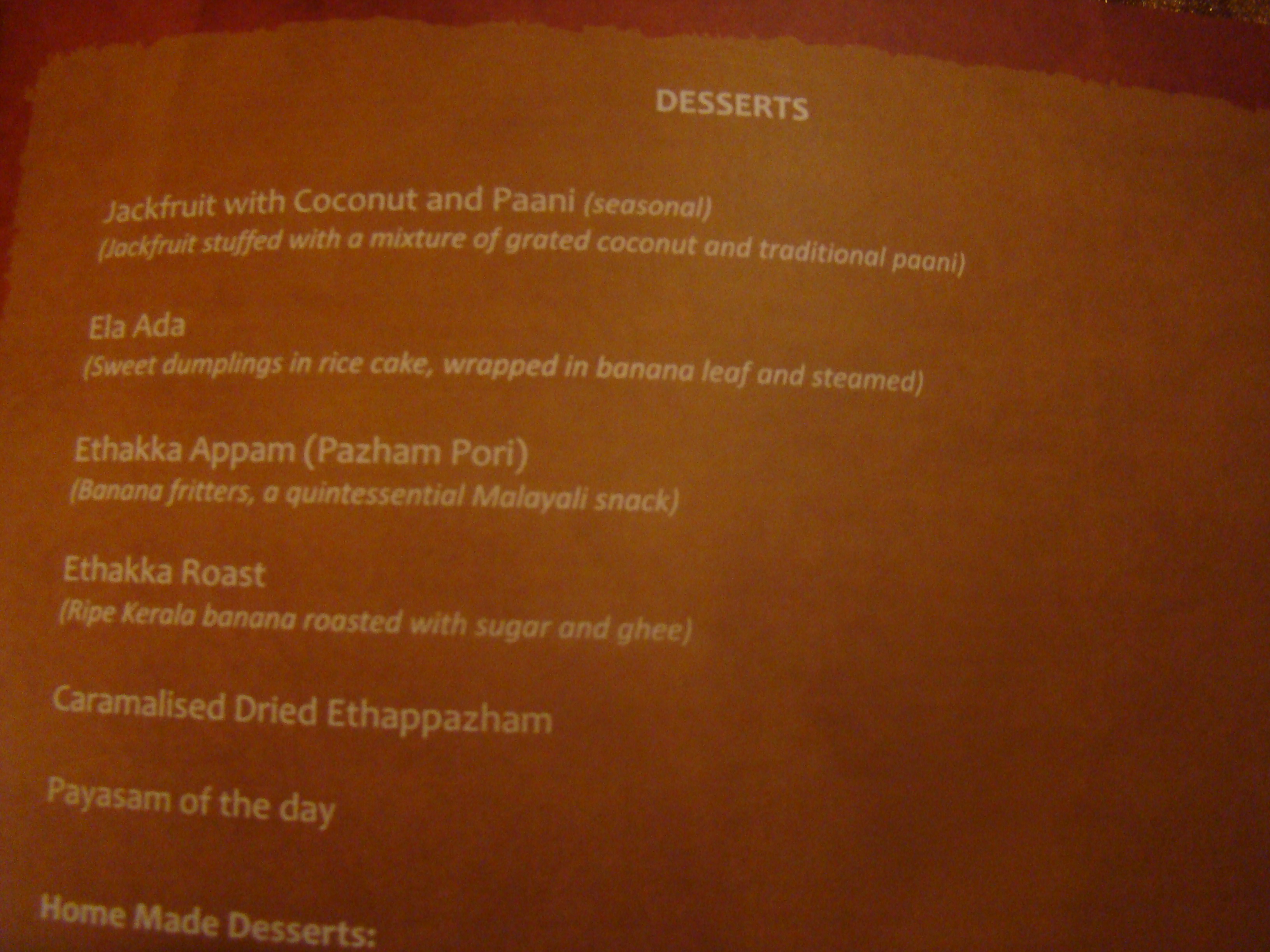
    On paper, the dessert options would make you salivate in anticipation – Ela Ada, Ethakka Appam, Ethakka Roast, Jackfruit with Coconut and Paani, and so on. But we were brought back to earth with the now familiar ‘Unavailable’. The Caramelised Dried Ethappazham turned out to be a bit too syrupy and had less-than-ripe bananas and the Ada Pradhaman was quite insipid too.

    Kumarakom does quite a good job of delivering authentic Kerala cuisine, and considering the portion sizes, the pricing is also just right – Rs.900-1000 for two. The non availability of certain dishes is thankfully compensated by the tastiness of those that made it to the table.