
• God in the details

    Sometime back, Vedant shared a video on Reader – a Punjab village in 1925. It reminded me of how little of documentation we have as we go further back in time. I could see two factors in this – documentation itself didn’t happen because it was not an easy process, and storage mechanisms that were used then haven’t really endured.

    These days, we do a lot of documentation, on the web and offline – pictures, videos, text, creating a lifestream that at this point, looks to be durable, because as each technology gets replaced by another, we are also building means to transfer the data captured. My own lifestreaming experiments have been on for quite a while now. New tools like foursquare only add to it, and I find that I can actually recollect a lot from this information.

    I’m inclined to believe that data capture itself will only get better with time, though the reactions to it will definitely be varied. But it did set me thinking. In the enterprise, the more the data, the more we are able to glean information and knowledge about things, people, behaviour, preferences and so on. Do you think, even at a theory level, that if we actually had data of all humans over a really long period of time, we will be able to crack the profound questions that we haven’t found an answer for – why do things/people exist the way they do, the complete effects of one’s action/inaction, the purpose of life itself? Will this data help us unlock dimensions that have been closed to us thus far? Like I’ve asked before, how would that affect our God constructs?

    until next time, data and daata 😀

    Bonus link: Your place in the 7 billion
  • Johnny Gone Down

    Karan Bajaj

    The good news is that Karan Bajaj moves away from Chetan Bhagat territory (which can’t be said of his earlier work ‘Keep Off the Grass’, though I found it better than Five Point Someone) and he’s not really among the ‘Rakhi Sawants of Indian literature‘ (if it is what I think it is), the bad news is that contrary to what he says, I thought he was more connected with/in KOTG, and therefore the work had more depth, as though he was sure of his footing.

    Having said that, he has made the canvas wider with this work, not just geographically, with a protagonist – Nikhil/Nick, who moves from MIT to Cambodia to Thailand to Rio to Minnesota to Delhi but also with the trades he picks up – from Buddhist monk to drug lord to an internet-boom millionaire, and therefore the experiences and people related to each theme.

    While this works in providing a racy script, it also means that I felt a superficiality in the way each theme was handled. The ‘Second Life’ styled virtual world, for example, while it typified the kind of services that were launched in the boom era, was way too easy. And that’s just it. Everything, from the beginning, whether a positive or negative, just fit in and flowed, too smoothly, just like Karan Bajaj himself describes Nikhil’s state when his life begins to settle back. But I think its still a good read and the pricing really helps. 😉

    [Spoiler, relatively] I’d rather have had an unpredictable end in line with Nikhil’s life until then, but instead it turns philosophical. In fact, I thought KOTG’s ‘comfortable in own skin’ was better than the ‘highs-and-lows life better than even keeled, stable existence’. A better thrust on transience would’ve worked better for me.

    But like I said, unless you’ve been a Colombian drug lord, you’ll find the various karmayogi avatars in Nikhil’s life interesting enough for you to not regret picking it up. 🙂

  • Amagi

    Amagi provides a technology that gives advertisers the opportunity to target specific geographies on national television channels. In conversation with co-founder Srinivasan KA.


    [scribd id=75290142 key=key-1q6jss7iqek23vr0xe99 mode=list]

  • Branded Spikes

    While waiting for the cognitive teardown of the immensely viral Kolaveri (like this Angry Birds one) in the form of either ‘What we can learn from’ or ‘How to craft videos like’ posts and also wondering how long it would take my Twitter timeline to move back from RIP to make-fun-of when a celebrity dies, I read this very interesting post titled “The New Patterns of Culture: Slow, Fast & Spiky” (via)

    It offers fantastic perspectives on creation and consumption patterns of culture, and digital’s weighty role in the changes being wrought. The limited ‘spotlight’ options of an earlier era (mainstream media) now have to co-exist with platforms and mechanisms that are open to most. ‘Scale is no longer a guarantee of stability.‘ Consequently, attention is the more coveted prize. Another related phenomenon is that ‘Change no longer happens all at once for everyone‘. I remembered ‘IsItOld‘ when I read this. 🙂 I sense quite a few concepts agglomerating here. Small ideas, which I haven’t written about for a while now, and transmedia storytelling, for starters, and a reversal of polarity. (the last via Neil Perkins post, linked to earlier)

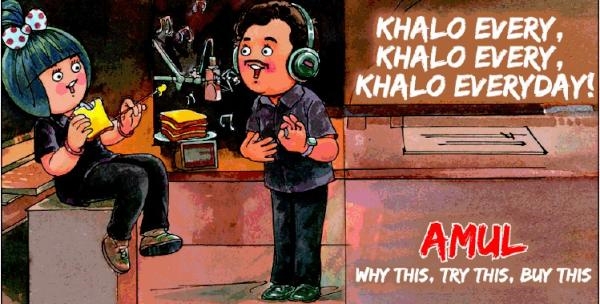
    Brands have always been using popular culture. One brand that I can immediately think of is Amul, and yet, I almost missed their Kolaveri ad. (via) Yes, not the greatest, but decent. The point here is that while they got the creation right, the distribution is still iffy. And that’s another challenge. Popular culture is more complex than ever before. With the abundance of content and platforms, keeping a watch on the long tail of culture, prioritising according to the audience-fit and then distributing it is not going to be an easy task.

    I have always liked (and hence, borrowed with credit in presentations) the analogy of bonfires and fireworks to social media and advertising. (respectively) The implications of this are not just in standard brand advertising but also in branded content. Brands now have to think of how the long-term story and the spikes can work together and ideally, complement each other, even while figuring out what role advertising and branded content play in each. Despite the seeming fit of social media to spikes, I wonder whether we will, in the medium term, see a role reversal – ‘mass’ media providing spikes and the internet dealing with the long term story, before settling into shared roles.

    until next time, get a spike mike

  • Hearing Laws

    His wife was shouting, again, but despite being at the receiving end, he knew he couldn’t fault her. They tried healing it themselves, with no success. A few days later, as they sat with the professional, answering her questions, her voice was still ringing in his ears, or so it seemed. The doctor diagnosed Tinnitus.

    until next time, a heard mentality