
• Empowerment

    In ‘Is Kindness a Strategy?’, Jeffrey F. Rayport shares the story of an American Airlines employee who ingeniously helped a passenger catch a flight though he was late, by using the express lane for ‘invalid’ guests. He mentions that many colleagues of the employee might not be happy with her way of dealing with the passenger. He also writes about Ritz-Carlton’s use of “service recovery” – a company’s ability to respond quickly, decisively, and effectively to a service problem of its own making — is a powerful way to increase loyalty among existing customers. He rightly draws the distinction between the two approaches – they vary on who’s at fault, the customer or the company, and asks what any business might stand to gain if it oriented its associates to look out aggressively for opportunities to perform true acts of kindness for their customers.
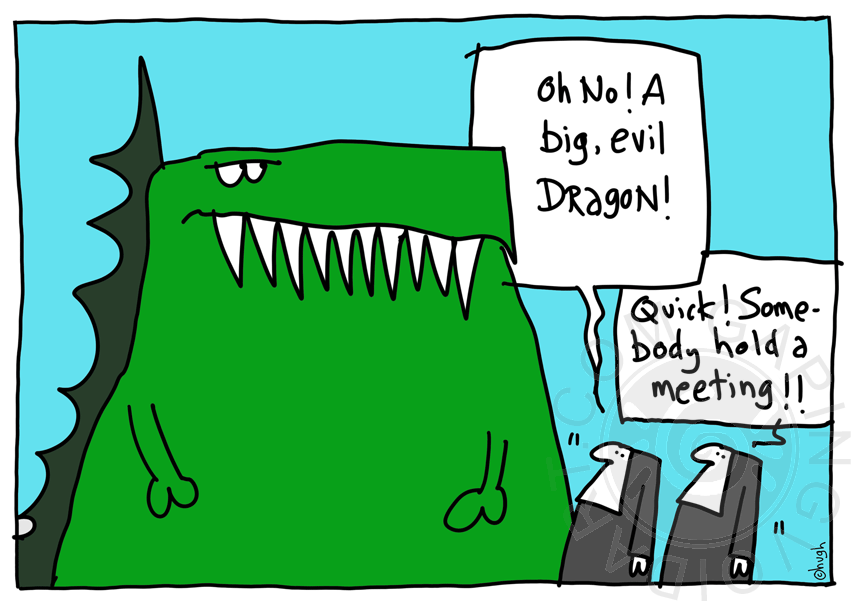
    In my mailbox, a few minutes earlier, I had seen this, in which Hugh MacLeod takes a (what I considered a) legit shot at meetings. As always, the toon says it all. When confronted with a business problem, (generally) the organisation’s first impulse is to meet, discuss, analyse and arrive at a consensus… probably 24 hours later. Yes, even when it involves a real-time platform.

    As I was writing last week’s post on culture, I was asking myself on the ingredients that make up a great organisational culture. Based on the above, I’d say Empowerment. When you have hired a professional to do a job that he has skills in, he/she should be empowered to apply his judgment to situations and not have to go through red tape or meetings involving people with minimal perspective on the matter. The first tenet of Zappos’ famous core values is “Deliver WOW through service”. In the same breath, Tony Hsieh also talks about “investing in a corporate culture that allows employees freedom and space” and follows it up with “If you get the culture right, then most of the other stuff, like great customer service or building a brand will just happen naturally.” On a related note, their unique hiring policy ensures that their sales staff don’t need scripts, they are trusted enough. It also ensures that an excellent culture is built by finding a fit between what makes the individual and the organisation tick. Empowering the employee so that he grows and so does the organisation.

    until next time, power trips

  • Realty Check 1

    They would’ve loved to live here. A relatively hidden area in the heart of Koramangala, such that the EMIs would karmically commit them to several rebirths. But they had a plan. A group deal involving like minded people – to dump garbage there everyday until the rates came down. This post is the first step. 😉

  • Deaf Heaven

    Pinki Virani

    I’m quite a fan of Pinki Virani’s earlier work – Once was Bombay, so there might be a bit of a bias here. 🙂

    ‘Deaf heaven’ is billed as her first work of fiction, but is perhaps as close to non-fiction as it can get. The characters are clearly based on the contemporary personalities – from movie stars to politicians, and the descriptions are such that a little knowledge can easily help you identify them – the ‘caterpillar -eyebrows’ actress to the leader of the saffron army, to the famous film star and his wannabe famous son and the lesbian maker of daily soaps. See? 🙂

    The narrator is the cleft lipped and recently dead Saraswati, librarian by profession and collector of facts. Over a weekend, with an eclipse that serves as a climax for the multiple narratives, she traces the lives of the characters, a mixture of the famous and the ordinary, connected to each other by varying degrees of separation.

    The book is a commentary on modern India and its mixture of contradictions, with representatives from different geographies, strata in life, age, and religion. Though primarily a woman’s perspective, the author manages to tackle the paradoxes of the emerging superpower – from female infanticide (and an ingenious way of communicating the unborn child’s gender – an illegal act), and tribal exploitation, to the mechanics of religion-politics, the effect of chemicals on vultures and the ‘death by railway track’ on Mumbai’s famed local trains, all interconnected, just like the characters.

    Though a preachy tone does dominate the last part of the book, it is definitely a must read, not just for the pertinent and fundamental questions the author makes us think about, but also for her razor sharp wit.

  • Aromas of Coorg

    Fully automated vending machines that serve freshly brewed authentic filter coffee, that’s the business Aromas of Coorg is into. In conversation with co founder Radhakrishnan M.

    [scribd id=86451170 key=key-70nv6akkcvvf11mocv6 mode=list]

  • Culture.org

    For quite a while, I have believed that culture is the most underestimated and underutilised tool among the organisation’s means of gaining strategic advantage. A few like the much venerated Zappos have used this lapse to maximum effect and by assembling a group of passionate and aligned individuals generated profits and publicity, all while retaining a culture that continues to thrive. Remember “Anyone can do what we do, but nobody can be who we are.”?

    Last week, Maneesh wrote an excellent post titled ‘The Importance of Culture‘ that started off a discussion on twitter involving him, Harish and me. Having experienced a few instances when the influx of money into an organisation (not necessarily a startup) changed the internal landscape completely, I wondered whether scale (that many a time follows money) and culture are usually mutually exclusive. It’s not always so, but it takes not just a very skilled management team, but also an empowered employee bunch down the line to make it happen. It takes communication, rewarding the right behaviour and a lot of clarity to ensure that the culture is not lost. To quote from the post, “Culture is attitude, it is not behaviour. Everyone knows this, but we all get it messed up.

    When he linked professionalism and culture, I smiled because I remembered an incident from a couple of years back. That (very interesting) discussion, which prompted this post, was on whether passion or professionalism could better help the organisation scale. For various reasons, at that time, the two were mutually exclusive in the organisation. I argued for professionalism, because to me, it represented consistency and reliability. We both refused to accept the easy compromise of ‘both are necessary’. Towards the end, the management guru equated a professional to a mercenary. To me, the difference, was in alignment. In that sense, I agree with Maneesh that professionalism is practically non-negotiable. To quote from the post again, “You become a professional when you care. Your culture defines what you care about.

    A couple of days after this discussion, this tweet appeared on my TL

    Posts across years, across industries, across lines of work, but if you read them, you’ll sense the similarity.

    To me, culture is not a fancy set of perks and trappings that money can buy. It’s a sense of belonging, a feeling of being connected to a set of objectives and activities that give the individual a sense of purpose. A sense of enjoying the ride even when it’s a tough one, because you know there are many who will be your parachute in case you fall off a cliff that you didn’t anticipate. When that feeling is lost, the light in the cubicle is switched off. More often than not, permanently.

    until next time, culture counter