
• I, the responsible

    …and the poor poor girl died earlier in the day I wrote this. Given the delay between my writing posts, and them getting published here, we should have collectively moved on from the issue by now, at least in terms of mind space and media space- mainstream as well as trending topics.

    Much, much has been written about the issue – the male/female/Indian/ NRI/feminist/opportunist/armchair activist/ weekend activist/ ‘I was there to protest’ perspective, and these were only some examples – slice and dice any way you like and you’d find a voice that spoke on behalf of the piece you carved. Like this.

    Much as I abhor what happened, I see it (rape) only as one symptom of the disease we all have – our own malformed sense of justice. Probably one of the worst symptoms, but not the only one. Injustice is injustice, and it varies by degrees only on the basis of our own perspectives of right and wrong. It happens everyday – talking on the mobile phone while driving/riding, fudging tax forms, making the maid plead for a salary raise, bribing a cop, drinking and driving because you have assured yourself that you are still in control… ask your conscience, you’ll come up with many more. No, I’m not really confusing it with breaking the law – here’s an example. Five hundred times you speak on the phone while driving and nothing happens, but nothing stops the five hundred and first time being the instance that maims someone for life, and leaving him/her bereft of limbs, and perhaps dignity. Ask that person which is a larger crime – what happened to him or a gang rape – the answer should not be surprising. Every action/inaction that affects the dignity of another person, that shows another person that one can get away with breaking the law, that walks the grey area between absolute right and wrong in however minute a way, is injustice in some form.  And in this daily, casual, personal #theekhai attitude to justice lie the seeds of every horrible act of injustice. Any kid watching this today and seeing the perpetrator walk away scot free will imagine he can get away with a bigger crime. And so it grows, and morphs into multi-thousand crore scams and gang rapes further down the chain. A bit like the broken windows theory.

    Granted that an elected government has among its duties the responsibility of ensuring the protection of its citizens. Should we protest if they do not? Of course, but that does not absolve me of my obligation, nor does it free me of the nagging thought that as a race, our notion of justice is based on convenience. Sometimes I wonder if the birth of laws in society was a response to the slow death of justice within human beings.

    So yes, I am the privileged who can update my Facebook status, and move on with my life. I am responsible and there’s nothing I can do about it. Before I casually judge others, I have to wonder if I have the moral authority to do so. After all, I only vary by degrees.
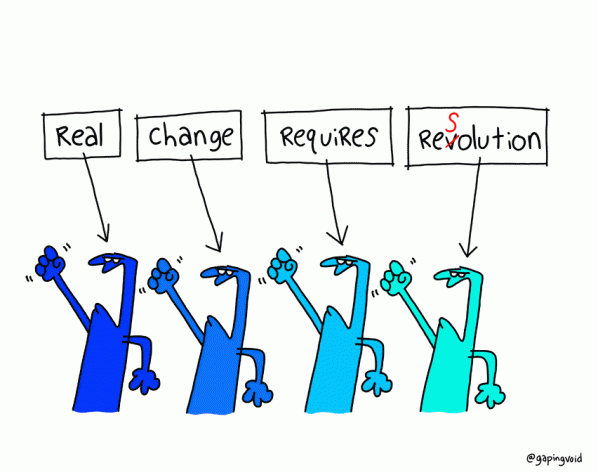
    (image via gaping void)

    until next time, </justice>

  • Treetle

    Treetle helps you find people in your neighbourhood who are interested in the same things that you are. In conversation with founder Pankaj Dugar..

    [scribd id=122398088 key=key-2d5x186ls25co2ncjha8 mode=scroll]

  • Vengeance Of Ravana

    Ashok K Banker

    The seventh book of the Ramayana series that was never expected. Ashok Banker has his own reasons for writing it, as he mentions in the Foreword. He also uses the section to outline his plans to document the past, present and extrapolated future of India as well as alternate history. I was quite happy when i read this because it seemed a noble endeavor. And then the book started.

    I have been a fan of the other books (except for Book 3, which i thought was an unnecessary stretch) in the series and have, in reviews, admired how the author brings characters and the age to life and uses prose in a way that makes you (even) identify with them.

    But this book completely failed for me. The plot, if any, doesn’t go anywhere. I could’ve flipped 10 pages and still not missed a thing – except for prose. It’s as though the mandate was to describe every occurrence / character/ vista in as many words as possible. Fitting in contemporary phrases like collateral damage and terms like vortal seem terribly forced. It’s a vengeance story, but sometimes you wonder who it is directed at!!

    If you’ve been reading the Ramayana series, I guess you’ll have to sit through this one too, just to see where it goes, but go in fully prepared for a prose avalanche. The author does seem to be on his own trip – good for him, not so good for readers. Sad.

  • A picture to go with me

    Something in Mishi Saran’s ‘The Other Side of Light’ made me think of a visual that would accompany me on the final journey. I’m not really a painting kind of person, so it’d probably be a photograph.

    A photograph that captured my life in one still moment, or my soul itself. Something that was much more than a thousand words. Something that only I understood and could connect with, so its existence beyond my own would be meaningless.

    For now, I don’t think I have a photograph like that. Or perhaps each photo, when I look back at it, is as much the deserving one as another. Each one, a different me, real and alive at that point in time, reduced to memory soon as it is captured.

    until next time, transience

  • With great data…

    LinkedIn’s article curation is improving very well in my case. What I particularly like is the dash of serendipity in the list. One of the articles I recently read was “Are we all being fooled by Big Data?” Though it is less to do with business per se and is skewed towards economic forecasting, it does make for a very interesting read.

    Gartner’s 2013 Strategic Technology Trends has Strategic Big Data as one. In fact, I’d also add ‘The Internet of Things’, ‘In Memory Computing’ and ‘Actionable Analytics’ (also in the list) as related items, as a source, enabler and application respectively. While Big Data has been talked about for a while now, and has seen applications as well, I am not sure how accessible it is to the majority of organisations and brands. In essence, is it ‘mainstream’ enough? (I see organisations struggling to link existing data) Are there frameworks being built that will aid analysis and action across various functional domains – ways to nimbly access and use contextually relevant ‘packets’ from troves?

    Probably 2013 is when we will see things moving. But there’s something about data that worries me. This has come from my own experience as well as from the things I have read/heard. And that’s where the organisation’s intent becomes important, because you can find data to validate most anything! This is all the more significant because with improving technology, the volumes of data will have the potential to help brands shift paradigms and disrupt the status quo. But it can also be used for strategic/tactical blunders. As the saying goes “If you torture data long enough, it will confess to almost anything

    All of this reminds me of social media. The hype, the evangelism, the tools and so on. And just like social, Big Data has in it the ability to amplify the inherent nature of the enterprise.

    until next time, think big