• Mammoth Book of Short Science Fiction Novels

    The book consists of 13 science fiction novellas all written between 1950 and 1980. At the outset, I am a bit disappointed that I didn’t like the book as much as I thought I would. The start was fantastic, with Isaac Asimov’s “Profession”, where he manages to narrate a story that’s universal and timeless. I wasn’t particularly impressed with John Campbell’s piece, though it was made into comics and movies. Lester Del Ray’s “For I am Jealous People” has an intriguing plot in which God abandons the human race and sides with aliens.

    “The Mortal and the Monster” by Gordon Dickson also proved too slow for my liking, and though well paced David Drake’s “Time Safari” seems jaded now that we are inundated with Jurassic monsters regularly on the screen. Phyllis Eisenstein’s “In the Western Tradition” is an interesting plot but from just a human angle.

    “The Alley Man” by Philip Jose Farmer was too convoluted and slow for me, but I found the concept of John Jakes’ The sellers of the dream” very intriguing. Donald Kingsbury’s “The Moon Goddess and the Son” was another extended work and I gave up on Barry Longyear’s “Enemy Mine” after a few pages. Larry Niven’s “Flash Crowd” had teleportation which I have always found interesting and it helped that it was a fast moving plot. Frederik Pohl’s “In the Problem Pit” was also just barely there but the book ended reasonably well with Robert Silverberg’s “The Desert of Stolen Dreams”.

    There were indeed many stories which I would rate as good science fiction, but there were too many universal human condition stories which were science fiction only because of a setting which then faded into insignificance. There were also a couple of fantasy works which seemed to be masquerading as science fiction. I would say that the “Science Fiction Treasury” edited by Isaac Asimov is a much better read. But it’s still amazing to see many of the concepts spread between what is now reality, or aspirational or still science fiction.
  • Canvera

    Canvera helps the professional photographer increase his/her profits by delivering high quality technology-enabled products to service their clients better, and to help the end consumer get good quality photo products

    [scribd id=126781145 key=key-16pnixh3tdnpyspzslsp mode=scroll]

  • Project Lead

    My earlier post on media consumption fragmentation also made me think of the other side – the creation perspective. Despite the hubbub of “integrated campaigns”, some platform, more often than not, plays the lead. In earlier eras, choices were easier – until televisions came into the picture, it was limited to newspapers, events, radio; even after TV made its inroads, things like objectives, costs, geographical reach of the brand etc could be used to make decisions. In general, I’ve seen TV trumping print more and more as time passes, taking on the role of project lead.

    After the advent of social, and despite the low internet penetration, the above parameters have increasingly started working in favour of social ‘media’. Of course, there’s always the beginning of the curve when everyone wants in because of the shiny new object syndrome, but I do believe we are crossing that stage now. I still see “let’s do this on social media too” (after the entire campaign has been conceived and produced) or the single slide on social rampant, but that’s also part of the learning curve. As always, some brands are moving faster than others.

    We already have brands, internationally, that are experimenting (and successfully) with ideas that are inherently social, and using traditional media for say, additional reach. Just as TV took over from newspapers, it is possible that social will take the seat at the head of the table at some point. It is also possible that it would go the way of digital – relegated to performance campaigns, and belying its potential. That is even more so if social is measured in the same ways as the media before it. However, I think this time the story would be played out differently. But then again, I also think there will be a fragmentation of the brand story, understanding each platform’s nuances, using its inherent strengths, making frameworks that have tailored measurement indices, and in the process, providing a cohesive perspective to the consumer, and cohesive metrics for the brand.

    until next time, leaderboards 😉

  • Lovestrong

    Slightly dated in the context of real time, but I thought this was a pertinent read in the Armstrong era. It’s titled “Honesty of the long-distance runner” and is about a Spanish runner Iván Fernández Anaya. He was running second in a race he had no chance of winning when he saw race leader Abel Mutai pull up about 10 meters before the finish, thinking he had already crossed the line. Instead of exploiting the situation, he let the Kenyan win using gestures to communicate. He thought it was the fair thing to do. He also candidly said that if a Eur/World medal was at stake, he’d probably have done things differently.

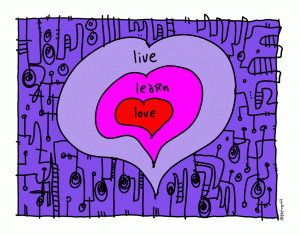
    I saw this poster at gaping void, related to  purpose, but twisted it a bit in this context. It isn’t as though there aren’t things we love to do. As we move further in life, we learn more about the way life works. Sometimes these things we love make business sense, sometimes they don’t or requires either stellar talent or more hard work than we are willing to put in. Some of us work at it, some of us lock the love away and some of us decide to find an easy way out. And thus it is that even things which involve love and passion – sports and arts – have been converted into competitions and ruthless economically viable phenomena. So really, where does the corruption begin?

    until next time, strong-armed

  • The Oriental Kitchen

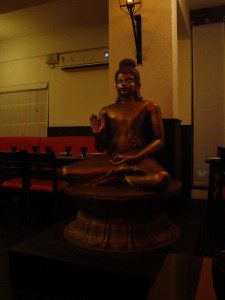
    When we read about The Oriental Kitchen on the web, and saw the address, we thought it would make it the fifth restaurant in that building – the one that houses The Great Indian Thali, Barbeque Factory and An Elegant Elephant. But turned out that El Tablao had shut down and Spain had been replaced by Chinese-Thai. Ah well, the Buddha has always been clear about the transient nature of it all, so he wouldn’t have had any qualms about replacing the Spanish paraphernalia that made up the earlier ambiance. The chandeliers remain though, and thankfully so does the view. We were the only group when we reached, and were asked if we had a reservation. After an awkward silence during which we scanned the rows of empty tables and chairs, we got exactly the table we wanted. 🙂

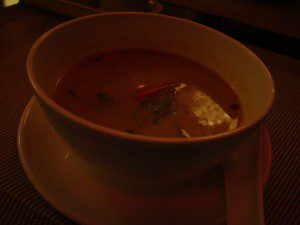
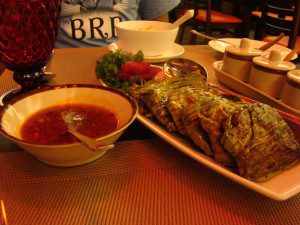
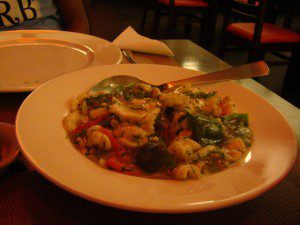
    Since Zomato had the menu, we roughly knew what we wanted, and asked for a Tom Kha Chicken soup. Before that arrived, we got a little complimentary amuse-bouche made of darsaan and peanuts. Sweet and spicy it was, and did its job very well. The soup arrived soon after and though we would have liked it to be thicker and wished for the coconut milk to have a stronger presence, its flavours were quite good. Not the best we’ve had, but passable. We had also asked for a Banana Leaf Wrapped Grilled Chicken. That turned out to be really good – spicy with a hint of sweetness and a sauce that complemented it very well! Great presentation too.


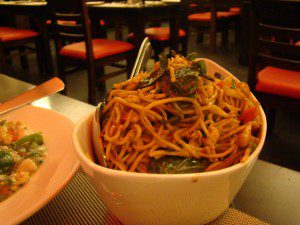
    For the main course, we asked for a Thai Chilli Garlic Noodle with Chicken and though we wanted a Tsinghoi Chicken, the person who took the order recommended a “Slice Chicken with Corriander and Fresh Red Chilli.” (sic) Both the dishes were good (and spicy) though the red chilli was replaced by a green version.


    The service was friendly and helpful. All of the above cost us just over Rs.1230. I’m guessing Oriental cuisine will definitely have takers in this part of town despite competition around.

    The Oriental Kitchen, 612/1 Lotus Building, 4th Block , 80 Feet Road, Near Sony World Signal, 4th Block, Koramangala. Ph: 40906789