• @ Social Business Summit

    I was quite thrilled to be invited to speak at the Mumbai version of the Dachis Group’s Social Business Summit – not just because of my awesome co-speakers, but because this is a platform that has seen the likes of Tony Hsieh and John Hagel earlier this year! To confess, a little nervous too, since (as my friend Kavi Arasu, whom I met for the first time after years of knowing him online, put it) I was going to ‘open the batting’! But in the end, it did turn out very well, judging from the audience reaction. Here’s my presentation – The Currencies of Engagement @ Scale, with a talk flow right below since slides with Yoda and Spock could seem way out of context in the subject of Engagement @ Scale.

    The currencies of engagement @ scale

    It was a fantastic experience – the crowd, perspectives of co-speakers, meeting Gaurav, Haroon, Nadhiya for the first time outside of Twitter, catching up with Gautam, Sumant, Sanjay and Ideasmith, and being introduced to a whole bunch of people that I hope to be in touch with.

    But my biggest thrill was in getting this platform to share my ideas on an evolving domain that I am passionate about, and being appreciated by the likes of Jeff Dachis and Michael Jones. It was both exhilarating, and humbling.


    A few photos here, though my expressions make it seem more like ComicCon or a theatre workshop! :O

    I also wrote a more elaborate post at Medianama. Do take a look.

    until next time, #SBS2013 #ftw 🙂

  • Tangerine – Koramangala

    Tangerine at Indiranagar had always been in my favourites list from the first time I dropped in there. But thanks to the column space hogged by Namma Metro construction and the resultant chaos on the road, and helped by competition ‘toitening’ its grip, my visits had tapered down to zero. So I was extremely happy when I saw a signboard late last year in Koramangala – one that was familiar in terms of font and colours – that announced the launch of the restaurant. I learned during my visit that the Indiranagar outlet had been shut down. A stone’s throw from the busy Sony World junction, (when coming from Indiranagar, it’s the first left after the Sony World Signal – it’s just off the road) and yet somehow retaining a sense of calmness, exists the new version of Tangerine that started operations in September. Yes, they do have valet parking and two wheelers can find easy parking in the lane.

    Some of the tables offer a wonderful view of the road. The trademark light-coloured wooden furniture has made it, but sadly, their companions, the ‘chimney’ lampshades haven’t. You can check out the menu at Burrp. They also plan to have wines soon.
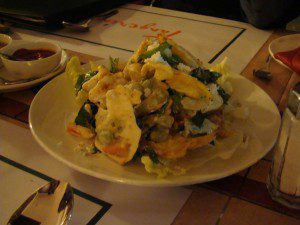
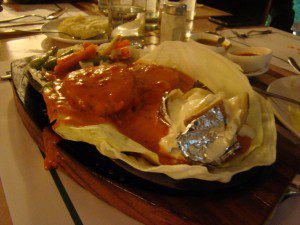
    The Spicy Chicken and Coriander Soup had been a favourite, so we decided to begin with some nostalgia. Unfortunately, it hasn’t taken the location transition very well. It was thinner, stingier on the coconut cream, and the chillies hadn’t been informed about their role. The Fried Prawns that came next did nothing to salvage the situation. The prawns were leathery, and beer wasn’t the only thing that deserved to be battered. Mustard Chicken Sausage Flowers hooked us with its matter-of-fact, non-flowery description, but the actual dish, though not lacking in flavours, went a tad overboard on the saltiness. Hope took a long time coming, and it came from an unexpected quarter – Vegetables with Feta. But even that was too little, and too late, since we had to remind the service staff at least a couple of times that we had ordered a veg starter, as the vegetarians at the table cast mournful glances at the dishes that arrived much before theirs. In the end, they gloatingly offered to share their fried vegetables and tasty cheese dish with us meatheads!

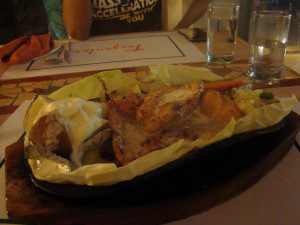
    Despite unfortunate experiences with aquatic life earlier, we asked for a Fillet of Fish ‘Moutarde’. The last word sounds like a lot of things, but it’s only French for mustard, and that was indeed the prime player in the dish that also featured red chilli flakes and oregano, all of which complemented the grilled fish perfectly. But the Chicken ‘Desiree’ unfortunately left a lot to be desired. The chicken was rubbery, the jacket potatoes weren’t boiled well, and the sauce, despite featuring spiced honey and lemon (on paper) was rather insipid. The penne pasta, with a sauce that had minced chicken, red chilli flakes, tomatoes and herbs, thankfully brought some cheer. It wasn’t dry; the flavours were brought out really well, and it was just spicy enough to make an excellent dish. The vegetarians ran out of their beginners’ luck with the Stuffed Cottage Cheese Steaks, as the paprika and herb sauce proved to be extremely spicy. In case you want to experiment, there are some interesting Indian Sizzler options.


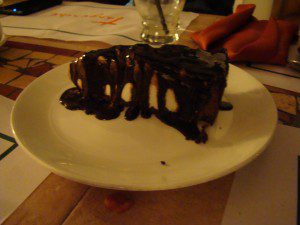
    All the knives that were out thus far for the place were replaced with spoons after the desserts arrived. In a heavily competed section, the Mud Pie emerged the winner, despite having a slightly tough base. The unique Death by Chocolate would have won if it had not been at room temperature, and had been less grainy. The Tiramisu was not bad either. But the actual winner was the chocolate sauce and they clearly knew it, judging by its active presence in any dish that offered a chance!

    For about Rs.1300, you could share a non veg starter, a couple of non veg main course dishes and a dessert. (Inclusive of taxes and service charge) The service delayed quite a few dishes and while they had their reasons, they weren’t really convincing.

    The desserts and an old times’ sake fondness might get me to visit again, but Tangerine needs some tangible improvement if it hopes to win the affections its Indiranagar version had earned. In the journey from one end of 100 feet Road to another, something seems to have been missed out. It isn’t as though the food was uniformly bad, but in Koramangala, where we’re approaching the state of one restaurant per family, things need to be perfect for a restaurant to thrive.

    Tangerine, 52, 100 feet Road, Koramangala, Ph: 080 41152678/9

  • Live Empty

    old tree and new tree stories

    (via)

    Such is the pace of life now that I can easily identify with the opening paragraph here. As I read on, I completely loved the part about the graveyard being the most valuable land in the world, “because with all of those people are buried unfulfilled dreams, unwritten novels, masterpieces not created, businesses not started, relationships not reconciled.” The rest of the article is about dying empty – to complete every task, thought, action, to leave nothing unspoken, uncreated, unwritten. 

    Later, I read on Brain Picking, “Henry Miller on Creative Death“, in which Henry Miller, defining art, says, “Strange as it may seem today to say, the aim of life is to live, and to live means to be aware joyously, drunkenly, serenely, divinely aware. In this state of god-like awareness one sings; in this realm the world exists as poem. No why or wherefore, no direction, no goal, no striving, no evolving…. This is the sublime, the a-moral state of the artist, he who lives only in the moment, the visionary moment of utter, far-seeing lucidity…. in the sense that any moment, every moment, may be the all; for the artist there is nothing but the present, the eternal here and now, the expanding infinite moment which is flame and song.” And later in the article “On the contrary, his zest for life is so powerful, so voracious that it forces him to kill himself over and over. He dies many times in order to live innumerable lives.

    I read a pattern in these. Of dying every day and being reborn the next day. A new life. I faintly understand and relate to this, but within me is another side that plans, that likes stability, and saves for a rainy day. I am unsure of how these two can co-exist. And I can’t help but be drawn to the lines at the beginning of the Miller post ““One aspect of our nature cannot be exalted above another, except and the expense of one or the other.” 

    If so, I already know the winner, and as the first post points out, that would create an angst, or a perpetual state of discontent. It would seem as though the opposite of ‘die empty’ can only be ‘live empty’. There can be no middle path, and that’s scary and sad.

    until next time, empty vessels and a lot of noise

  • Fortune’s Favorites (Masters of Rome #3)

    Colleen McCullough 

    The third book in Colleen McCullough’s “Masters of Rome” series, after “The First Man in Rome” and “The Grass Crown”, begins just a few years after the latter. Sulla gets back to Rome, the beauty of his early days giving way to a toothless self with a hideous wig and an addiction to wine, and true to character, wreaks terrible vengeance on his enemies – Young Marius, Cinna and Carbo- and becomes Dictator of Rome.

    The seeds of Rome’s Republic days were probably sown that early as Sulla changes laws that had persisted for years. But what he also aids is the rise of the two other “Fortune’s Favourites”. He gave enough room to Gnaeus Pompeius, who, very early in life gave himself the title Magnus and sought to play down the other moniker Kid Butcher, and was the wealthy provincial whose military machinations and continuous search for military glory finally made him senior consul without being a member of the Senate. Though not easily, Sulla also helps free Gaius Julius Caesar from the position of flamen Dialis, the yoke that a bitter Gaius Marius had hung on his neck before he died. And then, true to his promise, Sulla makes an exit, on his own terms.

    In this book, through the later years of Sulla, and the early years of Caesar and Pompey, the author brings to life the character of Rome and its citizens. The presence of other familiar characters like Cicero, Spartacus and Mithridates add to the excitement. With a few eventful campaigns, the author also gets to pace the book well, allowing the characters to build slowly. Pompey’s supreme confidence in his own abilities, his showiness, the ignominy he suffers at the hands of Sertorius, and his tantrums when things don’t work his way all give us a glimpse of his character, a stark contrast to the confident yet subtle-when-required Caesar, whose diplomatic and military coups at an early age showed that he was destined for greatness. The brilliance of Caesar’s mind is on display as he brings a truce between Crassus and Pompey, uses his aunt’s death to show Romans that he is indeed Gaius Marius’ true successor and explains how time was his greatest ally all point to him indeed being the “greatest prime mover of them all”

  • A new brand narrative

    Dove’s immensely viewed ‘Real Beauty’ video has sparked a parody and many debates including how the content would (or would not) help sales. But what it actually reminded me of was a quote attributed to Marty Neumeier (via)

    Brand isn’t what you say about your product, it’s what other people say about your product.

    A little reminder that the marketer’s best attempts at defining the user’s perceptions have a chance of failing, especially in the era when everyone is a publisher. Sometime back, I’d read a post on Smashing Magazine which argued that the traditional way of brand building – repetition and consistency – applicable in a time when media options were limited, needs to give way to a playful, adaptive brand that is flexible while keeping intact the core principles. (Oreo is one of the better examples here) It defines the brand as an ecosystem of interactions that embraces different platforms, co-creation with customers and proposes a very interesting method to achieve this – apply the concept of ‘minimum viable product‘ to brand design.

    On another front, it was heartening to read that at least some feel that venture capital needs to get serious about brand thinking. Though not in so many words, this post is also in alignment with the concept of brand as an ecosystem and gives several good examples of brands earning the trust of users as well as going beyond their products and services in the positioning. This post uses the phrase ‘Clean Slate Brands‘ to describe new, unknown brands who are using better products/services, radical transparency and ‘open operations’ to compete with, and beat more ‘revered’ brands. (follow the link for examples)

    But what happens to established brands? How do they redefine themselves to be relevant in this changing scenario? This led me to think about Maslow and his hierarchy of needs. Do you think that the traditional form of brand building and communication focused on the bottom 2 sections – Physiological, Safety? As products and services become more efficient courtesy technological advances, and functionality becomes a given as opposed to a value proposition, should brand design as a science (and brands that have thus far used the traditional method) realign to focus on the top 3 sections – Love/Belonging, Esteem, and Self Actualisation? Think about the cola giants – from thirst to happiness (Coke) and Empathy (Pepsi Refresh) is that what they have been doing?

    until next time, a brand’s new story 🙂