Converted the talk at the Social Business Summit into an article at Medianama. It’s long, but do read! 🙂

I’m trying to remember how we came to know about it, but when we did, it had only been a couple of weeks since this restaurant specialising in the ‘Taste of Assam’ had opened. Its predecessor had been Rasoi (if I remember right) and it’s exactly opposite Zingron (map) where we are frequent visitors thanks to the spicy North Eastern dishes that get rid of our sinus blocks! 😉 There are ample side lanes for you to park your vehicle.
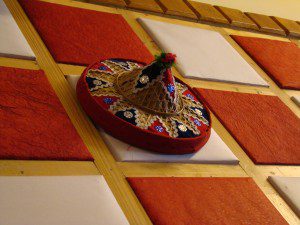
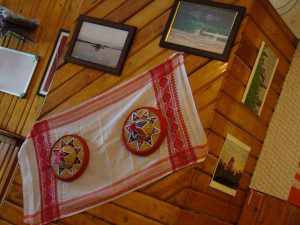
A flight of stairs will take you to what we thought was the restaurant, but though the furniture was there, there was no sign of life. So we climbed another flight of stairs and found a friendly face sitting at a counter in a bright restaurant. In the limited space, there are photographs, handicrafts and knickknacks that clearly bring out the Assam connection. The seating is neat and functional.
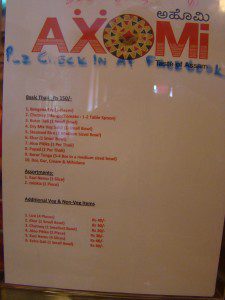
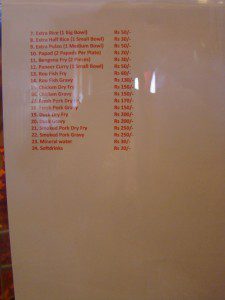 The menu is limited, (click for a larger view) so drop in here specifically for the cuisine. No multi cuisine stunts have been attempted. We asked for a couple of basic thalis, and also decided to try the fish fry and the pork fry. Later we also added the duck for good measure!
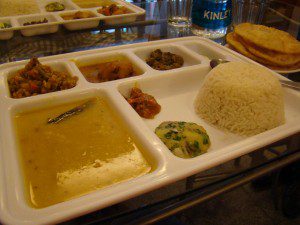 The thali has rice with a series of side dishes – an awesome chutney, brinjal both fried and a thick pasty version, dal, papad, a dry mixed veg dish, a mashed potato + chilly combination (pitika) that was superb. I didn’t really like the khar much. The pork was excellent though heavy, and we enjoyed the fish as well. But the duck was probably the best dish, with a refreshing (made from papaya juice, apparently) gravy. It went very well with the Lusi (luchi) we ordered.
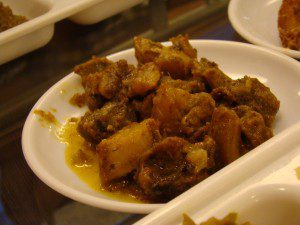
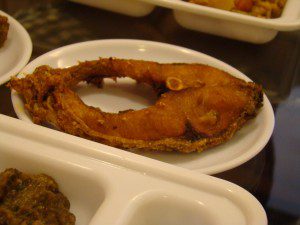
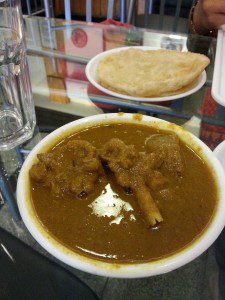
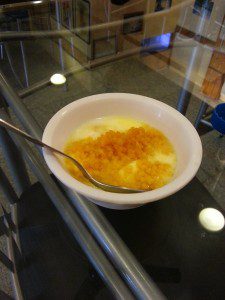 We barely had space for dessert, which was a mix of many flavours, though the curd dominated it more than we’d have liked. All of the above cost us exactly Rs.800. The service is pleasant and courteous, and quite prompt as well.
Axomi, 360, 1st Main Road, Koramangala, Ph : 09986731340

(image via)
Sometime back, I read this excellent post titled “Your Lifestyle Has Already Been Designed“. A colleague shared it with me because he felt I’d like it. And right he was, because it echoed my own thoughts on how our consumption these days have little to do with our needs. The author in fact, goes a step further to say that the typical 40 hour work week (actually it’s way more) manufactured by big business has reduced our free time to such an extent that whatever we do get is spent less in meaningful, healthy activities and more in drowning ourselves in wanton consumption. While that may or may not be true, I think we have a choice, but one that involves winning a battle within. When we lose the battle, we begin indulging ourselves covering it up with the ‘deserve it/earned it’ argument, and the culture of random consumption lives to fight another day. The author sums it up rather well with “We buy stuff to cheer ourselves up, to keep up with the Joneses, to fulfill our childhood vision of what our adulthood would be like, to broadcast our status to the world, and for a lot of other psychological reasons that have very little to do with how useful the product really is.”
In a larger sense, we tend to live a life that’s not really ours. I cannot help but remember the words of a near-immortal “Your time is limited, so don’t waste it living someone else’s life. Don’t be trapped by dogma – which is living with the results of other people’s thinking. Don’t let the noise of other’s opinions drown out your own inner voice. And most important, have the courage to follow your heart and intuition. They somehow already know what you truly want to become. Everything else is secondary.“
In essence, what we consider as motivation from our own self is actually not. I found an amazing/bizarre manifestation of this in the truly unique story of Mike Merrill, who divided himself into 100000 shares and ‘sold’ himself. Known as the IPO man, his investors would earn a profit out of activities he did outside of his job. In fact, his intent behind the entire activity was to raise funds for things he wanted to do, and felt he would make a profit from. What followed is a fascinating story that has resulted in the investors even getting to have a say in Mike’s personal relationships and sleep patterns!
I couldn’t help but think of how similar it was to an ordinary person’s life. It is an extreme case, but when we’re driven by wants and motivations that have little relation to needs, the only difference is that Mike is conscious of his lack of control, while we are smug in our belief that we’re in control. I most definitely am not saying we should be living like ascetics, but the balance does lie in consciously separating needs and wants. That, I believe, is the way to a fuller life. A different kind of more from a different set of mores. I wonder if it’s a coincidence that the term ‘Utopia’ was coined by a person named Sir Thomas More. 🙂
until next time, more or less over
P.S. The good news is that increasingly these days, I see people making conscious choices across the board – lifestyle, media, time, relationships. The more the merrier 🙂
Amish Tripathi
Part 2 of the Shiva Trilogy. Shiva continues his journey from Meluha into Swadeep, after managing to broker a peaceful arrangement between the Suryavanshis and Chandravanshis. He then shifts his focus to what he considers a common threat, and a fount of evil – the Nagas. His search for the Nagas takes him into the Chandravanshi kingdoms and brings him in touch with various populaces who have ties with the Nagas. As the book progresses, events force Shiva to reconsider his belief in the Vasudevs as well as his stance on the Nagas, and towards the end, he begins his journey into the land south of the Narmada – the abode of the Nagas.
The book sees the birth of Karthik, Shiva’s son, as well as the introduction of other popular Hindu mythology characters – Ganesh, Kali, Parashuram etc. The author, as with the first book, tries to find a logical explanation to the mythological portrayals, though he does take a lot of creative liberties. Book 2 also ends with revelations and a set of questions which most likely will be answered in The Oath of the Vayuputras.
I felt that the prose and the style had definitely improved from the first volume, though I still found the rampant use of modern day phrases and expressions by mythological characters a put off. Once again, the narrative is paced well, and there is no dearth of imagination. I’ll definitely be waiting for the third volume and the ‘master puppeteer’.