
• Ends & Beginnings

    A few weeks ago, I met the gentleman who was my first boss in Bangalore. We were meeting after a long time, and over a cup of coffee, he asked me for my visiting card. He looked at it for a while, and said, “I don’t know about you, but I feel very proud about this.” It was a humbling moment. He then smiled, and asked me if I remembered our interview conversation.

    Of course I did, because it was one of those occasions that changed my life’s trajectory. He reminded me that when asked why I wanted the job, I had answered “..because my future wife already has a job in Bangalore and I need to move here from Cochin to get married’. He had laughed. The year was 2003, and thus began my life in Bangalore.

    The conversation was a reason in itself for a bout of nostalgia, and as I made my way back home later in the evening, my mind was replaying the time I had spent in this city. But there was another reason too, and that’s what this post is about. (more…)
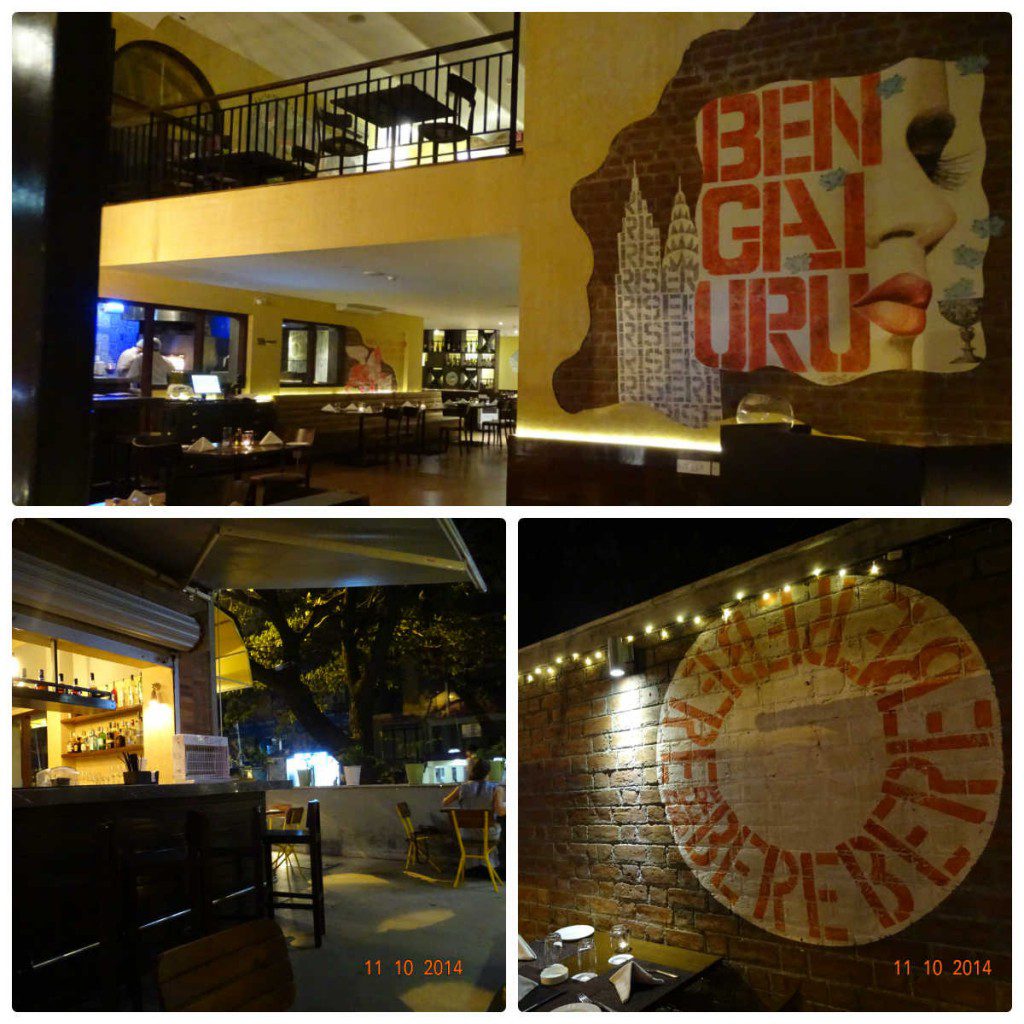
  • Serafina

    Serafina sounds like a fantastic super villain from the Marvel universe, but this is about a restaurant in Koramangala. (map) I think I could easily associate charming or pretty if I had one word to describe the place. The brick walls, decor, furniture, lighting and the fantastic music (classics, played at just the right sound for one to enjoy it and yet have a conversation without a megaphone) lend it a touch of classiness. They have seating on two floors inside, and an alfresco option that faces the 80 feet Road. On a pleasant Bangalore evening, we chose the latter.

    collage1

    (more…)

  • Remember that we’ll be forgotten

    To my pleasant surprise, an old school friend commented on my breadcrumbs and Black Swans post. I continue to be amazed by how much digital has allowed us to find and discuss shared interests. The post was around a couple of themes – whether the set of digital breadcrumbs we are leaving now (courtesy everyone being a publisher) will allow generations later to have a better sense of our history, and whether, therefore, our species will be more anti-fragile thanks to this data and the predictive analytics AI can build out of it.

    My friend shared an article that talked of Vint Cerf’s warning about us being a ‘forgotten generation’. (I had read the Guardian version earlier) Essentially, his fear is that the lack of guarantee in backward compatibility of software means that documents stored many not be accessible at all. Both led me to Digital Vellum and Project Olive, which aims to establish a robust ecosystem for long-term preservation of software, games, and other executable content. (more…)

  • Return of a King: The Battle for Afghanistan

    William Dalrymple 

    “Those who cannot remember the past are condemned to repeat it” This book brings that quote to life! More than the book itself, kudos to Dalrymple for choosing a subject that has so much of relevance in the contemporary era! In fact, I wish it were written a few years earlier. ‘Return of a King’ is the story of the British (East India Company) invasion of Khurasan (modern day Afghanistan) in 1839 in an effort to establish their man Shah Shuja ul-Mulk, (descendant of the Ahmad Shah Durrani, regarded to be the founder of the modern state of Afghanistan) on the Kabul throne in place of the incumbent Dost Mohammed. That was the easy part, but as one Afghan commented then, the British had gotten in, but how would they maintain this status quo, or even get out? In a couple of years, the Afghans, in an ever changing mixture of coalitions, rebelled against the British and massacred them on their way back to Hindustan. The British then created an Army of Retribution to avenge this, and ended up bringing things back to square one.

    What set off this chain of events is something I have read about in some Sherlock Holmes adventures and seen alluded to in other works like ‘Kim’. The Great Game, an international milieu of intrigue that pitched the mighty powers of the time – Russia and Britain – against one another. Afghanistan, as per British intelligence, was where Russia was poised to strike next, to control Central Asia. This was supposed to be achieved with Dost Mohammed’s help. The Russian plans were far less threatening than reported by the British and ended up creating a war that need not have been. There is some amazing parallel here with what the Russians (80s) and the Americans (now) tried to do in Afghanistan! (more…)

  • Algorithms of wealth

    Some strange quirk in the cosmic order of things led to Landmark shipping me Piketty’s ‘Capital in the Twenty-First century’ instead of Rana Dasgupta’s Capital! I kept the book (yet to read it though) because economic disparity has been an interest area for a while now, I had touched upon it in the context of AI and job loss in Artificial Humanity. Reading The Black Swan has only accelerated this interest.

    Taleb divides the world  into Mediocristan and Extremistan to point out the extent of predictability in the context. Mediocristan can safely use Gaussian distribution, (bell curve)  but in Extemistan, that’s dangerous. From what I understand, given that there’s no real limit upper limit of scale, individual wealth will increasingly behave in a more Extremistan way. To quote his own example, “You randomly sample two persons from the US population. You are told that they earn jointly a million dollars per annum. What is the most likely breakdown of their income? In Mediocristan, the most likely combination is half a million each. In Extremistan, it would be $50,000 and $950,000.” He states that almost all social matters are from Extremistan. (more…)