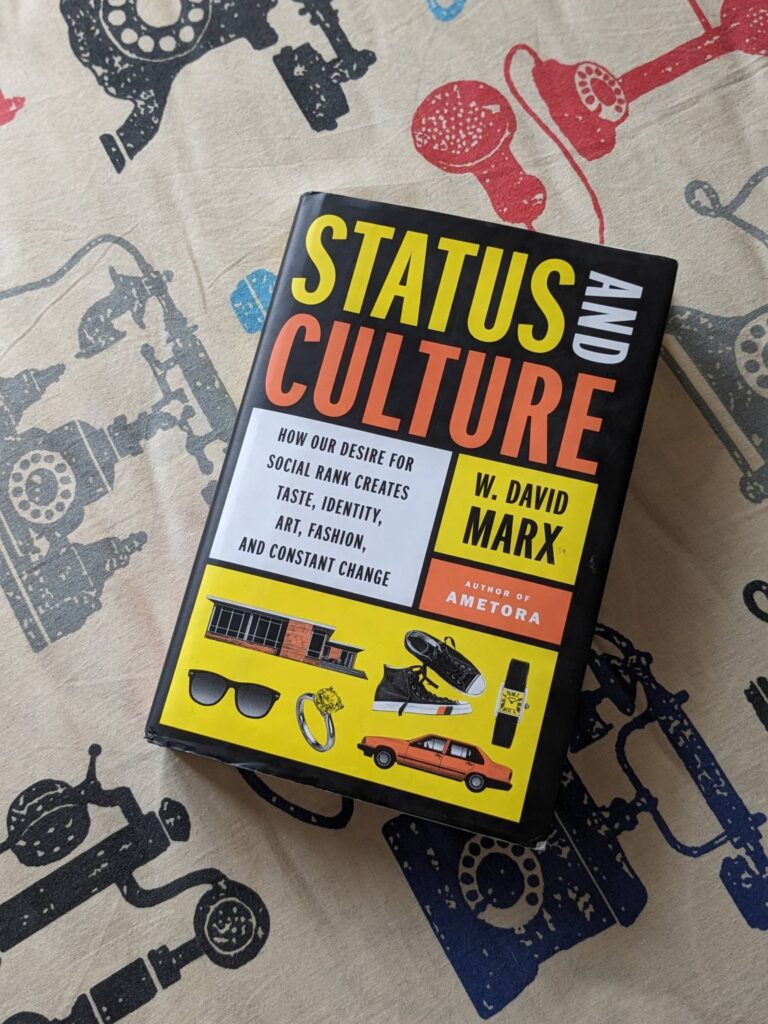
W. David Marx
I love it when a book matches the expectations set by the cover. In this case, a very intriguing “how our desire for social rank creates taste, identity, art, fashion, and constant change”. As GenX , and a marketer, I have often tried to make sense of the changing nature of culture courtesy the effects of the internet. This book is extremely insightful as it navigates what culture is, how it gets fashioned, and then, how it has changed in the last couple of decades.
The premise is that beyond functionality and pleasures, most things we do is for status-seeking. And this sparks creativity, which in turn, creates culture. David Marx uses a bunch of sciences, including anthropology, neuroscience, economics, philosophy and meshes them with art history, and media studies to answer why things become popular, why that changes over time, and how it shapes our identity and our behaviour.
The book is divided into four parts, beginning with understanding status, conventions, signalling, and how this relates to taste, authenticity and identity. It then delves into classes and sensibilities, subcultures and countercultures, how status-seeking feeds creativity, and fuels culture, and its changes. Further, it uses fashion cycles as a means to understand how cultural changes happen, and the role of mass media in it. This section also studies the part that history plays in shaping culture, and how frequent blasts of ‘retro’ are inevitable. All of this puts us in a great place to understand what the internet age has done to culture, and some direction on what is ahead.
I found the book engaging and accessible, and very useful in understanding my own behaviour and ‘tastes’, as well as that of people I know, and society at large. Highly recommended.
Notes
1. The Beatles mop top haircut’s origin story is Stu Sutcliffe’s (the original bass guitarist of the Beatles) German girlfriend trying to imitate the French mode, which was becoming popular among the local art boys. After their reluctant conversion, it became their signature, and a global trend!
2. Status denotes a specific position in the social hierarchy. Every status comes with specific rights and duties, the most desirable benefits coming to those at the top (more attention and rewards, deference, access to scarce resources, dominance – make others do things against their wishes). Status is bestowed by others, it is social. Status is contextual – local, global. And it is zero-sum, when one gains, someone else has to lose.
3. Achievements get embodied in particular forms of capital – political, educational, economic, social. This capital determines our memberships in different groups.
4. Different status levels have different conventions. At first conventions of social interactions regulate behaviour at a conscious level, then we internalise them and they become habits. And then they set our perceptual framework for observing the world, and our expectations. Our sense of meaning and order. Lifestyle is thus a requirement of social rank and an expression of it.
5. Just as we internalise conventions, status value acts on our brains at a subconscious level. Conventions with high status value appear to us as beautiful, and vice versa. But we attribute this liking to other things like practicality, cost, sentimental value or just personal preferences. (vacations)
6. The moral duty of self actualisation is a status duty – individuals at the top of the hierarchy must pursue unique behaviours and distinctive choices.
7. Status symbols are a signal that allow a quick reading of and by others. But they offer alibis (quality, aesthetic features etc) so it is not just a symbol.
8. There are five signalling costs – money, time (PhD), exclusive access, cultural capital (knowledge of conventions by spending time among high status), norm breaking
9. Taste, as reflected by multiple signals, is how status appraisals happen. To have good taste means making better choices than others.
10. Lifestyle choices must reveal congruence – an internal consistency with the target sensibility. Deep knowledge opens the door to better taste, and congruence reveals our commitment to high status sensibility. The highest status people make distinctive choices through bounded originality.
11. In signalling, we build personas – observable packages of signals, taste, sensibility, immutable characters and cues absorbed from our upbringing and background. Others use this persona to determine our identity. And we have a ‘self’, known only to us.
12. Our ‘cultural DNA’ = hidden elements, immutable characters and cues, conventions for normal status, emulations (of higher status) and individual distinctions
13. iPod won as a status symbol, though Microsoft Zune had better features
14. Old Money taste focuses on patina, visual proof of age in their possessions (vintage) They uses this as an advantage over New Money.
15. The professional class (70s onward) built a balance of economic, social and cultural capital. Impressing old money and embarrassing new money’s ‘loud’ tastes
16. New Money’s use of economic capital in signalling spurs the creation of expensive luxury goods – sports cars, summer homes, designer clothes etc. Old Money’s countersignalling and focus on patina and cultural capital get companies to make classic, modest goods with functional appeal. The professional class’s signalling through information creates a market for middlebrow/consumer media guides, functional goods, artisanal goods, and copies of Old Money lifestyles. Underprivileged individuals’ desire to be part of culture outdo peers pushes companies to offer kitsch and flashy entry-level consumer goods.
17. Immanuel Kant a sorted 3 authoritative criteria for artistic genius – the creation of fiercely original works, which over time become imitated as exemplars, and are created through mysterious and seemingly inimitable methods.
18. Individuals make adoption decisions within the framework of human interaction. They consider how when and from whom they receive information, how they view uncertainty about switching and how they will be judged in the community for making the switch This creates five distinct groups, innovators, early adopters, early majority, let majority and laggards. The diffusion process – high status adoption of new convention for distinction, early adopters’ embrace of that convention as emulation of their status superiors, early majority reinvention and simplification to follow an emerging social norm, late majority imitation to avoid losing normal status , laggards’ passive adoption without intention
19. Elite flock to three particular categories of items that fulfil their needs. Rarities, novelties and technology innovations.
20. Four related phenomena, in the internet age – the explosion of content, the clash of maximalist and minimalist sensibilities accompanying the rising global wealth, the rejection of taste as a legitimate means of distinction, the over evaluation of the past in Gen X’s retromania and the abandoning of the past in Gen Z’s Neomania.
21. “You can’t just walk around and be visible on the internet for anyone to see you. You have to act and the main purpose of this communication is to make yourself look good.” Social media also enables us to quantify our status like never before in like retreats comments and followers.
22. Before the internet, elites could protect their status symbols behind information barriers and exclusive access to products. The internet broke that.
23. Another elite group has stepped in to countersignal gauche extravagance, the professional class tech billionaires who are forming their own taste culture. They created wealth without shedding their professional class habitus. Skeptic of glamour and respect for thoughtful thrift, they make their choices based on functional rationales rather than the open pursuit of status symbols.
24. Omnivorism (consume and like everything) has had major effects on culture over the last few decades. In the past taste worked as a decision classifier by drawing clear lines between social groups. Omnivorism drains this power by declaring nearly everything suitable for consumption.
25. Collectively reaching the stage of meta knowledge we come to understand the arbitrariness of our own preferences taste and culture. The proclaimed superiority of preferred styles over others is accordingly and arrogant and bigoted act.
26. Omnivore tastes then can be used to dismantle the status structures that prevent the equitable distribution of respect. In a world of celebrity wealth-gospel, and millennial financial anxiety, young entertainers face little backlash for aggressively courting likes, subscribers and advertisers. Follower counts and gross earning appear to be the only relevant sign of cultural import.
27. Youth find ‘self expression by enlisting in a global army (e.g. BTS)
28. Hysteresis – the lingering values of a previous age continuing to guide our judgments