Category: Society & Culture

  • Purpose Purporting

    Purpose. I remember bringing this up earlier in ‘Coincide‘ and mentioning that different life stages manage to give us short term purposes which leave little time for this line of questioning – a larger purpose of life itself.  Like I told a friend recently, as though we took a life API and churned out all these fancy apps that now distract us from the purpose. What happens when you take those out of life? And when I say ‘those’, I also mean the alternate rat race that we convince ourselves is not one.

    Turn out the light
    And what are you left with?
    Open up my hands
    And find out they’re empty.
    Press my face to the ground
    I’ve gotta find a reason.
    Just scratching around
    For something to believe in:
    Something to believe in.

    I’ve wondered, even if one loves the work one does, does that become a purpose in itself? Is it really possible to be a karmayogi. Is that what makes a Tendulkar or a Yesudas? A larger sense of purpose? Doing the thing that they were meant to do? But even if that were so, what motivates them,  for a karmayogi should not feel any attachment towards the fruit of his actions. Indifference and detachment. There’s obviously a difference, yet to realise it fully.

    I have also wondered, actually worried, if its the lack of a larger purpose that drives one to (try to) leave a legacy? Creating something that will perhaps outlive us, in whatever scale ? Does the potential future of a creation give a sense of purpose to the present?

    On twitter, @Bhuto asked me whether anyone had asked me if my handle meant “hand in the crypt” (manus being Latin for hand). No one had, the handle actually came into being because I couldn’t get the original spelling as an ICQ handle. 🙂  I answered that I’d always thought of a grimmer version – of this being an online crypt. I think I’ve mentioned this here earlier. So years down the line if someone discovers this, the lifestream will perhaps convey a life.

    You talk too much.
    Maybe that’s your way
    Of breaking up the silence
    That fills you up.
    But it doesn’t sound the same
    When no one’s really listening

    If you think that’s weird, there’s actually a site that has the same idea – 1000 Memories. Or how about a wireless headstone that will share its owner’s story with future generations? 🙂 Or there’s also the Howard Stark version (when he speaks to his son) ” What is, and always will be, my greatest creation, is you, Tony.” Yep, that’s quite a popular way too. 😀

    For those who follow Malayalam movies, as is his wont these days, Mohanlal has already given the answers to ‘purpose’, in Aaram Thampuran, though the question was put differently. 🙂

    But it is somehow difficult to even consider that life, in whatever way it is lived, is its own purpose.

    You’re spending all your time
    Collecting and discovering
    It’s not enough.

    until next time, multipurpose lives?

    (Lyrics: Something to believe in, Aqualung)
  • Coincide

    A friend of mine, Soubhagya, is an avid photographer, who, despite my best efforts, still shies away from running his own photoblog. So when he asked me to take part in a writing experiment, I thought it would be a relatively painless way of introducing him to blogging, and hopefully, he’ll like it enough to do it on his own. The idea’s pretty simple – he’s given me a couple of pictures he has shot recently, and wants me to write a few words on each. Here goes

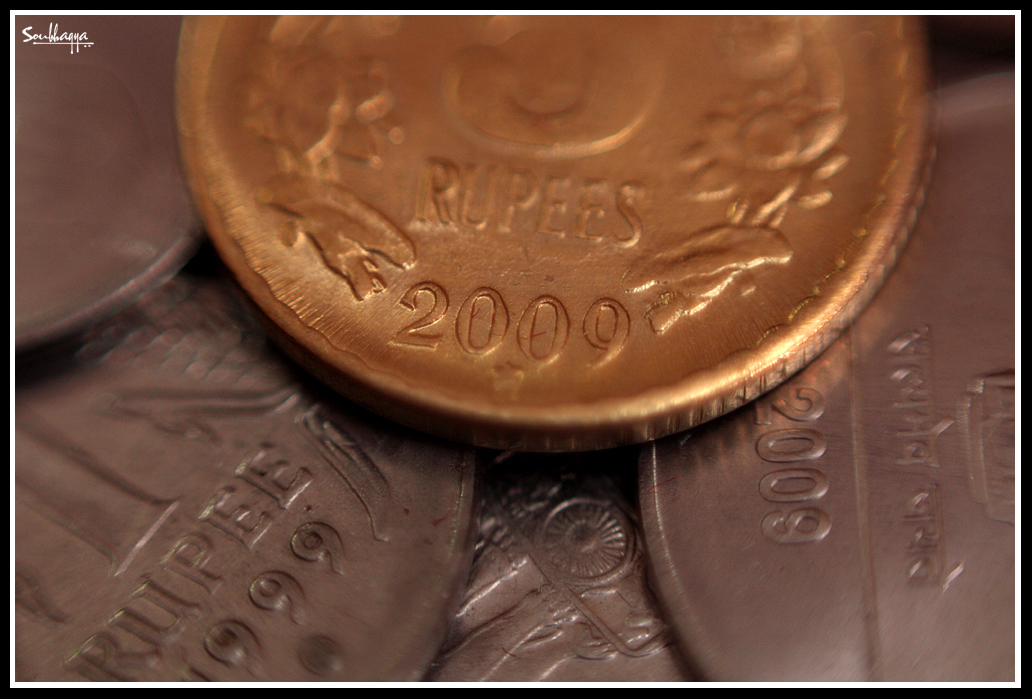
    the face of money‘The face of money’ is what Soubhagya calls it.

    What’s my value? To a politician, I’m a vote that will help him in his quest for power. To my employer, I am a worker who gets paid for the job I do. To the places I eat out in, to the shops I buy things from, I am a source of revenue. To the people who care for me as an individual, these are perhaps not the parameters of calculating their value for me. It’s a different currency. So the question is complete only if I ask “What’s my value to …. ?”  Now, what if I were to pose the question to myself? Do I measure myself by my financial status, or the lack of it? Is it the ‘Likes’ on Facebook or the followers on Twitter? Or is it by the number of lives I have touched, in one way or another? Is it a combination? Is it what I deem as my potential? How much is that dependent on externalities? And doesn’t that change with time? Which brings me to..

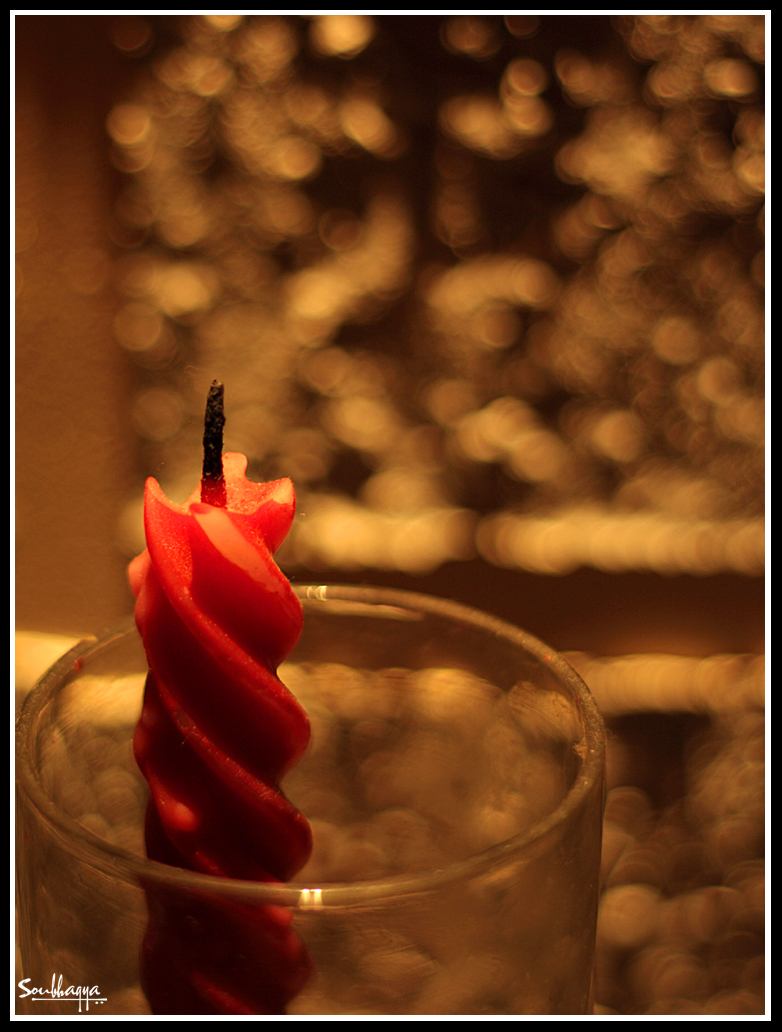
    Burnt out ‘Burnt Out’

    Purpose. I have always been interested in the purpose of our lives. All life forms in general, and of course, specifically us, humans. Generally, at different stages in life, we get stuck with different routines, sometimes by choice, sometimes not – school, college, work and so on. There is a short term purpose to it all, so we rarely look for something beyond. By my definition, ‘purpose’ gives a meaning to what we do, something beyond the money that it brings in, something that really makes us happy just by doing it, as though we are destined to do it. One could rationalise and say that the money then becomes a tool to ‘buy’ the things that give happiness, but that’s arguable.. We prioritise according to our baggage, some are okay with trading an amazing weekend and regular holidays for mind numbing work, some wouldn’t be able to manage it at all, and there are tons of options in between. The candle reminds me of the passion that we bring into what we do, and I believe that depends on our approach to ‘purpose’. Burn brightly or be a shallow flame? In both cases, there is a finite lifetime in which it has to be done. For me, even the task of finding a purpose is a tough one. Whichever way one sees it, there is always the possibility of a burnout. Such is life. So burn you must, and light up the place as much as you can. 🙂

    until next time, wax eloquent 😉

    PS: Now split ‘coin-cide’ and you might figure out a new possibility

  • Facet

    Facebook’s policy changes a while back meant that suddenly,  the average user (as opposed to the technophile and conspiracy theorist) is raising an eyebrow, or both, depending on knowledge levels, at what it means to his privacy. This is not an indication of whether someone is below or above average, let’s not go there. Meanwhile, K and I have been discussing David Bond (Erasing David), which has to do with online privacy (though not in a Facebook context)  – how one man challenges experts from a security firm to track him down using information they can gain about him from the public domain, while he tries to outrun them.

    K noted that in the olden days, this notion of privacy didn’t exist, as everything was known to everybody. I agreed that in the new age, our connections are more, we include a lot more people in our lives, even indirectly, by just sharing our data online. Our work, lifestyle and advances in technology mean that we communicate more, meet more people, and yes, ‘friend’ them.

    It does good too, no taking away from that. Ironically, K and I know each other from work, from quite a few years back. We never interacted much then, and I was more pally with others in her team. I still remember, a couple of years back, when I met K and another colleague of hers in a shop, I chatted away with him, and rewarded K with a lousy smile. 😀  But these days, we have amazing conversations online, and I’m hardly in touch with her colleagues. Thank you Facebook 🙂

    As perhaps the first generation of Facebook users, we are in an interesting place (and time). I read “Chasing the Monk’s shadow” recently, a book in which the author retraces Xuanzang’s journey (we knew him as Hieun Tsang in our history text books) and it made me appreciate the value of the written word – especially when it resurfaces in a  different era.   It was in this context that I considered what really appears in our profiles on Facebook.

    (Generalising) We friend erm friends, but we also friend parents, siblings, relatives, acquaintances, and even random animals. We display our likes, dislikes, interests, information, and through our conversations, we add layers to this. But its amazing how, sometimes, when I ‘like’ something that someone has posted, and glance at the others who have liked it, I realise that I don’t know them. We’re connected by one common friend.

    The common friend, who I might know from college, and the other person might know from work. How much of mining would it require to unearth the nuances in the relationships between ‘friends’? Would it be possible to mine the fact that while I might make a smart alec comment on a person’s status, I might never have met him/her in real life? Would it be possible to mine the different persons we are, to different people, in different contexts. The worries, the fears, the quirks, whims and yes, likes, that we never express, the things that probably make us human – they exist in our minds. We only share a part of ourselves online. We are still strangers, sometimes even to ourselves.

    So yes, while all sorts of data from browsing history to buying habits are out there, maybe, in this hugely connected world, without the ‘real metadata’, in a way we are still disconnected from most of our ‘friends’… and the information gatherers? Since its slightly difficult to be like Schmidt (Google CEO), who infamously said “If you have something that you don’t want anyone to know, maybe you shouldn’t be doing it in the first place”,  I believe that we should be responsible about what we share (even if that’s in the form of a ‘Like’) online.

    So all I’m saying is, you can press that little ‘Like’ button below, and nothing catastrophic is going to happen… yet 🙂

    until next time, face off

  • Higher Stakes

    The ‘cow slaughter ban’ bill that got passed in the Karnataka assembly sometime back, got a lot of people’s erm, goat, especially Mallus, for many of whom, paradoxically, its a ‘holy cow’ issue. But the phenomenal prospects of wordplay is not what got me thinking. Its the idea of something getting banned and the protests that follow.

    Take smoking, for example. I’m sure all the smokers would have been fuming at the bans that came out on various aspects of the product and its usage, but a lot of us feel that its a good thing for different reasons. Me, mostly because those lousy forwards with the much abused ‘kick the butt’ subject line, and horrible pictures, have stopped. I find that the majority of people I know support this ban, citing health reasons etc. But the beef ban, which (at least in a way) prevents killing of a life form, finds lesser supporters. Personally, I love beef, but as time passes, my feelings of guilt have also been strengthening, and its the case of a subjective like over ruling a ‘better for the cosmos’ thought. A sad rendition of  the “way to a man’s heart…. ” too. But I do wonder about a future when the majority would say that the beef ban is a good thing. A higher state of awareness?

    A few days back, I read Seth Godin’s post titled “Fear of Philanthropy“, where though his context is mostly to do with ’cause marketing’, he writes about knowing how much (of giving) is enough.  He paraphrases a question (attributed to Peter Singer) “Would you save a drowning girl even if it means ruining a pair of Italian shoes? If the answer is yes, why not use that money to save 20 kids starving to death at the other end of town/world?” Isn’t it the same? (I need to read up more on Singer, Practical Ethics, and the idea of “the greatest good of the greatest number”).  Godin points to proximity, attention and intent as factors that weigh in in our decision to ‘give’.

    Proximity and attention. I remember wondering in a post sometime back whether all this connectivity, instant communication and micro popularity would make us less compassionate and more inconsiderate. But then again, does this connectivity increase our proximity to issues and would it be negated by the lack of attention? Heh. Will it make us more conscious or will it cause to go even deeper into our own comfortable bubble?

    Intent. I saw Will Smith’s ‘Seven Pounds’ when it played on TV recently. The idea of a man donating different organs/parts of his body, after ensuring that the receiver is indeed worthy – ‘a good man/woman’ (“You’re a good man even when no one’s looking”). Commenting on the intent would spoil the viewing for you, but the point here is the time and patience taken to identify and verify the ‘goodness’. I’d have liked to do that too, but I’m afraid of what all it would entail. I convince myself that I don’t have the time. However, I can’t help but wonder optimistically whether one day, the collective consciousness would help take my awareness so high that my intent is made all the more stronger and then, everything else will cease to be a factor. But then I look in the mirror and say that I’m better off looking within myself, for its difficult to refute an oft asked question “I didn’t make it this way, why should I contribute to making it a better place, when I can buy my happiness in other ways?” As Godin says, its effective enough, sadly so.

    until next time, streamlined thoughts 🙂

    PS. meanwhile, if you’ve been reading this blog for a while, and have liked it, do officially ‘like’ it here 🙂

  • Gulp fiction

    I’m quite a huge fan of Heroes and was quite sad to see Season 4 end, more so than normal season finales, because after quite a while, there was a villain that I could really empathise with.  Robert Knepper as Samuel Sullivan just rocked. Though the villainy is manifested in his selfish desire to become more powerful, there was something in his arguments that made me forget it at regular intervals. To give you some context, the entire series revolves around people with special abilities (think X-Men). This season, mostly through Knepper’s character- Samuel, emphasised a lot on how society treats such people. Samuel’s desperation to belong (and later make normal people respect his kind) is expressed very well in his conversation with another character with abilities, Claire.

    “Freedom is what you do with what’s been done to you”, says Claire, quoting Sartre.

    “I always thought freedom was just another word for nothing left to lose”, counters Samuel, without acknowledging “Me and Bobby McGee” 🙂

    The urge to belong and the pain of being different. Mo wrote a post recently on being chided for missing a reference in a conversation. A reference to Pulp Fiction.  At a broader level its also a small commentary about our consumption of popular culture, and second had experiences. Its a sentiment I share – that somehow the consumption of popular and even off beat culture and getting the respective references is the benchmark for judging a person. So, to get bombarded with “haven’t you seen/read/eaten.. don’t you know..” is now a common thing. Like I told her, thanks to everyone becoming media, C+ is actually a great grade, considering the noise.

    In some ways, I felt it also throws up our need for validation. The consumption and the opinions we have on that decide the kind of role we land in our immediate crowd, and now, the larger world. From “Govinda movies??!!” and “MLTR is why I go away from you” to “Eww, you’re still on Orkut?! .. Omigod, how can you play Farmville??”,  this judgment happens all the time  🙂

    At times, the validation is for others and their expectations, and at times for the self. In many ways, I think its like some gladiator fight where a person is just fighting himself, and the expectations he has set. The audience could be the self, or others. If its the latter, its all okay so long as the person conforms to a broadly accepted set of norms within the crowd.Even if one wants to get out of it, its difficult. Its difficult to sever the connection between a validation that is given to one without asking and the ties that one would want with other humans. 🙂

    In Heroes, Claire’s character’s ability is instant regeneration. Break a bone, receive a bullet wound, and she heals instantly. In the last scene of season 4, she throws herself from the top of a Ferris wheel, lands on the ground all broken up, and immediately heals, all in front of a waiting media crew. An open challenge to society to accept her the way she is. And another character says “Its a brave new world”. To me, it was a statement of hope, one that will get out of a TV show that’s part of popular culture, and enter the real world.

    But meanwhile, for now, until the pill happens, the moment one goes beyond what can be immediately understood, and what provides a point of reference, one has to be ready for “And I will strike upon thee… “:D

    until next time, reverence to reference 🙂