
Category: Society & Culture

  • Relative..reality

    For some strange reason, I’ve read Pankaj Mishra’s books in reverse order..well, almost. I read The Romantics first, a long time before, and it remains a book I’m very attached to. Its a good book, but I’ve never figured out the exact reason for this strange bond, in spite of making a rare exception and reading it a second time. Maybe it was the time I first read it (a stage of life) or its characters or its title, someday I hope to know, it will tell me a bit more about myself, perhaps. But meanwhile, from The Romantics, I was lured straight to ‘Temptations of the West‘. A few months later, I read ‘An End to Suffering‘, which served as a kind of introduction to Buddhism for me, as Mishra mapped it on to his own spiritual evolution. I finally completed his first book, ‘Butter Chicken in Ludhiana: Travels in small town India’ more recently. Though its title would indicate so, calling it a travelogue would be a gross injustice, as it also manages to recreate the India of the 90’s. So, yes, it is a travelogue, but like many of its ilk, it works in space and time. No, this is not really a review. 🙂

    I’m quite glad that I read his books in the order I did. If I read it earlier, I might have been irritated by the cynicism in the book. But having read his later books, I felt almost as though I was with him, as his thoughts and personality evolved. The book gives you loads of nostalgia triggers – from Baba Sehgal’s ‘Main bhi Madonna’ (i still remember the Magnasound casette cover :D) to mentions of Nonie and Mamta Kulkarni, it draws upon tiny incidents of those forgotten days.

    Many of you may not be able to associate at all with those three people mentioned above, for me, they bring back an era, their importance is relative. I even wondered whether, in future, we will have nostalgia townships, like we have the amusement parks now. The 70s, 80s, 90s re-created in terms of people, music, movies, fashion and all the elements of pop culture that can be attributed to an era. So, when you have those nostalgia pangs, you can call a few friends and take a vacation to bring back a period in your life. 🙂

    A common theme struck me as I ‘moved’ through the book’s pages. Mishra mentions Murshidabad looking towards Calcutta in hope, for job prospects and a better life in general. In many people’s perception, Kolkata is perhaps the worst of the metros on those terms. He writes about the ‘immense cultural vacuum of North india’, and ‘looking towards Bengal for instruction’, and the decline of Allahabad and Benaras. But I realised that for me, those two places were perhaps teeming with culture and history. Again, in Murshidabad, he talks to a person who considers the Babri Masjid as just another mosque, while a nation still burns at regular intervals – the repercussions of an act long ago. The common theme is the relative nature of these things – they means different things to different people, all relative versions of the same thing equally real, when considered from each point of view.

    I remember thinking about progress during my Andaman visit. I saw it in its current state, and can visualise it in the years to come, as tourism becomes a larger factor in the scheme of things, and the changes it will invariably bring in, into a way of life. To quote from the book we’ve been discussing

    Civilisation, however, is on the move, and as E.M.Cioran remarks, nothing more characterises the civilised man than the zeal to impose his discontents on those so far exempt from them.

    When the tourist money flows into the system, it will help the locals afford many things that they perhaps didn’t have access to. But even those who do not wish to change might be sucked into this new way of life because it would be a question of survival. Were they better off and happier before all this happens to them? I don’t know, because after all, even happiness is so relative now.

    Objectivity –  based on observable phenomena and uninfluenced by emotions or personal prejudices, and not the result of any judgments made by a conscious entity. But everything is relative. Things not seen from one’s own perspective don’t seem to matter, and objectivity’s definition would suggest “no one’s perspective”. Maybe that’s why we don’t care for it much anymore?

    until next time, time, space and relativism
  • The Immortal’s reality

    ‘1984’ is a subject that has appeared in many conversations, no, not Indira Gandhi’s assassination, George Orwell’s book. And every time it did, I have smiled politely and pleaded ignorance except for ‘Big Brother’, nothing to do with Shilpa Shetty’s adventures or Sunny Deol’s movie, in spite of my Bollywood fixation. I read the book a while back, and was absolutely fascinated by the dystopian world Orwell has created.

    Though I found many facets of the book interesting, there were two that were more equal than the others. 🙂 One was the idea of a few people controlling the minds and actions through unrelenting propaganda (among other things) and the sentence ‘He who controls the past controls the future, he controls the present controls the past’. History being written by winners, and it being what’s recorded (either in books or other data storage devices), or people’s minds. The second interesting thing is to do with the latter, of how reality is such a deceptive thing, and is of our own making. If there are two of us, and both of us agree that one is flying, then that is reality for us. Yes, you might laugh at the simplistic approach, but in the context of the book, absolutely possible.

    The human mind, its storage capabilities, and its evolution is a subject that keeps popping up regularly in this blog. Recently, the concept of singularity has interested me a lot, and I’ve been reading up material available on the net. While I’ve been interested in science fiction for quite a long time (from watching Star Trek and Sigma on DD, okay well, that’s a start to Doctor Who and the Foundation series in school and college, with minor setbacks like not being able to like Clarke, and recently, not able to enjoy Doctor Who on the BBC) and I saw singularity as a natural progression of that basic interest. Except, as I read more, I realise the lines between fiction and reality are beginning to get blurred.

    I had an interesting conversation recently with a friend S which was a sort of mash up of both these subjects. We were discussing the effects of these advances on society. I brought up the argument from 1984 that whatever happened the three tier classification of society (high, middle and low classes) would be retained in some form or the other. S was of the opinion that the have- have not divide would widen, he even brought up the concept of human farms, harvested for body parts. (a human controlled version of the Matrix). The 1984 premise of thought control would be perfect for that.

    And then, after teleportation, time travel, whether teleportation would be significant if we are able to replicate all sensations before that (as of now, we can see and hear across distances, smell, taste, touch remain) and similar interesting stuff came the subject of immortality. I said , one of the things that sadden me when I’m reading science fiction is that I’ll not be around to witness science fiction becoming reality. But I also  wondered whether, even if the body were capable of lasting for an infinite amount of time, would the mind be ready for it. All of our life, we base on finite time – things to be done, objectives to be achieved, what if we had all the time in the world, how would we adjust? S pointed out that these things happen gradually, and by the time we become immortal, we would have already grown used to really long life spans. Like many things now, we would take it for granted, and would not appreciate the significance. We were only having coffee but discussed how there might still be loss of (memory of) experiences so far, and how there would perhaps be preloaded SIM cards one could install, and how the immortal’s “will” would have instructions of the “I don’t want a Windows OS for my body, Chrome is where my heart is” variety. Ok, cheesy, but can you imagine the possibilities?

    My biggest concern was the revenue model. If i lived forever, how would I afford it? What would be the economics of such an existence? Writer this century, sportsman the next, will natural ability be of any value or significance? And the final question, will we able to control time enough to have alternate realities? S says never, but i get back to the 1984 premise of reality, of controlling sources of information to ensure that the past is consistent with the present, and I wonder what humanity will end up doing.

    until next time, morality and mortality…

  • The clique friendly web

    In spite of the last post, I’m a bit ambivalent about Vir Sanghvi’s column.

    On one hand, I am in complete agreement with the rebuttals that I have read – Lekhni, Amit, Rohit. Rational and well articulated.

    And yet, over the years, that’s almost 7 of them, I can confidently say that blogger cliques have always been around. They may not have been formed with that intention, but over a time frame, many have developed that way, and this is a phenomenon I see on twitter too, where ‘followers’ tends to be taken literally. Will I name any? No, simply because they are cliques, and these days, cliques to mobs is a single click conversion. Heh.

    Simplistically put, many news channels and newspapers started out as a means of expression. Those who produced good content realised that many were paying attention to what they had to say. They looked around and noticed that there were others of their kind too. Mutual acknowledgment was a bit difficult because of business considerations, but they still stuck together, broadly, in terms of stances towards issues. The adoption of the medium rose, bringing new audiences. Somewhere, the quality of content became iffy. Sometimes because it had become a business, and sometimes because the content creators lost objectivity and started dictating norms, because they believed their audience was THE only audience that mattered. Of course they had measurement tools. Heh. (Just a small detour to say that even media planners trash the TAM and IRS/NRS methodology, yes, go on, take a poll)

    And then the web happened, and became a force to be reckoned with. It brought with it, blogs, which took less than 5 minutes to create. Some of the creators spent exactly that much of time. But others stuck on. Time and effort brought them recognition, and even some fame. They looked around, saw others of their kind. There were hardly any business consideration, linking to each other became the norm. The audience was being built all this while, and unacknowledged, a herd mentality too. Personal branding crept in. In many cases, the quality of content might have dropped with time – rehashed content using previously successful templates, link-baits, these are just online manifestations of things we see in newspapers and television. But though the posts were not as funny as they used to be or not well thought out, the audience stuck on, it was after all, a cool community to be in. There’s nothing wrong with it, its human nature to seek out kindred souls. The unfortunate part is the increasing intolerance for contra-views among many bloggers. You can see enough comment wars if you look around. At some point, perspectives became dogmas.

    And then came twitter, and microbloggers. It became all the more easier – from the simple RT to #followfriday and lists, there are multiple tools available, to build audiences, and cliques. And as I’ve written before, we on Twitter are famous for mobs. 🙂

    So,  my point is Mr. Sanghvi, relax. We’ve seen it all before, its only the medium that has changed. The people remain. This too shall give way to something else. If all goes according to the way it has before, in a few years, you can chuckle over post like yours by some blogger, who thinks someone in what is then the new media has been judgmental to a senior blogger. Heh.

    Meanwhile, the good part is, the web makes content production and distribution very easy, so you can ignore people if you personally think they’ve ‘lost it’. You will always find a contra-voice, it might be brow beaten sometimes, but it exists.

    until next time, sanguine 😉

  • Time Off

    In an earlier post – “Brood Mode“, I’d written about expectations, and how sometimes, they cannot be met. In the context of that post, Austere had commented thus “Is it the instant-ness demanded of the response that puts one’s brain to a side?” I messaged her on Twitter, that ‘the time construct’ was something I’d planned to write on next.

    Our response time has been shrinking on a continuous basis, twitter, FB etc are a manifestation of that – real time, but the changes have been happening much before that, probably with every advancement we made, not just in communication, but even things like transportation. So, the thought is, if we had more time on our hands, would we be behaving differently with people?

    When I was chatting with Meeta recently, we started discussing this, in the context of relationships with people. It started with me saying that the traffic during the daily commute to work, made me forget all the rules I make for myself, because with all the lane cutting and parking woes, its easily a scenario in which you’re either aggressive or you end up on the road, literally. So I wondered if it would be different if there were no time constraints.

    Despite only a superficial similarity, I was reminded of another construct – money. What started out as a tool of convenience has enslaved many and managed to dictate their actions. Much like the things we create to crunch time. The similarity ended there. Time is not money. Quite obviously, time exists with or without us, though the latter can force one to ask “Who does it exist for then? So let me put it this way, it is a construct that’s still not fully understood, whereas we made the money construct. But for the fun of it, imagine what you would’ve done if your life wasn’t dictated by time. What if you had all the time in the world. Would you be a different person? Would you behave differently with people?

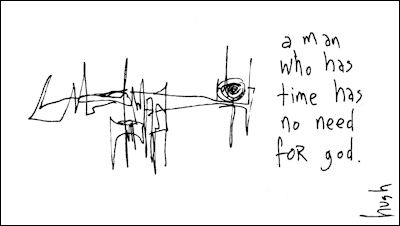
    As it regularly happens these days with me- by sheer coincidence, the day after I had this discussion with Meeta, I came across this work from Hugh MacLeod, which puts it so well

    time

    until next time, timed out for a fortnight 🙂

  • Blocking Crowds

    Even if you’re not really a 140 type character, you’d have heard about the CBI – Chetan Bhagat Incident, that is. But if you haven’t, not to worry much, we have a link, starring our very own celebrity blogger Nikhil Narayanan, who created the hashtag that led to the deluge. Considering Nikhil’s proximity to another author (turned politician) we’re also probing into other possible links with the external affairs ministry. But that’s for later. :p

    In essence, what started as a debate on piracy – books, not Somalian warships and blockades- led to Chetan Bhagat blocking a couple of twitterers, and the phase that launched at least a few hundred tweets, each a warship using variations of the word ‘block’. Samples can be found here, and my contributions here. My friend Vimoh (as usual) wrote a very objective post on the entire episode, capturing life on Twitter and the presence of celebrities on Twitter very well. Chetan Bhagat can take solace in the fact that his desired aim of uniting India (as stated in 2 States) did happen on Twitter, with very few exceptions. My stated aim of Chasten Bhagat also happened. I think he now understands how the ‘2.0 state’ works, since a couple of days later, we found him very sportingly, making a dig at the incident – “wife screamed at me this morning for no reason. felt like blocking her.” Now that’s cool. 🙂

    Some perspectives.I’ve blocked people on Twitter too (I still feel bad about those nice girls who sent me what they must’ve thought were useful links), but not after warnings in the public stream. Like I commented on twitter, The Comic Project said it best here, ” If you want to block, block; don’t talk” . In the same article, Surekha also pointed out that though it began as fun, it quickly spiraled into a mob. Something that Nithin, who proved to be a very good voice of reason, had pointed out just when the spiraling started. The ironic part is that I’d have missed out on all of this if Surekha hadn’t popped up on a chat window and told me something was brewing. (Fault attribution check :p)  And though I usually avoid hashtags, a window of wordplay opportunity I couldn’t miss. So i dived right in, ignoring the standard operating procedure of checking out origins. Big mistake, no pun intended. 😐

    I hate mobs, and on the other blog, it is a subject that keeps appearing every now and then. So it sucks to have been part of one. In a post from long ago – 5 years back, titled “Communities and echo chambers“, Dave Winer commented “Your “friends” are an angry controlling abusive mob. …… If friendship is just that, people being friendly and supportive, great. But if it’s really defining who it’s okay to attack, then it’s not friendship.” I perhaps cannot define the relationships on twitter (always) as ‘friendship’, but as I become part of communities on various kinds of social networks on the web, it becomes all the more important to keep a check on the ‘belonging’ craving. Its a lesson learnt.

    until next time, mob bile…

    PS. But all that doesn’t stop me from an occasional dig – like yesterday, when I suggested a brand ambassador for Haagen Dazs, after their franchisee in Delhi did a unique preview – for those with international passports only. To an extent, the mob was in action yesterday too 🙂