
Category: Society & Culture

  • I, the responsible

    …and the poor poor girl died earlier in the day I wrote this. Given the delay between my writing posts, and them getting published here, we should have collectively moved on from the issue by now, at least in terms of mind space and media space- mainstream as well as trending topics.

    Much, much has been written about the issue – the male/female/Indian/ NRI/feminist/opportunist/armchair activist/ weekend activist/ ‘I was there to protest’ perspective, and these were only some examples – slice and dice any way you like and you’d find a voice that spoke on behalf of the piece you carved. Like this.

    Much as I abhor what happened, I see it (rape) only as one symptom of the disease we all have – our own malformed sense of justice. Probably one of the worst symptoms, but not the only one. Injustice is injustice, and it varies by degrees only on the basis of our own perspectives of right and wrong. It happens everyday – talking on the mobile phone while driving/riding, fudging tax forms, making the maid plead for a salary raise, bribing a cop, drinking and driving because you have assured yourself that you are still in control… ask your conscience, you’ll come up with many more. No, I’m not really confusing it with breaking the law – here’s an example. Five hundred times you speak on the phone while driving and nothing happens, but nothing stops the five hundred and first time being the instance that maims someone for life, and leaving him/her bereft of limbs, and perhaps dignity. Ask that person which is a larger crime – what happened to him or a gang rape – the answer should not be surprising. Every action/inaction that affects the dignity of another person, that shows another person that one can get away with breaking the law, that walks the grey area between absolute right and wrong in however minute a way, is injustice in some form.  And in this daily, casual, personal #theekhai attitude to justice lie the seeds of every horrible act of injustice. Any kid watching this today and seeing the perpetrator walk away scot free will imagine he can get away with a bigger crime. And so it grows, and morphs into multi-thousand crore scams and gang rapes further down the chain. A bit like the broken windows theory.

    Granted that an elected government has among its duties the responsibility of ensuring the protection of its citizens. Should we protest if they do not? Of course, but that does not absolve me of my obligation, nor does it free me of the nagging thought that as a race, our notion of justice is based on convenience. Sometimes I wonder if the birth of laws in society was a response to the slow death of justice within human beings.

    So yes, I am the privileged who can update my Facebook status, and move on with my life. I am responsible and there’s nothing I can do about it. Before I casually judge others, I have to wonder if I have the moral authority to do so. After all, I only vary by degrees.
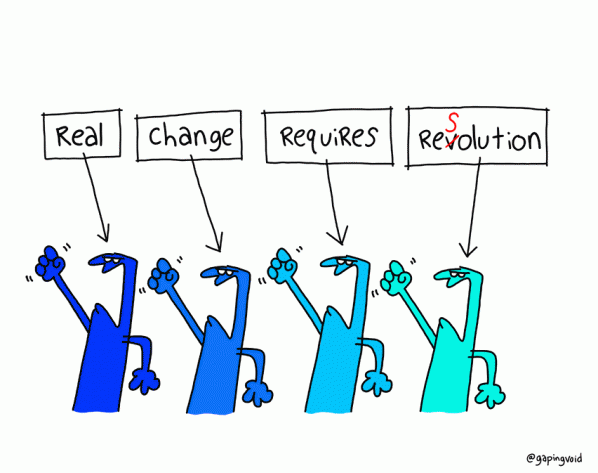
    (image via gaping void)

    until next time, </justice>
  • Posture child

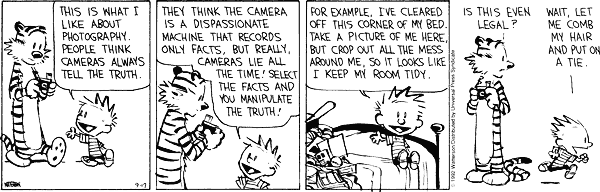
    I guess that’s the reason why Calvin & Hobbes is so utterly loved by so many folks. Profound, timeless, universal truths expressed in such a unique way!

    I had never seen this one until recently. Why blame Instagram for filters? They existed long before anyway 🙂 I thought this strip found great application in all kinds of posturing from time immemorial, and especially so now – in the social media context, when everyone is a publisher. Over a period of time, I wonder how fast we would forget who we really are (if ever we come to know it or knew it) It would probably be irrelevant in the real-time era. We would be the statuses and photos and everything else we like and share every minute. After all, I’m no longer the person who wrote it anyway, and who’s to say the non posturing self is the real deal?

    until next time, impostor 🙂

  • A life less rich…

    On Quora, there is a question which has been getting some very interesting answers – “Is getting rich worth it?” I remembered my post “Halve Notes” from sometime back when I saw it. Rich is of course a very relative term – relative not just in terms of comparison with others, but dependent on time, one’s location etc. Also, factors like one’s health, emotional well being etc have the potential to change the worth completely.

    I don’t think I want to get super rich. I still ride an Activa, live in a rented apartment and  my consumption patterns do not really conform to my income, or as some say, my age. 😀 I have been trying to analyse why. I do like to spend on things I enjoy doing – books, movies, food, travel to name a few – and would not want to forego these for lack of money. But I also do not want to get used to things/habits I might find difficult to sustain later without compromising on my belief systems. So it’s a balancing act, with a bias towards caution thanks to my middle class upbringing perhaps.

    My dystopian future is an old age where I cannot live life on my own terms. That’s probably why I found this story -of one Mr. PM Sahay – so distressing. It’s part of The Delhi Walla’s commendable 130000 portrait project. Mr.PM Sahay is a 74 year old retired bank manager who is forced to sell puppets in Connaught Place to  sustain his family. (I am hoping none of his Rohtak neighbours happen to see all this on the web!) He travels 50kms from his town every day. His legs ache, he says and he has to support himself on the columns and sit on manhole covers near rubbish bins. He is a victim of circumstances. The best laid plans can go wrong, after all. Being rich at least takes care of some things, it would seem.

    until next time, a rich life…

  • Plan C

    This post has been pending for a while, the date of publishing of the article that inspired the post is evidence enough. It is about people who leave their jobs to follow their passion, but instead of the success stories we are used to, it focuses on the difficulties on that path. Even if you’ve not taken that path already, it’s quite possible that you have contemplated it. It’s romantic – the freedom, being your own boss and doing the thing you like – Plan B. But it’s not easy, and it begins as early as even identifying one’s passion. (must read)

    Interestingly, NYT themselves had an article almost a year later that asked “What Work is Really For” and answered that with an Aristotle quote “we work to have leisure, on which happiness depends.” Though I didn’t know about this quote until recently, this is a perspective that I have often used to debate with people who say those who do not like their jobs should quit. There are many reasons why people don’t, and one of them is consciously making a choice to work (possibly on things they don’t enjoy) for the 2 days (and vacations) when they are able to spend their resources – money, effort and time – on things they enjoy.

    The reasons people don’t scale up those 2 days could be many, including the difficulties involved in the early stages of setting up, and then maintaining a positive balance – of money and life. Money is after all an essential resource. It buys things, it opens doors. But when your passion becomes your work and your principal source of money, does it feel the same? Or does it become a job?

    I liked the second NYT article also for its last 3 paragraphs. It addresses the money conundrum. It talks about how right from when we are born, we are taught to be consumers, thanks to capitalism, which though calls itself an open market where we have the freedom to buy is actually a system unto itself.  The choices are not really independent. It points out that education should be meant to make us self determining agents. True freedom requires that we take part in the market as fully formed agents, with life goals determined not by advertising campaigns but by our own experience of and reflection on the various possibilities of human fulfillment. But that’s not an easy path either. It calls for independent thinking and a subjective view of fulfillment and happiness. And that brings us to the familiar “to each his own”

    until next time, work it out 🙂

    Bonus Read: Six Rules to guide your career

  • Balance Wheel

    Somewhere between the need to belong and the constraints of conformity lies that Utopian state. I am beginning to realise that this is applicable across all modes of social interaction, whether they be real or virtual.

    It begins with people finding a common interest or ‘wavelength’ and sharing great vibes. School/college cliques, blogs and microblogs, workplaces, interest groups and so on.  Startups are fun places to work in the initial years because rules are made on the go, blogs and microblogs in their early days were sparsely populated and everyone was discovering their own voice and community norms.

    I have always wondered what breaks the utopian state – time or an increase in the group size. These days I am beginning to be convinced that it is the latter. As each new member is added to the initial set, the needle begins to slowly shift from the erstwhile average. The addition of new members also changes the dynamics of the group and slowly the earlier common sense of belonging changes even as a new one is created. Some adapt, others refuse to conform and break away.

    But what I have also realised recently is that there is a middle path – refusing to conform but refusing to go away either. It is a tightrope walk, and best done without baggage. And that’s the walk I am trying to learn, across my worlds.

    until next time, walking schtick