Category: Society & Culture

  • Humachines and the role reversal

    In his post ‘Virtual People‘, Scott Adams writes that his generation would be the last of the ‘pure humans’  raised with no personal technology. Someday historians will mark the smartphone era as the beginning of the Cyborg Age. From this day on, most kids in developed countries will be part human and part machine. As technology improves, we will keep adding it to our bodies.

    Singularity has appeared on this blog in various forms, and in at least a couple of posts, I have written about the augmented human, and like the proverbial frog in the slowly-boiling water, we wouldn’t know when it happened. (check this post for a fantastic short film on the subject) In fact, medical applications of 3D Printing are already accepted and on the rise. Not just ‘accessories like hearing aids or dental braces, we have moved on to a lower jaw, (previous link) 75% of the skullan ear, and yes, ‘cyborg flesh‘! It’s obvious that the applications are improving the lives of many. My question though remains – as we replace more and more of ourselves, possibly the brain itself within my lifetime, what happens to the essence of us that makes us human – the feelings, the emotions, the zillion unique reactions to various physical and mental stimuli?

    In this wonderful post titled “How not to be alone“, in which the author writes about how we have begun to prefer (diminished) technological substitutes to face-to-face communication, (I couldn’t help but remember this)  he quotes Simone Weil, “Attention is the rarest and purest form of generosity.” And from that statement I realised how the the narrative might come full circle – I remembered this post I had read a few months back. It mentions bots that have passed the Turing test (“test of a machine’s ability to exhibit intelligent behaviour equivalent to, or indistinguishable from, that of an actual human”) and has a compelling argument that while we’re singular entities with a complex design, we’re still just blueprints –  with many similarities. This also  entails that we’re building machines that can mimic, and evoke, our emotions. Thus, he writes, the era of artificial emotional intelligence is not far.

    Perhaps, in the future we will outsource our humanity and reverse roles – half-machine former humans who deal with each other in mechanical ways and go back home to a humanoid bot that will give it all the empathy and emotional anchoring needed. Or would it need it at all? 🙂

    until next time, be human, comment 😀
  • A different kind of more

    (image via)

    Sometime back, I read this excellent post titled “Your Lifestyle Has Already Been Designed“. A colleague shared it with me because he felt I’d like it. And right he was, because it echoed my own thoughts on how our consumption these days have little to do with our needs. The author in fact, goes a step further to say that the typical 40 hour work week (actually it’s way more) manufactured by big business has reduced our free time to such an extent that whatever we do get is spent less in meaningful, healthy activities and more in drowning ourselves in wanton consumption. While that may or may not be true, I think we have a choice, but one that involves winning a battle within. When we lose the battle, we begin indulging ourselves covering it up with the ‘deserve it/earned it’ argument, and the culture of random consumption lives to fight another day. The author sums it up rather well with “We buy stuff to cheer ourselves up, to keep up with the Joneses, to fulfill our childhood vision of what our adulthood would be like, to broadcast our status to the world, and for a lot of other psychological reasons that have very little to do with how useful the product really is.”

    In a larger sense, we tend to live a life that’s not really ours. I cannot help but remember the words of a near-immortal “Your time is limited, so don’t waste it living someone else’s life. Don’t be trapped by dogma – which is living with the results of other people’s thinking. Don’t let the noise of other’s opinions drown out your own inner voice. And most important, have the courage to follow your heart and intuition. They somehow already know what you truly want to become. Everything else is secondary.

    In essence, what we consider as motivation from our own self is actually not. I found an amazing/bizarre manifestation of this in the truly unique story of Mike Merrill, who divided himself into 100000 shares and ‘sold’ himself. Known as the IPO man, his investors would earn a profit out of activities he did outside of his job. In fact, his intent behind the entire activity was to raise funds for things he wanted to do, and felt he would make a profit from. What followed is a fascinating story that has resulted in the investors even getting to have a say in Mike’s personal relationships and sleep patterns!

    I couldn’t help but think of how similar it was to an ordinary person’s life. It is an extreme case, but when we’re driven by wants and motivations that have little relation to needs, the only difference is that Mike is conscious of his lack of control, while we are smug in our belief that we’re in control. I most definitely am not saying we should be living like ascetics, but the balance does lie in consciously separating needs and wants. That, I believe, is the way to a fuller life. A different kind of more from a different set of mores. I wonder if it’s a coincidence that the term ‘Utopia’ was coined by a person named Sir Thomas More. 🙂

    until next time, more or less over

    P.S. The good news is that increasingly these days, I see people making conscious choices across the board – lifestyle, media, time, relationships. The more the merrier 🙂

  • All ideas are equal, some more equal than others…

    (via Threadless)

    A conversation in office on an unrelated topic led me to ask this question on Twitter.

    ..and @atulkarmakar gave me his perspectives


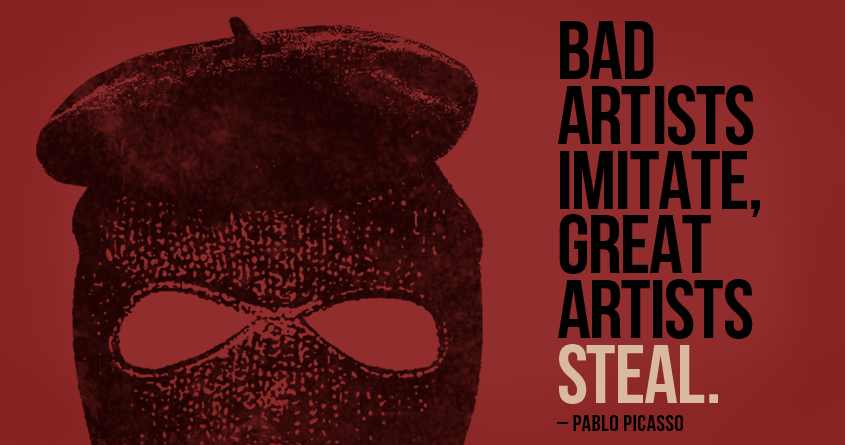
    Just like Atul mentioned, I had first considered whether it was because creative ideas were considered more personal  and a business idea/model an impersonal, corporate entity. But my starting point had been advertising, to which this does not really apply. Compare the reactions of Company A replicating Company B’s business model/idea versus them being ‘inspired’ by their advertising. In the case of advertising, both agencies might get paid and both clients might benefit. But in the case of a business, the second player could benefit from the mistakes (strategy/execution) of the pioneer and build a more successful business. That would be really unfair to the first guy whose business idea might have been a really creative solution to some need. And yet, it’s more likely that the aping of ads would spark a larger debate and the business cloning would be ignored. Am I missing something? Any perspectives you want to share?

    until next time, game of clones

  • Food for the soul

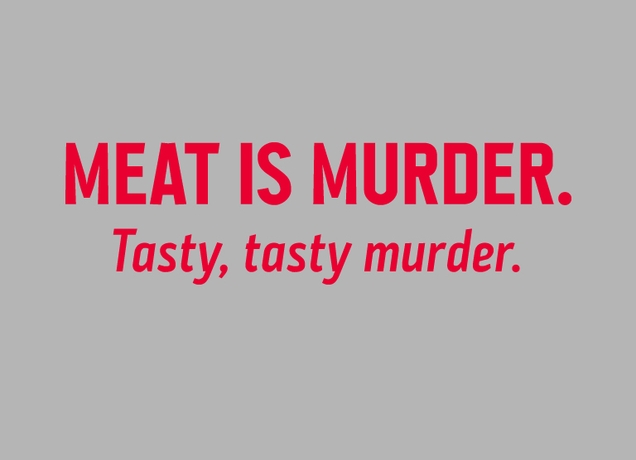
    Thanks to Zomato, I got to spend some bak bak time with Mayur back in February. Along with Rocky, this guy gets to do the two things I’d rather do always – eat and travel. While it was a fun meet up, it was impossible to agree on the subject of meat. Most of the others around were fanatical carnivores – like myself (and I was wearing a tee with the message above) – so we traded insults with him for the first few minutes before the man silenced us with “food is like religion, and you should not piss on other people’s temples”.

    After that the conversation quickly moved to life philosophy. I (along with at least one other person) was curious to know how he kept himself interested in the food + travel routine. Wouldn’t it get monotonous? We talked of retaining child-like levels of curiosity and wonder, an openness to experiences, of starting the day asking what newness can be done today and realised that as we grow older, we look for reasons not to do things, as opposed to the reverse.

    After taking my trip with a food quote, (and underlining his instant wit) he went off to talk to other folks, and the rest of discussed how this also translates to how we interact with other people. Earlier, we used to trust others until they gave us a reason not to, and these days, it’s exactly the reverse. I wondered if this is probably related to the ‘openness to experiences’ we had talked of earlier.  (more…)

  • Movie magic

    There’s a new wave of movies in Malayalam which have now gotten a genre all to themselves – they are being called ‘new generation’. This has as much to do with the new breed of filmmakers/actors/technicians who’ve begun to make their mark as it is to do with the themes that are portrayed in these films and the mindset that a viewer has to probably adopt – this mindset being radically different from the one reserved for the standard potboiler fare that viewers were used to. I stress the last two because it isn’t as though these kind of movies had never been made before. It was just that they were very few in number. Simply put, the maker and viewer generations are now showing a radical shift from even say, 2-3 years back – in terms of approach, outlook, perspectives, perceptions and expectations.

    Movies being a medium of expression, I have always been intrigued by the subtexts, though I have not had the liberty of time to actually spend thoughts on the subject.  This article, for instance, does a good analysis on Mani Ratnam’s movies and the influence of various narratives. These days, when I watch (malayalam) movies from the 80s and 90s,  I try to identify the themes that have been used in/inspired them. Earlier than that would be difficult since I have no primary experience of the era.

    I saw Thoovanathumbikal again recently, a fantastic movie which deserves a ‘new generation’ tag even if it were made now, especially because of its sensibilities. It is very much what I call a mood movie – requires the viewer to succumb to the mood to truly enjoy it, especially the current day viewer who expects something to happen every second, and nuances are not counted. (probably why Annayum Rasoolum was not appreciated much – it’s less to do with the theme and its twists and more about the way it’s been dealt with – the sophistication and the aesthetic) Timeless as Thoovanathumbikal might be, I wonder how much one would appreciate it more if one had experienced first hand the societal values, mindset  and the ethos of the time. The rain, for example, which plays such an important part, do we view it in that light anymore? At the same time, the maturity of the person is also a factor. I was nine when it released and would have slept through it! 🙂

    And that’s probably why cinema is indeed magical – not only is it a representation of an era, or a part of it, but at any point in time, there’d be someone who’d be able to relate to it, across the passage of years.

    until next time, moving pictures