Category: Society & Culture

  • Certain, simple frames

    I read an article recently on decision making, which among other things wrote about how instinct could beat analytical thinking. An insightful heuristic that I found in it was this – ..if you are in an uncertain world, make it simple. If you are in a world that’s highly predictable, make it complex.

    While the article focused on decision making in the business context, I could relate to it in the personal context. I see the world at large as an uncertain and complex place, and have spent a lot of time in the last few years trying to contain its influence on my own life. It has been an evolution. The expectations frame  I have written about does a fairly good job of reducing the variables, but it isn’t perfect. There are people and events that frustrate me, I sometimes lose my cool, and my remorse later doesn’t really change anything for anyone, including me. (example) (more…)

  • Objectivity, and the path to joy

    Sometime back, a colleague and I had a conversation on retaining objectivity during decision making. I felt that if one does not do that in life generally, it won’t happen at work either. We live in our narratives, and the brain, after all, is only so flexible.

    That led to a train of thought. Objectivity (also) comes from being able to step out and get a view of one’s self from outside. Insights into one’s self can happen all the while, if you allow it. Two recent incidents to highlight this. (more…)

  • Brand with a worldview – Part 2

    I think my first thoughts on the subject appeared in 2012 – Mean better than average, featuring Cleartrip, who had put a non-customer in place with sarcasm after a polite conversation failed. It took another 5 years for a redux in Feels & Fields in Marketing. The framing was that if the end game was for the brand to be the first choice when a consumer thinks of the category, what would be the strategy in a world of attention scarcity? Using the powers of targeting and personalisation to catch the customer at the right time and place (medium + stage of a funnel) with the right messaging, or having a world view that is so relatable to a kind of customer that the brand becomes entrenched in his/her mind? Or both?

    I followed it up with  Brand with a worldview, which had examples from the Super Bowl 2017 ads, many of which had an overt or covert political stance. My inference was that we are largely irrational creatures, and absolutely prone to confirmation biases. We’d love our brands to echo our world view… Smart money would be on brands that can use data to glean consumer sentiment beyond domain, and leverage that understanding when forming a world view.

    This post takes the thought forward, and I have framed it quite simplistically with 3 aspects – customer, competition, and company. We also have a hot example to embellish the hypothesis – Nike! Tons have been written about its latest adventures, but let’s just overdo it anyway. (more…)

  • Finn, Tolstoy, and happy families

    “You’ve heard that line about all happy families being the same?”

    “War and Peace”, I said.

    “Anna Karenina, but that’s not the point. The point is, it’s untrue. No family, happy or unhappy, is quite like any other.”

    I read this in The Woman in the Window by A.J. Finn recently. I use the Anna Karenina principle quite a bit in many contexts and discussions. In fact, recently, while reading Guns, Germs & Steel, I realised he had used this framing too. To put it simply, there are x number of conditions that definitely need to be met for something to succeed. The ‘something’ could be anything from origin of life to economical supremacy, and the ‘x’ conditions would change with that context. But in a given context, only those who fulfill all the x conditions will succeed.

    Naturally, as a believer, I was miffed by Finn’s (character’s) statement. But, could he be right?

    As I write this, D and I are a day away from celebrating 21 years of being together, 15 of them in a married state. Speaking of state, Kerala in the late 90s and early noughties, much like other non-metros in India, wasn’t friendly to intimacy or dating. In fact, the reaction to our relationship was actually a combination of the two – intimidating! Especially since a couple of religions were involved. Anyhow, here we are, 21 years later – happy.

    The stage was set for a thought experiment. Are we happy in the same way other couples are? I’d think not. I don’t really have data, so I will use  a simple non social-media-posturing observation. There are a lot of happy families with kids.* We chose not to succumb to that genetic pressure. So we’re different from other happy families. Does that mean Finn is right, and Tolstoy was wrong?

    I think it just isn’t as binary as that. Tolstoy was right because if one figured out the conditions that need to be met for a happy marriage, I have a feeling the successful couples would be meeting them (children most likely will not feature in that list). Finn is right too, because the way in which the couples met them would be drastically different from each other.

    In any case, I don’t think we have found an objective framing of happiness to begin with!

    *There is interesting data (Google searches and experiments) to show how “kids bring happiness” is just belief transmission for evolution’s needs and not the truth it is portrayed to be. But people have their own narratives of what happiness is, so I’ll leave it at that. 

  • Choices & Automation

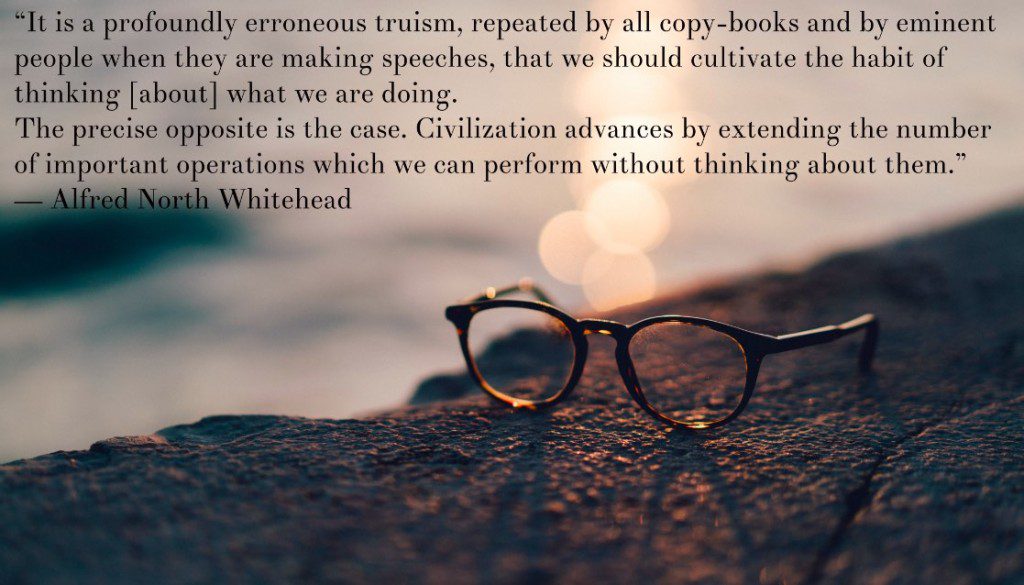
    Taylor Pearson wrote an excellent primer on blockchain a while ago. While explaining why blockchain matters, he quoted something by Alfred North Whitehead

    Untitled 1

    Photo by Joshua Newton on Unsplash

    (more…)