Category: Purpose

  • ..the question remains

    It has been more than a couple of years since I wrote on the subject of planning – the acceptance of destiny vs free will in The Uncertainty Principles and the balance between change and stasis in its follow up. In my mind, the debate continues to rage, with flash points on a regular basis, thanks to various life scenarios and the things I read. I also realised that the recent narrative posts (1,2) are also a different way of framing this debate. Like I wrote in the posts, some narratives are already chosen for us, and some we choose, but these are all our attempts to fulfill our sense of belonging. In other words, our endeavour to find the reason for our existence – our purpose. Does one find it by working towards something or by dealing with life on a real time basis?

    A few days back, I read an article in HBR titled “It takes purpose to be a billionaire“, in which the author classifies ‘purpose’ into three buckets. Not that everyone’s idea of ‘purpose’ is to become a billionaire, but this is very clearly a planned path to achieve something that contributes to the sense of purpose. While the article does not mention it, the category I have always wondered about consists of people who have followed their passion – sports people, artists etc who have worked on a skill and honed it to near perfection. A very interesting perspective I read on that premise is the Scott Adams’ “Practice and Genes“, which takes a look at the theories on the subject and finally states that the critical element is luck. The most important skill involved in success is knowing how and when to switch to a game with better odds for you.

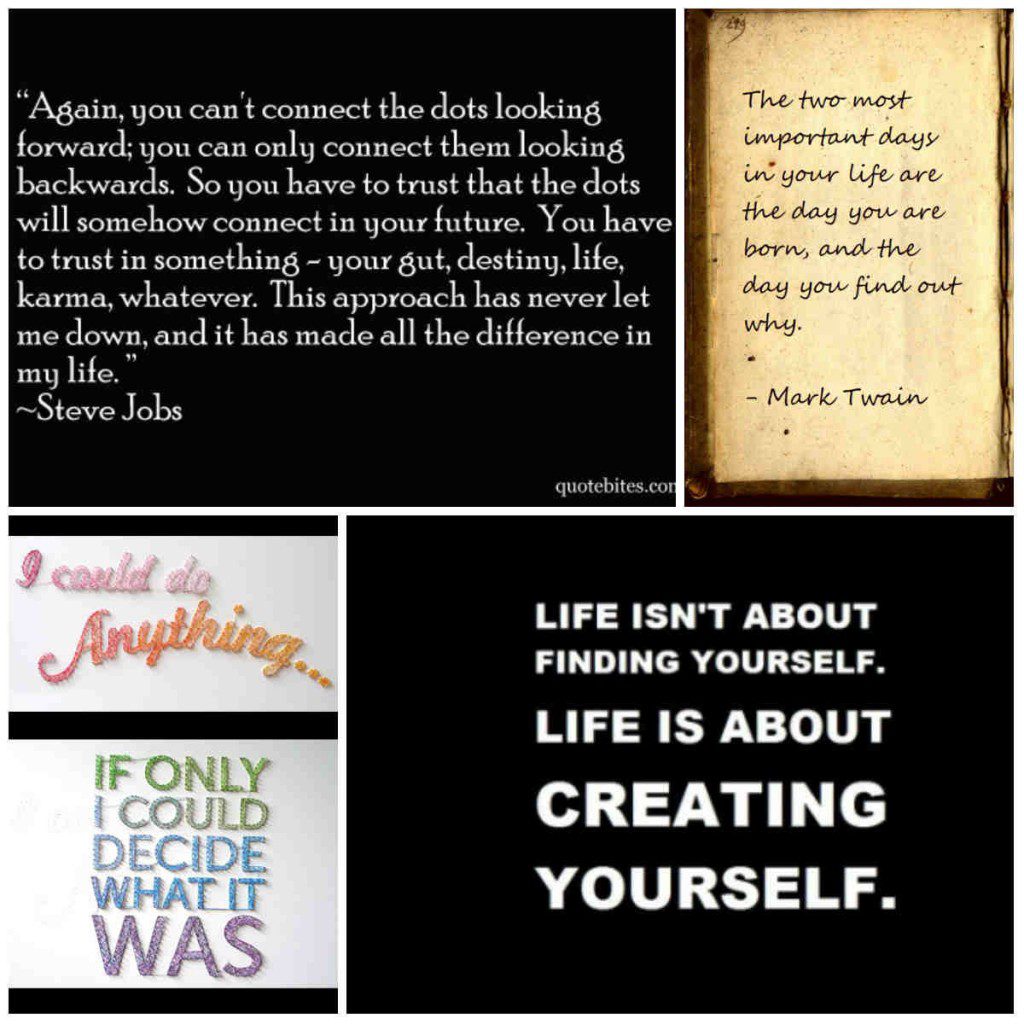
    Which brings me back to purpose and how we find it, and my introspection. “Who looks outside, dreams; who looks inside, awakes” ~ Carl Jung. (via) I thought about the ‘living in the moment’ perspective that finds a place in Buddhism texts and several other works of wisdom. At first, I thought it supported the destiny and real time approach, specially because it is difficult not to have baggage associated with the plans one makes. (literally and otherwise!) But then I realised that it was less to do with the planning aspect and more to do with how we deal with scenarios. Even if one works on a plan, how one deals with a setback to it is where the advice has value. In essence, that won’t help solve the debate.
    collage

    There are profound statements that support both ways of looking at it. I continue to rack my brains to find the path that will fit me, or make it. I think there is an element of subjectivity involved. That does not make the job easier, in fact, it probably makes it tougher. After all, “He who knows others is wise. He who knows himself is enlightened.” Lao Tzu

    until next time, the clock ticks away in real time

  • The narratives that we drive

    It probably started with the ‘narrative’ post, but a few things I read later made me wonder about our choices of narratives and where this could be leading to. Some narratives happen to us depending on our circumstances – time, geography etc, and some we choose of our own volition, or so it seems. Continuing from the earlier post, I think it’d be safe to say that with a more connected world, our ability to choose narratives has been heightened. Abundance of creation, and consumption. I think this was the related fantastic little piece of content that triggered this entire line of thought. It has some thoughts on material consumption, and though delivered differently, it has some profound insights as well.

    Partly thanks to that abundance, the noise around us has also increased, and has found better ways of being amplified. To quote Clay Shirky,

    It is our misfortune, as a historical generation, to live through the largest expansion in expressive capability in human history, a misfortune because abundance breaks more things than scarcity.

    In fact, one could argue that compulsive consumption (material, and otherwise) is one of the reasons for our ‘emptying out‘. (do read) As I was writing this, I had a sense of deja vu, and some searching pointed me to this, written 3 years back, in which I tried to figure out whether there was a middle path between a self that was driven by others’ perceptions and one that was driven by a moral compass dictated by few external stimuli. In that post, I had quoted from Paul Graham’s ‘addiction’ post,“we will increasingly be defined by what we say no to” I think that still holds true.

    In this era of abundance, what narratives should we choose to be part of? How can one be objective, is one even right by being objective? An excellent post whose advice I hope to implement more is this. I really couldn’t disagree with any of the 30 things mentioned, it just seemed intuitively right. But I think this would serve as an excellent first lesson..

    (via)

    until next time, an open and shut existence

  • Live Empty

    old tree and new tree stories

    (via)

    Such is the pace of life now that I can easily identify with the opening paragraph here. As I read on, I completely loved the part about the graveyard being the most valuable land in the world, “because with all of those people are buried unfulfilled dreams, unwritten novels, masterpieces not created, businesses not started, relationships not reconciled.” The rest of the article is about dying empty – to complete every task, thought, action, to leave nothing unspoken, uncreated, unwritten. 

    Later, I read on Brain Picking, “Henry Miller on Creative Death“, in which Henry Miller, defining art, says, “Strange as it may seem today to say, the aim of life is to live, and to live means to be aware joyously, drunkenly, serenely, divinely aware. In this state of god-like awareness one sings; in this realm the world exists as poem. No why or wherefore, no direction, no goal, no striving, no evolving…. This is the sublime, the a-moral state of the artist, he who lives only in the moment, the visionary moment of utter, far-seeing lucidity…. in the sense that any moment, every moment, may be the all; for the artist there is nothing but the present, the eternal here and now, the expanding infinite moment which is flame and song.” And later in the article “On the contrary, his zest for life is so powerful, so voracious that it forces him to kill himself over and over. He dies many times in order to live innumerable lives.

    I read a pattern in these. Of dying every day and being reborn the next day. A new life. I faintly understand and relate to this, but within me is another side that plans, that likes stability, and saves for a rainy day. I am unsure of how these two can co-exist. And I can’t help but be drawn to the lines at the beginning of the Miller post ““One aspect of our nature cannot be exalted above another, except and the expense of one or the other.” 

    If so, I already know the winner, and as the first post points out, that would create an angst, or a perpetual state of discontent. It would seem as though the opposite of ‘die empty’ can only be ‘live empty’. There can be no middle path, and that’s scary and sad.

    until next time, empty vessels and a lot of noise

  • Lovestrong

    Slightly dated in the context of real time, but I thought this was a pertinent read in the Armstrong era. It’s titled “Honesty of the long-distance runner” and is about a Spanish runner Iván Fernández Anaya. He was running second in a race he had no chance of winning when he saw race leader Abel Mutai pull up about 10 meters before the finish, thinking he had already crossed the line. Instead of exploiting the situation, he let the Kenyan win using gestures to communicate. He thought it was the fair thing to do. He also candidly said that if a Eur/World medal was at stake, he’d probably have done things differently.

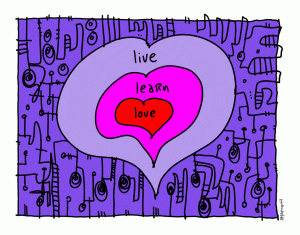
    I saw this poster at gaping void, related to  purpose, but twisted it a bit in this context. It isn’t as though there aren’t things we love to do. As we move further in life, we learn more about the way life works. Sometimes these things we love make business sense, sometimes they don’t or requires either stellar talent or more hard work than we are willing to put in. Some of us work at it, some of us lock the love away and some of us decide to find an easy way out. And thus it is that even things which involve love and passion – sports and arts – have been converted into competitions and ruthless economically viable phenomena. So really, where does the corruption begin?

    until next time, strong-armed

  • Of fame and purpose

    I completely missed Bigg Boss 6. Except for knowing that the arrested-for-sedition cartoonist and Sapna Bhavnani were participants, my exposure to it was limited to lunch conversations at office, where two of my friends seemed to be avid followers. 🙂 I thought my ignorance was only fair, since they are usually clueless when I mention the names of micro-celebrities on Twitter.

    Increasingly, I am realising that popular culture is going through massive fragmentation. The above was an example. I think this generation is connected with more people than any before it. It has always been so, with better means of communication, but this time, it has been an explosion. We’re still coping with the overload, or filter-failure, as Clay Shirky calls it. Despite social networks, or probably because of them and their algorithms, we miss out on many things.

    I was thinking of all this in the context of fame. Fame, to me, has some connection with my favourite subject these days – purpose. Fame can serve as a means, or end, or a by product of purpose. The thing is, with the fragmentation I mentioned earlier, fame probably has to be redefined, also because its shelf life has been drastically reduced. Once upon a time, a name/photo appearing in a newspaper was an achievement. (let’s ignore the notoriety piece 🙂 ) Later, before channels mushroomed, it was television. But now….

    One of the things that might happen because of all this is the gradual de-linking of fame and purpose, if it does exist. I’m still trying to figure out how that will shift our perspectives on purpose.

    until next time, being famous ain’t what it used to be…