Category: Purpose

  • Of fame and purpose

    I completely missed Bigg Boss 6. Except for knowing that the arrested-for-sedition cartoonist and Sapna Bhavnani were participants, my exposure to it was limited to lunch conversations at office, where two of my friends seemed to be avid followers. 🙂 I thought my ignorance was only fair, since they are usually clueless when I mention the names of micro-celebrities on Twitter.

    Increasingly, I am realising that popular culture is going through massive fragmentation. The above was an example. I think this generation is connected with more people than any before it. It has always been so, with better means of communication, but this time, it has been an explosion. We’re still coping with the overload, or filter-failure, as Clay Shirky calls it. Despite social networks, or probably because of them and their algorithms, we miss out on many things.

    I was thinking of all this in the context of fame. Fame, to me, has some connection with my favourite subject these days – purpose. Fame can serve as a means, or end, or a by product of purpose. The thing is, with the fragmentation I mentioned earlier, fame probably has to be redefined, also because its shelf life has been drastically reduced. Once upon a time, a name/photo appearing in a newspaper was an achievement. (let’s ignore the notoriety piece 🙂 ) Later, before channels mushroomed, it was television. But now….

    One of the things that might happen because of all this is the gradual de-linking of fame and purpose, if it does exist. I’m still trying to figure out how that will shift our perspectives on purpose.

    until next time, being famous ain’t what it used to be…

  • Stated Obsession

    A defining purpose, or rather, the lack of it, is something that has been gnawing at me for a while now. One can go about the daily motions of life without defining a purpose, and it need not affect professional objectives or progress. In fact life must, and will go on without a purpose, but once the gnawing begins, it is difficult to rid of. It might be the result of something that I am often accused of – extra doses of analysis – self and otherwise. 🙂

    A friend-in-law (coined to refer to the spouse of a friend :D) recently got probably one of the biggest highs possible in his domain – a result, I am sure, of the hard work he put in, and his unwavering belief in the self. The hard earned outcome of a well stated purpose and well directed passion. May he have many more.

    One of my favourite Malayalam movies in recent times (actually in the all-time list as well) is Ustad Hotel, about a young man and his choices – two paths and their implications symbolised by his father and grandfather respectively. The game changer in the movie is inspired by Narayanan Krishnan. (do read if you are not familiar with the name) In real life, Narayanan Krishnan has defined his purpose, and bravely soldiers on, helping those who have no one else to help them.

    Completely different scenarios, with completely different motivations, but linked by the presence of a purpose. I can cite excuses – primarily the business of living and an interest in way too many things to devote myself completely to one – but I know those are just excuses. I am still searching for the reason – the inability to find something that defines me or the inability to devote myself to pursuing it, or just sheer lack of guts. My only hope is that I have some time left, but the clock is ticking.

    until next time, a gnawing tick

  • In Principle

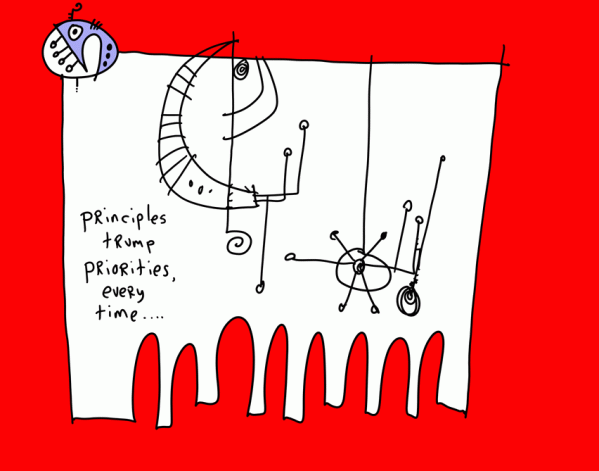
    Stannis Baratheon is probably the least charismatic among the contenders in the Game of Thrones, but I have liked him for his stubborn, unwavering sense of duty and justice – even in those situations when a compromise might have helped him meet his objectives. Even his claim for the throne is not borne by desire, but by his belief that he is the rightful heir. I am on Part 2 of Book 3, so I have no idea how this is all going to pan out, or whether his character will change later, but for now I can relate to it, though in my daily existence, I’m not able to shake off the pragmatist in me many a time.

    That is also why I loved this Gaping Void poster, and identified with it immediately.

    As I’d written in the 1000th post in another context, perhaps the joy is in doing something because it is the right thing to do.

    until next time, first principles 🙂

  • Legacy, Mastery, Success

    At Brain Pickings, that treasure trove of awesomeness, I found this quote attributed to Ray Bradbury on legacy, through a character in Fahrenheit 451:

    Everyone must leave something behind when he dies, my grandfather said. A child or a book or a painting or a house or a wall built or a pair of shoes made. Or a garden planted. Something your hand touched some way so your soul has somewhere to go when you die, and when people look at that tree or that flower you planted, you’re there.

    The subject of legacy keeps popping up here, and my understanding, especially since the last post has been that it is not something that one works towards, but happens as a (side) result of doing something that you love to do. In that sense, I would read between the lines above and add that ‘doing what you love to do’ as a prequel to the quote.

    One of the best posts I have recently read was Hugh MacLeod’s ‘On Mastery‘. I immediately riffed on it over at the other blog. It articulated things that I know for certain were muddled up somewhere in me, wanting to be told but finding words missing. He starts with trying to define success “Suc­cess”. What does it take to be suc­cess­ful, pros­perous, happy, have a sense of pur­pose etc?, separates it from the by products like fame and money and arrives at “It’s something that truly belongs to you”. For the master (as someone commented on the post) it’s more about the process than the product. Low key, known by a few, but masters in their chosen domain. “It’s something that truly belongs to you, always.”

    In the ever hyper world of real time media, micro-celebrities and experts, fame and money are many times the definitions of ‘success’, and though I do know at least a few people who have bucked that trend, it was heartening to read posts that told me that such thoughts weren’t really alien.

    There is an interesting article I read on the subject on HBR titled “You Are Not a Failure” which had an intriguing classification of  types of creativity — “conceptual” (in which a young person has a clear vision and executes it early, a la Picasso or Zuckerberg) and “experimental” (think Cezanne or Virginia Woolf, practicing and refining their craft over time and winning late-in-life success).

    Thanks to the deluge of information and opinions, it is ridiculously easy to give up on yourself and lose confidence. As Godin writes in “Do we have to pander?“, it is also easy to compromise, and then defend.   I think this is not just for greatness (people or things), but also holds true for personal belief systems and mores. And probably, at the very end, the perseverance really doesn’t achieve anything other than the satisfaction of setting one’s own definition of success and spending time and energy on it. But I have a feeling it’s worth it. A legacy in itself.

    until next time, this happens to be post #1000 here 🙂

  • Gene-rational

    Sometime back, there was a debate on Samadooram, a talk show on Mazhavil Manorama. The topic was the changing nature of colleges in Kerala, specifically the waning influence of arts and creativity in general. Panelists included a student politician, a regular student, a college professor, a socio-cultural commentator, a literary figure, among others. Among the various sub-topics discussed were the rapid increase in number of colleges, the pressure on students, the internet revolution, the effects of changing societal and familial conditions, with several aggressive comments on how the earlier generation should give way to the new, rebutted well by the older panelists. All the panelists, and many in the audience gave varying perspectives on the subject and it became a very interesting albeit noisy debate, which brought out several moments of generational difference.

    When the Roadies spoof became a rage and a discussion topic, I remembered tuning out after Season 1 because I just couldn’t understand the entire exercise. I also understood that for some reason, it meant a lot for a section of the 18-25 audience, and that it was a big deal.

    It made me think of what has changed, beyond the passage of time  and why. I realised that the entire ‘intent’ of various phases in our lives had changed. The innocence of childhood, the new found freedom and the process of evolving a world view during college have all given way to a single point agenda for the child from the time it is born. The intent is to mould a creature that can survive the peer competition and whatever else the world can throw at it. The changes in education and the college atmosphere are IMO, by-products of this.

    The paradox is that thanks to the internet, this is probably the best time for an individual to explore and make the most of his interests in life. It gives you the freedom and the tools to be the person you want to be. Unfortunately, it is quite possible that at a young age, they don’t have the confidence (or even the clarity of thought) to choose a path. They are guided by society’s norms, norms which have a benchmark of ‘success’ that rarely accommodates the individuality perspective. The ones who break these shackles get to live a life.

    until next time, grown down