Category: Purpose

  • An age when age doesn’t matter

    While discussing a ’40 under 40′ list, I joked the other day to a colleague that my only chance of getting into one now was to reduce my weight by about 15 kg in a few years! It made me think of a strange yardstick I have employed in valuing others’ achievements – their age. To elaborate, if I came across a person who had attained a measure of success, I would be mollified if I figured that the person was at least as old as I was. If they were younger, mollified would be replaced by mortified. How dare they achieve something earlier in life?! Very strange, I know. I have quite a few theories on it – upbringing, a ‘paying your dues’ perspective, the way I have progressed in my career and what I’ve had to do, or perhaps just the result of being brought up in an age when folks worked hard all their life to attain things that we might consider a basic need now.

    I gained freedom from it (or so I think) quite recently. The irony was that this realisation dawned  just after a meeting with someone whom I would say has been quite successful in his profession. As I made my way back home in a cab, I passed quite a few bus stops. It was late evening, and people were waiting for a bus to take them home.  Young people, middle aged people, and even a few old people, their faces echoing their toils. Perhaps they had a long bus ride ahead of them, perhaps they would have to stand all the way, perhaps they would have to get down midway and catch another bus. This was their life everyday, the cards they were dealt. Some might be unhappy, some would have made their peace, and some might even be happy. Their lot in life, or a bus they missed at some point in their life. Even as I had many, many things to be thankful for. So, what business did I have grudging someone because they worked hard and/or were lucky enough to make a mark early in life? (more…)
  • Happiness: The End

    A while ago, in Happiness and Compassion, I had written about what Fahadh Fasil described as the biggest lesson he learnt from failure – he said it made him decide that he would only do things that made him happy. The more I read, the more I think, and the more I live, the more I start relating to what Fahadh is doing, and what Aristotle said, “Happiness is the meaning and the purpose of life, the whole aim and end of human existence.” Everything else – fame, power, money, compassion, detachment etc – is probably just the means we create.

    The thing though is, even if happiness were indeed the purpose, I can see at least a couple of challenges. In this excellent read “10 truths you will learn before you find happiness“, the first point is “It is impossible for anyone else to define YOU”. This echoed my first challenge – a difficulty in defining what happiness is to me. At the next level, I felt that the paths to happiness are confusing and have many things going against them. For instance, fame – “..other people’s heads are a wretched place to be the home of a man’s true happiness.” (Schopenhauer) Or compassion/pity (not kindness, which I regard as a more active expression, though the following might apply to it as well) – “There is a certain indelicacy and intrusiveness in pity; ‘visiting the sick’ is an orgasm of superiority in the contemplation of our neighbour’s helplessness” (Nietzsche) As you can see, it isn’t difficult to bring each down.

    (more…)

  • Linking learning & labour

    I’m a huge Asimov fan, and am constantly amazed at how he was able to have a perspective of the future on multiple fronts. I was reminded of two of those recently thanks to their application (of sorts) in contemporary scenarios.

    First, Hari Seldon‘s (pretty much the foundation of Asimov’s Foundation series) psychohistory, which was able to make general predictions on the future behaviour of large populations using history, sociology and statistics. The easy contemporary connection is big data and predictive analytics.

    Second, a short story written by him called ‘Profession‘, (do read) in which every person’s profession is based on an analysis of his/her brain, and no choice is given to the person in this matter! In India, we seem to be already there even without the analysis!

    Collectively, these two made me think of employment, and on a related note, education. The thought was that with so much of data available on education and employment, we should be able to create ‘tests’ to compute the interest and aptitude of individuals at a very early age. What this would aim to do is to eliminate the herd education that currently exists. Instead, children would learn things that help them in a profession for which they have the intent and interest, using say, a combination of traditional classrooms and MOOCs. Also, this would no longer be one part of a life cycle, but a continuous process – helping the individual thrive in a dynamic environment.

    If you remember, LinkedIn was my representative for ‘L’ in the ‘change imperative‘ deck. That was because I felt that it had the data and the vision to be the catalyst for this kind of a change. I was very happy when it underscored this faith with the fantastic ‘future self‘ experiment, in which they identified the future professional self (5 year time frame) of LinkedIn user Kurt Wagner – another user Mussarat Bata – using various data points!

    LinkedIn hasn’t really built this as a public tool, but just imagine the possibilities! A platform that shows people the possibilities which take them closer to their ‘purpose’. (remember ‘The Evolution of Work and the Workplace‘?) I sincerely hope to see this in my lifetime. 🙂

    until next time, live and learn

    Clipboard01

  • The world we create

    A while ago, I had written about the narratives of our lives, a look at various narratives across time – from religions and nations to popular culture and brands to the internet – that have (arguably) tried to fulfill our sense of belonging. All the narratives I had considered were external in nature, though they might be dictated by our choices and preferences.

    An excellent comment on the post by The Lit Room made me consider ‘the narrative of individual imagination’. As I answered, it is probably the most important one, as it takes all sorts of external stimuli, and converts it into a unique stream of consciousness. Just when I began thinking of writing a follow up post by including that aspect, I was reintroduced, thanks to Devdutt Pattanaik’s Sita, to the concept of ‘aham brahmasmi‘ – “every human creates his own imagined version of the world, and of himself. Every human is therefore Brahma, creator of his own aham“. I think it is impossible to crack everything that goes into the making of one’s own consciousness, which is probably what led to

    Clipboard01

    (image via)

    But there are at least a couple of perspectives that the book provides in terms of how one can create an ideal ‘world’ for oneself. It says, “stay true to the idea of dharma. Be the best you can be, in the worst of circumstances, even when no one is watching.” I thought a bit about what actually drives our actions, and realised that at the bottom of it is fear. (debatable) Not just one fear, but many, many fears driven by our contexts – some we acknowledge, some we don’t. George Lucas probably figured it out earlier, (see) though we might travel paths different from what Yoda has suggested. The book also states that – Fear is a constant, and faith is a choice. Fear comes from karma, from faith arises dharma. Faith in what, was the next thing I pondered over. In oneself, and a moral code that one adheres to? Or a higher power/cosmic law that governs all that happens? Or is it just a mechanical process with the fittest surviving? There are more options as well, probably, but I like to go with the first, because in the world that I create, my actions can ensure I do not have to fear.

    Meanwhile, also from the book – Shiva chooses the path of asceticism and self control to control the aham, and the world it creates. Vishnu chose to live amidst materialism and yet find a way to break free – a middle path. (now I can see why Buddha is assumed to be a form of Vishnu) I think there are several degrees to choose from, and there lies the challenge. I also realise that it if each of us are creating our own worlds, we cannot really answer the questions of the world at large – a universal answer – because it is an aggregate of each of our worlds, which are different from each other and have unique rules. We can only find the answers to our own world, and through our individual paths, find our own version of the answer to the purpose of life.

    until next time, muddled path

  • Guided by fear

    live1

    I have this habit of adding a bookmark fold at the bottom of the page when I want to refer to it again. It is quite a task when I have to figure out much later what line in the page I’d originally bookmarked for! These days, Instagram solves it. At some point, I’m sure I can search my feed with a #quote hashtag and retrieve all the ‘bookmarks’ easily. Yay!

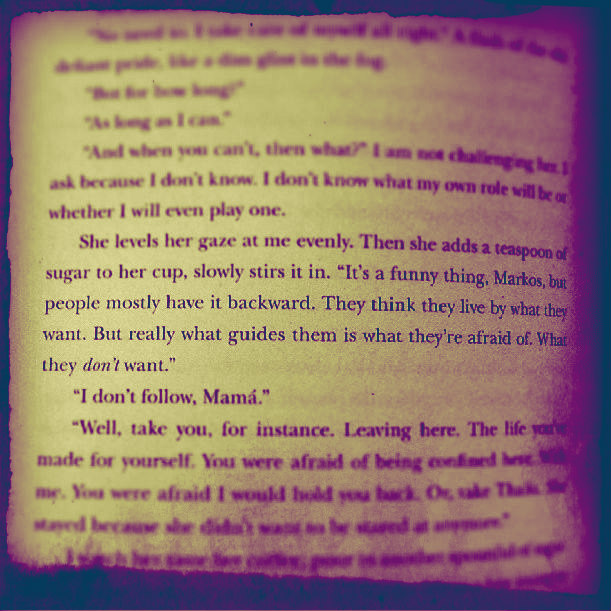
    “And the Mountains Echoed” had many such bookmarks. (still an unconscious habit despite the Instagram method) But this one has to be my favourite – “..but most people have it backward. They think they live by what they want. But really what guides them is what they are afraid of. What they don’t want.” I can easily confess that a large share of my actions is to preclude some dystopian version of my old age. (one) Many a time, this leads me to choose cautious paths over (what I think might be) more emotionally fulfilling ones, and even ones that I think might be leading me to my purpose.

    But when I thought about it a bit more, I realised that it can be read positively too – after all I am afraid of being switched off without knowing why I was here, and that’s what makes it an obsession! Also, the ‘afraid-don’t want’ factor often drives me to do things that are out of my comfort zone, so it’s possibly even pushing me towards my purpose, albeit from a different direction. Just a form of reduction? 🙂 It’s probably not a coincidence that my second favourite quote from the book is “When you have lived as long as I have, you find that cruelty and benevolence are but shades of the same colour

    until next time, fear off