Category: Life Ordinary

  • The ride of a lifetime

    The year was 2008. For 7 years, I had been serving as a palliative care owner to second hand two-wheelers. This included manually-powered visits to workshops every other day, to the extent I had called the original one Potential Honda, because it was Kinetic only occasionally! And that’s how I finally decided to take the bold step of buying a brand new two-wheeler for the first time in my life, at double the cost of my mobile. I bring that up because now Activa competes with the likes of Apple and Samsung for the share of wallet!

    Fast forward to 2013, when D got herself a four wheeler, and a driver, I cajoled her into letting me use both, and stopped using the Activa for office commute. But it still was my go-to vehicle for chores. From about 2016, I became an Uber regular, but the Activa continued its role. I think it was the pandemic, and then the zoning out that separated us.

    And thus, here we are in 2022, and I am wondering how does one say goodbye to a partner who has been with you in your 20s, 30s and 40s! But I have to. Unlike the foreign object and these guys, the maintenance effort is not trivial. It doesn’t help that it needs a fitment certificate later this year!

    And thus this thank you post. To a relationship in which I cheated on you with another two-wheeler only once – when they insisted I use a wheelchair when going in for an angioplasty last year. To a relationship in which we got hurt just once – back in 2010 in Austin Town on a rainy night. I remember crying that night, as I picked you up and continued home, because a truckload of things made life seem so unfair. I am older and a little wiser now, and life doesn’t seem very unfair, but I thought of the lifetime we’ve been through and blinked back tears, when I stood gazing at you before I put you up for sale.

  • A proxy life

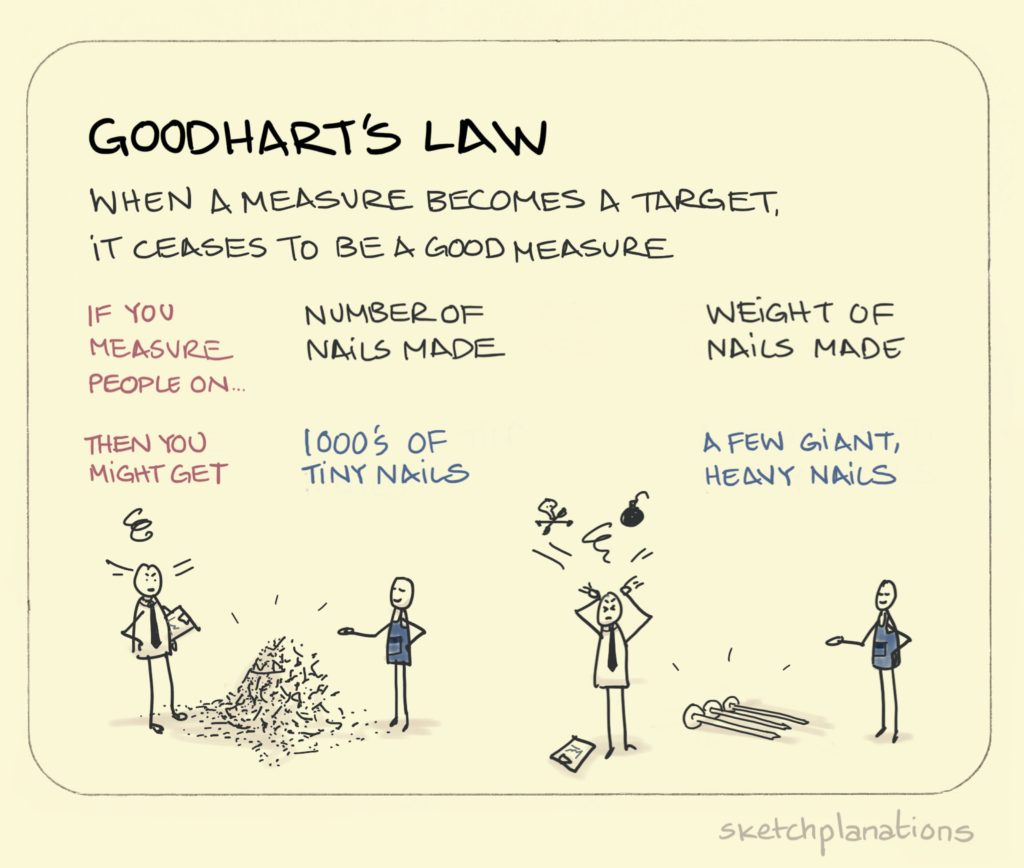
    I have forgotten where I first came across Goodhart’s Law. It was probably Farnam Street. It states that “when a measure becomes a target, it ceases to be a good measure.” An illustration should help.

    https://sketchplanations.com/goodharts-law

    In the organisational context, it serves as a great lens to evaluate strategy and progress. As the illustration above shows, the entire direction of a desired goal can be changed when measures become targets. But, and maybe it’s a Baader -Meinhof phenomenon, I am now seeing different versions of it everywhere.

    To set some context, as more and more things have been digitised, the volume of information has just exploded. For instance, before the advent of social media, there were limits to one’s “people like me” canvas, because even an awareness of them was constrained by physical distances and the limits of one’s social circle. It had to be in real life, and public spaces like a cinema or even a vacation spot were probably an extreme. Social media changed that scale massively. Many factors including this volume of information, the lack of a granular understanding of the lives of this new set of people whom you’d never meet, and the innate human desire to do better than neighbours meant that appearances became the norm. Since we are not wired to process such large volumes of information, we dug deeper into ‘measurement by proxy.’ Not that this mode of measurement is new. For instance, we have used material manifestations (apparel, cars etc) as a measure of wealth. The stock price is a single-number measure of everything about the company. But with abundance of choice and the limits of processing power, we started developing heuristics and measuring what was easy. Meta photos (FB/Insta/WhatsApp) became a measure of everything from the quality of life to the strength of relationships. Popularity as a measure of excellence, price as a measure of quality, fitness as a measure of health, #booksread as a measure of erudition and so on.

    How does this connect to Goodhart’s Law? We end up optimising our resources for the measure, not the end goal. Which means that though the goal is say, happiness and a good quality of life, we end up aiming for the measure. From the kind of photo that will get more likes to buying that thing/experience that will surely make us happy. And as we feed this more, the mind keeps on wanting. The happiness fades in a short span of time. And as the Buddha has wisely pointed out, that loss of happiness is what becomes suffering.

    In the AI risk narrative, there is the story of the paperclip maximiser, a seemingly trivial task of maximising paperclips that might lead to “first all of earth and then increasing portions of space into paperclip manufacturing facilities”. The corresponding human version that I wrote in Peak Abstraction was that maybe we will get to a state where, if we get enough likes on the couple photo on Insta, there would be relationship bliss! What a wonderful world.

  • Designing my desires

    A world of transactional efficiency

    It was a little over 4 years ago that I first brought up the increasingly transactional nature of our interactions and even existence in general. I was reminded of it while listening to Amit Varma’s podcast with Nirupama Rao. Interestingly, they brought up contexts similar to what I had used – mails and rails. I had used birthday greetings going from long mails/cards to a ‘Like’ on someone else wishing the person a birthday. Travel was the other context, and I liked Amit’s example of train journeys being a unique experience. In contrast to say, the flight from point A to B.

    Last year, around the same time, I had framed it as An Efficient Existence, and used the example of Taylor Pearson’s 4 minute songs – the timeframe he had mentioned for songs in the context of  certain rules that creators need to follow if they want their work to be consumed and appreciated. I had brought up an earlier era of Floyd, Springsteen, Fleetwood Mac etc whose songs didn’t follow that template. Demand or supply, what happened first, I asked. Does it have to do with the abundance of choice now, and the demands of instant gratification? While templated packages for all sorts of consumption are increasingly the norm, people also want to finish and move on to the next thing on their list. Transactions. (Generalising), there seems to be very less desire to have an immersive experience. Outside the screen, that is. As the Spotify ads show (unintentionally and literally) we’re usually in a bubble, oblivious to our surroundings.

    (more…)
  • Moving past

    It’s April 24th. Later in the day is my favourite part of the week – the Sunday evening ritual with D. Balcony, drink, sunset, and mood music. Sometimes we fill it with conversation, and sometimes we’re just content in each other’s presence. Today is extra special because it’s our anniversary – 19th.

    It was a week ago, when it suddenly struck me that back in April 1993, he would have still been in a state of shock. It had only been a few months since he turned 49. They would have celebrated their 18th later in the year. But it wasn’t to be. A month ago, she passed, leaving him with a boy in his teens and a girl in primary school.

    In that moment of my realisation – of what he had lost – I saw everything he has done since then in a new light. And after all these years, I understood, and wept, for his loss.

  • A converging life

    The year was 1993, and at least for the next 4-5 years during which I actively played the game, I was hard at work trying to replicate it every time I bowled. Such was the magic of The Ball of the Century. I don’t even watch cricket now, and yet, I could sense my own excitement when I showed the clip to D.

    No wonder it came up in an evening with friends soon after. 40-something year olds who are still at war with the phrase ‘middle age’. We talked about Warne and how everyone was shocked – after all he was only 52. In the context of cardiovascular diseases, I think 40s are the new 60s, mostly courtesy a drastic shift in lifestyles. And that’s when it also struck me that all our celebrity crushes and role models are entering the second half, if not already well into it. In them, we see our own epochs. They are a part of us, and their age or agelessness have started defining us by holding up a now uncomfortable mirror for us. When health events happen to them, or when they pass on, or they retire (like Shahid Afridi at 18), we feel the spectre of old age. And along with that, the grip of our own mortality tightening. We’re watching the clock and conscious of time.* Or maybe it’s just me.

    But let’s not get morbid. While Simone de Beauvoir called ‘elderhood’ the ‘crusher’ of humankind – with our own biology and expectations of ourselves, and society’s different manifestations of ageism, she also believed that it is an opportunity to turn to ourselves, to be more responsive to our own needs, and less obliged to other people.** And hey, we still have mid-life crises, and the thrashing around for relevance and meaning. Also, apparently, in a happiness vs age graph, the 50s are when the curve begins its upward journey towards making a smile.

    But yes, the series of undulating hills that I wrote about in a post a while ago are certainly coming up. And while The Lincoln Highway is not my favourite Amor Towles book, two pages in it, when Abacus Abernathy weighs his life, were magic to me. I see no way to top that, so I’ll just leave you with it.

    What an extraordinary passage were those first years in Manhattan! When Abacus experienced firsthand the omnivalent, omnipresent, omnifarious widening that is life.

    Or rather, that is the first half of life.

    When did the change come? When did the outer limits of his world turn their corner and begin moving inexorably toward their terminal convergence?

    Abacus had no idea.

    Not long after his children had grown and moved on, perhaps. Certainly, before Polly died. Yes, it was likely at some point during those years when, without their knowing it, her time had begun to run out while he, in the so-called prime of life, went blithely on about his business.

    The manner in which the convergence takes you by surprise, that is the cruelest part. And yet it’s almost unavoidable. For at the moment when the turning begins, the two opposing rays of your life are so far from each other you could never discern the change in their trajectory. And in those first years, as the rays begin to angle inward, the world still seems so open, you have no reason to suspect its diminishment.

    But one day, one day years after the convergence has begun, you cannot only sense the inward trajectory of the walls, you can begin to see the terminal point in the offing even as the terrain that remains ​before you​ begins to shrink at an accelerating pace.

    In those golden years of his late twenties, shortly after arriving in New York, Abacus had made three great friends. Two men and a woman, they were the hardiest of companions, fellow adventurers of the mind and spirit. Side by side, they had navigated the waters of life​ ​with a reasonable diligence and their fair share of aplomb. But in just these last five years, the first had been stricken with blindness, the second with emphysema, and the third with dementia. How varied their lot, you might be tempted to observe: the loss of sight, of lung capacity, of cognition.

    When in reality, the three infirmities amount to the same sentence: the narrowing of life at the far tip of the diamond. Step by step, the stomping grounds of these friends had shrunk from the world itself, to their country, to their county, to their home, and finally to a single room where, blinded, breathless, forgetful, they are destined to end their days.Though Abacus had no infirmities to speak of yet, his world too was shrinking. He too had watched as the outer limits of his life had narrowed from the world at large, to the island of Manhattan, to that book-lined office in which he awaited with a philosophical resignation the closing of the finger and thumb. 

    *Trivia: It has been a decade since Gangnam Style became a phenomenon, two decades since Sourav briefly became Salman at Lord’s, 25 years since Diana died, Arundhati Roy got a Booker, the release of Hanson’s mmBop, Aqua’s Barbie Girl, and Titanic, and 30 years since Basic Instinct released, and Babri Masjid was demolished.

    ** Simone de Beauvoir recommends we fight for ourselves as we age