Category: Yesterday

  • Back to eternity

    Despite being a Star Trek fan, I happen to think that Time is the final frontier, at least in the horizon that I can see. I find it quite intriguing that, though it might be looked on as a tool for tracking, I can perhaps not account for most of my lifetime. I don’t mean the large picture, I haven’t lost it totally yet, but specific minutes. Take for example, the last hour and account for all the thoughts that rushed in. I would find it difficult.

    If you close your eyes, and allow your breath to be the only meter, the perspective of time undergoes a shift. Meditate a bit, and its easy to see. Easy to see that even the measurement of time – years to seconds and beyond is our  construct. But it is so ubiquitous and enmeshed in our lives that it seems as though it is a constant and only we change. It requires dramatic events for us to pause and note the passage of time. Kahlil Gibran has said, ‘Perhaps time’s definition of coal is the diamond”

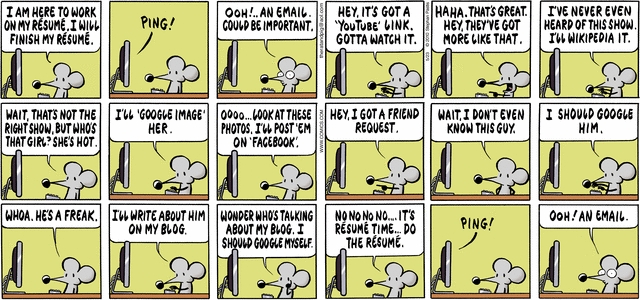
    Meanwhile, I wonder if all the information about those unaccounted for minutes is stored somewhere in my brain, and is just not deemed enough to be of any priority for me, and hence seems inaccessible. The tools that consume me these days – most specifically Twitter, and more recently, Foursquare, also help me keep track of what I’ve been up to, and when it works the same way for everyone is when there is an information deluge, and that seems to be something we find difficult to handle. Something that we have discussed before. There is a toon I found (here) that correctly describes the way a lot of us seem to be functioning now

    Clipboard01

    And in another example of how man is shaping his own evolution, I read about companies like Lifenaut, which  ultimately aim to create humanoid robots powered by a backup of the original human’s brain. (via @pkaroshi) The first step is to create a digitised version – an avatar, and give it enough data for it to mimic the original human. It makes me wonder whether we will be able to create ‘consciousness’.

    And that makes me think a bit more – by the time, we are technologically advanced to create it, will we have forgotten what consciousness is? Which also begs the question whether we have ever understood it at all, when we are not even mindful of the minutes of our lives? How does one define it? So many reactions which seem pre-programmed when one thinks of it, actions and reactions more out of habit than any conscious choice being exercised.

    So yes, with all of the work happening at a rapid pace, (do read) I think its more ‘when’ than ‘if’ – that we will become immortal, and time, from a future point of view, will become immaterial, because the future will be infinite. But we still may not be able to undo what we did a minute back. Where does that leave us? To quote Pico Iyer (from Abandon) “God has to be understood in the context of everything that is not Him”. But that is a different discussion, I guess. Its only that with every advancement that humanity makes, and in that process also usurps things once attributed to divinity, I begin to wonder where that leaves our versions of God?

    until next time, time.ly links 🙂

    PS. I tweeted sometime back, even if you never read an Asimov work, or never plan to, this is one that you should read. The Last Question.

  • Butter Chicken in Ludhiana: Travels in Small Town India

    Pankaj Mishra

    If one were to go by the title, Pankaj Mishra is hardly the person who can be trusted to write about the “national bird of khalistan”, after all he’s a complete vegetarian, but then this book is about ‘travels in small town India’. From Kanyakumari and Kottayam to Ambala and Murshidabad and Gaya to Mandi and Udaipur and many many more small towns across the length and breadth of India, this is quite a wonderful account of a transforming India..and Indians.(set in 1995)

    While there is an unmistakable cynicism that runs through many accounts, it does not really take away much from the conversations with a wide array of people – their fears, their hopes and aspirations, and how they cope with the changes around them. Television viewing habits, consumerism, big dreams, all figure as a framework for the author to show the ‘progress’ that Indians seem to be making as far as lifestyles go. ‘Progress’, because the author doesn’t seem to be entirely pleased with these changes, and the effects on existing ways of life, but since we also see them through the eyes of the people the author meets, the book manages to retain some objectivity.

    While some would say there is an aimlessness to the travels, I’d say that despite the differences in locales and attitudes, there is a common thread that runs through the book – of humans, their reactions to change, and how in many ways, a lot of things remain unchanged, despite what the superficial would indicate.

    The book worked for me in many ways – I could find glimpses of ‘The Romantics’ (a later work of fiction from the same author, which happens to be a favourite) as his travels take him to Banaras. It also brought about some nostalgia, as it is set in the early 90s, and the changes that the author talks about are something that anyone in the their teens (or even older) during that time, can identify with. These, and the wry humour – especially the part where he’s mistaken for a potential groom by Mr.Sharma in Ambala – that surfaces occasionally, took it many notches above a general travel book..

  • Watermark

    Sometime back, while trying recollect the name of a Chinese restaurant in Koramangala which existed circa 2003, I got stuck. Despite different mashups of the various terms used typically for Chinese restaurant names, nothing sounded right. It was a small mom-and-pop joint and since the net didn’t then feature all the resources it has now, I was well and truly stumped. It was quite disappointing since we’d had many a meal there. It didn’t help that I have this ‘thing’ about remembering such places, events and people. I feel as though I have betrayed them in some way. Yes, weird, thank you. :p  The book, for once, couldn’t help either. I finally got the answer by checking with a friend who’d been in Koramangala long enough. Once I got the name, I even managed to get an image on the net – Szechuan Garden. 🙂

    A few days later, I watched Pakal Nakshatrangal, a movie about a script writer – director played by Mohanlal. The narrative is from the perspective of his son, an author, who writes his father’s biography, and in the process tries to solve the mystery of his death. The movie begins with the demolition of ‘Daffodils’, the cultural hub of the previous era’s intellectuals and the scene of Mohanlal’s many exploits. There is a sequence in which a television newsreader reports this and we can see different people viewing it from different places reminiscing about their experiences there. A group of people connected by a place.

    A place or an event in that place – that means something to a set of people – something only they share. And when they cease to exist, the memory disappears. Its as though whatever they shared never existed. A bit like the Garden State quote that I often end up using “Maybe that’s all family really is. A group of people who miss the same imaginary place.”

    It reminded me of another Malayalam movie I’d seen a while back. Kerala Cafe, an anthology of ten short movies, with the place – Kerala Cafe, a coffee shop in a railway station, serving as the connection. But more than that entire movie, I remembered my favourite – Island Express, written and directed by Shankar Ramakrishnan. (Part 1, 2, seems unedited, and has incomplete subtitle help!!) [Spoiler] The story is about several people who were in some way affected by the Perumon tragedy in 1988, and their meeting at the fateful place a couple of decades later. Its narrated by Leon, who  lost a lot himself, but makes a photo-book of it after seven years of efforts. I realise that Leon’s phrase, that remained with me long after the movie, is what this thought is all about.

    As time passes, and life moves on, some of us are left holding the memories of these places, sometimes by choice, sometimes because we have no other choice, and sometimes by chance. But there’s no doubt about the transience of it all. Its after all, a matter of time. Perhaps the entire idea of a lifestream – the things I share here, and everywhere else is all about the phrase that Leon uses – ‘a memory with a watermark’.

    until next time, memories without shelf-lives

  • Sikkim Day 3 – Tea, Gangtalk, and the legend of Pawan Chamling

    The alternate plan we chose consisted of the tea estates in South Sikkim, and the Padmasambhava statue in Namchi. Our driver was the same, and that’s when we figured that we still didn’t know his name. Our expectations of a unique local name evaporated at the mention of ’Prakash’. We followed the same route as the day before, this time though, Prakash offered a lift to some lady friend/relative of his. The sign on the road that said ‘Welcome to Nathula and the old Silk Route’ seemed to be mocking us.

    The tea estates were actually more peaceful than Rumtek, as we watched the workers, laden with baskets, moving slowly.

    1 2

    httpv://www.youtube.com/watch?v=s7OdfkZfmsA

    The rain insisted on greeting us again, and the tea estates and Namchi were shrouded in mist, just before the clouds opened. The kids didn’t seem too unhappy about having to stop their football game though. 🙂 The break meant that I even tried my hand at doing what  I’ve seen Twilight Fairy and Ashu Mittal do amazingly well.

    6 5

    Meanwhile, the mists meant that even the tall, all seeing statue couldn’t have had a view worth talking about. Pawan Chamling made his first appearance as the man who had conceptualised the entire statue idea. Thankfully, he didn’t do a Mayawati. Thereafter, we would behold this name on many bridges and other constructions. To borrow an old Escotel ad line “Only the rain covers Sikkim more than Pawan Chamling does”

    3 4

    We arrived late at Gangtok, at about 3, and were famished. We decided to drop in at Gangtalk. Though we initially got a seat inside, we managed to shift to one that offered a good view of MG Marg. By the time we got our food, it was almost 4. It turned out that they had other burning issues to tackle in the kitchen, literally. We spent our time looking at the Bollywood posters on display – Teesri Manzil, Guide, and hey, Karz. I looked at D, and she glared back. There was a raucous group at the neighboring table. A kitty party, we thought, and points were being given for the most absurd cackle that could be generated. If ever a ‘Gangtok Times’ were launched, this crowd would probably populate Page 3. My prayers, Gangtok. The meal was redeemed by a superb Khwa Sye (sic). (Khao Soi) The owners were quite apologetic about the delay, and we saw the scene enacted at many other tables. We were the last set, it meant we had a longer chat. They promised that if we returned for dinner, they would redeem themselves.

    We had planned to catch the ropeway in the evening. We reached there at 4.40, and learned that though the information that it was open till 5 was right, ticket sales stopped at 4.30. We trudged back, to a place where I clicked ’the bull in the china shop’, even as D bought herself a nice handbag, and finally ended up across the street  (from Gangtalk) at Baker’s Café. Mostly for the MG Marg view. We were lucky enough not to get a seat that offered the view, because the other side had an even more splendid view.. of the mountains.

    7 8

    Surrounded mostly by foreigners and giggly high school girls, yet another music related nostalgic journey was triggered as I listened to ‘The Power of Love’ and ‘I want to know what love is’. The girls seemed to be enjoying it much, and I wondered whether these songs would always appeal to an age in life and stand the test of time, despite other entrants in the music scene.

    We arrived at Mintokling, struggling for breath, and caught glimpses of  poor Shashi Tharoor also struggling to retain his post. Dinner was at Café Live & Loud, and the chilly pork was awesome. Another place with a great ambiance. They’ll probably remember me too, when they get their internet bill.

    9 10 11

    Reciprocally, D would remember them later at night too, as her cheese pizza retraced its path. I wondered if she  had sampled the massively popular, Danny Denzongpa owned ‘Hit’ beer  (he also owns an alcohol brand called ‘He-Man’) when I was looking at the ‘pure’ Gujarati restaurant across the road.

    12

    For now, we hit the bed.

    13