Category: Social Commentary

  • Awesomeness is homemade

    Three weekends and three Malayalam movies – different genres, different directorial approaches and a largely non-overlapping cast. But all of them underlying that this is indeed becoming a glorious age for Malayalam cinema! New stories, novel thoughts, fresh perspectives – this is a wonderful time to be a viewer. I decided to write this post, because as I’d mentioned earlier while on the subject, movies are a representation of an era, and years later, I’d like to read this and remember what a great time we had!

    On the first weekend, we saw ABCD, (trailer) starring Dulquer Salmaan, who with each outing impresses further, seems destined to be an actor and a star, and might not have to wait for years like his father (Mammootty) to attain either. Our decision to see it in the theatre was also heavily influenced by the presence of Jacob Gregory, whom we were fans of thanks to Akkara Kazchakal. The movie was not meant for intellectual stimulation and delivered its promise of entertainment quite easily. What it also did was look at contemporary issues in a non-preachy way. Despite a few niggles – the editing could have been better, Gregory’s accent could’ve been worked on and he could have been better utilised in the first half – Martin Prakkat has ensured that his success continues after his debut film Best Actor. Extra points for not trying to force fit a love story that could have spoiled the superb essaying of a script-backed character by Aparna Gopinath, the very anti-thesis of a traditional Malayalam movie heroine.

    The second weekend saw us in PVR for 5 Sundarikal – an anthology with stories of 5 different women in various life stages. 5 directors, with one of them making a debut. My favourite was Aashiq Abu’s Gowri, (despite not being a fan of Kavya Madhavan) thanks to the really sensitive story of a couple whose life goes through a drastic change after a seemingly casual remark by a visiting friend. Kullante Bharya was an equally strong contender, and quite unchacteristic of Amal Neerad, I might add. I place it second only because the story is an adaptation. Dulquer takes on the narrator role with ease and does a splendid job of making sure the nuances are caught just right. Shyju Khalid’s Sethulakshmi, based on a story by M Mukundan, is poignant and very disturbing! Fantastic treatment of the story in terms of catching expressions, and portraying scenarios. Anwar Rasheed’s Aami does not fail only because of the superb portrayal of the protagonist by Fahadh Fasil, who captures the flitting gray shade nuances of his character with ease, and the riddle based flow of the story. Sameer Thahir’s Eesha, starring Isha Sharvani and Nivin Pauly reminded me of a short story (not sure if it’s Archer) and was probably the only one which only worked marginally for me. But in all, it was an excellent compilation.

    The best was saved for the last – Murali Gopy teaming up with Arun Kumar Aravind after Ee Adutha Kaalathu – Left Right Left. The title of this post is inspired by its tagline – revolution is homemade. Fantastic casting, with Hareesh Peradi, (what was he doing in Red Chillies?!)  Murali Gopy and Indrajith making each character easily believable. So strong is the script that you feel the angst and pain that each of them have within – and that even goes for the ruthless character played by Hareesh Peradi. The political overtones are more than obvious, but yet manage not to take over the film. There is an immense amount of realism in the movie, and that is not because one could easily associate it with real life personalities, but because even the secondary characters have a clear DNA – why they are the way they are, what drives them, what is their rationale for doing the things they do. It is really difficult to choose between the three protagonists and that’s because of the strong script as well as the brilliant portrayals. Like I mentioned in a tweet, it was awesome to see the sons of gifted actors – Murali Gopi, Indrajith Sukumaran, Sudhir Karamana, and Vijayaraghavan in a single movie! If that isn’t new generation Malayalam movies, what is? 🙂 A powerful, hard hitting movie, and kudos to the director for delivering the script just right! For now, watch the back story of the characters in the movie’s potent anthem

    until next time, malayalam cinema #ftw

  • A life less lived..

    Quite a while back, I remember writing about people who, despite their circumstances, continue to plod on through life, not giving up on it. I ended it with a quote from ‘The Hurt Locker’ by James ‘Everyone’s a coward about something.‘ I added that sometimes it’s life, and sometimes it’s death.

    I was reminded of this when I read about the Goa couple‘s suicide and another one closer home – a person I knew, if only for a few months – one which came as a rude shock. In the first case, Anand Ranthidevan and his wife Deepa took a very deliberate and seemingly well thought through decision to end their lives, planned down to the last detail. The label I’ve heard several times in conversations – real and virtual – is disturbed. I don’t subscribe to that, it’s probably the reaction from a society which just cannot accept that people without any troubles could really make a conscious decision to end their lives. I can actually identify with it because in conversations with friends, I’ve toyed with the idea of driving off a cliff at say 55-60, when a life has been lived fully.

    But just like the question in the earlier post – why people continued to plod on, I am interested in the flip side too. Why do people choose to end it? In situations where the individual is troubled by something – physical/emotional/under the influence of a drug, there is probably a point where he/she feels the problem cannot be solved, and chooses to end the journey.

    The Goa incident is different because the individuals were in their prime, at least in terms of age. When sports personalities, actors etc retire at the ‘right’ time, they sometimes use the ‘Why retire now vs Why don’t you retire now’ line. Can one think of life that dispassionately? Probably, if one knew what lay after, or if one didn’t care, or thought it wasn’t worth the effort. Or when one felt that one’s existence didn’t matter to anyone but the self. Or maybe there when there was no problem worth solving. What do you think?

    until next, life </span>

  • A social club of one

    Sometime back, I read a post on @daddysan’s blog on choices and how we “defend freedom of choice but we criticize those who exercise it because those choices may not be concurrent with ours.”  To be noted that the thrust of the argument is not on ‘labeling’ products/services per se, but labeling the people who consume it, more so in cases when it’s a personal choice and doesn’t endanger or even affect others in a significant way.

    I found this post interesting because I have always been intrigued by choices and their significance, not just from the perspective of whether they are choices at all, but also from that of the judgmental robes we like to wear. The last time I had written about the latter was in the context of expertise. But a comment on this post gave me quite a new direction for thought. More on that in a bit.

    In the context of the post itself, though I understand that labeling (and battles around them) has probably been around from the time the species became 2 in number, I think the publishing power that the internet created has taken it to a whole new level. So while “people who smoke/drink versus those who don’t”, “people who apply coconut oil on their hair versus those who don’t” and so on have had battles fought with much fervour, the internet’s ability to aggregate opinion has escalated many issues to war levels, like the examples daddysan has used.

    And so I wonder if it has something to do with the ‘Like’ necessity that has increased its hold over our lives recently. Social endorsement, even from total strangers. When I am a consumer of X, and you chose to buy Y instead of X, it is as though you have not ‘Liked/Retweeted’ my awesome intelligence in choosing X. Peer reaction was probably a major factor in my choice, whether I acknowledge it or not, and in saying that I have gone wrong, you have invoked my ego and brought up the subject of whether I chose X purely for its tangible or even intangible benefits or whether I chose it to conform to some section’s decree. Now, you probably didn’t mean to do any of this, and also are under some sort of peer review process yourself, but that’s irrelevant and it’s now war. Just like many of the Likes/shares/retweets are from people I don’t even really know, the war just brings in all sorts of strangers and camps.

    For the record, I have exactly one Apple product, which was gifted to me, and if it has any iron parts, it should be rusted by now. I read Chetan Bhagat and when I get a chance, take potshots at him. Just can’t resist. 😀 I think Ponytail sucks, and again, don’t lose a chance to crack a line at his expense, but I have held back much since the time he made a movie with the awesome Funny Deol. Joke sako to Joke low is the policy.

    But, enough. The comment that made me think was made by Jo Chopra McGowan, and it was about how individual choices add up, affect others, and could probably end up in impacting popular culture/lifestyles etc. I’d never thought of it that way. But yes, most of us/our actions influence at least one other person, and so the chain goes. More often than not, our reasons for doing so remain un-shared, and somehow one personal choice could create a conformity wave. Obviously the easy way to stop it is to make conscious choices and that brings us to the vicinity of square one. 🙂

    until next time, unheard mentality!

  • Comic Gone

    Some time back, Comic Con India had its first edition. And it promises to remain, for me, just like the Jaipur Lit Fest. I’ll come back to that in a while. Meanwhile, unlike the Jaipur Lit Fest, I wasn’t found living in a cave for this one. But that didn’t stop my participation from being limited to virtuality – a Comic Kaun tweet, (which someone thought was a genuine event  resulting in a #facepalm moment for me), wordplay with Roshni resulting in #CommieKaun – finding revolutionaries, tweeting photos and using the new display of global solidarity – the Facebook Like.

    So, the comparison to the Lit Fest. For the last two years, I have been making hazy plans to get there. Every time I see camels here in Bangalore, I also wonder whether they might consider shifting the venue, but I guess that’s unlikely. And especially after the controversies this year, I don’t think I’ll bother going again.  Can’t stand places where you can’t say things in a lighter vein. So I will just sit here in Bangalore, and hope for some controversy so I can have some fun with it on Twitter.

    The Comic Con event seemed quite popular this year.  So I asked myself why I felt I wouldn’t drop in next year. There seemed to be something more than the  omnipotent but generic laziness + shyness combo. Given my affection for superheroes and costume creation, Comic Con would probably be fun.

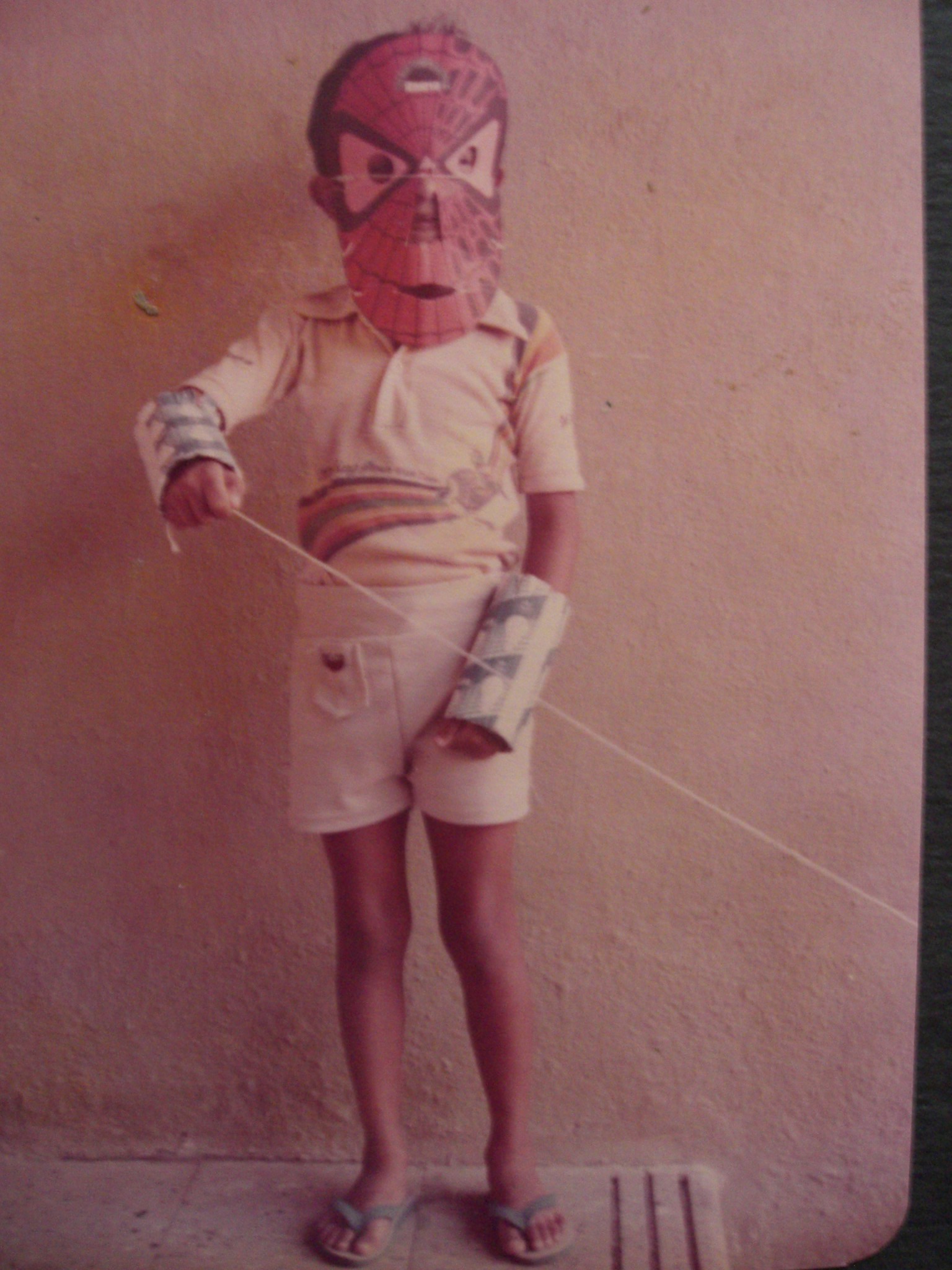
    If I were still the boy on the left, I would probably have been there instead of writing a post. But somewhere in a couple of decades, I’ve forgotten how much fun it could be even when Spiderman was just a Rasna sponsored mask, Bajaj bulb covers and a piece of thread. Now there are other roles, and other audiences, and playing for an audience of one is just a distant hazy memory. When I can remember it better, maybe I’ll go.

    until next time, cosplay time doesn’t last forever.

  • Running for eternity

    I must confess that I didn’t like Mitch Albom’s “Tuesdays with Morrie” as much as his other book “The Five People you meet in heaven“, but writing anything negative about a non-fiction book such as this is not in good taste, so I refrained from doing a review. I also think that it is not so much a bad book and this takeout is more to do with my evolution than the writing or the concept itself.

    The good thing though is that it does have quite a few nuggets that you can chew on for quite some time. 🙂 This is my attempt to thread together a few. To be precise, three of my favourites.

    At least a couple of times in the second half, Morrie talks about how people run after the next house, vacation, car, job etc because they think that this will grant them the elusive ‘meaning, and how our culture has ‘forced’ people to feel threatened when they stand to lose their materialistic gains. This is what makes money God, and them mean. This is, of course, completely debatable, but I brought this up only for context. It led me to think that how, in infancy and in old age (from several instances I have seen, read about) and perhaps sickness, we are more concerned with needs, and at all times in between, it moves towards wants.

    On a tangent, I remembered the ‘proof of good times’ thought that I’d shared earlier, more than a year back, in ‘Progress Report‘, and how we capture images and notes, sometimes for ourselves, and sometimes for others. Ourselves, for memories, and perhaps posterity, and others, because, I thought ubiquitous social connectivity is perhaps making us inadvertently live a life we want to portray to others. I discovered a nice usage in the book that connected to this thought of eternity attempts “And tapes, like photographs and videos are a desperate attempt to steal something from death’s suitcase“.

    And while on posterity and eternity, the last one, a quote from Henry Adams “A teacher affects eternity, he can never tell where his influence stops”. I think, in that sense, every being is a teacher, and thus lives on.

    until next time, wednesdays with manuscrypts, okay? 😉