
Category: Social Commentary

  • A social club of one

    Sometime back, I read a post on @daddysan’s blog on choices and how we “defend freedom of choice but we criticize those who exercise it because those choices may not be concurrent with ours.”  To be noted that the thrust of the argument is not on ‘labeling’ products/services per se, but labeling the people who consume it, more so in cases when it’s a personal choice and doesn’t endanger or even affect others in a significant way.

    I found this post interesting because I have always been intrigued by choices and their significance, not just from the perspective of whether they are choices at all, but also from that of the judgmental robes we like to wear. The last time I had written about the latter was in the context of expertise. But a comment on this post gave me quite a new direction for thought. More on that in a bit.

    In the context of the post itself, though I understand that labeling (and battles around them) has probably been around from the time the species became 2 in number, I think the publishing power that the internet created has taken it to a whole new level. So while “people who smoke/drink versus those who don’t”, “people who apply coconut oil on their hair versus those who don’t” and so on have had battles fought with much fervour, the internet’s ability to aggregate opinion has escalated many issues to war levels, like the examples daddysan has used.

    And so I wonder if it has something to do with the ‘Like’ necessity that has increased its hold over our lives recently. Social endorsement, even from total strangers. When I am a consumer of X, and you chose to buy Y instead of X, it is as though you have not ‘Liked/Retweeted’ my awesome intelligence in choosing X. Peer reaction was probably a major factor in my choice, whether I acknowledge it or not, and in saying that I have gone wrong, you have invoked my ego and brought up the subject of whether I chose X purely for its tangible or even intangible benefits or whether I chose it to conform to some section’s decree. Now, you probably didn’t mean to do any of this, and also are under some sort of peer review process yourself, but that’s irrelevant and it’s now war. Just like many of the Likes/shares/retweets are from people I don’t even really know, the war just brings in all sorts of strangers and camps.

    For the record, I have exactly one Apple product, which was gifted to me, and if it has any iron parts, it should be rusted by now. I read Chetan Bhagat and when I get a chance, take potshots at him. Just can’t resist. 😀 I think Ponytail sucks, and again, don’t lose a chance to crack a line at his expense, but I have held back much since the time he made a movie with the awesome Funny Deol. Joke sako to Joke low is the policy.

    But, enough. The comment that made me think was made by Jo Chopra McGowan, and it was about how individual choices add up, affect others, and could probably end up in impacting popular culture/lifestyles etc. I’d never thought of it that way. But yes, most of us/our actions influence at least one other person, and so the chain goes. More often than not, our reasons for doing so remain un-shared, and somehow one personal choice could create a conformity wave. Obviously the easy way to stop it is to make conscious choices and that brings us to the vicinity of square one. 🙂

    until next time, unheard mentality!
  • Comic Gone

    Some time back, Comic Con India had its first edition. And it promises to remain, for me, just like the Jaipur Lit Fest. I’ll come back to that in a while. Meanwhile, unlike the Jaipur Lit Fest, I wasn’t found living in a cave for this one. But that didn’t stop my participation from being limited to virtuality – a Comic Kaun tweet, (which someone thought was a genuine event  resulting in a #facepalm moment for me), wordplay with Roshni resulting in #CommieKaun – finding revolutionaries, tweeting photos and using the new display of global solidarity – the Facebook Like.

    So, the comparison to the Lit Fest. For the last two years, I have been making hazy plans to get there. Every time I see camels here in Bangalore, I also wonder whether they might consider shifting the venue, but I guess that’s unlikely. And especially after the controversies this year, I don’t think I’ll bother going again.  Can’t stand places where you can’t say things in a lighter vein. So I will just sit here in Bangalore, and hope for some controversy so I can have some fun with it on Twitter.

    The Comic Con event seemed quite popular this year.  So I asked myself why I felt I wouldn’t drop in next year. There seemed to be something more than the  omnipotent but generic laziness + shyness combo. Given my affection for superheroes and costume creation, Comic Con would probably be fun.

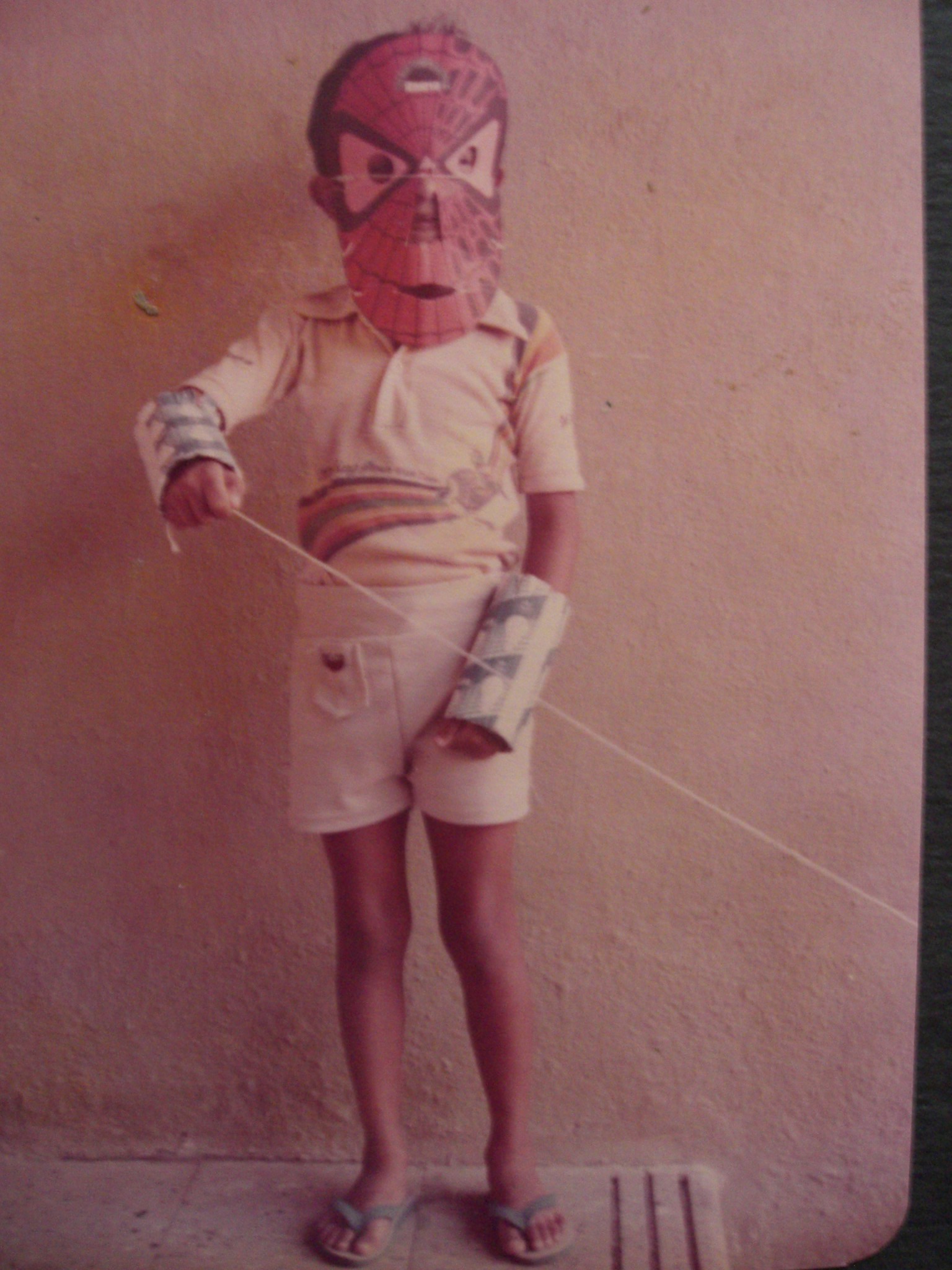
    If I were still the boy on the left, I would probably have been there instead of writing a post. But somewhere in a couple of decades, I’ve forgotten how much fun it could be even when Spiderman was just a Rasna sponsored mask, Bajaj bulb covers and a piece of thread. Now there are other roles, and other audiences, and playing for an audience of one is just a distant hazy memory. When I can remember it better, maybe I’ll go.

    until next time, cosplay time doesn’t last forever.

  • Running for eternity

    I must confess that I didn’t like Mitch Albom’s “Tuesdays with Morrie” as much as his other book “The Five People you meet in heaven“, but writing anything negative about a non-fiction book such as this is not in good taste, so I refrained from doing a review. I also think that it is not so much a bad book and this takeout is more to do with my evolution than the writing or the concept itself.

    The good thing though is that it does have quite a few nuggets that you can chew on for quite some time. 🙂 This is my attempt to thread together a few. To be precise, three of my favourites.

    At least a couple of times in the second half, Morrie talks about how people run after the next house, vacation, car, job etc because they think that this will grant them the elusive ‘meaning, and how our culture has ‘forced’ people to feel threatened when they stand to lose their materialistic gains. This is what makes money God, and them mean. This is, of course, completely debatable, but I brought this up only for context. It led me to think that how, in infancy and in old age (from several instances I have seen, read about) and perhaps sickness, we are more concerned with needs, and at all times in between, it moves towards wants.

    On a tangent, I remembered the ‘proof of good times’ thought that I’d shared earlier, more than a year back, in ‘Progress Report‘, and how we capture images and notes, sometimes for ourselves, and sometimes for others. Ourselves, for memories, and perhaps posterity, and others, because, I thought ubiquitous social connectivity is perhaps making us inadvertently live a life we want to portray to others. I discovered a nice usage in the book that connected to this thought of eternity attempts “And tapes, like photographs and videos are a desperate attempt to steal something from death’s suitcase“.

    And while on posterity and eternity, the last one, a quote from Henry Adams “A teacher affects eternity, he can never tell where his influence stops”. I think, in that sense, every being is a teacher, and thus lives on.

    until next time, wednesdays with manuscrypts, okay? 😉

  • Farm Vile?

    While two movies, despite not being remotely connected in terms of geography or genre, are perhaps not a trend, it did remind me of a conversation from more than a year back – something I blogged about too. An excellent conversation with S, that started with the dystopian scenario of 1984 and human farms and moved on to time travel, all in the context of advancement of society and the species.

    The movies in question are Gamer and Peepli Live, and the one thing that links them – the value of the human life. While the former is set in a word of the future, in which a new technology allows replacement of brain cells to allow full control of a body by a third party and finds application in gaming (one game in which gamers control a real person in a proxy community, a far more ‘real’ version of Second Life, and its more violent avatar, a multiplayer third person shooter game in which death row inmates fight for freedom), the latter is seemingly less complex – a farmer is ‘encouraged’ to commit suicide for the betterment of his family – more specifically, for the money they’ll get as compensation.

    And the question they make me ask – at what point in the future does mankind stop treating human life as sacrosanct? One could argue that it never has been, with the amount of killing that happens around regularly, but what I mean here is as a species. So, when someone says ‘human farms’, there won’t be gasps or expressions of horror/disgust. With population figures soaring, virtual lives competing with real ones, rise of machines, increasing gaps between the haves and have-nots, do you think it will happen? Just in case you think I’ve completely lost it, we’ve already started experiments with living beings – microorganisms in games.

    until next time, knotty question.

  • Armchair travel plans

    If I discount Pico Iyer, the travelogues of Pankaj Mishra, and Mishi Saran’s Chasing the Monk’s Shadow, I hardly read travel books. But I picked up Rahul Jacob’s ‘Right of Passage’ on a whim (influenced by Pico Iyer’s comment on the jacket) and quite liked it, mostly because its really not just a travelogue. Shall publish a more detailed post on that later.

    I was hooked on early enough thanks to the last lines of the preface

    Still, there is this final paradox of travel: time and again, these memories come back unbidden with the clarity of something that happened yesterday, long after we have returned to the rhythm of our lives

    Later in the book, he compares flight travels with train journeys – that he can remember his first flight journey but the rest are a blur. In contrast, however, he remembers most of his train journeys. Though I’m not really the most frequent of fliers, I can relate to that.

    I wonder if its to do with memories of childhood, in which train journeys played a very important part (for me), and that affinity meant that later journeys would also be cataloged better by the brain. Or is it the entire set of experiences – from ‘uniform’ airports to passengers consciously avoiding each other even if it means staring resolutely at the seat in front compared to colorful railway stations that seem to be oozing character to seats facing each other and almost forcing conversations?

    I juxtaposed this with cities and their culture too. Recently, when I went to Cochin, and dropped in at its most ‘happening’ mall, I wondered how much of homogeneity was being created by malls. The same brands, almost the same store experiences, familiar multiplex chains that somehow give you an air of familiarity even in an unknown town (not Cochin for me, but otherwise). How much of a city’s original hangouts and culture will survive this  onslaught? In fact, I even told D that I could already see landmarks of my days in Cochin  (local shops famous for some particular item) disappearing and the new ones (like a Nilgiris store) being unfamiliar to me. Would most people prefer familiarity over serendipity? Or would a middle ground be found – carefully packaged serendipity?

    Going beyond the things to be seen in a place, every travel experience is also about the  discovery of the character of the place you visit. Will we end up creating a homogeneous world, in our constant quest for convenience, and change travel from the train journeys they should be (opinion) to controlled fancy flights?

    Fortunately for this generation, this is perhaps not a reality we’ll live to see, and even in the sunset years we will have our memories and photographs and be thankful that not all journeys need travel.

    until next time, planed travel