My surname is very unobtrusive. It is present in all my official documents. It’s absent in my signature, and when I am casually giving my name in say, a form, I stop at my middle name, which exists courtesy Kerala’s matrilineal ethos. The surname’s modest behaviour is apt for the person it represents.
(more…)Category: Personal Updates
-
Zoned Out
On hindsight, I should have known it wouldn’t be that easy. A little over 150 days after Comfort Zoned appeared here, 2021 did a 2020 to me with a heart attack. Yes, literally. There is no hidden wordplay, as most of my friends assumed when I let them know! Should have done Anjuna to angina, since we had just returned from Goa the previous week! For someone paranoid enough to have done a genome-based preventive health assessment to detect and insure, this was insulting. I hadn’t expected it for at least another 3 years.
Heart attacks seem to be common now, and I checked in and out after a 3D/2N (Columbia) Asia sojourn. But cliched as it sounds, I had a lot of time to reflect. More so because while in the ICU after the angioplasty, I could hear the man who lay opposite my bed, in throes of pain and anguish, trying to find some meaning in the life he had lived. Maybe he sensed something. He became silent in an hour, even as nurses and doctors frantically tried to save him. A few minutes later, a long beep was all that remained.
It made me revisit the luxury (and privilege) of my comfort zone, and since this will be published after my second angio (done on a date that has other life-changing memories), I thought a good way for me to figure out the next chapters would be to frame the story so far.
Money
- D and I arranged our own marriage, and began our lives in Bangalore with a 1 lakh loan from Citibank. Everything that followed – the hard work, the decisions – was to prevent dependence on anyone. This is not an easy responsibility and probably what led to a scarcity mindset.
- It has an effect on many things, including career choices i.e. how you make money. If I had to “follow my passion”, I would probably be a travel writer, try my hand at script writing, and maybe even aspire to blink-and-miss roles. But that’s a bet. You get paid a lot if you’re in the top 1%, but the world is mostly the 99% who didn’t. Instead, I chose financial security as my North Star, and thankfully marketing isn’t the most boring career. In terms of learning, it never stops, but the focus for 20s, 30s and 40s – explore, expand, and extract respectively. See, alliteration! It’s important to keep your side interest alive. 🙂 You’re fortunate if you manage to do both.
- I think financial security is underrated – there is a trade-off, but it gives you the agency to lead the life you want. Even when you’re only moving towards it, you will become increasingly comfortable investing in things you like – in my case, books, travel, good food and alcohol, ridiculous decor… And I think, if/when you’re able to tame your ego and self image and get rid of delusions of significance, things become even better! The biggest trick in the book is starting early – compounding is an extraordinary phenomenon, and it needs time.
Relationships
- One problem with the scarcity mindset is that it also tends to define relationships. It was only after I got to a certain comfort level in terms of our “f*** you money”, that I even let most people in. Because early on, I had at least a couple of experiences when a friend/relative borrowed money, and only after a couple of missed deadlines told me about their philosophy of “Do I even have to pay you back?” That led to exits – money and relationship, and I became cynical about the value of relationships.
- Only recently, I realised that the early mindset of being independent and not taking help might have caused a judgmental “not giving help” side effect. Funnily enough, this isn’t applicable to causes and the world-at-large, but instead, directed at friends and relatives (The intrigues of my empathy). I am still cynical, but more conscious of it, and its machinations.
- Find and hold on to people who can give you non-judgmental company. It’s a treasure. I think you have to be lucky to find new friends in your 40s! That damn ability seems to shrink with age. And once you have made certain consequential and irreversible choices – the kind of apartment you buy, being parents (or not, like us) – it adds constraints. On a side note, I think folks who are parents are better at compromises and negotiations!
Health
- Back in 2006, I first came to know about my stratospheric cholesterol levels. Since then, in one form or another, I have been exercising five days a week. I love my beef and chocolate, and my rum and whiskey, but everything is consumed in moderation. But fitness and health are different things that we tend to conflate. Also, the genes have a will of their own, and despite reading a lot about it, I thought I could beat it with a diet and exercise regime. Nah.
- Do yourself a favour and at least at 35, start an annual checkup habit. Yes, you might have to do trade-offs, but at least to me, being in control of the narrative seems like a better choice than a take-it-as-it-comes approach, because the latter also has an effect on your spouse/partner/family. One realisation is that we have a remarkable ability to normalise things, even those we thought we could never change/live without.
Navigation
A couple of things that are applicable to all three aspects above
- Habits: Another underrated phenomenon. And they work as a force multiplier in both directions i.e. the good ones will give you superpowers, and the bad ones will pull the rug from under you. Take the time to understand what kind of person you are, and want to be. And build your habits around that. The caveat to that is moderation. For instance, I am a compulsive planner. The good part – I could guide D while experiencing a heart attack, because I had the scenario planned. The bad part – irritation when things don’t go according to plan e.g. not enjoying a vacation because the plan is chockablock. On a related note, it is in the nature of things to change. I can assure you that you will laugh at the things you decided/did when you were younger. In that context, acknowledge that habits will need rewiring too. To borrow from another context, “we first shape our habits, then our habits shape us”. A good idea to revisit them every once in a while, and look at them objectively.
- Trade-offs: Many things in life are finite, include time and money. While “All I want is everything” is a perfectly normal stance, reality most likely will include trade-offs. Some conscious, and some that you realise only later. The higher the ‘conscious’ tally, the better I feel. You will need to find your own balance. A related application is in decision-making. A friend taught me to ask myself “how important will this be in five years?” For the past few years, my optimisation has been to give myself optionality, with a broad idea of where I want to be. Reality is a full contact sport, and there’s only so much control you have.
P.S. A good book to read on many of these things – Morgan Housel’s The Psychology of Money.
-
Mentoring Startups @ Microsoft Ventures’ Accelerator Program
When I come to think of it, my sales/brand jobs have all been on startup mode, though the organisations themselves were quite established – Dishnet DSL in 2002, WorldSpace in 2003, MidDay Bangalore in 2006, Bangalore Mirror in 2007. Myntra was still a startup when I joined in 2011. I really can’t remember when I first became interested in startups – perhaps Bangalore’s culture of entrepreneurship affected me soon as a landed here – in 2003. But it really started manifesting itself only during my stint at The Times Group. Muziboo was probably among the first I actually interacted with (in 2008) and I still remember sending feedback to Deap for Burrp’s mobile site in 2009.
It was in 2010, when I started writing the startup column for Bangalore Mirror that I understood why I probably had such a fondness for startups – in them I see individuals who have in some way connected to their purpose in life. That gives them a passion and energy that is amazingly infectious. After the column’s run ended in 2013 (at 97 Bangalore based startups!) I had no official reason to associate with them any longer, though the connections I’d made early on – Zomato, for example – gave me an occasional opportunity to indulge my interest.
(via)
All of this would explain my immense happiness when I was invited to be one of the mentors at the Accelerator Program of Microsoft Ventures last year. The Accelerator is part of a global establishment and helps entrepreneurs launch/scale their startup through a 4 month intense program that begins in January and July every year. At the accelerator, the entrepreneurs get access to quite a few things – a pool of mentors with expertise across various domains, (design, brand, technology, to name a few) office space to work from, and a ton of connections to help them gain funding and scaling opportunities. (FAQ) The other crucial factor they get, and I’ve seen it not getting the attention it deserves, is the Accelerator team itself. I have seen their diligence and their interactions, and they add an enormous amount of value in shaping ideas into executable plans.
I’ve now been part of the last two batches, mentoring a couple of startups in each batch – TommyJams and Tookitaki in the previous batch, and Imly and Voonik in the current. Respectively operating in the domains of entertainment, advertising, food and fashion, these four by themselves are enough to give you an idea of the diverse kind of startups that make up each batch. Though I’ve worked closely with these, I’ve also had multiple conversations with other startups and have been impressed by the sheer quality of ideas behind many of them, their willingness to learn and reinvent if necessary, and the tenacity with which they execute their plans.
My role may be that of a mentor, but I’ve learned quite a bit too. My learning has been in many forms – watching the startups in action, understanding at least a part of the intricacies of the domain they operate in, their approach to the challenges they solve, and most importantly, conversations with other mentors. Many of the mentors belong to the investor community and bring with them fantastic perspectives on a wide variety of things.
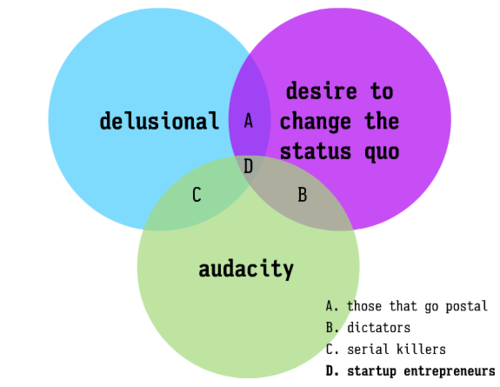
It has been an exciting experience for me thus far, and I’ve been planning to write about it for a while now. The immediate trigger came last week in the form of an invite for the Demo Day of the current batch. I also learned that the Accelerator had started taking applications for the next batch. In my own selfish interest, I’d like to play a role in the life of some entrepreneur out there. If you think you are ‘D’ in the figure below, apply away!

(via. Check the superb original deck here. Thanks @m3sweatt for p0inting out )
Disclosure: In case you’re wondering, mentors don’t get paid, not even to write this! 🙂