Category: Life Ordinary

  • Moving past

    It’s April 24th. Later in the day is my favourite part of the week – the Sunday evening ritual with D. Balcony, drink, sunset, and mood music. Sometimes we fill it with conversation, and sometimes we’re just content in each other’s presence. Today is extra special because it’s our anniversary – 19th.

    It was a week ago, when it suddenly struck me that back in April 1993, he would have still been in a state of shock. It had only been a few months since he turned 49. They would have celebrated their 18th later in the year. But it wasn’t to be. A month ago, she passed, leaving him with a boy in his teens and a girl in primary school.

    In that moment of my realisation – of what he had lost – I saw everything he has done since then in a new light. And after all these years, I understood, and wept, for his loss.

  • A converging life

    The year was 1993, and at least for the next 4-5 years during which I actively played the game, I was hard at work trying to replicate it every time I bowled. Such was the magic of The Ball of the Century. I don’t even watch cricket now, and yet, I could sense my own excitement when I showed the clip to D.

    No wonder it came up in an evening with friends soon after. 40-something year olds who are still at war with the phrase ‘middle age’. We talked about Warne and how everyone was shocked – after all he was only 52. In the context of cardiovascular diseases, I think 40s are the new 60s, mostly courtesy a drastic shift in lifestyles. And that’s when it also struck me that all our celebrity crushes and role models are entering the second half, if not already well into it. In them, we see our own epochs. They are a part of us, and their age or agelessness have started defining us by holding up a now uncomfortable mirror for us. When health events happen to them, or when they pass on, or they retire (like Shahid Afridi at 18), we feel the spectre of old age. And along with that, the grip of our own mortality tightening. We’re watching the clock and conscious of time.* Or maybe it’s just me.

    But let’s not get morbid. While Simone de Beauvoir called ‘elderhood’ the ‘crusher’ of humankind – with our own biology and expectations of ourselves, and society’s different manifestations of ageism, she also believed that it is an opportunity to turn to ourselves, to be more responsive to our own needs, and less obliged to other people.** And hey, we still have mid-life crises, and the thrashing around for relevance and meaning. Also, apparently, in a happiness vs age graph, the 50s are when the curve begins its upward journey towards making a smile.

    But yes, the series of undulating hills that I wrote about in a post a while ago are certainly coming up. And while The Lincoln Highway is not my favourite Amor Towles book, two pages in it, when Abacus Abernathy weighs his life, were magic to me. I see no way to top that, so I’ll just leave you with it.

    What an extraordinary passage were those first years in Manhattan! When Abacus experienced firsthand the omnivalent, omnipresent, omnifarious widening that is life.

    Or rather, that is the first half of life.

    When did the change come? When did the outer limits of his world turn their corner and begin moving inexorably toward their terminal convergence?

    Abacus had no idea.

    Not long after his children had grown and moved on, perhaps. Certainly, before Polly died. Yes, it was likely at some point during those years when, without their knowing it, her time had begun to run out while he, in the so-called prime of life, went blithely on about his business.

    The manner in which the convergence takes you by surprise, that is the cruelest part. And yet it’s almost unavoidable. For at the moment when the turning begins, the two opposing rays of your life are so far from each other you could never discern the change in their trajectory. And in those first years, as the rays begin to angle inward, the world still seems so open, you have no reason to suspect its diminishment.

    But one day, one day years after the convergence has begun, you cannot only sense the inward trajectory of the walls, you can begin to see the terminal point in the offing even as the terrain that remains ​before you​ begins to shrink at an accelerating pace.

    In those golden years of his late twenties, shortly after arriving in New York, Abacus had made three great friends. Two men and a woman, they were the hardiest of companions, fellow adventurers of the mind and spirit. Side by side, they had navigated the waters of life​ ​with a reasonable diligence and their fair share of aplomb. But in just these last five years, the first had been stricken with blindness, the second with emphysema, and the third with dementia. How varied their lot, you might be tempted to observe: the loss of sight, of lung capacity, of cognition.

    When in reality, the three infirmities amount to the same sentence: the narrowing of life at the far tip of the diamond. Step by step, the stomping grounds of these friends had shrunk from the world itself, to their country, to their county, to their home, and finally to a single room where, blinded, breathless, forgetful, they are destined to end their days.Though Abacus had no infirmities to speak of yet, his world too was shrinking. He too had watched as the outer limits of his life had narrowed from the world at large, to the island of Manhattan, to that book-lined office in which he awaited with a philosophical resignation the closing of the finger and thumb. 

    *Trivia: It has been a decade since Gangnam Style became a phenomenon, two decades since Sourav briefly became Salman at Lord’s, 25 years since Diana died, Arundhati Roy got a Booker, the release of Hanson’s mmBop, Aqua’s Barbie Girl, and Titanic, and 30 years since Basic Instinct released, and Babri Masjid was demolished.

    ** Simone de Beauvoir recommends we fight for ourselves as we age

  • .bio

    D heard a podcast recently, in which a “patient”, after going through an entire treatment procedure, realised that she had been misdiagnosed – there was no illness! This could be an isolated case, but even then, how could it happen?

    Based on my recent experience with the doctor community, I realised that at least one facet of it was like any other profession. Some doctors keep themselves updated and bring a nuanced understanding. On the other hand, some still stick to what they have been told a decade or more ago, despite advances in procedures and medicines. For instance, several doctors in top hospitals for years had claimed I had a sinus problem. Dr. A finally diagnosed and treated it as a migraine, that too through a tele-consultation, and just like that those irritating headaches disappeared. In another instance, I probably became the first patient to ask for an endoscopy because the idiot gastro I consulted only because of an operational exigency, had no clue! To top that, the ‘counselling’ he did after that was practically the equivalent of asking me to take the next flight to the nearest temple town because the rest of my life would be devoid of meat, alcohol, spice and pretty much anything worth eating! Luckily, a different doctor with a slightly unorthodox approach cured me. I thankfully had my doctor-cousin J to whom I could turn to for perspectives each time I lost my mind, but not everyone has that luxury!

    All of this made me think about the profession and how things have changed. In my childhood, we had trusted doctors, who knew the family and were practically friends. They asked questions, took time to diagnose and were wary of indiscriminately throwing medicine and scalpels at every problem they saw. Of course, that can be taken to the extreme too. A few years ago, my dad’s doc in Cochin was responsible for his month-long hospital stay and pretty much a downhill after, because his response to a cough for over a month was broadly ‘this too shall pass’! But barring exceptions, these days before you say hello, there are 10 tests and a hundred forms (and insurance, of course) when you have a health incident. While the earlier lot of doctors probably relied on first principles and sheer experience to train their gut and create hypotheses, which could be validated with tests, we now ironically have abstract numbers and parameters.

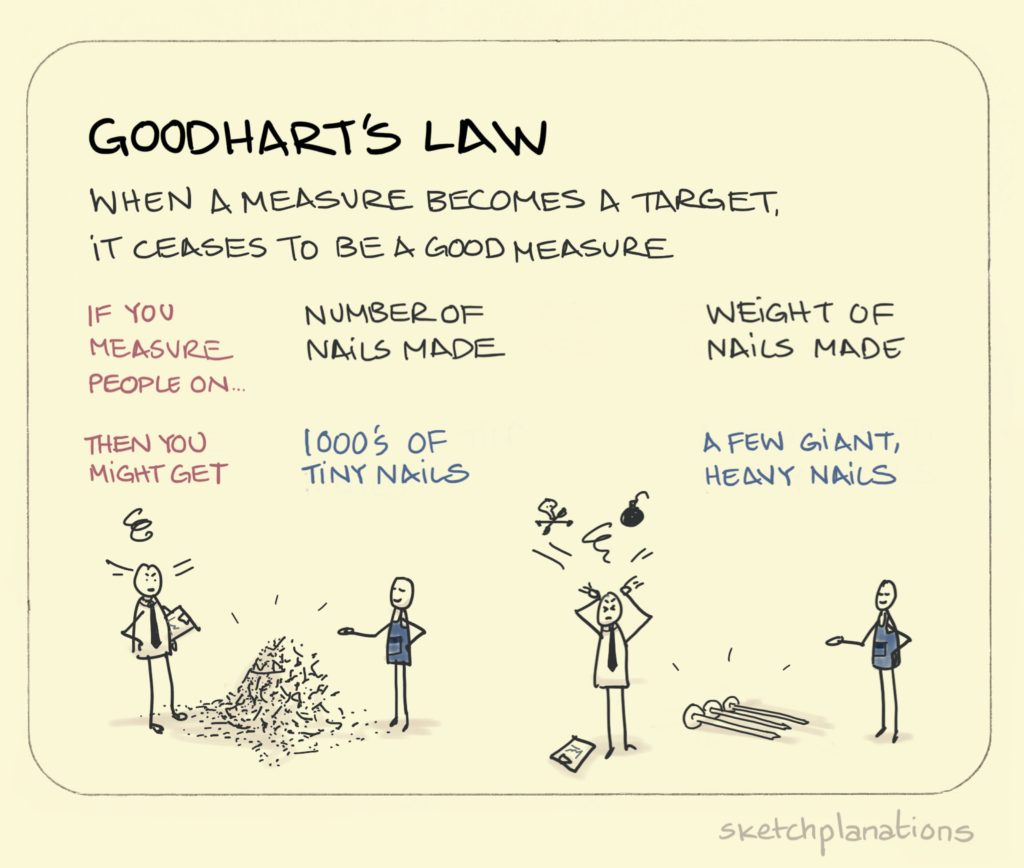
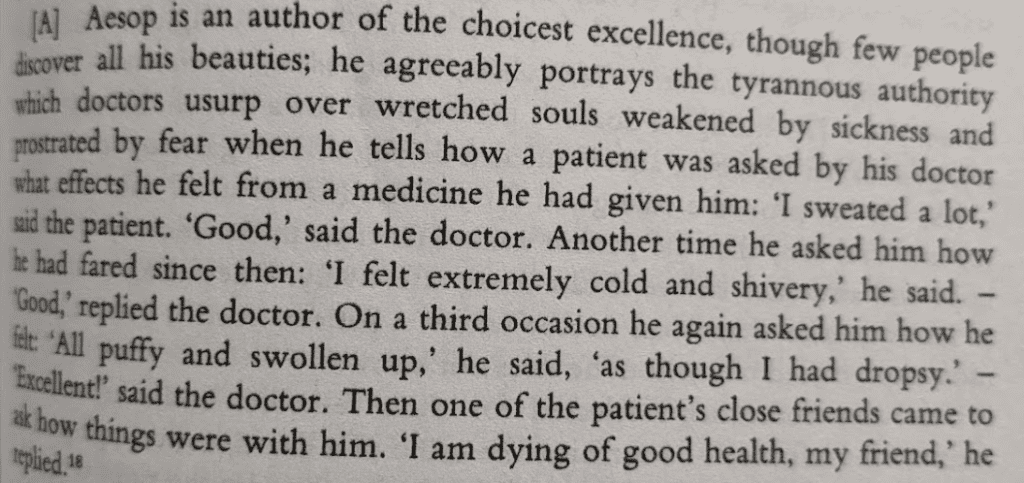
    What has also changed is how we select doctors. References aren’t easy, so we now choose doctors much like movies and restaurants – crowdsourced reviews, notorious for being gamed, or the ‘safety’ of a hospital chain, whose revenue models are infamous. Do doctors there optimise for pleasing people or treating them? Make sure the hospital keeps getting revenue, or ensure the patient doesn’t have to visit again?

    Which brings us to the nefarious component of practically everything in life now, even in a profession which was about saving lives. Money. Maybe it starts with the kind of money they have paid for their education, just as it is with a lot of other professions. They have to ensure they get return on their investments. Or maybe, as D pointed out, it isn’t even that nefarious, it is just conformity – this is what other doctors are doing. We are famous for that at a species level.* Or resistance to new ideas – after all, it was only a century and a half ago that the doctor fraternity resisted washing hands, and the poor doctor who proposed it lost his job and died in a psychiatric institution!**

    It made me wonder about the future of healthcare – at least two aspects of it. One of the big reasons we considered Kerala for retirement is the quality of government health care. Not that it’s perfect. In a town just over 50km from Cochin, where my in-laws live, the healthcare is borderline negligent! But from the little I have read, it seems other states are worse. I don’t see this improving, PM-JAY or any other Modiware notwithstanding. The taxes we pay, which are supposed to be used for things such as this, are probably being siphoned off to shell companies or for fighting the next election.

    On another front, what will the march of AI mean for all of this? Assuming we are able to program out the biases, will we have to worry less about medical costs because R&D can be potentially cheaper? Or maybe the arms race between microbes and us will become more intense. Will an increase in efficiency by the automation of tasks lead to more empathy? Will we have better diagnostics whose error rates are lower?

    At the ground level, from cancer and (potential) cardiac events via eye tests or sound and more accurately, to vaccines for the pandemic, there have been a lot of advances. Getting the genome sequenced, understanding genetic risks of specific diseases, collecting data via sensors and converting them into information and insight, and even creating rule-based programs to optimise for results ranging from aesthetic to cognitive are all possible now. After we have enough data, it should be (theoretically) possible to create a rule-based AI that works with sensors connected to the body and outside, to do everything from sleep structuring (mattress, temperature control, meditation apps, timing etc) to diets (recipe suggestion to ingredient ordering and even cooking – thanks to robot chefs) to an extremely optimised version of preventive health procedures right from the time of conception! And that’s probably a personalised step 1 of immortality!

    When health and healthcare change, how will the role of doctors evolve, and how (and how fast) will they adapt?

    P.S. Broadly related read on education – Why we stopped making Einsteins

    *Asch conformity experiments

    ** Keep it clean: The surprising 130-year history of handwashing

  • An IG Story*

    *Cheap thrills: Instant Gratification Story sounded less cool

    More than half a dozen years ago, in a Guardian article with bullet points fired against Powerpoint, Andrew Smith astutely noted that ‘In this century, it seems to me, our greatest enemy will not be drones or Isis or perhaps even climate change: it will be convenience.‘ We are now so deep into the convenience era that this would be met with ‘What’s wrong with convenience?’ Dennis Perkins, in a Vox article on video stores, had provided the answer – ‘The victim of convenience is conscious choice.

    I was reminded of this by the venture capital funded ‘who can deliver grocery fastest?’ pi**ing contest happening on Indian roads. I don’t know about the rules of venture capital, but road rules are definitely being rewritten by the delivery boys. Wrong-side riding, simultaneous road-screen navigation and so on. But that’s a whole different story.

    This is not just an India phenomenon. In its 2022 Media trends report, Dentsu has at least two points covering it – Omnichannel Everything (p9) and the Bring-it-to-me economy (p11). From Netflix to grocery and every consumption in between, these two trends rule.

    As Kavi notes in It’s too soon to say, our priorities are increasingly immediate over long-term. In everything from company results (QoQ) to bulking up with steroids to climate change. In a subsequent post, he continues this line of thought of us over indexing speed and time, and notes that this comes at a cost (and provides a useful framework to evaluate this for self). Intentionality is key, and this aligns well with my thoughts in the context of freedom.

    In a previous post – Default in our stars – I had written on the journey from Netflix’s Shuffle Play to the surveillance capitalist creation and exploitation of our behaviours. On the way, there are effects at an individual and societal level, including the loss of learning and the faculty to create and debate shared understandings.

    Increasingly, the convenience-based thinking and decision-making wiring that powers instant grocery delivery has started manifesting everywhere else. Politics was something I had pointed out around 4 years ago – In Other Fake news. As nuance does a speed-walk towards extinction, everything from the side you choose on Kim vs Kanye to pro-vax or no-vax is an us-vs-them all-out war. This is the meta level play of what Farnam Street calls The Small Steps of Giant leaps. Small choices on small things gradually removing the ability to think independently, form a point of view, debate it out with those who offer a counter-opinion, and replacing it with easy heuristics on which side to choose. When I think about how our species has advanced because of planning, sharing ideas, and finding ways to work towards them, I wonder if these are in some way the Chesterton fences of the mind that we are systematically removing.

    A related effect is the increasing inability to even conceptually think in years and decades. This has a disproportionate impact on two of the most important areas in life – health and wealth, or rather Insta-slim and Insta-rich. The unfair advantage of being able to think in decades on both is unfortunately lost to vast swathes of people once the instant gratification wiring takes hold. To quote from Farnam Street again, we win the moment at the cost of the decade. What’s more, one of the main ways to get this perspective – acquiring knowledge if not wisdom from those who have spent the time and effort isn’t spared either – we have 15 minute book summaries too. Zooming out, I wonder how much of narrative control we have already ceded.* How will one ever know!

    While cause and effect are still hazy, in my mind there is indeed a correlation between this instant gratification and being on stage and under scrutiny all the while. The mirror has been replaced by a selfie camera, and you can imagine what that would do to reflections!

    *Related Read: Because your algorithm says so

  • The building blocks of freedom

    In The Constraints on Freedom, I had brought up the impact of the loss of three basic freedoms at a personal level. The freedom to disobey, the freedom to go somewhere else, and the freedom to create new social arrangements. A big lesson from the book I got it from is that even at a civilisational level, ‘the map is not the terrain’ i.e. the granular trade-offs, impacts, and daily wins and losses of different societies don’t get covered in broad strokes. At an individual level, therefore, mapping one’s worldview and practices purely according to popular discourse and aping lessons from ‘experts’ blindly is probably not a great idea. This post is a start to framing my own can-need-want list and specific actions I would like to take to give myself (and hopefully some others around me) more basic freedom, and a bit more. I am framing this around three aspects.

    (more…)