
Covid19! As I watched people bang vessels, while washing mine, mopped the floor while waiting for the Sensex to please find one(!), and swept rooms while the lockdown enforced some sweeping changes, I also tried to step back and take a look – outwards and inwards – at what’s happening! (more…)
Category: Life Ordinary
-
Traveling – in & out
I borrowed the title of the post from a book I really loved – for exploring what travel could mean. Inward or outward, both of which I have experienced quite a bit this year.
One step back. For the last few years, we have been taking two international vacations a year. That just fits our annual travel budget, and the leave calendar at work. But who doesn’t like to take vacays more frequently? So this year, we stretched to fit an additional vacation within India – to Mussoorie. This also came from a feeling that we were being unintentionally snooty by ignoring our own backyard these days. 🙂 (more…)
-
Enough / Efficiency
In the 1930s, John Maynard Keynes predicted that advances in technology would increase productivity to a level that we would only need to work 15 hours a week. I wonder what he’d have to say about 996. It’s also ironic that despite the amount of time that technology has helped us save – Google Search, Facebook for easily connecting with an extended social network, Amazon Prime delivery and a host of other companies that deliver not just products but services as well – we still have a time deficit! I am generalising, if you have proven Keynes right, congratulations. But for the rest of us, what happened?
A couple of reasons are obvious. One – the ease that technology brought into our lives has also made us spend more time on it, thereby negating the saving. Two – this time spend has also exposed us to more stimuli that makes us want more. The second reason, by extension, has gotten us hitched on to a never-ending ride – efficiency for its own sake. (more…)
-
A plan to be
One of my first posts this year was Certain, simple frames, in which I had written about my lapse-of-reason episodes, and my methods of overcoming them. I had also mentioned in the post the insight I got about myself – the lapses of reason were triggered by my fear of it upsetting the plan. The Plan is financial freedom for D and me – we shouldn’t have to work for the sake of earning for current or future needs and wants.
In this context, I found a quote by Ramit Sethi that succinctly conveyed a perspective that I have touched upon in at least a couple of my posts – Prisons of Happiness (conscious choices of freedom and understanding the trade offs) and Please Find Detached (on delaying stimuli and minimising lifestyle creep) – a rather distinct definition of frugality.
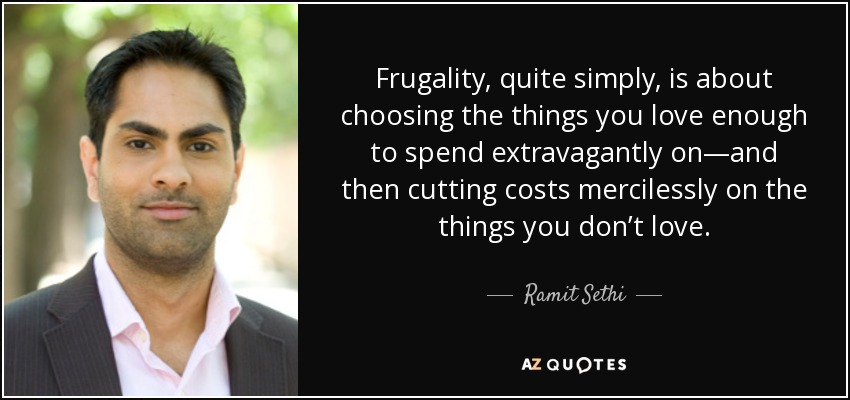
I have been doing this for a while, but the catch, as I have experienced, is in “choosing the things you love enough”, and it exists because of the intent behind that ‘love’. The usage of the word “love” is important. In my view, it is used to distinguish the things that one really wants.
But it is difficult to be objective about one really wants. Paradoxically, at different points, the intent could be a desire to belong, or a desire to stand out. A fundamental human need to connect and share that drives the first. A basic ego stokes the second. A desired destination here could be a kind of “reflective equilibrium”. Easier said than done!
The ego first derives from societal benchmarks, the projected self, and then self image. Getting beyond the last one is extremely tough. And if one does get close, there is an immediate realisation that there are no markers, no play books, no goals. There is no unseeing this either. “And once you are awake, you shall remain awake eternally. ”All very difficult to get used to, especially when the mind continues to ask, “Is it going to be ok?”
To quote Bill Bonner, “There’s the standard of living, which can be measured in dollars, and there’s the quality of your life, which can’t be measured at all.” The Plan is built on financials, and is therefore aimed at tackling the first part. The second is indeed an intangible, and speaks probably of a contentment that comes from being comfortable with one’s decisions. That’s why the plan is also an attempt to iron out the terms of one’s interaction with the world, and just be. The hope then, is that belonging will take care of itself because one is actively pursuing the wants that really matter, without money having a real say in it. The desire to stand out? Well, it will be forced to sit out!