Category: Books

  • The Age of Surveillance Capitalism: The Fight for a Human Future at the New Frontier of Power

    Shoshana Zuboff

    Around the same time last year, I remember tweeting a quote attributed to Jamie Bartlett – “The end result will be ad targeting so effective that you may well question the notion of free will altogether“. Connecting digital advertising to free will seems absurd, but it wasn’t a facetious remark. It reflected the reality of our times. This is the reality that Shoshana Zuboff explores and confronts in The Age of Surveillance Capitalism, frequently echoing the thought that keeps cropping up in my mind – how did we get here?

    She begins with a deeply personal story about her home, and brings up an “aware home” project in 2000, which among other things, assumed that the rights to the knowledge would lie in the hands of the human living in it. She then juxtaposes it against the current privacy policy and usage agreements of Google’s Nest, which all but completely gives the ownership to the search giant. This is just one example.

    Industrial capitalism thrived by exploiting nature, and surveillance capitalism is thriving by using human nature as a resource. That means that even though, due to rapid industrialisation and mass production, we got to a “second modernity” that provided millions access to experiences which were until then the preserve of a smaller elite, we are now being led back into a “neofeudalism”, a consolidation of elite wealth and power. How did this happen?

    Google plays the primary antagonist in this narrative, and though Brin and Page were initially reluctant, the 2000 bust set Google on a path that used the “behavioural surplus” generated by users. At a basic level, it is probably difficult to imagine that when one carries out a search on Google, the machine is searching for patterns in the expressed intent, and making rapid incursions into one’s life. And yet, that’s exactly how it works. It then leads to prediction products, economies of action and future behaviour markets, fuelled by an ever expanding scope of information extraction. Those ridiculous permissions apps require make sense now? And how does a corporation create and grow a future behaviour market? Simple, behaviour modification, whether you realise it or not.

    Over a period of time, Google has institutionalised its invasions into private human domains, helped in the beginning by the national security imperative following the 9/11 attacks. Chrome, GMail, Android, Photos, YouTube and so on have created a dependency that now borders on feeling left out of the societal narrative if one is not using these. The behind-the-scenes look at Pokémon Go is chilling – in terms of how users were giving away data of their own volition, how partners were brought on board to expand the scope of surveillance, and how human behaviour was controlled at global scale.

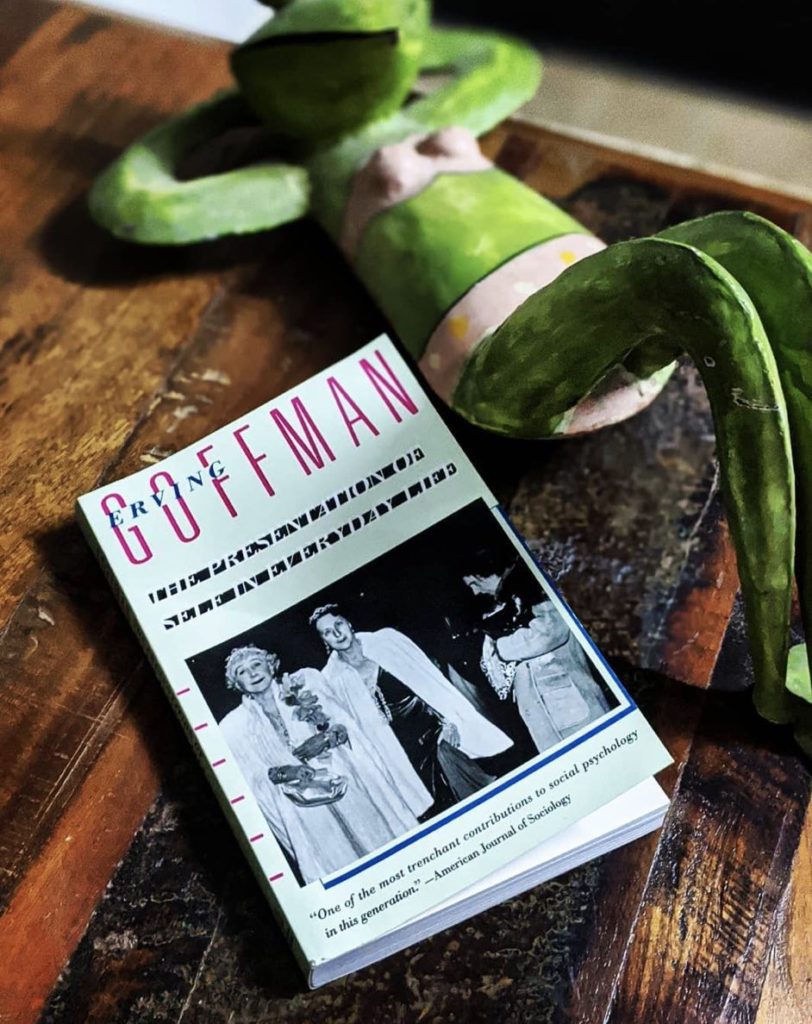
    Facebook makes its presence felt in the latter half of the book, thanks to its exploitation of social connections. By creating a prototype of a hive mind through the weaponisation of peer group reinforcement, it increasingly shapes minds and behaviour, especially that of young adults. The author uses Goffman’s framing in The Presentation of Self in Everyday Life and shows how the “backstage”, where individuals are truly themselves, is now shrinking thanks to the omnipresence of social incursions. Where does this lead to? One example is when the state starts using this power – China’s social credit system now has a direct impact on an individual’s life, driving economies of action in the real world. More broadly, totalitarianism, driven by powerful corporations.

    The consequences are that there is increasingly no refuge, no sanctuary, from the relentless efforts of corporations that are intent on controlling every facet of an individual’s existence. At a broader level, it threatens the fabric of society and democracy itself. Capitalism’s latest avatar has clearly gone rogue, refusing to abide by the reciprocal nature of every kind of interaction we have experienced thus far. Regulation isn’t really keeping up, except for some efforts by the EU. But there are those who refuse to give up – activists, and artists who use technology to keep out surveillance. However, this is a fight we have to contribute to, because what’s at stake is what makes us human – free will, or at least the notion of it. This is not an easy read, but it is a must-read.

  • #Bibliofiles : 2020 favourites

    The other primary activities – travel and eating out – took a hit in 2020, but reading prospered! Not just in terms of number of books, but the quality too. That’s why this year has a larger set, and that’s after some painful culling. And the numbers are enough to warrant a group photo, unlike last year!

    (more…)
  • Invisible Women: Exposing Data Bias in a World Designed for Men

    Caroline Criado Perez

    Enlightening! While a part of the title reads “exposing data bias in a world designed for men”, I think it extends well beyond that. It provides perspectives that I had not even considered, even though in the last few years, I have tried to be more conscious of the challenges that women face at the workplace, in public spaces, their everyday lives, and how the world works differently for them in the many, many things that men take for granted. This, therefore, is a book that I think men and women should read, for different reasons.

    For women, it will probably serve as an insightful articulation of many things that they have thought about, talked about, or attempted to change, and give them information about how women around the world have taken them up as challenges and sometimes succeeded in setting things right. I will stop at that, and not be presumptuous in assumptions.
    For men. Where do I even start? I think we will see the world differently after reading this book. The challenge for us would be to be conscious of the inherent bias in our thinking, our behaviour, and the way we design objects and systems. As the blurb says, imagine a world where the phone you use is too large for your hand, where the safety of the vehicle you travel in has not really been designed with you in mind, and the medicine you have been prescribed is just wrong for you because you weren’t adequately represented in trials! In essence, “the lives of men have been taken to represent those of humans overall.”

    The author uses data and case studies from multiple domains to highlight how women haven’t been fairly represented, and in many cases to also show how correcting this could lead to a better result not just for women, but for humanity overall. Public transport, urinals (ever wondered why there’s always a queue for women while men seem to find things much easier), workplace practices, product design, medicine, disaster relief, the pain is everywhere. And they are at various levels of seriousness. Some made me say “oh, I didn’t think of it that way”, many made me grimace, and most are just appalling.
    It has given me many perspectives, and a resolve to work harder at contributing to fix this. One really doesn’t have to be a genius to understand the impact better representation can make, at an individual and species level. With all that being said, in the end, I also have to admit, quite sheepishly, and to underline the point, that while many of my favourite authors are female, I might have completely missed this book if my wife hadn’t made it part of our list! See? 🙂

  • The Anarchy: The East India Company, Corporate Violence, and the Pillage of an Empire

    William Dalrymple

    There was so much money in India – that’s one of my biggest takeaways from this book! Every other page has a note at the bottom that shows the current value of the money that was paid to a local mercenary or the Company as protection money, or a deal as simple as crossing the river safely! I am exaggerating only a little bit. It reminded me of the inane charging for random things by modern airlines, and corporations in general trying to squeeze out every bit of revenue from the average user. And the story of the East India Company is exactly that – a corporation that arrived in India for trade, and ended up pillaging the country and finally giving it to the Crown on a platter.

    Dalrymple begins from where it all started – London, 1599, when the idea of the company was first discussed seriously by a diverse set of individuals. Though not an original idea, the joint stock process allowed the Company to raise resources efficiently in the beginning, and until things went south, provide handsome profits to its investors. The book traces the Company’s trailblazing journey in India, one that features not just its own principals like Clive, Hastings and Wellesley but the local rulers and power brokers as well – from the Mughal emperor (in name) Shah Alam, and Tipu Sultan to mercenaries like Benoît de Boigne who helped shape the Maratha army into one that matched the Company’s own fighting force, and interesting characters like Begum Samru, a feisty courtesan who became a mini-ruler in her own right! Some familiar from history, and others from the author’s own earlier works (like James Skinner from White Mughals). A word on Shah Alam – he is a far cry from his glorious predecessors, but in an age when living till 50 was a luxury, the man survived every tribulation that was thrown at him and lived into his late 70s even as his enemies perished around him.

    It is amazing how, from an inconspicuous office in far away England, with less than a hundred employees, a corporation controlled the destiny of a land as large and diverse as India. It was in 1600 that the Company received the charter from the Queen, and by the early 1800s, they had defeated the last credible threat – the Marathas. These two centuries are full of intrigue, and there are multiple occasions when a single different decision or event (e.g. if Nelson had not sunk Napoleon’s navy and the latter had been able to give Tipu an assist) might have resulted in an entirely different contemporary history. Politics – the English replicated the Roman divide et impera, and economics – many of their moves would have been impossible without local financing – went hand in hand in what was the first hostile takeover of a nation by a business entity. That’s not the only first – abuse of corporate power, lobbying, unfair trade practices, the Company pioneered all this. And finally, in another first, it had to be bailed out by the government because it was too big to fail!

    If you’re a history enthusiast, this is obviously a must-read, and even if you’re not, this is a fascinating piece of history that you’ll enjoy.

  • The Wizard and the Prophet

    Charles C. Mann

    The world is only a few decades away from reaching a double figure billion population. We’re already experience a scarcity of many things we take for granted – clean air, potable water, affordable food and scalable energy sources. How will the species survive? There are two lines of thought – both with the same intent, but fundamentally different approaches.

    Represented principally by Norman Borlaug (the wizard) and William Vogt (the prophet), this book juxtaposes these diverse lines of thought in the context of the four main resources – food, energy, air and water. Vogt sees nature as the main protagonist and the human species as one among the diverse cast of organisms. As per this view, humans have to understand and play within the constraints of nature. Borlaug considered humans the principal character, and nature as raw material that the species could reconstruct to its own advantage. It was just a matter of finding the right methods and technology, and educating people. A “worldview that valued efficiency rather than empathy and the spirit.” Two different ways to survive, and thrive. In a way, scarcity and abundance thinking.

    Funnily enough, even though both men were (almost) contemporaries, they crossed paths only once. Their arguments and their supporters and followers more than made up for it though!

    In addition to this very interesting philosophical debate, the book also works as a rough biography of Borlaug and Vogt. Both of them went through many trying circumstances, and whatever they have achieved is a tribute to their tireless spirit.
    Another very interesting section, towards the end, throws light on the behind the scenes action of the Green Revolution in India and Pakistan. It is amazing how events such as the Cuban missile crisis, India’s wars with China and Pakistan, and even Nehru’s death all had a crucial role to play! It was touch and go a lot of times and worth a screenplay.

    All of this makes for an interesting read and I wish the author had made it a bit more accessible by focusing a little less on the detailing. It is not an easy read, but it does provide some excellent perspectives on topics such as global warming, fossil fuel scarcity, GM foods, all of which have an increasing impact on our daily lives.