Category: Business

  • Decoding the rise of millennial investors, with ET Now

    From being part of the BTS Army to getting nostalgic about Backstreet Boys, millennials are a diverse cohort, and have many sub-segments. Based on the recent CAMS report, ET Now gave me an opportunity to chat about the investing patterns of millennials.

    The transcript.

  • $ocial Validation

    The presentation of selfie in everyday life is all around us, and the words I always refer to paraphrase this are

    When everything becomes image rather than action, you can’t judge the value of any act. You can only judge what it “looks like”. But when all of society is doing that, it means that you’re being judged on everything. After all, you may not always be acting, but you are always appearing. When it’s your appearance that determines worth, there is no moment to rest. There’s a social invasion.

    The Uruk Machine
    (more…)
  • Brands, Activism & Morality

    A while back, someone had joked on Twitter that by 2025, babies will be born outraged. But in 2020, the joke, at least in Indian advertising, is that when the Tanishq brand manager begins to think of a campaign, #BoycottTanishq starts trending. When I was writing the article on brands and empathy for Business Insider, I realised it would need a lot of effort for brands to go beyond signalling.

    However, with inequities becoming even more of a pressing topic, and the expectation from brands to be active participants in society – activism to action, is there an inevitable movement that we will see? And hence, this post on brands through the prism of activism and morality, from the perspectives of a consumer and a brand marketer, and the safety of an armchair.

    We are living in an era of woke capitalism in which companies pretend to care about social justice to sell products to people who pretend to hate capitalism.

    Clay Routledge
    (more…)
  • Evolving against entropy

    ​In the last fortnight, I had two interactions with customer care teams. The first was Kotak, for a bank account. There were failures at multiple levels, but the biggest takeaway was how difficult it was to get through to a human. Chatbots have their uses but this was extreme! Twitter DMs weren’t a help either. The second was Amazon, and that surprisingly included being put on hold for about 15 minutes and transferred 5 times! Thankfully, the problem was resolved in 30. But given the famed Amazon customer-centricity, this was a disappointment, and I wondered if at scale, it was inevitable. 

    What causes it? The best frame I have seen is entropy. (via) Yes, that physics and thermodynamics thing – the degree of disorder/randomness in the system. Though the meaning remains the same, the application changes. In the context of a business, it is the tax applied by the system between input and output. Just imagine the effort that is required to get things done in a corporate structure as against a startup. While it is theoretically possible for a complex system to have lesser entropy than a simple system, I have not seen it in practice. I can imagine why it is so – the randomness that can be generated by different touchpoints, and their optimization for following rules as opposed to providing solutions. What happened to me with Kotak and Amazon were examples of that.   (more…)

  • Choices & Automation

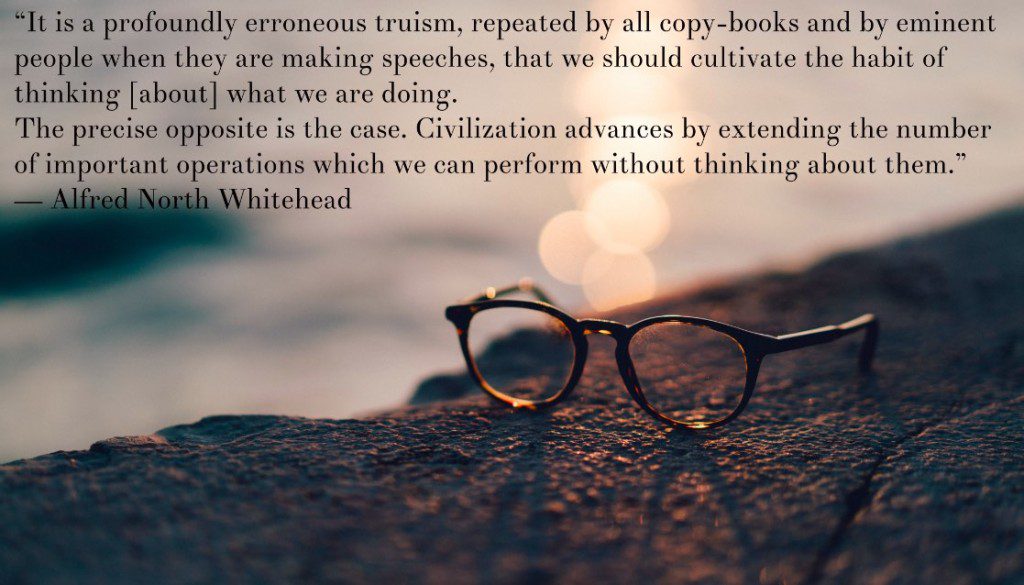
    Taylor Pearson wrote an excellent primer on blockchain a while ago. While explaining why blockchain matters, he quoted something by Alfred North Whitehead

    Untitled 1

    Photo by Joshua Newton on Unsplash

    (more…)