Now that I think of it, there are at least four ‘spiritual predecessors’ for this post on the blog. It began with ‘In a world of abstractions‘ (2017), followed by Peak Abstraction (2018), The Presentation of Selfie in Everyday Life (2020), and A Proxy Life (2022). Each of them are continuing explorations of how we have abstracted a bunch of real things, and created proxies by which we measure them.
Going by the story so far, it’d be fair to say that the more things we consume, the less time we have to get into details, and the more we rely on proxies. And across time, our consumption has only increased. And so our proxies have also multiplied.
Material accumulations as a proxy for wealth
Stock price/funding for a company’s health
Popularity for excellence
Price for quality
Fitness for health
Books Read (including that 5 min YouTube video) for intellect
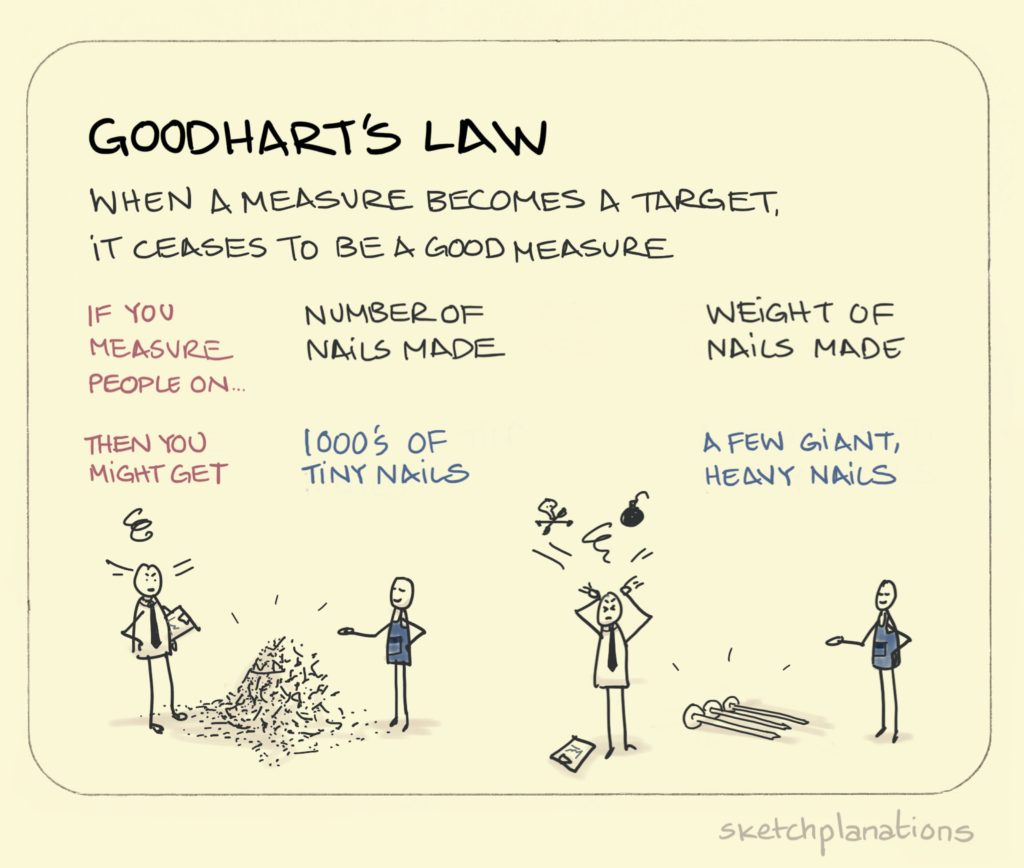
I have forgotten where I first came across Goodhart’s Law. It was probably Farnam Street. It states that “when a measure becomes a target, it ceases to be a good measure.” An illustration should help.
In the organisational context, it serves as a great lens to evaluate strategy and progress. As the illustration above shows, the entire direction of a desired goal can be changed when measures become targets. But, and maybe it’s a Baader -Meinhof phenomenon, I am now seeing different versions of it everywhere.
To set some context, as more and more things have been digitised, the volume of information has just exploded. For instance, before the advent of social media, there were limits to one’s “people like me” canvas, because even an awareness of them was constrained by physical distances and the limits of one’s social circle. It had to be in real life, and public spaces like a cinema or even a vacation spot were probably an extreme. Social media changed that scale massively. Many factors including this volume of information, the lack of a granular understanding of the lives of this new set of people whom you’d never meet, and the innate human desire to do better than neighbours meant that appearances became the norm. Since we are not wired to process such large volumes of information, we dug deeper into ‘measurement by proxy.’ Not that this mode of measurement is new. For instance, we have used material manifestations (apparel, cars etc) as a measure of wealth. The stock price is a single-number measure of everything about the company. But with abundance of choice and the limits of processing power, we started developing heuristics and measuring what was easy. Meta photos (FB/Insta/WhatsApp) became a measure of everything from the quality of life to the strength of relationships. Popularity as a measure of excellence, price as a measure of quality, fitness as a measure of health, #booksread as a measure of erudition and so on.
How does this connect to Goodhart’s Law? We end up optimising our resources for the measure, not the end goal. Which means that though the goal is say, happiness and a good quality of life, we end up aiming for the measure. From the kind of photo that will get more likes to buying that thing/experience that will surely make us happy. And as we feed this more, the mind keeps on wanting. The happiness fades in a short span of time. And as the Buddha has wisely pointed out, that loss of happiness is what becomes suffering.
In the AI risk narrative, there is the story of the paperclip maximiser, a seemingly trivial task of maximising paperclips that might lead to “first all of earth and then increasing portions of space into paperclip manufacturing facilities”. The corresponding human version that I wrote in Peak Abstraction was that maybe we will get to a state where, if we get enough likes on the couple photo on Insta, there would be relationship bliss! What a wonderful world.
It’s almost a year and a half since I wrote In Code we Trust. More recently, Tim Ferriss had Eric Schmidt on his podcast (transcript). In what I thought was a fascinating discussion based on the latter’s recent book The Age of AI: And Our Human Future, (coauthored with Henry A. Kissinger and Daniel Huttenlocher), they also brought up AlphaGo. Go was a game that humans had been playing for 2,500 years, and it was thought to be incomputable until DeepMind’s AlphaGo beat world champions. As Schmidt explained, some of its moves and strategies were the kind no one had thought of before. In Kissinger’s words, we’re entering a new epoch, similar to the Renaissance, this age of artificial intelligence, because humanity has never had a competitive intelligence, similar to itself, but not human. To note, a more recent version – AlphaGo Zero self-taught itself without learning from human games, and surpassed its predecessor in 40 days!
It was towards the end of 2020 that I came across Roblox and wrote Metaverse : Get a second life. Since that post, Mathew Ball has written the definitive primer on the Metaverse1, and if you’re interested in the subject, it’s a must-read. The word “metaverse”, ICYMI, was coined by Neal Stephenson in Snow Crash, and the book is being referenced in many recent conversations. In fact, Stephenson has been quizzed for years, each time we seem to take a step in this direction, and his comments continue to be prescient, insightful and hugely creative. This one, from 2017, in Vanity Fair, is a favourite, and contains, among other succinct gems
The purpose of VR is to take you to a completely made-up place, and the purpose of AR is to change your experience of the place that you’re in.
The thought first occurred to me a couple of years ago, when I realised that thanks to outsourcing and automation, we would struggle today to do many things that were once life skills. We also lost a little more than that – learning.
Sometimes directly, and sometimes, through the interactions with the world, they facilitated a learning experience that taught one how to navigate the world and the different kinds of folks that made up its systems.
It was continued with a bit more specificity in a subsequent post.
Instagram, Facebook, Tinder, Spotify, Netflix, Amazon – everything is a feed of recommendations, whether it be social interactions, music, content or shopping! Once upon a time, these were conscious choices we made. These choices, new discoveries, their outcomes, the feedback loop, and the memories we store of them, all worked towards developing intuition.
Intelligence, intuition and instincts. The journeys in the first two are what have gotten the third hardwired into our biology and chemistry. When we cut off the pipeline to the first two, what happens to the third, and where does it leave our species?