Category: India

  • Plugging In

    Since I have been on streams and brands for a while, I thought I’ll take a break and plug you in on a couple of discoveries and connections. For those reading this in Google Reader or actually anywhere else other than this site itself, kindly step outside. No, the hands can still be on the keyboard/mouse but please drop in at the site since it’s contextually relevant that you be here.

    One of the fringe benefits of writing this column for Bangalore Mirror is that I sometimes discover interesting startups that are useful to me as well. Now I am associated with two of them – one on each blog. And since we’re on discovery, and I don’t want to bore you more with semantics, allow me to introduce you to Dhiti, a content discovery engine driven by semantics. I first read about them at Pluggdin and then got a mail fromย  Aditya (at Dhiti) to try it out. I have, many a time, expressed my frustration about WP’s native search, the plugins I have tried to augment that, as well as the not-as-accurate-as-I’d-like YARPP plugin that I have been using so long. Dhiti arrived just in time and, from the short experience so far, has solved this to a very large extent. To see it in action, scroll away to the bottom of this post (later, after reading the post completely!!)

    The Dhiti plugin, which you can download from here, has versions for WP.com, (thanks Ranjani) Blogger or self hosted WP blogs like mine. It provides multiple ways for you to get to more, and contextually relevant content in this blog – a ‘search’ function, a ‘Topics’ section displays the topics the post covers, a ‘Concepts’ section which shows the related topics, and ‘Nuggets’ which show excerpts from posts. Words in both Topics and Concepts are clickable and when you click them, the Nuggets show the excerpts of posts in which they have appeared and highlight them, so you can quickly understand the context and navigate to the relevant post accordingly. It functions just like a browser with ‘back’ and ‘home’ functions. You can even make it a pop-out within the page if that works better for you. Do play with it and let me know your feedback. I have asked for better customisation options and am also supposed to get some analytics from them.

    So, Dhiti gives food for thought, and my new friends at the other blog give actual food. Ok, they help you find food, specifically restaurants. Zomato, formerly known as Foodiebay is now taking snippets from the restaurant reviews on my blog, and adding them to the menu and photos they already have. More than the hits that will hopefully deliver ;), I was really kicked about their Android app. If you have an Android, download the app right now from the market. It automatically detects your location, and then allows you to discover a random restaurant nearby, recommends a restaurant near you or just plain search. Pretty much all the website functionality is built into the app. There’s even a button to call! The showoff feature is the ‘Shake’ and though it doesn’t do the ‘slot machine’ like Urbanspoon, it still rocks! ๐Ÿ™‚

    until next time, scroll below for discoveries ๐Ÿ™‚

  • While on contextual reputation…

    Though I don’t answer much on Quora, I am quite a gawker and vote up answers too. One feature of Quora that I found extremely interesting and useful (and tweeted about) is the way Quora gives contextual ‘reputation’ (while reading answers) using the person’s topic bio. The interesting coincidence (because he also RT ed this tweet) is that I noticed it thanks to Mahendra‘s answer to a ‘Google Reader’ based question, and right next to his name was “Daily, dedicated user. Subscribed to over 200 feeds, followed by over 700 people on Reader/Buzz”. I must admit, before I realised that it was a topic bio, my first thought was why Mahendra was ‘wasting’ his Quora bio on Reader when he had such a huge list of phenomenal things he could say about himself. ๐Ÿ™‚

    But yes, coming back to ‘contextual reputation’, I liked it because it gives a lot of relevance and credibility and adds a layer to an answer – you can better understand where thisย  answerer and his response is coming from, for example. Another nuanced way of helping the reader weed out noise. I also thought this was a good way for brands/organisations to develop credibility in their domain, and involve their users, using function specific spokespersons, (brand, HR, operations etc) since “brands are currently not supported on Quora“.

    And now we can go off on a tangent and check out a few brand experiences I had last week, all with oblique connections to contextual reputation, though lycra like they might seem ๐Ÿ™‚

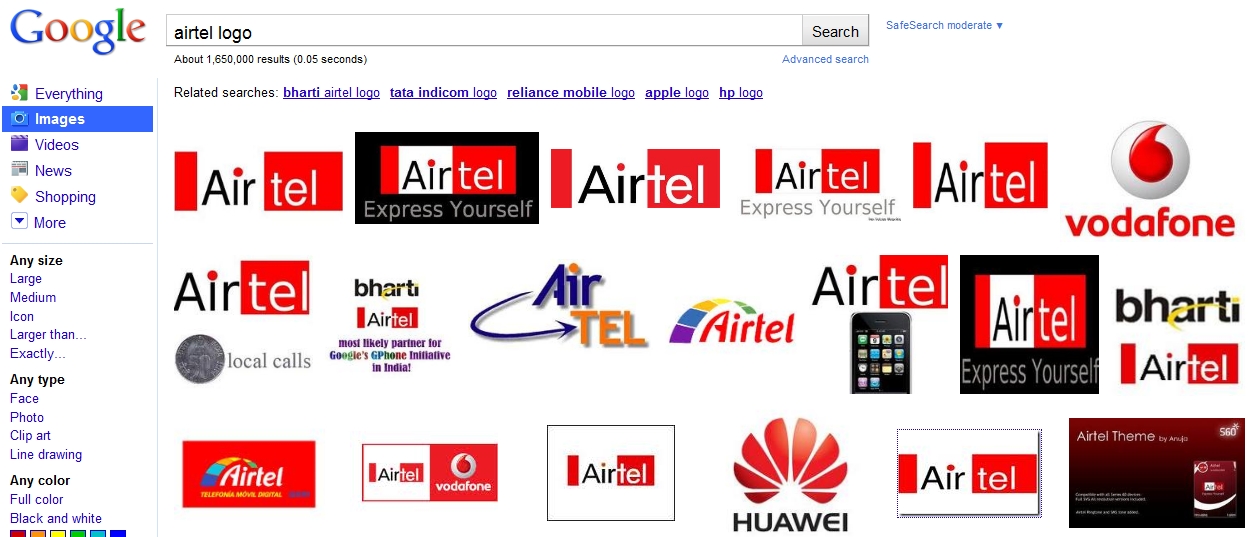
    When Airtel changed its logo sometime back, though there were infinite debates on the need and quality of the new logo, their on ground management of the logo change was almost unequivocally appreciated. However,

    To their credit, the ‘everything’ search, though has the old images, has the first link pointing to the new logo. But from an image perspective, ‘contextual reputation’ for logo change online gets a thumbs down.

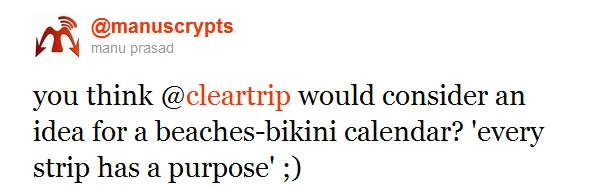
    Cleartrip, quite a favourite brand for their ‘no nonsense. clear talk and action’ way of managing their product and online presence, has a new campaign ‘Every trip has a purpose‘. But favouritism unfortunately doesn’t stop me from wordplay and I tweeted

    Just as i was chided for provoking a brand, and was replying that I trusted Cleartrip to have a sense of humour, they replied with a ‘laughing hard’. Contextual reputation thumbs up. Hopefully they weren’t being sarcastic.

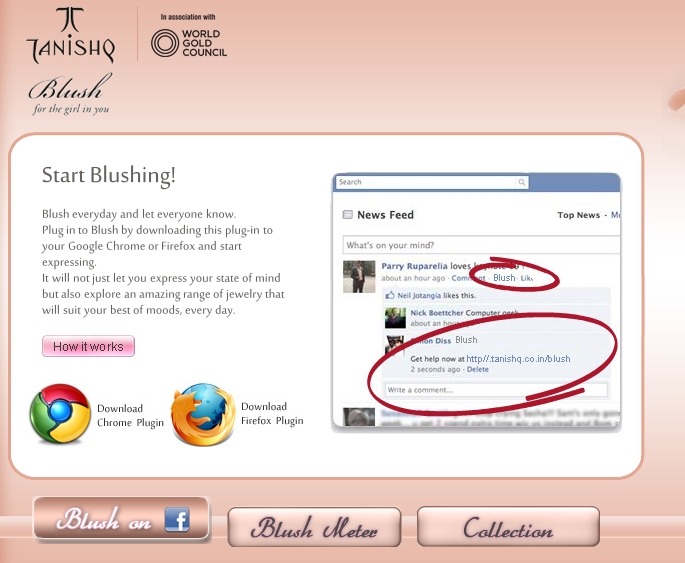
    The last experience was from Tanishq, whose new Blush campaign I came across last week. Like I tweeted then, immediately after the Quora tweet, I found it quite interesting and worth an applause that a brand was experimenting with a Firefox/Chrome plugin. Instead of me explaining how it works, I will, in my new found enthusiasm for imagery, give you a screenshot.

    As you can see, the plugin gives you, in addition to the ‘Like’, ‘Comment’ options you see after a Facebook status, a ‘Blush’ option, which when clicked, adds a comment with a link to the ‘Blush’ page. Hmm. I won’t get into a ‘app within FB vs outside website’ debate (there must be some reason, I assume). But unfortunately, boring that I am, I’ve never seen a jewelery that has made me blush. I can’t even see it in the Tanishq collection, assuming that I have the ‘where to wear it’ right. Maybe girls/women see it differently. So, why didn’t Tanishq just have a ‘Gold’ button, which would actually add to their ‘contextual reputation’ more than blush, and tie it to some sort of action that would actually get something tangible for all involved.

    For example, I install the plugin and start using it just because of the ‘show off’ value. What if they tied in an offer linked to the number of “Golds” I gave/received on statuses, and then communicated that in the comment that appears after I have ‘Gold’ed a comment. Or how about virtual gifts, a way to showcase the gallery, and then an easy app to add the virtual gift to a profile pic? I have an inkling that women are likely to have a “nice earrings/pendant. where did you get it from” conversation. They could even make this Like based contest i.e. if you virtually gift someone and get them to add it to their profile pic, and they get maximum likes (make a leaderboard) we’ll let you actually gift them for free. Do that on Valentine’s day, and it just might work.

    Meanwhile, I have a ‘reputation’ for longish posts, so I’ll just stop here.

    until next time, add to the context?

  • Social evolution, at least?

    Judging by the number of responses to his article in ‘The New Yorker’, Malcolm Gladwell seems to have ruffled quite a few feathers, especially in the Twitter loving community. Not surprising, since he has torn apart at least a couple of Twitter’s poster children revolutions – Iran and Moldova. His grouse seems to be that we have forgotten what activism is, and are perhaps doing the word disrespect by using it for activities that happen basis the ‘weak ties’ of social media. The benchmark he sets for activism are indeed high – the Civil Rights Movement, which happened before and without the internet.

    I could give you quite a few links that offer rebuttals to this argument or try to put in context – Evgeny Morozov’s post in NYT, Maria Popova’s vehement retort, Gaurav’s 6 point reasoning of why Gladwell is wrong, Anil Dash’s more nuanced approach, and even cite say, a Pink Chaddi campaign (in a country which has a single digit internet penetration) to attempt a contra view. But there’s no denying that armchair activism/slacktivism exists.

    However, as Maria explains in her post, different generations face different societal challenges. They also have a different set of tools that enable them to achieve changes in the status quo. And that’s probably why I think its unfair to dismiss the influence of social platforms in combating the issues of our time. The issues can be across domains – from water crises (check Mashable’s post on Blog Action Day 2010 – Water) to changing the ‘unhealthy’ business models of several traditional media outlets. It is challenging individuals to create and collaborate and break out ofย  work/life mindsets. I am able to be part of say, a micro finance venture and spread the word on social channels. Such changes can’t be deemed worthless. In any case we’re perhaps too early to postulate what these tools would achieve. Precisely being in the middle of this would take away our objectivity.

    Despite this hilarious Maslow’s hierarchy of internet needs, I’d like to think that we are moving through a hierarchy as web technologies evolve. From a general source of information, the web has moved on to being able to connect us in context. It has allowed the rapid amplification of signals. We have only started with location as a context of networking. There would be a tremendous difference when we start addressing civic issues, using social tools as a means to aggregate locality based communities.ย  In essence, tools are just that, and we have to define contexts to make them more useful. And we have to evolve to that level.

    Maybe there will never be massive revolutions, just small uprisings across time and place that subvert what could’ve been a great crisis if it was allowed to grow without checks.

    until next time, rebelution it is ๐Ÿ™‚

  • Group Pwn

    I’ve never gotten around to trying group buying/deal sites until once recently, though I always thought that they were fulfilling a need for businesses and consumers. But when I read this ‘peculiar’ story titled Groupon’s Success Disaster, I found myself identifying with it (from a consumer perspective, we’ll get to that in a bit) and since the number of group buying sites in India is only a few numbers lesser than the number of social media consultants, I thought it made sense to spare a few thoughts on it.

    The (linked above) story is of a small business owner, who, after 3 months of using Groupon, discovered that the deals were hurting the business financially and then had to take $8000 out of savings to cover payroll. Considering that, I thought the Groupon reply has quite a cruel title – ‘Too much of a good thing‘, but it is well drafted.

    The win-win for business-consumer in this is because it gives the former a chance to spread the word on the service and probably get some feedback on it and the latter mostly gets a good deal. Like I mentioned, I used a site recently for what seemed like a good deal. Though the deal process was painless, I ended up spending more money than what I normally would, thanks to a mis-communication (and some carelessness on my part). It means that I won’t be a repeat customer. It ends up as a lose-lose. Now this is probably the exception to how it usually happens, but…

    It did make me think whether the business owners get into deals with a strategy in place. Not just in terms of finance, but also in terms of their expectations of buzz, their delivery capability as well as how they’d manage to make the customer return. When it is kept in mind that social platforms and deal sites are mostly interwoven, I think it’d make sense for the business to use their service delivery (assumed good) and connect it to their social presence. A “We hope you liked it. Here’s an x% discount for your next visit and we would really appreciate it if you could leave your comments on FB/Twitter” approach. Facebook would especially help the business to spread the word beyond the usual early adopter set. While on retail, its difficult not to mention Foursquare. Though I’d love it if Foursquare aggregated the deals themselves, the businesses definitely can get active on Foursquare and push their deals to users nearby.

    With the (limited) examples I’ve seen, I doubt whether this is being done. So it reminds me of a lot of advertising,ย  and most social media efforts. The former because the message and the product/service are rarely (generalising) in sync, and the latter because of the lack of strategy and the herd mentality.

    until next time, regroup!

  • Hairsay

    So, the Old Spice manย  increased the sales of the product. Now we can renew the debate on the efficacy of social media on the bottom line. We obviously won’t ask for correlation data. ๐Ÿ™‚ The other side effect is that every brand manager will now want to replicate it – especially the viral and the ROI. Quite like a poster child (in India) of an era gone by – Sunsilk’s GangofGirls, which at that point had made many aย  brand manager experimenting with digital media tell their agency “I want one too”. Damn virals work at meta levels!!

    I recently read Kapil Ohri’s article on afaqs, on the site’s makeover – the shift from blogs and gangs to trends and forums and the ‘mandatory’ buttons – Facebook and Twitter. Its early days, so it’d be unfair to make a comment on the numbers, even if they were to be considered a parameter of success/ failure. But while, on buttons, I think YouTube videos would’ve been a help. More on that in a bit. A revamped GoG, and the Pantene vs Dove war for hairspace being fought offline and on blogs (Karthik, L Bhat) gives me enough food for thought.. and opinion.

    Sunsilk Gang of Girls: GoG could have (like an industry person commented on the afaqs post) integrated Facebook in a much better way. Check out what Levi’s has done at their online store. Instead of separate registrations and profile, Facebook’s plugins could make life easier for the user and automatically bring in the ‘gangs’. It could get them to pull their own photos from Facebook for the ‘Makeover Machine’, suggest it to friends, and so on. Or build a Twitter app that uses the display picture. It could have perhaps thought bigger and had their ambassador (Priyanka Chopra?) interact with the users through her own identities on these platforms. Or used a location based tool like Foursquare (or FB Pages or later Google Places) to start building a resource for salons and tips at each place (think of a Burrp! for salons), maybe in sync with a YouTube channel for tips.

    Pantene: Good Morning! They obviously missed a little thing when they didn’t pay attention to the pwnage of DNA at the hands of the Times Group during the former’s launch campaign in Mumbai back in 2005 (?), or the more recent Airtel- Reliance DTH fun. Not to mention the cliche that after a certain point, the only person who gets teased is the brand manager. Ok, I won’t overstate, but c’mon this is a real-time era AND they did walk into a Dovetailed ambush. Since the internet already has made them un-mysterious (thanks for that info, Karthik), maybe Pantene should have just added those FB page and Twitter links to their mass media communication, and solved the mystery immediately online. Mind you, thanks to our dismal internet penetration, they could still demystify it again on mass media, later, after perhaps, adding the content from their online and offline activities. (think non market research agency 80%) That way, there would’ve been at least some buffer against a Dove’s sneak attack. Arguable, but possible.

    Dove: All of us should take the time and remember the controversy over the ‘campaign for real beauty’. But hey, they saw an opportunity and used it. Effects on long term goals are again arguable.

    A little note on ‘low involvement’. I wrote about brands, content and new media platforms in the last post, in the context of the Old Spice campaign, and also mentioned the importance of ‘intent’ and setting objectives. Once the ‘why’ is done, the relevant crowd can be identified, along with the platforms and activation strategies – ‘(to) who’, where and what. (Read Rohit Awasthi’s comment on Karthik’s first post) When the ‘right’ content is pitched to the ‘right’ people at the ‘right’ time (and the ‘right’ platform too), very few categories are low involvement.ย  (read Naina’s comment on that post) And that’s the beauty of the web in general, and the tools that social media have provided marketers. Old Spice could be seen as low involvement too, until they did this campaign.

    But having mostly seen communication as advertising (except arguably PR), creating content for social platforms is in itself quite a challenge for brand managers. Even if they were toย  view ‘social’ as ‘media’, it requires a complete realignment of how media and content strategy is done, mostly because the mechanics of distribution are completely different. At a fundamental level, brands are dependent on users of platforms to create a buzz, and money doesn’t always work. At this point, tools can help with the ‘time’ (including location and other contexts) and ‘people’ (interest), and the way it works, if the ‘content’ is done right, people will get other people.

    Therefore brand managers need to make a more diligent effort. The fragmentation of traditional media does not seem to have made much of an impact on the costs involved in using them as distribution channels. So when ‘social media’ย  presents ‘free’ channels, brand managers see a value proposition and jump right in with a TVC and or/other weapons of mass mediocrity. Brands, I believe, need to invest a bit more on who they’re trying to reach, and then invest some more on building content and designing networks and constructs (irrespective of platform) that will drive the crowd to interact with the content and share it more. Content and people that will drive more connections, and help meet everyone’s objectives.

    But yes, until Augmented Reality allows me to scan a shampoo and tell me how many of my friends liked it, and think I should use it, (though my hair won’t last that long ๐Ÿ˜ ) lets keep playing all the shampoo games we can play. ๐Ÿ™‚ And while on using social platforms purely with a sales objective, I’m reminded of how Grandma uses her laptop. (vid below) Can it be used for those purposes? Of course! But is that its best case use? We can argue ๐Ÿ˜‰

    httpv://www.youtube.com/watch?v=Vg6emajJmEo

    until next time, sometimes brand strategies can be real poo!!