Category: Books

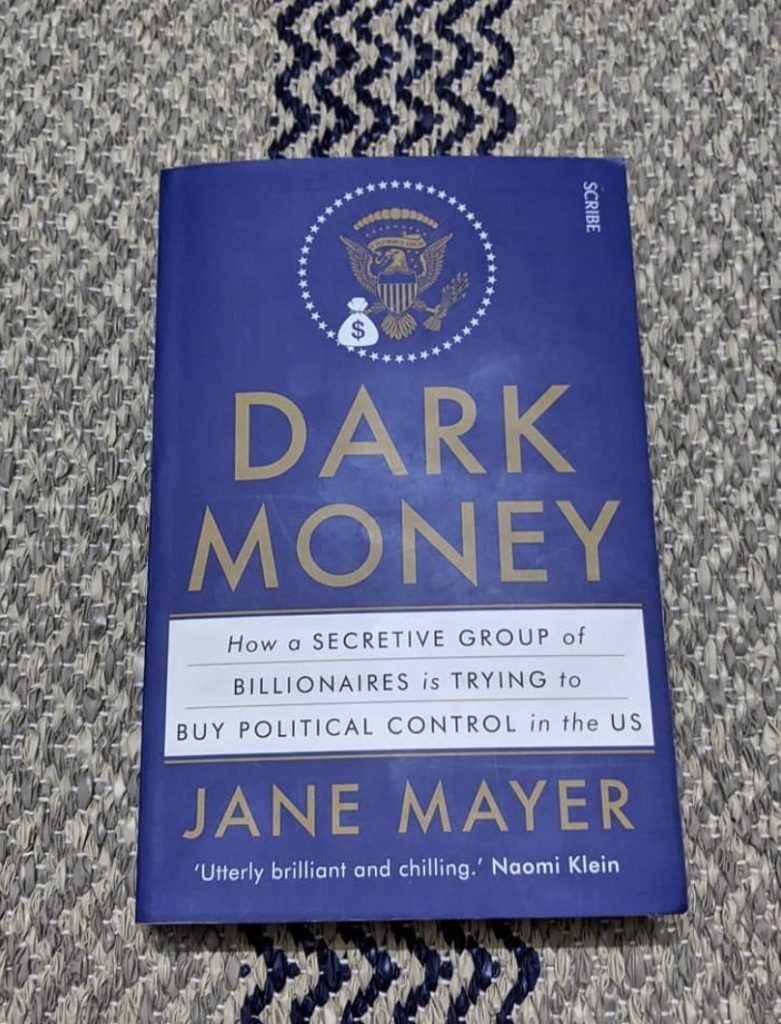
  • Dark Money

    Jane Mayer

    Across the world, the gap between the 1% and the remaining continues to widen, and the US is arguably the best example of this. How is society at large allowing this to happen, why aren’t politicians doing something about it? After all, elected representatives of common folks are supposed to work for their welfare, how is that structure failing? 

    In Dark Money, Jane Mayer provides an insightful and well researched analysis of how libertarian industrialists like the Koch brothers are systematically undermining the effectiveness of the US electoral system by flooding it with what they have in abundance – money! Hundreds of millions of dollars spent to impose their worldview on how government should be run. The “simple” worldview being that government oversight of business is an encroachment of freedom! In this world, social welfare and labour protection are unnecessary expenditure, while taxes on wealth should be minimal. Not that I am a theist, but Godless America! 

    The narrative starts in the late 40s, during the formative years of the Koch brothers. Influenced by LeFevre’s “government is a disease masquerading as its own cure”, Charles Koch’s political evolution began early, and with help from like-minded and wealthy others, it led to a well oiled machinery that operated outside the world facing political establishment, and yet has now managed to practically take over the Republican Party. 

    From the 70s, when the rich got a sense that they were being over-regulated, they had started a privately financed war to ensure their philosophy won. A big a-ha moment was the result of an understanding of how to use their riches to preserve their elite status, beyond the obvious means. This was the weaponisation of philanthropy, and the book provides the background on some prominent players like Richard Mellon Scaife, Joh M. Olin and the Bradley Brothers. The steady formation of the Kochtopus machinery is a fascinating read, and one has to admire the strategic brilliance that is at work here. 

    It’s not just ensuring the preferred candidates win, or even that only preferred candidates would stand for election. It goes well beyond, and starts at the grassroots. Using the anonymity of charitable organisations, they went systematically to the bottom of the value chain and thereby started funding online high school education, academia, think tanks, influencing public policy, lawmaking (including the judiciary via seminars and junkets), creating and stoking political activism – Tea Party agitations for instance, spreading alt truth like “climate change is a myth” by spending millions on media and micro-targeting, changing regulation on candidate funding and thus creating the phenomenon of superPACs, and finally even pushing out moderate Republicans, and in the words of one Republican, “supplanting the party”. Using money, coercion, and every means possible.
    Essentially they created institutions and networks that would manufactur ideas that follow their philosophy, converted that into action points through think tanks and academia, and got them executed through activist groups, lawmakers and politicians. A system that feeds itself and creates a world in its own image. 

    The irony of it all? Donald Trump. Firstly, though the machinery was successful in making Obama a lame duck president in his second term, ensuring the Republicans controlled the Congress, and thereby laying the base, he was not their choice of President. In fact, he tweeted in contempt about those Republican candidates who went to the Kochs for assistance. Secondly, he used their exact methods to win the election. However, it isn’t called a system for no reason – it controls the people surrounding him, and is thus, pretty much in charge.

    The book is superb in terms of research and pacing of the narrative, with details and context setting that make it a fantastic, absorbing read. It’s not just American politics, I think this will be the narrative of politics and society in many places. A must read, in our own selfish interest! 

  • Murder at Moonlight Cafe

    Ishavasyam Dash

    Eleven stories that take you on a rollercoaster ride of myriad emotions. As the blurb promises, the stories provoke and entertain.

    The subjects range from mythology, fantasy and social media influencers to murder, sexuality and horror. That last one (The Itch), I thought, had the potential to spin off into a standalone book/series. There’s also a mix of narrative styles – first person, letters, a YouTube monologue. What this achieves for each story is a character, flavour, and mood that is uniquely its own. What also stands out is the complete lack of a pattern, including the pace of the narrative. Some proceed at a leisurely pace, while others pack a lot in within a few pages.

    In just around 150 pages, there are worlds and corners that you will discover. I have at least five that I liked a lot. Smoke & Mirrors and The Herpetologist for the insight into the human condition and the empathy, Mariam’s Tears for the absolutely bizarre pop in the middle of the book, The Price of Apples for its innocence and sensitivity, and Kalika for the smart dose of philosophy. Pick it up to find your favourite. 🙂

    (I know the author, but though I feel really happy for her, I can safely say there is very little bias in the review)

  • Indistractable

    Nir Eyal

    Towards the end of the book, the author cites a survey which found that “almost a third of Americans would rather give up sex for a year than part with their mobile phone for that long”. Sex has been hardwired in us by evolution, and it’s a testament to technology that it has managed to hack even that! But then again, there was a time when even the printing press was called the biggest source of distraction. So this isn’t a new story. But we do live in a world in which the attention economy has optimised its notifications and nudges to ensure that it is heard/seen/felt. All the time. Whether we need it or not. It has us hooked and sometimes we don’t even know how much!

    This is the challenge that Nir Eyal writes about in Indistractable. He approaches it with a simple framework of internal and external triggers and distraction and traction (some nifty wordplay, that). The first thing to focus on, he says, is our own motivations – internal triggers. Not just the proximal reasons that are making us distracted, but the root cause. Our distractions are more often than not a way of escaping something we do not want to confront. He also believes we never run out of willpower and warns us against labelling ourselves as “easily distracted” or “addictive personality”. An opinion that I am not sure I agree with.

    The rest of the book is a step by step guide on how to get to an “indistractable” state – from making time for traction (things we value) to taking control of external triggers by various means in personal and professional lives, and in social settings as well as when you’re by yourself. The suggestions are practical and quite doable once you decide that they need to be done. Ironically, the section that I found most interesting was how to inculcate this quality in children. Ironic, because I don’t have any. What made it interesting was the logical approach, one that seemed quite feasible.

    The book keeps it simple, and is a good guide if you find yourself distracted more often than you’d like to be. I have been doing my own wrestling with “staying in the moment” for a while now and found most of the things mentioned a validation of what I try to practice.

  • The Age of Surveillance Capitalism: The Fight for a Human Future at the New Frontier of Power

    Shoshana Zuboff

    Around the same time last year, I remember tweeting a quote attributed to Jamie Bartlett – “The end result will be ad targeting so effective that you may well question the notion of free will altogether“. Connecting digital advertising to free will seems absurd, but it wasn’t a facetious remark. It reflected the reality of our times. This is the reality that Shoshana Zuboff explores and confronts in The Age of Surveillance Capitalism, frequently echoing the thought that keeps cropping up in my mind – how did we get here?

    She begins with a deeply personal story about her home, and brings up an “aware home” project in 2000, which among other things, assumed that the rights to the knowledge would lie in the hands of the human living in it. She then juxtaposes it against the current privacy policy and usage agreements of Google’s Nest, which all but completely gives the ownership to the search giant. This is just one example.

    Industrial capitalism thrived by exploiting nature, and surveillance capitalism is thriving by using human nature as a resource. That means that even though, due to rapid industrialisation and mass production, we got to a “second modernity” that provided millions access to experiences which were until then the preserve of a smaller elite, we are now being led back into a “neofeudalism”, a consolidation of elite wealth and power. How did this happen?

    Google plays the primary antagonist in this narrative, and though Brin and Page were initially reluctant, the 2000 bust set Google on a path that used the “behavioural surplus” generated by users. At a basic level, it is probably difficult to imagine that when one carries out a search on Google, the machine is searching for patterns in the expressed intent, and making rapid incursions into one’s life. And yet, that’s exactly how it works. It then leads to prediction products, economies of action and future behaviour markets, fuelled by an ever expanding scope of information extraction. Those ridiculous permissions apps require make sense now? And how does a corporation create and grow a future behaviour market? Simple, behaviour modification, whether you realise it or not.

    Over a period of time, Google has institutionalised its invasions into private human domains, helped in the beginning by the national security imperative following the 9/11 attacks. Chrome, GMail, Android, Photos, YouTube and so on have created a dependency that now borders on feeling left out of the societal narrative if one is not using these. The behind-the-scenes look at Pokémon Go is chilling – in terms of how users were giving away data of their own volition, how partners were brought on board to expand the scope of surveillance, and how human behaviour was controlled at global scale.

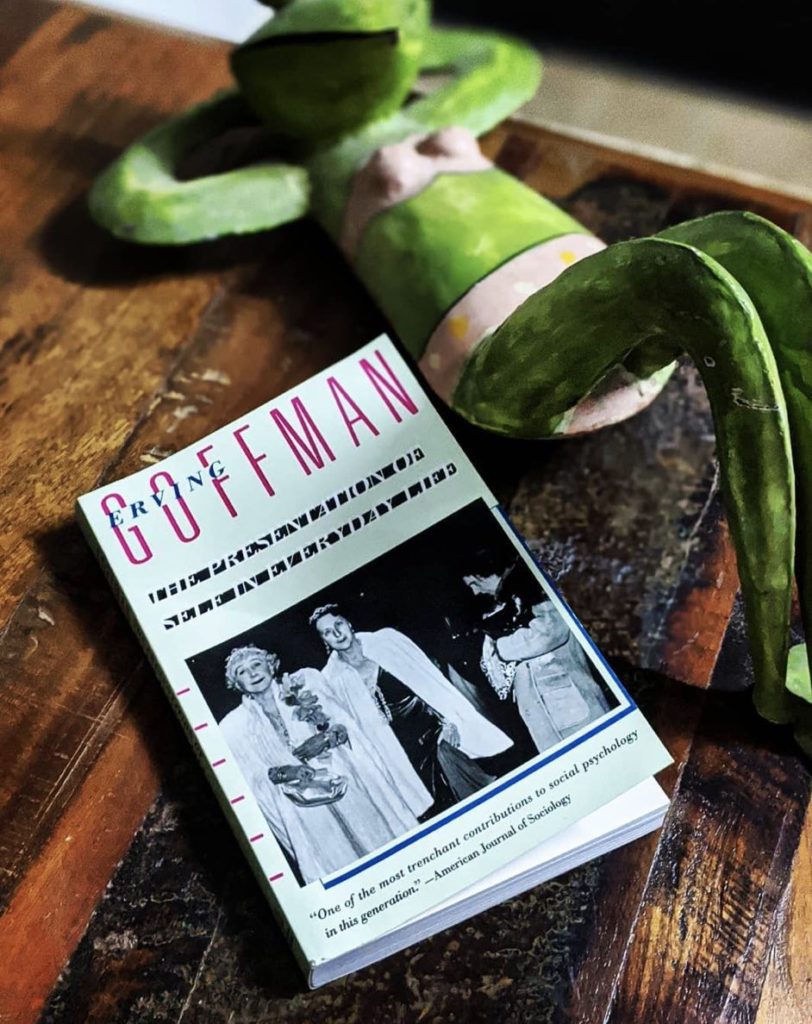
    Facebook makes its presence felt in the latter half of the book, thanks to its exploitation of social connections. By creating a prototype of a hive mind through the weaponisation of peer group reinforcement, it increasingly shapes minds and behaviour, especially that of young adults. The author uses Goffman’s framing in The Presentation of Self in Everyday Life and shows how the “backstage”, where individuals are truly themselves, is now shrinking thanks to the omnipresence of social incursions. Where does this lead to? One example is when the state starts using this power – China’s social credit system now has a direct impact on an individual’s life, driving economies of action in the real world. More broadly, totalitarianism, driven by powerful corporations.

    The consequences are that there is increasingly no refuge, no sanctuary, from the relentless efforts of corporations that are intent on controlling every facet of an individual’s existence. At a broader level, it threatens the fabric of society and democracy itself. Capitalism’s latest avatar has clearly gone rogue, refusing to abide by the reciprocal nature of every kind of interaction we have experienced thus far. Regulation isn’t really keeping up, except for some efforts by the EU. But there are those who refuse to give up – activists, and artists who use technology to keep out surveillance. However, this is a fight we have to contribute to, because what’s at stake is what makes us human – free will, or at least the notion of it. This is not an easy read, but it is a must-read.

  • #Bibliofiles : 2020 favourites

    The other primary activities – travel and eating out – took a hit in 2020, but reading prospered! Not just in terms of number of books, but the quality too. That’s why this year has a larger set, and that’s after some painful culling. And the numbers are enough to warrant a group photo, unlike last year!

    (more…)