Category: Philosophy & Worldview

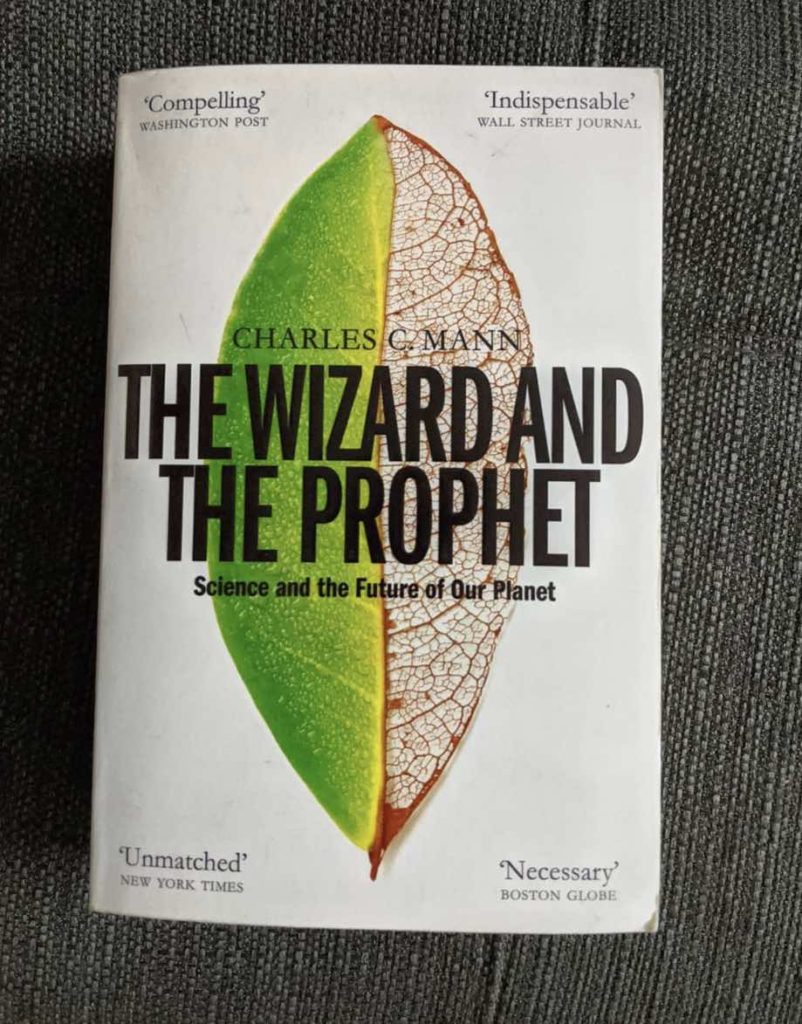
  • The Wizard and the Prophet

    Charles C. Mann

    The world is only a few decades away from reaching a double figure billion population. We’re already experience a scarcity of many things we take for granted – clean air, potable water, affordable food and scalable energy sources. How will the species survive? There are two lines of thought – both with the same intent, but fundamentally different approaches.

    Represented principally by Norman Borlaug (the wizard) and William Vogt (the prophet), this book juxtaposes these diverse lines of thought in the context of the four main resources – food, energy, air and water. Vogt sees nature as the main protagonist and the human species as one among the diverse cast of organisms. As per this view, humans have to understand and play within the constraints of nature. Borlaug considered humans the principal character, and nature as raw material that the species could reconstruct to its own advantage. It was just a matter of finding the right methods and technology, and educating people. A “worldview that valued efficiency rather than empathy and the spirit.” Two different ways to survive, and thrive. In a way, scarcity and abundance thinking.

    Funnily enough, even though both men were (almost) contemporaries, they crossed paths only once. Their arguments and their supporters and followers more than made up for it though!

    In addition to this very interesting philosophical debate, the book also works as a rough biography of Borlaug and Vogt. Both of them went through many trying circumstances, and whatever they have achieved is a tribute to their tireless spirit.
    Another very interesting section, towards the end, throws light on the behind the scenes action of the Green Revolution in India and Pakistan. It is amazing how events such as the Cuban missile crisis, India’s wars with China and Pakistan, and even Nehru’s death all had a crucial role to play! It was touch and go a lot of times and worth a screenplay.

    All of this makes for an interesting read and I wish the author had made it a bit more accessible by focusing a little less on the detailing. It is not an easy read, but it does provide some excellent perspectives on topics such as global warming, fossil fuel scarcity, GM foods, all of which have an increasing impact on our daily lives.

  • Principles: Life and Work

    References to Principles have been appearing in many of my favourite blogs and newsletters for a while now, and all the bits and pieces I managed to pick up from them were thought-provoking. The blurbs feature Bill Gates and Tony Robbins. So, expectations from the book were sky high, and I was looking forward to reading it!

    Did it deliver? Yes, in parts. Speaking of parts, the book is divided into two – life and work, with more pages devoted to the second. The book begins though, with a “Where I’m Coming From” section that gives the reader a background of the author’s life and does a good job of setting context for both the life and work sections. (more…)

  • The Evolution of Everything

    Matt Ridley

    For a while now, I have believed that Darwin’s theory of evolution is the most paradigm-shifting idea to have emerged from a human mind. On a related thought journey, I have also shifted from determinism to free will and back to determinism, all in a few years. This book connects both these thoughts, and is fundamentally an argument for evolution and against creationism. It argues that change is incremental and emergent and has a momentum all of its own, as opposed to the idea that it is directed by a person or a metaphysical force like God. (more…)

  • Guns Germs & Steel

    Jared Diamond

    One of my favourite books in recent times has been Sapiens – it did a fantastic job of showing how the species ascended to the apex position in evolutionary biology. A vertical journey, so to speak. But why didn’t all humans, spread across various continents, develop equally in terms of civilisation and technology? To use the book’s blurb, “why has human history unfolded so differently across the globe?” In the modern world, why does an Africa or even a large part of Asia have to work hard to catch up with the western world? That’s what the book seeks to answer.

    It does that by asking very interesting questions. For instance, why is it that the Spanish conquered South American empires, and not the other way? The book doesn’t stop at the proximate answers – horses, weapons, germs etc- but keeps asking a series of questions for the answers that come up. Even beyond the time that recorded human history begins. To when the species first made their appearance on the planet – in Africa- and how slowly they made their way to different parts of the globe.

    Primarily, four factors have ultimately caused the disparity in the fortunes of various peoples- how early they started, the difference in the environment and biogeography of the areas they populated (what plants and animals there could be domesticated to scale up food production and create the surplus needed for new skills and ideas to develop), the spread of ideas (the fascinating aspect of how the axis of the continent – except for Eurasia, all continents have a north south axis – plays a large role in why a large number of major civilisations and developments occurred in this part of the world), and the densities of population that allowed competing societies within continents to come up with radical ideas.

    In addition, there are also related interesting ideas. For example, how invention is actually the mother of necessity (examples of how some inventions had been made before, but are credited to the person/s who made the right tweak at the right time for others to adopt it in large numbers) and how some non-intuitive solutions have endured (e.g. the QWERTY keyboard).

    All of this make for a fascinating, if not easy read. Even though it was published a couple of decades ago, I think it is an important book for this time because it shows how evolutionary determinism is not just about genes, but the environment as well.

    P.S. I do wish he had spent some pages on how the British could conquer India. The only clue he does drop is how India’s environment might have created a caste system which prevented the creation and proliferation of ideas it otherwise might have had.

  • Enlightenment Now

    Steven Pinker

    “The case for reason, science, humanism and progress” – a part of the book’s title, did make me wonder whether there is a use case for this book at all. Especially 450 pages. After all, isn’t this self obvious? Evidently not! I haven’t read “The Better Angels of Our Nature”, the book the author wrote before this on the same premise, but apparently this book works as a rebuttal against all the criticism raised against the former. To note, “Enlightenment Now” works completely fine as a standalone work, one that needs to be read.

    The author begins on a very philosophical note, a question raised by a student during a lecture – “Why should I live”? He gives a brief answer that touches upon not just the opportunities available to an individual to progress and flourish, but because of her/his sense of empathy, also allow her/him to help others do the same.

    What enables this are the four concepts I mentioned in the first sentence. They are what the author calls the ideals of the Enlightenment, and through this book he aims to restate them in the context of the present.

    In the first three chapters the author writes about what Enlightenment is, what drives it, and what the forces acting against it are. One among them is this – even though one might agree to it in principle, one would never agree that it would work in practice. I have to admit, I am one of those.

    But before getting to that, some praise for the next seventeen chapters, which are all about the remarkable progress that we have achieved as a species. From life itself (mortality, life expectancy rates) to economic growth and reduction in poverty to the environment to wars to human rights to life satisfaction, the author uses reason backed by data to show how this is indeed the best time to be, and how it’s only going to get better. The data in itself does seem irrefutable, though to borrow from Ronald Coase, I do not know how much it has been tortured to confess.

    Even if I assume the data represents the whole picture, I cannot ignore the malaise of angst that I see around me, really and virtually. Is that an availability bias? Quite possible, but why is it increasing if the world is consistently improving?

    Is it really accurate to depict the Trump election as an aberration when across many democracies, the tide seems to be the same. Even if the high tide of economies helps all boats rise, not all of them will rise equally. Would they compare themselves to their own past or the current circumstances of those around them?

    And I think that forms the crux of my skepticism for the book – the individual experience. Our hopes, our attachments, our relationships are not always represented in the indices of society’s progress as a whole. Also, we are measuring the past with parameters we have now thought up, who knows what kind of indices later generations will think of. The graphs then might show that while we had collectively progressed as a civilization, we had failed on other fronts.

    In summation, I am reminded of the nuanced difference between the two kinds of victories – vijaya (victory over others) and jaya (victory over self). While the data shows the first against the collective ills that torment us, the second is probably what will give us the enlightenment that will finally make us happy.