Category: Philosophy & Worldview

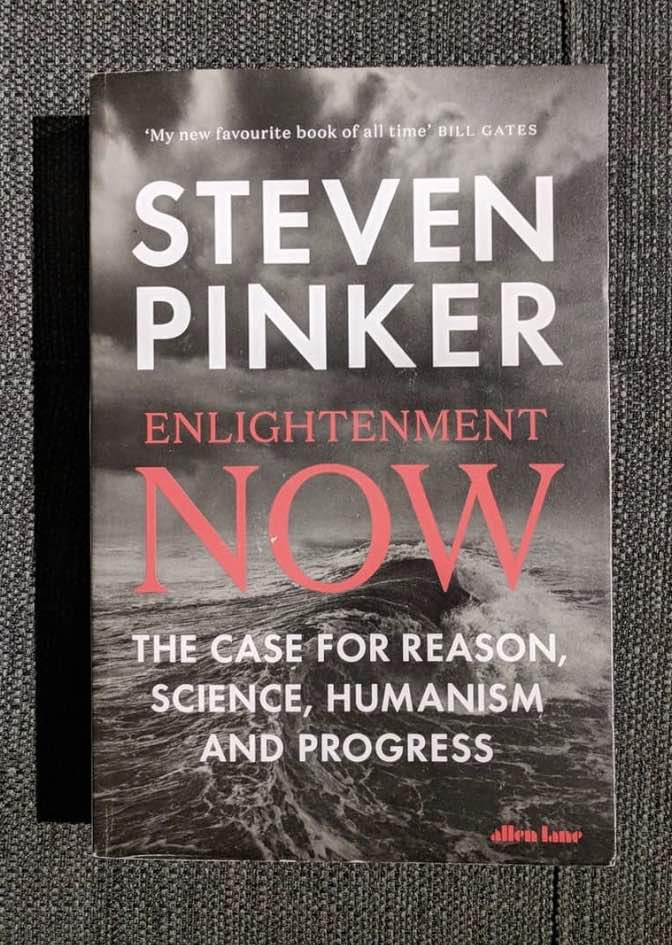
  • Enlightenment Now

    Steven Pinker

    “The case for reason, science, humanism and progress” – a part of the book’s title, did make me wonder whether there is a use case for this book at all. Especially 450 pages. After all, isn’t this self obvious? Evidently not! I haven’t read “The Better Angels of Our Nature”, the book the author wrote before this on the same premise, but apparently this book works as a rebuttal against all the criticism raised against the former. To note, “Enlightenment Now” works completely fine as a standalone work, one that needs to be read.

    The author begins on a very philosophical note, a question raised by a student during a lecture – “Why should I live”? He gives a brief answer that touches upon not just the opportunities available to an individual to progress and flourish, but because of her/his sense of empathy, also allow her/him to help others do the same.

    What enables this are the four concepts I mentioned in the first sentence. They are what the author calls the ideals of the Enlightenment, and through this book he aims to restate them in the context of the present.

    In the first three chapters the author writes about what Enlightenment is, what drives it, and what the forces acting against it are. One among them is this – even though one might agree to it in principle, one would never agree that it would work in practice. I have to admit, I am one of those.

    But before getting to that, some praise for the next seventeen chapters, which are all about the remarkable progress that we have achieved as a species. From life itself (mortality, life expectancy rates) to economic growth and reduction in poverty to the environment to wars to human rights to life satisfaction, the author uses reason backed by data to show how this is indeed the best time to be, and how it’s only going to get better. The data in itself does seem irrefutable, though to borrow from Ronald Coase, I do not know how much it has been tortured to confess.

    Even if I assume the data represents the whole picture, I cannot ignore the malaise of angst that I see around me, really and virtually. Is that an availability bias? Quite possible, but why is it increasing if the world is consistently improving?

    Is it really accurate to depict the Trump election as an aberration when across many democracies, the tide seems to be the same. Even if the high tide of economies helps all boats rise, not all of them will rise equally. Would they compare themselves to their own past or the current circumstances of those around them?

    And I think that forms the crux of my skepticism for the book – the individual experience. Our hopes, our attachments, our relationships are not always represented in the indices of society’s progress as a whole. Also, we are measuring the past with parameters we have now thought up, who knows what kind of indices later generations will think of. The graphs then might show that while we had collectively progressed as a civilization, we had failed on other fronts.

    In summation, I am reminded of the nuanced difference between the two kinds of victories – vijaya (victory over others) and jaya (victory over self). While the data shows the first against the collective ills that torment us, the second is probably what will give us the enlightenment that will finally make us happy.

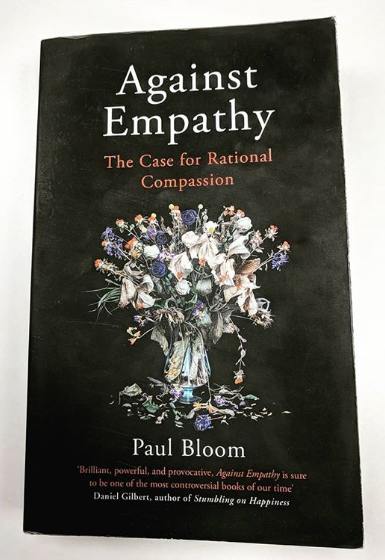
  • Against Empathy

    Paul Bloom

    As far as the title goes, he was preaching to the choir. My thoughts on empathy have been shaped over the last few years based on some excellent books like The Selfish Gene, The Moral Animal, Thinking Fast and Slow, Who’s in Charge? and even How Adam Smith Can Change Your Life, which is quoted by the author quite a bit. These thoughts are not kind to empathy being the best guide for decision making of the moral or even sometimes the day to day kind. They also favour rational compassion. So, theoretically, this book should have worked for me, especially because it has been recommended by some of my favourite thinkers.

    But it didn’t to the extent that I had hoped it would. This, I think, is largely because the premise of “against empathy” required little validation for me, it was the case for rational compassion that I was more interested in. After all, disproving one thing is not always automatic proof for another, even if the “another” is part of the title of the book! Unfortunately, the book spends just spends the last 10 pages (of 241) on rational compassion. Or at best 25, if one extends a benefit of doubt to occasions where the author argues for it in related contexts.

    I did come across a few interesting things though. Some framing for example – how both folks for and against gun control/immigration are possibly driven by empathy. The only difference is who they are empathetic to. And quotes – this one being my favourite – “Scratch an altruist, and watch a hypocrite bleed” ~ Michael Ghiselin. (I really believe in this one, and the selfish interests that drives erm, selflessness) I realised that I was in the august company of Thomas Hobbes and Abraham Lincoln in this. There are also interesting concepts like the moralization gap – how we discriminate between the immorality of acts done to us and done by us (exaggerate the first, downplay the other).
    The arguments are a mixed bag, but the writing style is witty and accessible and I would recommend it to folks who are intrigued by the thought of being against empathy. If you’ve already arrived at it via thinking/reading, this could help you in validation, but only on the first part of the title.

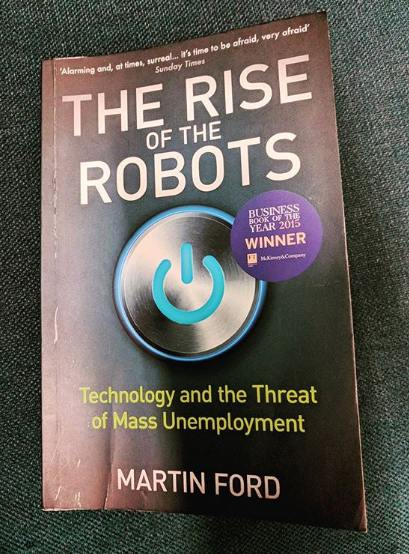
  • The Rise of the Robots

    Martin Ford

    The bad news – it would seem that the robocracy is inevitable. The good news – this is a very well written book!
    In most robotics and AI narratives, what gets lost is the nuance as folks very firmly root themselves in polarising camps on the future of our species. The reason why this book worked for me was because its focus was less on the dramatic headline (what) and more on why it would happen. It is a very well researched book and sets about debunking popular schools of thought in a very clinical manner. The author is also wise enough to call out the things he is not sure of and mention alternate points of view, as well as objective enough to not fall for the hype of everything that’s new and supposedly disruptive.

    Though he does begin with the now ascertained fact that the first wave of automation will take away the routine and predictable jobs, he also warns that it won’t stop there. Even what we would call the higher end jobs will be safe only for a while longer. He is clear that this is a wave of disruption different from what we have seen before because the cognitive abilities that get developed will be replicable and scalable. He also demolishes a couple of currently popular coping mechanisms – consistent re-skilling, and man-machine collaboration.

    The second half of the book focuses on the economic and societal implications of the rise of the robots. He predicts the fall of middle class demand as well as economic mobility, as incomes stagnate or disappear completely, and warns that economic growth would not be sustainable since robots cannot be expected to be consumers, and the plutocracy (top 5% of the population) which has the money can only consume so much!

    The solution he believes in is some version of a universal income which would ensure the participation of a larger segment of the population and give some semblance of prosperity to everyone. But he also sees several challenges in execution.

    Beyond the broader narrative, there are some fascinating statistics and anecdotes – the development of Watson, the scarily increasing time it takes for employment to regain its original levels after a recession, the sale price of Internet behemoths (YouTube, Instagram, Whatsapp) framed as a cost/employee, and so on.

    While the outcomes may not really be palatable to anyone who belongs to the species, it doesn’t take away from what a fascinating read this is!

  • The Sovereign Individual

    James Dale Davidson, William Rees-Mogg

    One of my favourite books is The Moral Animal. It does a great job of explaining the connection between the mental organs and behaviour, and does justice to the explanatory line on its cover – “why we are the way we are”. I liked it a lot because it did a stellar job of helping me understand the reasons behind my mindset, relationships and interactions with the world at large. While that book helped me understand myself, this one helped me understand the world much better.

    Considering that it was published in 1997, this is as much a prediction machine as it is a brilliant book. It took at least till the middle of the last decade for even the internet to manifest itself in the form we are now familiar with. Therefore, accurately predicting the rise of e-commerce and cryptocurrency (referred to as cyber currency) is a feat in itself. The projections are not just in the field of business but cover social, economical, societal, political and even moral aspects as well. For instance, the rise of nationalism, filter bubbles, the twist in increasing income disparity (from between nations to within nations) because of lack of access are all themes that are being played out now. (more…)

  • The Gene : An Intimate History

    Siddhartha Mukherjee

    “As our island of knowledge grows, so does the shore of our ignorance.” probably best describes this book for me. My understanding of the subject grew manifold after reading this book, but I also realised how little we know!

    Perhaps the one question we all seek an answer to is “Why are we here?”. There probably is no universal answer to that question, as science and religion like to approach it in different ways. Personally, I think that purpose is either just a narrative in hindsight, or a story we build to create meaning in our lives.

    Meanwhile, science has raced ahead of religion in explaining “how are we here?” In terms of the two building blocks that have existed before us – atoms and genes – as well as the influence of the one we created – byte. This book is the story of what the author describes as “one of the most powerful and dangerous ideas in the history of science: the gene, the fundamental unit of heredity, and the basic unit of all biological information.” Indeed, it is the history of this unit – from its presence in a human’s mind as an abstract idea to the human attempts to write and rewrite it – that makes up this book. (more…)