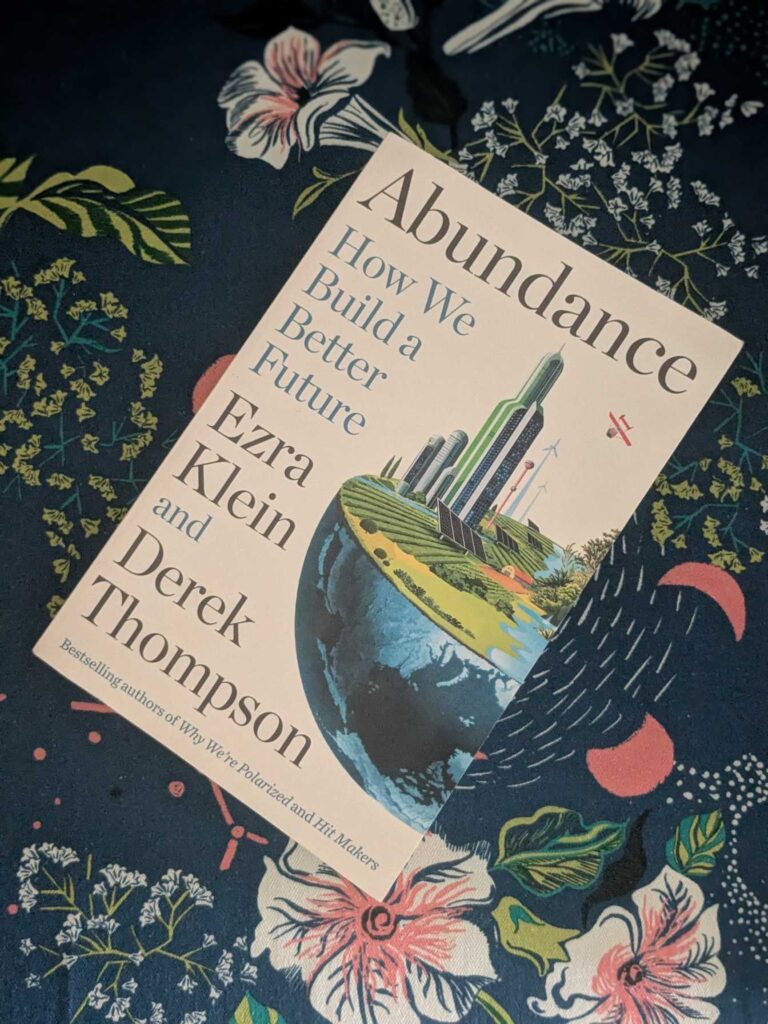
Ezra Klein, Derek Thompson
Just so we are clear, the scope of this book is only the US, the rest of the world will have to figure its own way to abundance, though we might learn a few tricks from this. Ezra Klein and Derek Thompson wonder why, for all its enormous wealth and technological capability, the US cannot address the fundamental human problems of hunger, homelessness, life-threatening diseases, and fuel an equitable world with clean energy.
Indeed, the introductory chapter ‘Beyond scarcity’ does imagine an utopian world really well. And it’s clear that it isn’t technology that is stopping us. Sigh.
Through the analysis of political, economic and cultural ethos across decades, they trace the ‘how we got here’ to a scarcity-driven politics, not from the conservative right that likes to keep the government out of most things, but from the so-called progressives on the left. They identify a decades-long shift beginning in the 1970s – when American liberals became more concerned with process than outcomes, enforcing strict zoning codes, environmental regulations, and costly infrastructure mandates that, in real life, put the brakes on growth.
I remember reading this point of view in Francis Fukuyama’s Political Order and Political Decay, where he says “there is too much law and too much ‘democracy’ relative to the American state capacity”. That it has now become a vetocracy, with economically powerful special interest groups and the judicial arm having hijacked the system and preventing reforms. Of course, given his leaning, it probably came from a different sentiment.
A central theme is the critique of process and proceduralism. The book argues that when the Democratic-leaning coalition ties itself to onerous permitting processes, it inadvertently bolsters housing shortages, dilapidated transit systems, and underinvested public utilities – a supply problem across all infrastructure, leading to people at lower rungs being gated out. This can be seen now as a regulatory impasse in many liberal jurisdictions, where well-meaning (in isolation) rules and community objections prioritise preventing ‘bad’ development over enabling ‘good’ development.
Klein and Thompson present their solution into an ‘Abundance Agenda,’ a Third Way framework aimed at rebalancing social goals and regulatory safeguards. This agenda aspires to dismantle needless barriers while preserving essential protections and build economic dynamism without sacrificing equity. A middle ground to a progressive movement fearful of change and a conservative movement allergic to any government action.
While I liked the synthesis idea, the ‘how’ is not even a thought beyond a few small examplesof when such an approach has worked. Clearly, the challenges at higher scale would be massively different. These are diverse problems- housing, climate change, research , innovation, and mass deployment of this ‘abundance. I also wonder how capitalism would react to it. Elite capture of every resource has been a recurrent phenomenon, what is their take on an abundant life for everyone? Can humans really live without classes and status?
Having said that, this is a very accessible and thought-through book. It provides an excellent systematic flow through the five chapters – each, with its own narrative of what is happening with examples, why it is happening seen through the lens of historical, economical and cultural contexts, and what can be done (directionally) to remedy it.
Quotes & Notes from Abundance
1. The fascinating story of Katalin Karikó and mRNA in ‘Invent’ (p 129)
2. Operation Warp Speed (OWS) is one of the best examples of solving at scale. The creation and distribution of Covid vaccines in ‘Deploy’ (p 184)
3. “It was as if liberals took a bicycle apart to fix it, but never quite figured out how to get it running properly again.” Paul Sabin