I picked up the book after reading an interesting anecdote from it on how Agassi cracked the Boom Boom Becker serve, and then only sparingly used the knowledge so Becker wouldn’t know he knew the tell! I haven’t read autobiographies before and didn’t know what to expect, but what I did get from it was a classic five-setter between Agassi and Sampras. And as it goes, if it reaches the fifth set, Agassi invariably wins.
Sometime back, during a college reunion, D’s friend mentioned how she was shocked when she realised that she (and therefore us) were ‘those people’ who were being referred to as ‘middle aged’. A couple of years ago, I had written a blog post on entering the second half of my life, which I was hoping would not be a “mountain’s downhill, but instead, a series of small hills, gracefully undulating until the end.” So yes, I have been thinking of old age, and this book, though written back in 1970, is a great exploration of what it means to be old.
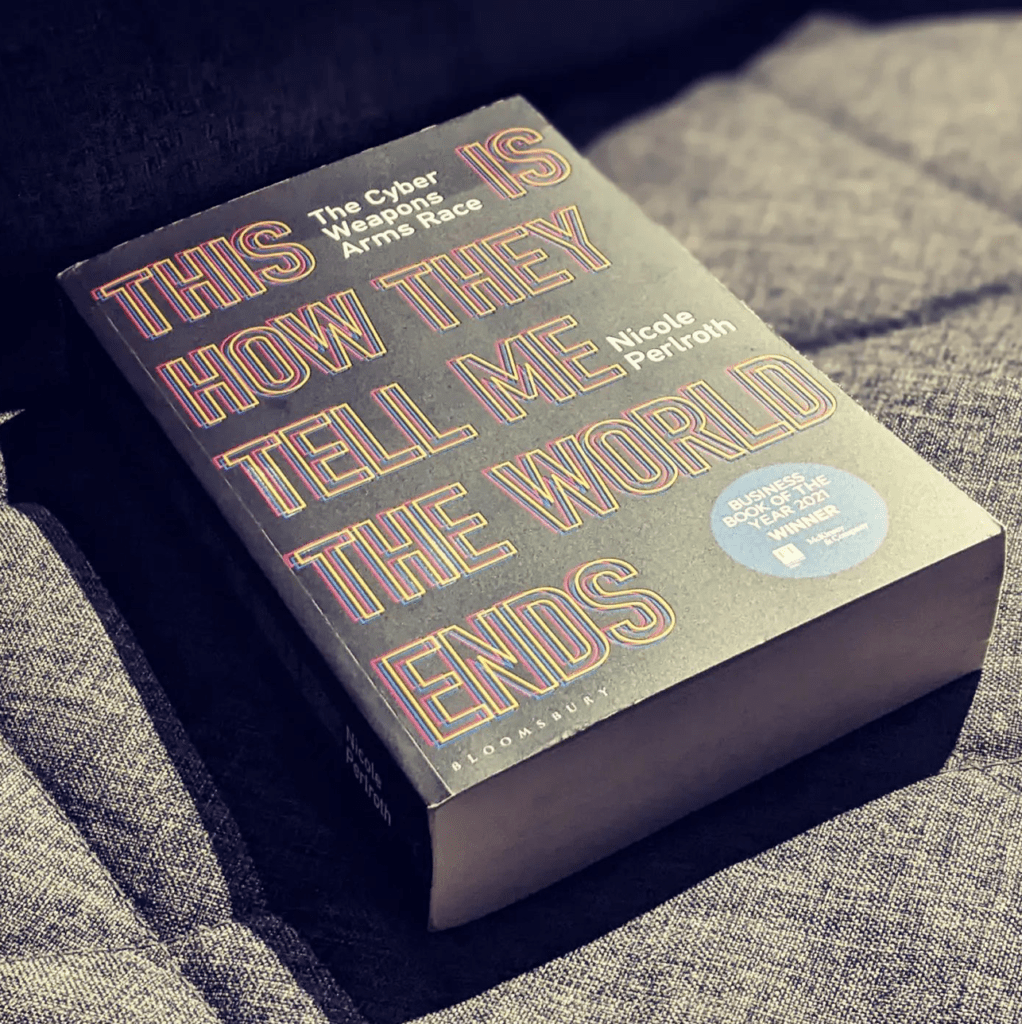
In the epilogue, Nicole Perlroth goes back in history to a summer afternoon in 1976, when in the parking lot of a biker bar, a team of scientists from SRI International (which had an office in Menlo Park) sent the first email over the internet to ARPANET, as a demo for Pentagon officials who had flown in for this. In the world then, national security was largely a function of things in the physical domain – hijacked planes, rogue nations with nukes, drug trafficking, terrorists and so on. (Almost) half a century later, the world is a different place. Forget rogue nations or terrorists, a single hacker can seize control of a plane in mid-air with nothing more than a play on the code in the software running the plane. Everything from election systems, power grids, nuclear power plants, gas pipelines to hospital systems can be held hostage with ransomware. Most of them have been, and every device we use – from mobiles and laptops to connected homes and cars – is vulnerable. This is the story of that transition.
Nicole begins the book in Ukraine, where she was surveying the aftermath of a devastating cyberattack, which included the Chernobyl radiation monitors going offline. The culmination of Russia’s revenge for the 2014 Ukrainian elections, which they unsuccessfully tried to hack. That the hack boomeranged and destroyed Russia’s own oil giant Rosneft’s data is a good example of how even those who unleash attacks cannot be sure of its speed and direction.
But the story begins in the Cold War era, back in 1945, when bugs were ‘microphones’ and the advanced exploits were through anything that was attached to a plug – typewriters, copiers, printers etc. There is an extraordinary story from 1984 of Project Gunman, and how a coil in an electric typewriter was ‘weaponised’ with a magnetometer and a recording device for spying!
And then came the computers. The first version of Linux had 176000 lines of code, now Microsoft’s Vista has 50 million. Each a potential vulnerability. Back in the day – from the late 90s, brokers started paying coders to purchase exploits in hardware/firmware/software – Sun, Cisco, Microsoft, HP, Oracle. They then sold it to these companies, sometimes having to show them proof of how it could be exploited. As the internet grew in size and became a global network, an underground market for exploits formed and the US government started building an arsenal including zero-days (a software/hardware flaw which doesn’t have a patch yet, called so because the ‘good guys’ have zero days to fix them). Some zero days are ‘ideal state’ – they require zero interaction from the target’s end, no mails or messages, and also ‘clean fail’ – they wouldn’t trigger an alert or crash a computer. But since the days of Stuxnet (2010), which had as many as seven zero-days and was used by the US to neutralise Iran’s Natanz nuclear facility), things changed. Just like Hiroshima, a weapon had been revealed and it would not go back into the box (Michael Hayden, former NSA director).
Also, in 2007 came the iPhone, supercharging the era of government snooping, and an invasion of privacy with minimum effort! By 2015, the NSA was even snooping on their own First Lady! It is now a minefield with different governments including not just powers like Russia and China but Iran, North Korea, Israel their opponents within the country and outside, hacker groups, tech companies, and government agencies all in an arms race to win cyber wars in milliseconds.
The book has many interesting stories. The origins of Pegasus (by the NSO in Israel), named after the winged horse, and which could capture vast amounts of data from the air without leaving a trace. Aurora – the Chinese Legion Yankee attack on Google, and Brin’s strong response, though it was only for a short while. Argentina’s thriving hacker ecosystem, Iran’s ‘burning flag’ response to the US in its Aramco hack, Russia’s hacking of the DNC, WannaCry by Lazarus from North Korea, HeartBleed based on a widely used OpenSSL software, the linkage between the assassination of Jamal Khashoggi, the purchase of exploits by Emiratis, and the publishing of Bezos’ private photos (the source was actually the mistress’ brother, but the phone was simultaneously hacked too) are all signs of an escalating war. There is also a funny story on how, after Trump ordered Russia to close their San Francisco consulate, plumes of black smoke began pouring out of their building’s chimney. They were obviously burning something, and when a reporter asked an exiting man and woman about it, with acrid smoke billowing around them, they replied, “there is no burning.”
The weapon will not go back into the box, and it is now capable of devastation in milliseconds. The world, while aware of this, is not willing to find alignment on things that will now start taking human lives. One excellent place to start is to stop taking buggy code to market. In an economy that rewards first-to-market and “move fast and break things”, this is not going to be easy. As usual, Scandinavia leads the pack for safety, but Japan offers an instructive lesson in making cyber hygiene a priority for everyone from government agencies to individuals. But this provides no comfort because it is really an arms race with seemingly no end.
The narrative is relentless and extremely accessible. It throws light on an area which we shouldn’t be ignoring, given how much is at stake. For me, it is also a validation on not going beyond the mobile phone in terms of tech hardware. But that really is small relative safety, nothing more. And just like Nicole, I wonder when we will see the ‘mushroom cloud’.
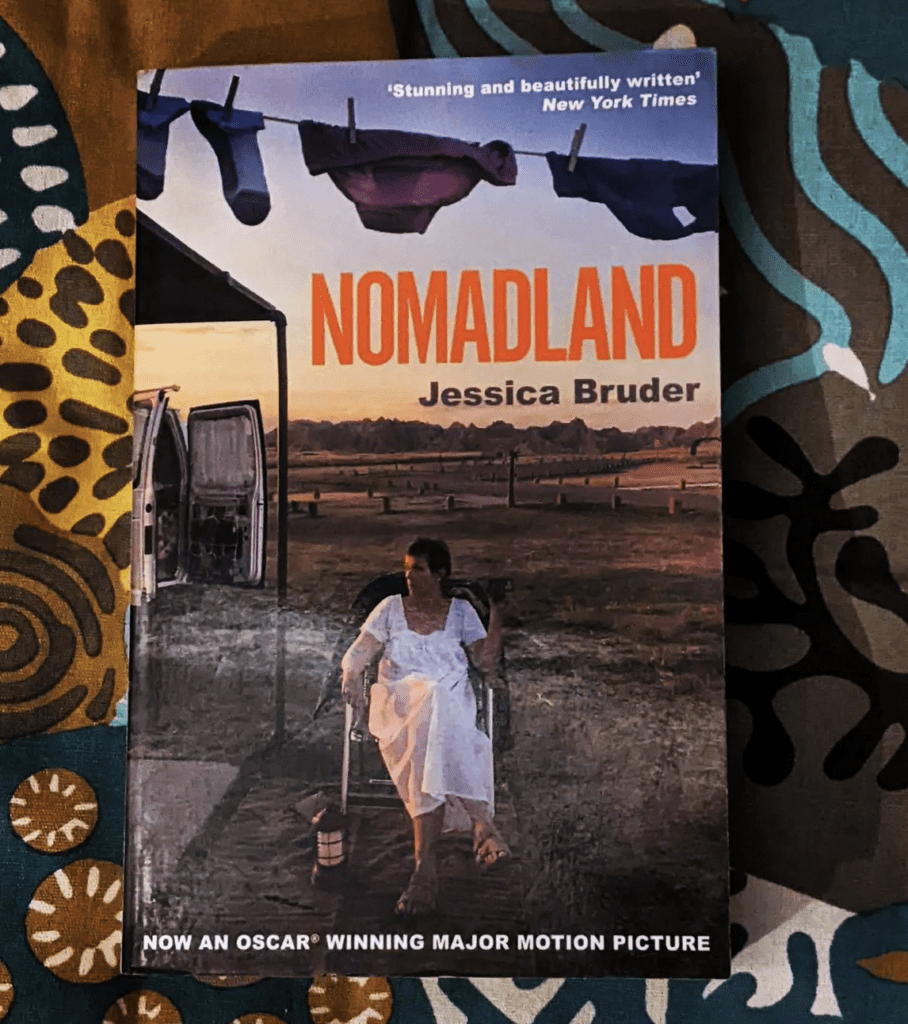
After I watched the movie, I felt compelled to read the book. For those who have taken the same route, this is not Fern’s story, she is a fictional character. But she does make a great representative for the nonfictional reality of those who have taken a less travelled road.
There are two alternate narratives at play – in one, the economics of the times forces people into living a nomad life in RVs and vans. In the other, people choose to live a life of freedom without being tethered to a place. There is deep poignancy in both. While a big culprit is indeed the Great Recession, I found many of the origin stories startling. One wrong move or a chance incident causing a drastic change in lifestyle – a messy divorce, a bad investment, a health condition (self or family). When groceries, utilities, medicines, credit card debts and so on are done, and nothing is left, you start to really think about rent and sometimes choose to be house-less before you become homeless.
People with master’s degrees who have held down white-collar jobs, travelled internationally, owned million-dollar properties, now forced to do labor at beet harvests in below-freezing temperatures, made to work overtime in the U.S. Forest Service in part-time jobs without overtime pay, or do mind-numbing work at Amazon warehouses. In all cases body-breaking, at an age when the body is on its downward trajectory. And such is corporate greed that they’d rather have an ambulance waiting outside for the inevitable trips to the hospital than improve working conditions. Intelligent people, who get slotted in roles far below what they are capable of. A globe-trotting software executive now working five days a week at an Amazon warehouse until just before dawn, on overtime shifts lasting 12 hours, with half an hour for lunch and two fifteen minute breaks. In his old life, he had spent $100000 a year, now he has learned to get by with $75 a week. People who have to take 4 ibuprofens for the pain before heading to work! This is the behind-the-scenes of Cyber Monday.
What goes on in the minds of those who have taken this path – their relationships with family and the communities they form, their own thoughts of how they are spending their lives, their sense of identity, their future? They don’t want to be thought of as poor and whining, there is pride and sense of agency. And many of them may not choose to go back to their earlier lives. But I wonder.
Through many unforgettable people – poets and bloggers and artists and ordinary folks – Jessica Bruder brings this all to life. She hasn’t parachuted into the story at different points. She has gone through the steep learning curve, endured and survived, had an ‘unbeetable experience’, worked in the Amazon warehouse, and lived this life for three years in Halen, her rig. Thanks to that, this isn’t just casual reporting. It’s written with inquisitiveness, understanding and empathy, and is a must-read because there is a life that’s outside of the American Dream, which offers lessons to all of humanity.
Notes Michael Reynolds “We have to find secure sustenance for people that is not subject to the monster called the economy. The economy is a game. This game should be about nonessential things (motorcycles, computers, televisions). A person feeding their family, staying alive, having shelter…that should not be subject to an economy.” “Which parts of this life are you willing to give up so you can keep on living?”
Growing up in the 80s in India, it was impossible not to have experienced the Cold War in some way – from listening to adults discussing it to having USA vs USSR wrestling matches between us kids! So this was nostalgia to some extent. And even though not by design, this was an opportune time to read this. To understand the direction and extent of the US hegemony in the last three decades and its impact on contemporary geopolitics, and to read it at the specific time when the Russian military invasion of Ukraine is bringing out a world order that is not just US-centric.
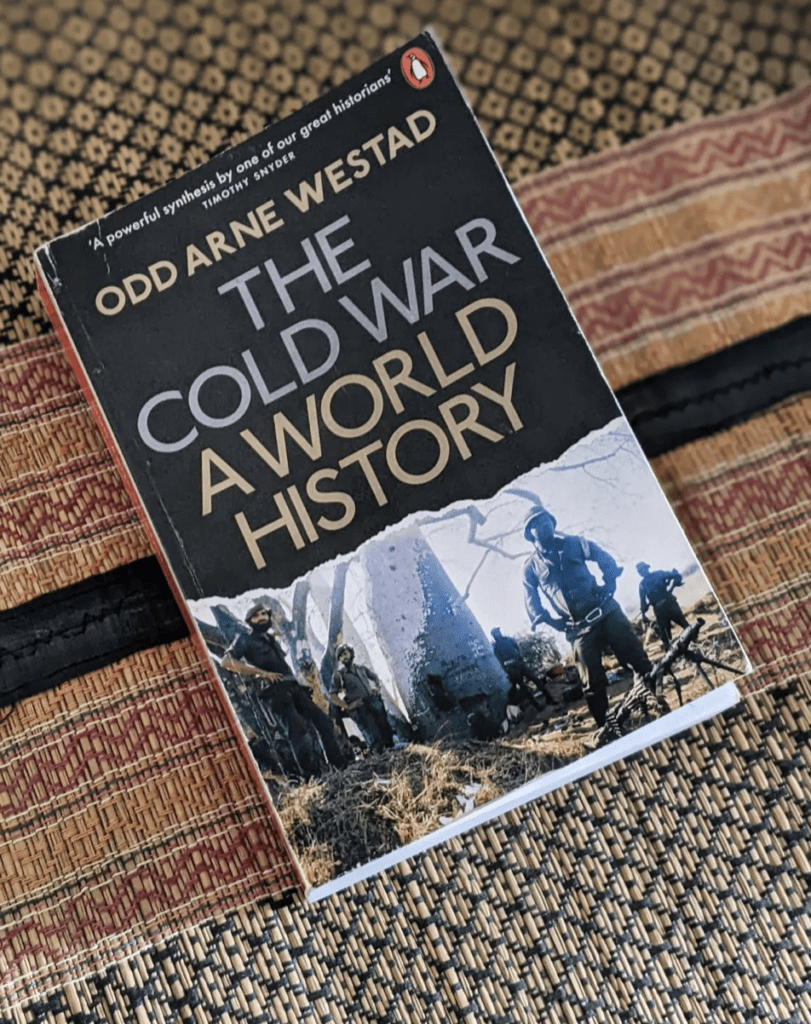
The Cold War is about not just about philosophy and politics, but people, places and the events that were either cause or effect. Ideologically, it was a contest of how the world and its citizens should be organised and into that whirlpool a lot of countries, policies and people were sucked. And in the end, as Depeche Mode sang, “The dawning of another year…one in four still here”.
It is interesting to note that this level of bipolar conflicts are quite rare in world history, barring say Spain’s Catholicism vs English Protestantism. Though the Cold War can be seen as a confrontation between capitalism and socialism from 1945 to 1989, its roots exist even before World War 1. And its impact can be seen in contemporary politics – from the state of Afghanistan to authoritarian China to unhinged North Korea.
Socialism as a thought had existed since the French Revolution but its acceleration and the start of the Cold War happened in the context of two processes – the emergence of new states (50 in 1900 to 200 by the end of the century) and the transfer of power to the United States during the world wars. This combined with the Russian Revolution of 1917 and the creation of the Soviet state as an alternate to the US brand of capitalism set the stage. The socialists considered the war a creation of capitalism and saw it as a war between robbers and thieves who had nothing in common with the soldiers fighting the war. The only thing that could benefit the common man was socialism and communism. Lenin set up Comintern in 1919 to which a bunch of nationalists and anti colonialists flocked. Towards the end of WW2, Churchill used “an iron curtain” despite the Soviets being an ally.
And thus began the tussle that saw historic personality clashes and alliances – FDR, Stalin, Churchill, Truman, Eisenhower, Kennedy, Brezhnev, Johnson, Khrushchev, Nixon, Ford, Carter, Reagan, Gorbachev as well as Latin American, East European and African dictators, Chinese autocrats, South Asian, Middle Eastern and “non aligned” leaders like Nehru and Sukarno. Not to mention China playing the superpowers and sometimes getting played. The Cold War had places as far away as Berlin, Brazil, Baghdad and Busan all becoming a theatre of war. When one looks at the dictatorships that the US propped up in Latin America, it is easy to wonder whether it’s really different from what the USSR did in Eastern Europe. The book also takes us through the context in which organisations like the UN, IMF and NATO were formed and how they became the arenas of the Cold War. Multiple spurts of arms races, events such as the Korean, Vietnam and Afghanistan wars, the Suez Canal clash, Cuban missile crisis, and even an ‘internal’ event like Watergate all left their mark.
It is fascinating to think about how the world might have been different if Gorbachev had decided not to take his annual vacation in Crimea in August 1991. Would there have been a coup at all, or would he have been able to put it down and steer the Soviet into a democratic coalition of independent republics? Would they have been part of the EU now? Would there be Putin, or even Donald Trump? Odd Arne Westad does a great job of making this narrative of contemporary history accessible and engaging. It is not an easy task to map time, places and people and cover everything that deserves a spot, but he does a fabulous job. if you’re even slightly interested in history, this should be in your reading list.
Side Notes 1. Denmark in 1899 was the first country to have an agreement of annual negotiations over wages and working conditions. Probably explains its quality of life now. 2. Capitalist Norway has more state ownership of companies than China 3. Hilarious Soviet Russia jokes on pg 368, 535 4. Romania was so poverty-stricken that when Ceausescu visited Queen Elizabeth in 1978, the palace staff removed all valuables from guest rooms because he and his wife Elena might take them back with them! 5. One does feel sad for Gorbachev and how under-appreciated he was by his own people. For a Communist leader, Glasnost and perestroika were extremely liberal initiatives with the good intent of providing more freedom and a better quality of life for the people of USSR 6. An entire chapter is devoted to Indira Gandhi and boy, she was strong! In intent, speech, and action. To stand up to the might of the US when surrounded by Pakistan and China is no mean feat. “My father was a statesman, I am a political woman. My father was a saint. I am not.”