Category: Mind

  • Metaphors we live by

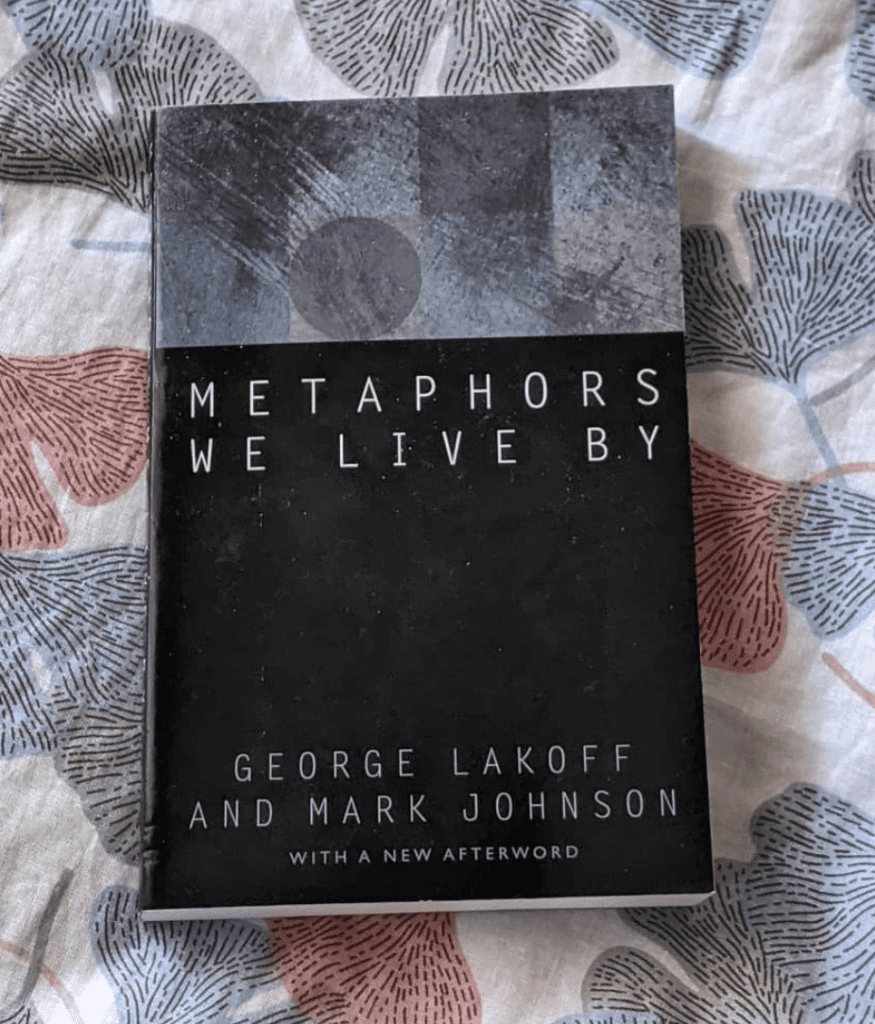
    George Lakoff, Mark Johnson

    In “How Emotions are Made“, Lisa Feldman Barrett wrote how concepts, goals, words all help the brain frame any new stimulus it receives and that by reframing concepts and looking at them more objectively, we can reshape what emotions are surfaced, and thus exercise free will. But how does one go about that? In the vast scope of “Metaphors we live by”, we get an answer to that too. 

    Metaphorical concepts are so ubiquitous in our thoughts and deeds that we don’t even realise they exist, let alone their effect on how we think about everything from business and ethics to marriage and poetry. Conceptual metaphors allow us to use the inferences in domains we can sense (space, objects etc) on other domains of subjective judgment. In a way, this is how we are able to transmit ideas and create a shared understanding. We often ascribe this to language, but it actually begins with metaphorical concepts.

    The light bulb goes off in the first few pages, when the authors use “Argument is war” as an example. It’s because war is the metaphor we have used at a concept level, that the words we used to describe it are about winning/losing it, or “your claims are indefensible” or ‘He demolished my arguments” or “I attacked his weak points” and so on. Another example to think of is “time is money” – you use spend/save/run out of/invest to describe time. 

    In addition to the structural metaphors above, there are oriental metaphors, which provide a spatial orientation, and are based on our physical and cultural experiences. For instance, happy (spirits rose), consciousness (woke up), control (top of the situation), more (numbers went up), future events (what’s up), good things (looking up), virtue (high standards) are all “up”, while their opposites are down. 

    A thing to note is that a concept can have multiple metaphors e.g. Ideas are food (half- baked), people (father of modern physics), plants (fertile imagination) and many more. Another interesting part is the grounding of concepts. For instance, how we conceptualise the non-physical in terms of the physical. Harry is in the kitchen (which is spatial), in the army (social), in love (emotional). 

    The book further talks about the structuring of our experiences – experiential gestalts, as well as coherence of metaphors (including overlaps of metaphors, how they affect form, and how they can ultimately create realities. It also gets into very interesting territories – the nature of truth, objectivism and subjectivism. It points out how both miss the part that we understand the world through our interactions with it, and proposes an Experientialist alternative. 

    Since I started reading the book, I have been watching the words I use (” I am running late”, “I don’t think we should spend more time on this”) and imagining different metaphors. Because by changing the metaphors we live by, we can change our everyday life, and our future. This is far from an easy read, but even (more than) 40 years after it was first published, it is still pathbreaking.

  • The Mind is Flat

    Nick Chater

    I think the name of the book is a meta play, because the book convinces you of just that -“the mind is flat”. It is also the most convincing case I have read against AGI (Artificial General Intelligence), even while showing why we have had successes in narrow AI. Before you think it’s an AI book, it’s not, it’s about the human mind. We think of our mind having depths that we cannot fathom at this point, consisting of inner motives, beliefs and desires, many of which are unfathomable to us, and that behaviour is just a superficial aspect of it. This book argues that no such depths exist. The mind is flat.

    But what the mind is, is an excellent and immediate improvisor of actions, and beliefs and desires to explain the actions. My mental (re)action was “no way”, even though a part of this was familiar to me thanks to “How Emotions are made”. The author divides his case into two parts – the first part dismantles the perceptions created by classic psychology about beliefs, desires, hopes, and aims to prove that there is no “inner world”, and the second part provides an alternate theory – memory traces of previous momentary thoughts and experiences. 

    What really works is the accessibility of the narrative and how it is structured. It’s never a “believe me because I told you so”. Instead, we are led through a series of visual and thought exercises that question our understanding of reality. Slowly, a shallow world of improvisations are revealed to us. The mind works on “precedents, not principles”, and our emotions are creative acts made by a superb interpreter – our mind. With multiple examples, he shows our capacity to create “meaning” from nothing. Our inventiveness is brought out by the metaphors we live by, which are not always bound by “cold logic”. And that’s why we are able to create AI in areas where solutions are precisely defined. A general AI would require imaginative interpretations, something humans are very good at, but not really able to explain how!

    This does lead to my favourite “free will vs determinism” debate, and once again, the answer is that at any point, despite the determinism that has happened because nature and nurture, we have the freedom to change our mind. But then again, if it is flat, what’s there to change? Or does it contain a coda of traditions and precedents in the form of genes? While we create meaning from nothing, our quest for the depths of the mind is also perhaps a need to find “meaning”. I’ll leave it at that.

  • Indistractable

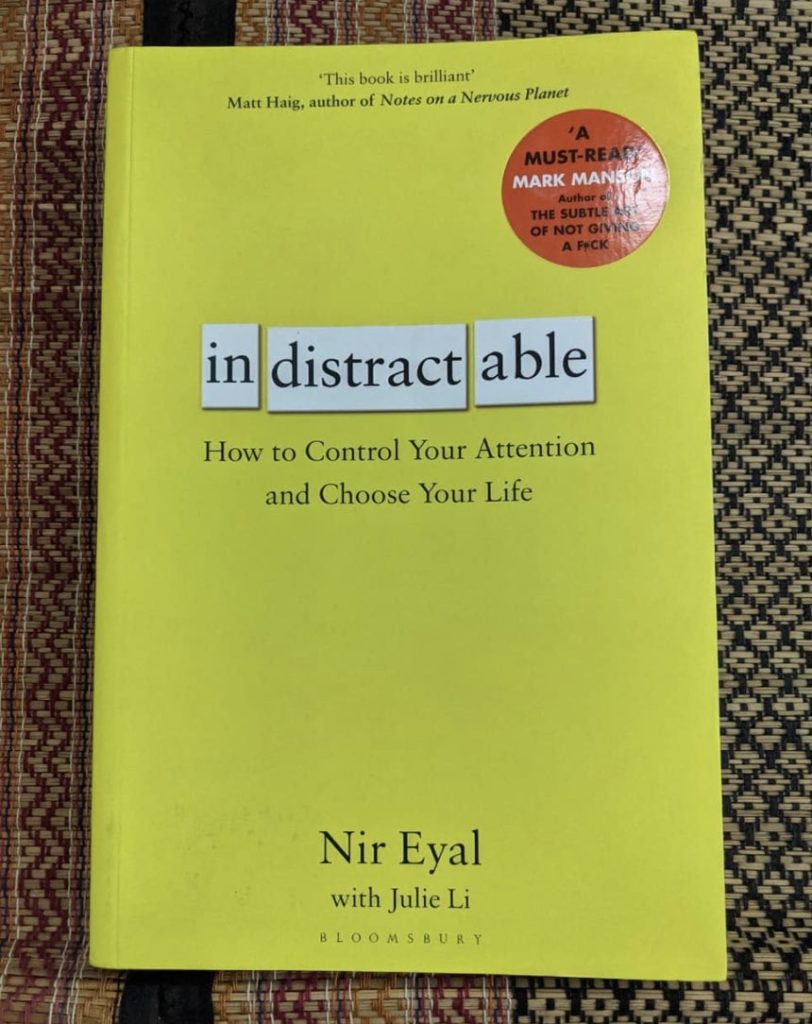
    Nir Eyal

    Towards the end of the book, the author cites a survey which found that “almost a third of Americans would rather give up sex for a year than part with their mobile phone for that long”. Sex has been hardwired in us by evolution, and it’s a testament to technology that it has managed to hack even that! But then again, there was a time when even the printing press was called the biggest source of distraction. So this isn’t a new story. But we do live in a world in which the attention economy has optimised its notifications and nudges to ensure that it is heard/seen/felt. All the time. Whether we need it or not. It has us hooked and sometimes we don’t even know how much!

    This is the challenge that Nir Eyal writes about in Indistractable. He approaches it with a simple framework of internal and external triggers and distraction and traction (some nifty wordplay, that). The first thing to focus on, he says, is our own motivations – internal triggers. Not just the proximal reasons that are making us distracted, but the root cause. Our distractions are more often than not a way of escaping something we do not want to confront. He also believes we never run out of willpower and warns us against labelling ourselves as “easily distracted” or “addictive personality”. An opinion that I am not sure I agree with.

    The rest of the book is a step by step guide on how to get to an “indistractable” state – from making time for traction (things we value) to taking control of external triggers by various means in personal and professional lives, and in social settings as well as when you’re by yourself. The suggestions are practical and quite doable once you decide that they need to be done. Ironically, the section that I found most interesting was how to inculcate this quality in children. Ironic, because I don’t have any. What made it interesting was the logical approach, one that seemed quite feasible.

    The book keeps it simple, and is a good guide if you find yourself distracted more often than you’d like to be. I have been doing my own wrestling with “staying in the moment” for a while now and found most of the things mentioned a validation of what I try to practice.

  • The Algebra of Happiness: Finding the equation for a life well lived

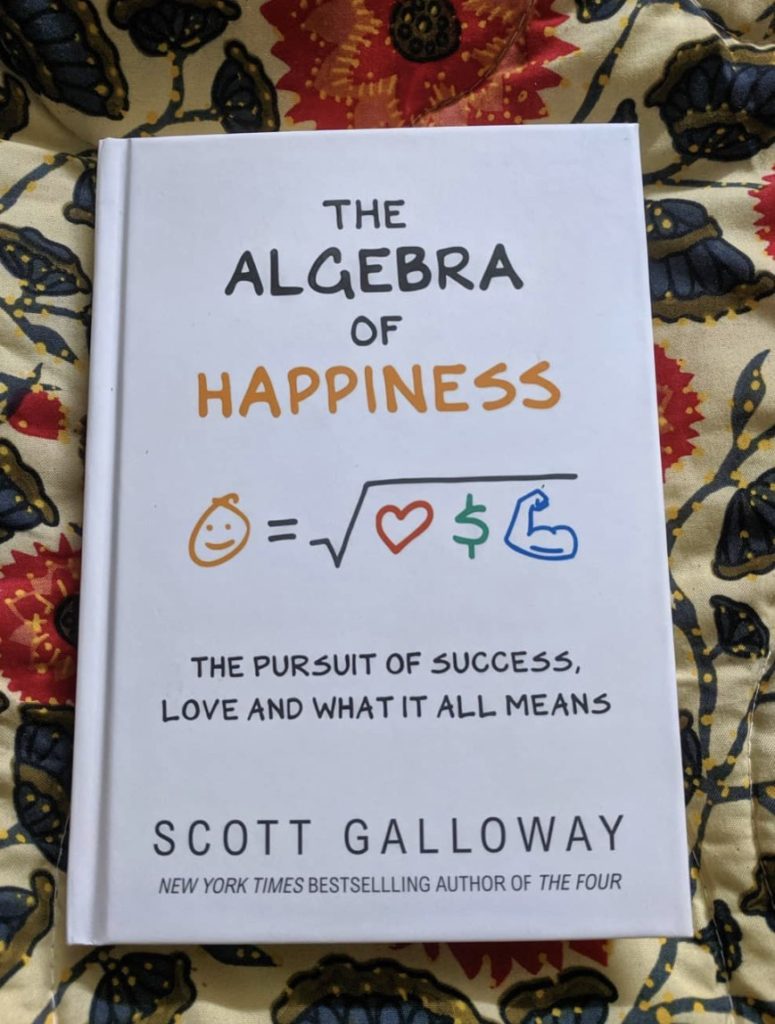
    Scott Galloway

    I’m familiar with Scott Galloway thanks to his various talks on YouTube. Funnily enough, I haven’t read his other book – The Four – which is related to the YouTube videos. But given the logical nature of his talks, and the reasoning behind the conclusions and predictions he makes, I was curious to find out how he approached happiness as a concept. Apparently, this is also the subject of the last session of his Brand Strategy Course at the Stern School of Business, NYU.

    If you’re not familiar with his work, it might be a good idea to watch one of his videos. For nothing else but to prepare you for his tone. It’s blunt towards abrasive, but laced with humour, and since it’s usually about brands worth billions, a roast is probably fine. I mention this because the book, despite being about happiness, follows the same style and tonality. I enjoyed it, but if you’re expecting a serious book that delves deep into the theoretical construct of happiness, this might not be the one.

    The author begins by admitting that his life is not exactly the perfect framework of happiness. Perhaps that’s what places him in a perfect spot to deconstruct happiness. Multiple entrepreneurship experiences, failed marriage, complicated relationships with parents and friends, all tend to give you perspectives of what happiness actually means.

    The book is divided into four section – basics, a deeper look at success, career, ambition, money and the professional life in general, love and relationships, and finally introspection. The age arc of happiness, the importance of having a right partner, alignment on money, not keeping score, being accountable to those who you care for and being present in their last days, understanding your own values, not being an a****ole – the lessons are delivered pretty much staccato outside of the broad sections. Profoundness and profanity coexist, and adds a lot of texture to the narrative.

    At the risk of repeating myself, this is quite unlike the standard “happiness” book you will read, but it delivers a bunch of insights that I found valuable. There is bluntness, but there is also humour and empathy, and together it ensures the book gives you some happiness.

  • How Emotions Are Made

    Lisa Feldman Barrett

    Just when I thought I was getting some stability (in my thinking) on the free will vs determinism debate, here comes fresh food for thought. As per ‘How Emotions Are Made’, while the combination of genetic and environmental factors do determine our behaviour, free will has a definite play.

    The core theme of the book is a constructionist theory of how emotions are made, as opposed to a classic theory. The classical view assumes that each emotion has a unique ‘fingerprint’, as against the opposing view that variation is the norm. This has implications not just on how we physically manifest our emotions but on our understanding of how the nervous system operates as well. And finally, the classical view believes that emotions are inborn and universal. But the alternate view is that emotions are formed based on shared concepts, influenced by social reality and culture.

    The view of the brain as a tiered system (survival, emotion, cognition) is one of the first myths that the author breaks. Further, as opposed to being the result of a stimulus-response mechanism, emotions are a result of the brain simulating and predicting, based on a bunch of factors. What we call emotions – anger, fear, happiness etc- are concepts that get created and honed in the brain. Concepts, goals, words all help the brain frame any new stimulus it receives and then predict. By reframing concepts and looking at them more objectively, we can reshape what emotions are surfaced, and thus exercise free will.

    Towards the middle of the book, the author sets up the answer for “are emotions real” with the classic philosophical question of “If a tree falls in a forest and no one is around to hear it, does it make a sound?”. The answer is that both fall under the “perceiver-dependent” category. Emotions are thus, a social reality and become real because of collective intentionality and our ability to communicate using words.

    This understanding of emotions, and how much we control/are in control has implications on a lot of things ranging from our daily behaviour to the way the judiciary system works and how we deliver justice.

    ‘How Emotions Are Made’ is refreshing because of the alternate perspectives, all of which are backed by science. The author makes it a point to call out hypotheses where it’s not. The language is technical only when needed and explanations are lucid. In all, it is a fascinating book that has made me rethink a lot of what I thought I knew about myself and the world. Not an easy read, but absolutely worth the time. And that’s why it made it to my 2019 favourites.