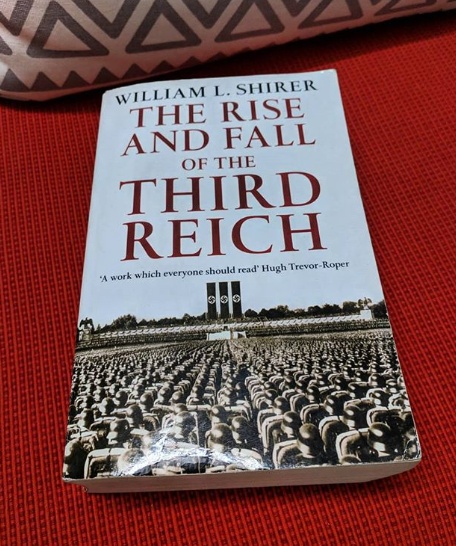
William L. Shirer
What a fascinating read! The second world war was one of the most defining events of the contemporary era, and The Rise and Fall of the Third Reich provides a fantastic view of what happened in Germany between 1930 and 1945, chronicling the ascendance of Hitler and the Nazi Party and its eventual demise.
Hitler’s dream was to establish a Reich that would last a thousand years, though it finally managed just about a dozen. But in those few years, he managed to give the world the kind of shock it had probably never experienced before.
The book actually begins much earlier, and traces Hitler’s early life, his disenchantment with the socio-political environment prevalent in Austria and Germany, and his entry into regional politics. Through smart thinking, astute use of the economic depression, a lot of outmaneuvering of politicians far bigger in stature than him, and quite some luck, he took himself to a position where the nation was practically begging him to seize control. It is amazing to see the number of instances long before he gained power when a small change would have led to a different history than the one we are familiar with.
His baby steps into expanding Germany’s borders through cunning and then brute force, his affection for the largely ineffectual Mussolini, the poor judgment and horrendous miscalculations exhibited by the European powers, Stalin’s greed, all led to a state of affairs that made war inevitable. Germany dominated the early period, the Blitzkrieg tore through defenses, and it is astonishing to see how close they came to taking over all of Western Europe early in the war, in addition to Scandinavia and Eastern Europe. Through the mid to late 30s, what is also evident is Hitler’s own iron will, determination and political astuteness using which he outplayed his opponents over and over. But in Stalin, he met his match, and he underestimated the man and his country’s military strength. A costly mistake.
At some point, Hitler’s megalomania took over, and his downfall began. His allies, the Japanese, didn’t help the cause much by drawing the US into the war. He repeated history by disastrously opening two fronts in battle. He also misread the importance of North Africa and the Suez. But it is chilling to note that with a little patience and by sticking to strategic alliances, he might not have lost the war at all. The Rise and Fall of the Third Reich also covers the role played by several inept leaders of the German armed forces in bringing and keeping Hitler in power, and their inability to stand up to the dictator, even as they realised that he was leading their country into disaster. Also described in detail are the several plots that were hatched to assassinate Hitler, including Operation Valkyrie.
This is a commendable piece of work – not just for chronicling an important piece of history, but for the painstaking research that must have gone into it, and the control on a narrative with so many moving parts, all of which are important.
At 1100+ pages and the smallest possible font, The Rise and Fall of the Third Reich is not an easy read. But if you have any interest in history, and the war that shaped the modern world, this is a book you should definitely invest in.