Category: History & Politics

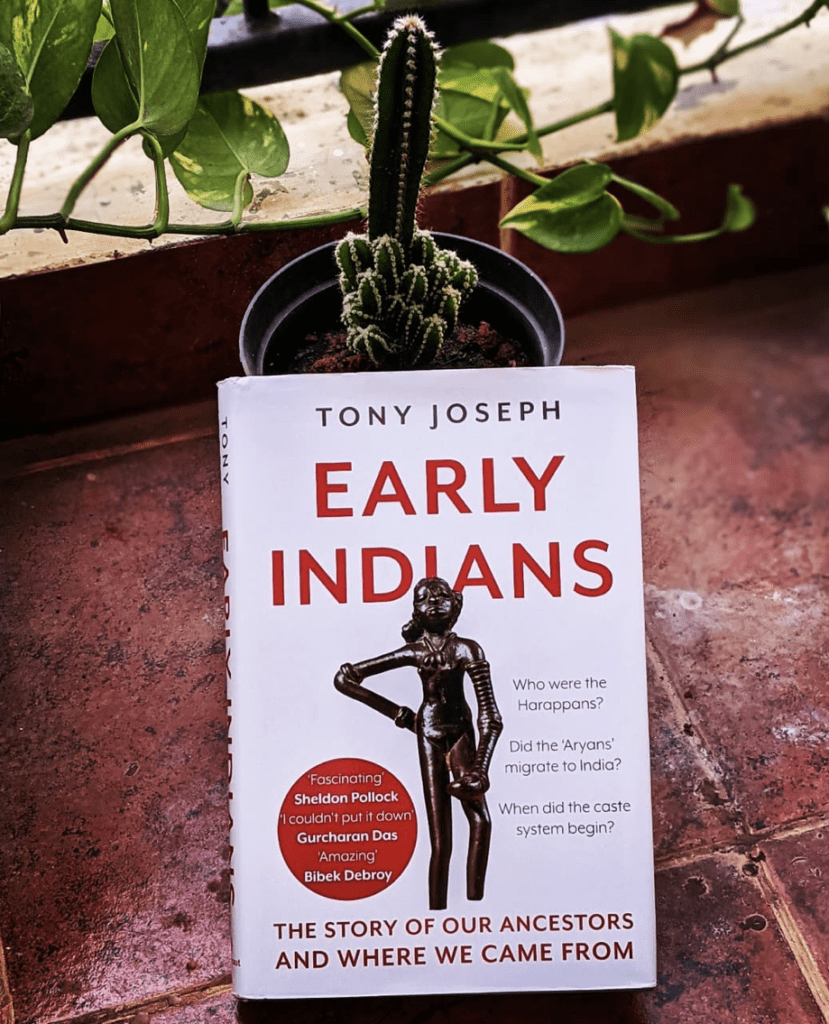
  • Early Indians

    Before I get to how wonderfully interesting this book is, I have to say I am surprised it hasn’t been banned yet! It easily, and scientifically I would add, dismantles all of the Indigenous Aryans and Out of India Aryan migration theories that have been doing its rounds on not just WhatsApp but larger forms of media, and encouraged by the current powers that be! 

    Tony Joseph starts right from the beginning to answer the questions, “Who are we Indians? Where did we come from?” The beginning is about 65ooo years ago, when Homo sapiens decided to venture out of Africa, and subsequently entered the Indian subcontinent. Although if you ask an archaeologist, the answer would be 120000 years! They are referring to the first group of modern humans who left behind archaeological evidence. The 65000 comes from the geneticists who are talking of humans who left behind a lineage that is still around. 

    The author uses the metaphor of a pizza to show how we got here. The First Indians, from the previous paragraph, forms the base. The story of the next layer – the sauce- begins in the Levant (West Asia), where approximately 20000 years ago, hunter-gatherers were being stressed by the glacial period that turned many areas uninhabitable. Many centuries of experiments on gathering and processing food later, when plant and animal domestication began to see success, some Zagrosian (region of Iran) herders reached Balochistan, around 7000 BCE, mixed with First Indians and formed the basis of the Harappan Civilisation. 

    I don’t think we appreciate the Harappans enough. They were really advanced for their time, in their unique practices and outlook, across multiple facets of what we call civilisation. Public infrastructure, weight standardisation, jewellery and pottery, they excelled at many things. They were around for over 6000 years, created the Dravidian languages and were the ancestors of all Indians. There are some word examples that show the connection between Elamite – an extinct language spoken in a region that is part of present day Iran – and Tamil, Malayalam, Telugu. The occurrence of places ending with vali/oli in Western and Southern India is because of the Proto-Dravidian language connection as (some of) the Harappans started moving southwards when their civilisation collapsed. Fascinating stuff! 

    Back to the pizza. The Aryans were the “cheese” who arrived from the Steppe around 2000 BCE. It was the Aryans who brought in the Indo-European languages. They originated in the Kazakh Steppe and moved across Southern Central Asia and then South Asia. And yes, the earliest Vedas postdates the Harappan civilisation. So it’s not as if the Harappans were the Aryans! The present day Indian population is a product of the intermingling of two sets. ANI [Ancestral North Indians – made up of Harappans (First Indians + Zagros agriculturalists) + Steppe pastoralists] and ASI [Ancestral South Indians – Harappans + First Indians (south)] In addition we have toppings in the form of Austroasiatic and Tibeto-Burman language speakers as well as Greeks, Huns, Sakas, Parsis, Mughals etc. 

    There are three distinct areas of science that have contributed to our understanding (even if it is not complete) of the answers to the two questions. Archaeology, genetics and linguistics. They have their “little” differences, but collectively, they have provided substantial scientific proof. 
    And now, after everything that happened from then until the present day, if we ask who is the best representation of Indians at this point, the answer is a tribal woman, because she carries the deepest rooted lineage. Adivasi (first inhabitant). How ironical given the way we treat them! Civilisation and progress! 

    A must-read if you are even remotely interested in history.

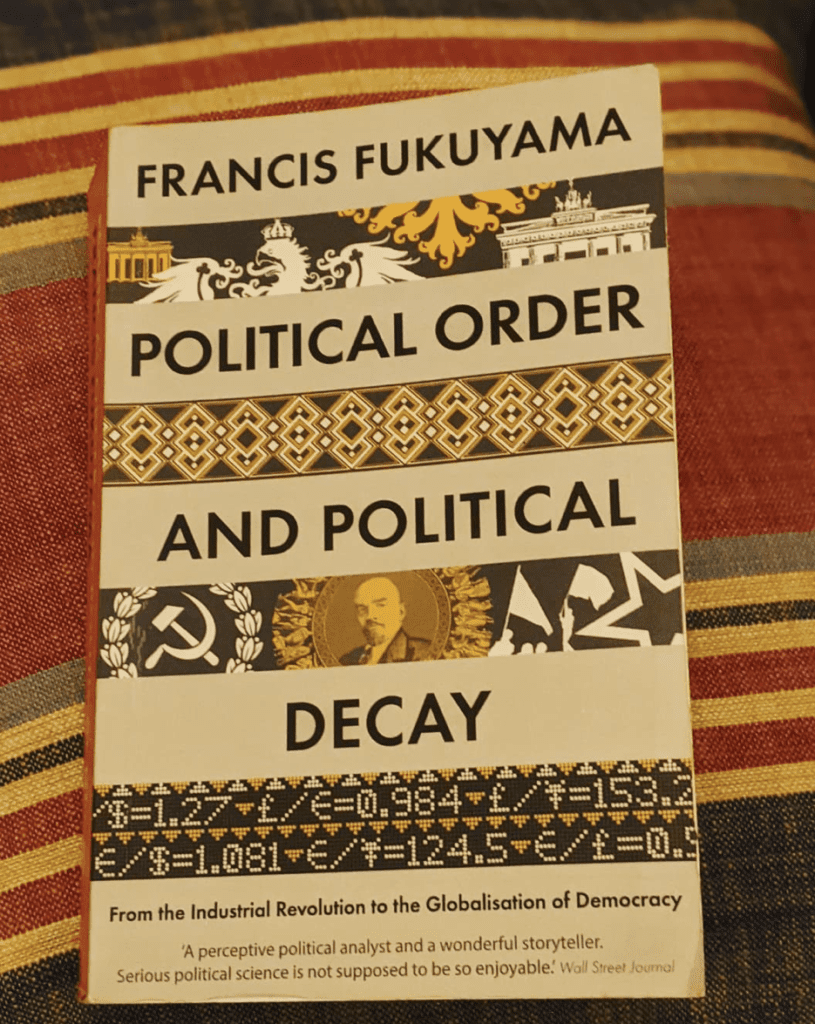
  • Political Order and Political Decay

    Francis Fukuyama

    The first volume – The Origins of Political Order – went straight into my favourites, and so does this one. While the former was about the components of a stable state, and how political institutions developed differently in various parts of the world, this book begins at the dawn of the Industrial Revolution and shows how state, law and democracy developed to their current state, by (also) considering three additional dimensions of socioeconomic development – social mobilisation, idea legitimacy, and economic development. The industrial revolution and the economic growth that followed caused a movement to urban areas, where new social groups were formed based on fluid identities. This mobilisation serves as a foundation for changing political institutions with new ideas. The book also throws light on the various reasons for the decay of institutions, and offers directional thoughts on fixing them. 

    The author frames the development of the stable state by asking how a country can “get to Denmark”, which is the benchmark for an ideal state. While there is some specific focus on the US, also warranted by its early and unique path to democracy, the depth of analysis that has gone into many countries, across Asia, Latin America, Africa, Europe, is just astounding! History, economics, policy, geography, (with critique and usage of content from another favourite book – Guns, Germs & Steel), culture and many other facets, all going into understanding the state of politics in a particular country. There are many routes to modern government, including the necessities that war creates (“unfortunately”, Latin America never had its share, and Europe had plenty of it – both have class stratification, national identity, and geography to thank) and peaceful political reform. And once there, the principle of effective government is meritocracy, the principle of democracy is popular participation, effective states operate through law, but law can be an obstacle to appropriate levels of administrative discretion – how is balance achieved? The material is phenomenally complicated, and bringing it to this level of accessibility is something the author should be credited for. 

    The first part of the book focuses on parts of the world that experienced liberal democracies first – Europe and the US. It also analyses why Germany has an uncorrupt administration while Italy and Greece are plagued by corruption. In the former, how is state strength related to organised crime? How does cynicism and social distrust get culturally embedded? How were Britain and the US able to reform themselves from patronage-led public sectors? And why was Britain able to get there faster than the US? An active middle class accelerated Britain while US got a unified business community and middle class professionals only in the late nineteenth century. At a broad level, we learn early that the sequencing of events matters greatly. Countries where democracy preceded state-building (US) have had higher problems in achieving high-quality governance than those who inherited modern states (Germany, through some excellent civil service reform and an educational system) from absolutists. And that democratic societies without a strong national identity have trouble unifying the population with a common narrative. 

    The second part deals with parts of the world that had been colonised – Latin America, Asia, Africa, and the Middle East. When the imperial powers left, many of these nations were neither fully Westernised nor able to retain their traditional political organisation. However, there are success stories like Costa Rica, which according to many frameworks should have become a banana republic. There are also disasters, like Argentina, which, blessed with climate and resources, should have become a model country. The reasons are complex, and Sub-Saharan Africa vs East Asia is a great example of different development paths. In both areas, as well as Latin America and the Middle East, states that had strong institutions were able to reestablish them, while those that didn’t struggled. Interesting to note that African ethnic groups are largely a modern phenomenon, created or at least consolidated in postcolonial times! The specifics of the Japanese system and how their military-led nationalism has evolved until the present day is also fascinating. The problem that East Asia now faces is making the state accountable. The nuanced difference between rule by law (state using law for its ends) and rule of law (law binding on the state) is superbly explained. In the Middle East, the threat is that popular mobilisations risks being hijacked by religion. 

    Part 3 focuses on democratic accountability and goes back in time to the period after the French and American revolutions to see how democracy spread. The timing in various countries vary depending on the changing relative positions of social classes – middle class, working class, elites, and peasants. The rise and growth of middle class was a great catalyst to democracy. While doing this, it raises a question extremely important for the current times – with increasing globalisation and technological advances, the middle class is getting hollowed out. What happens to democracy then? 

    The final section of the book is on political decay, and there is a heavy focus on the US, which has now gotten tied up in the very checks and balances it had set up to protect democracy. In the author’s words, “there is too much law and too much “democracy” relative to the American state capacity”. It has now become a vetocracy, with economically powerful special interest groups and the judicial arm having hijacked the system and preventing reforms. No modern book can avoid China, and this is further proof. The author sees the Chinese model as the biggest nondemocratic challenge to the idea of liberalised democracies. How will the Chinese middle class behaves in the next few decades? Even as it grows, will it be content to live under a “benevolent” one-party dictatorship? 

    I think I will re-read both volumes, they are such treasure troves of information. If you like books that explain the system of the world, this is a set you most definitely should pick up. 

  • How Fascism Works

    Jason F. Stanley

    In “The Origins of Political Order“, Francis Fukuyama talks about three institutions that have to be in stable balance for democracy to take root and thrive – the state, the rule of law, and accountable government. When that doesn’t happen is when we get contemporary Russia or China. But in various countries, there has been a sharp spike in fascist organisations, either overt or covert, and a polarisation in political discourse. Nations such as Myanmar, India, Poland, Hungary and even the United States may not be called fascist at this point, but are increasingly vulnerable. 

    In “How Fascism Works”, Jason Stanley looks at the structures that are common to Fascist movements – the ten tactics that are the pillars on which the narrative of “us vs them” is created and reinforced. A mythic past that breaks down common history and is rewritten to support the Fascist vision for the present and future. Propaganda that twists democratic ideals to serve their purpose. Anti-intellectualism that attacks universities and academia in general who might challenge their ideas. These three work in tandem to create an “unreality”, followed by the onslaught of conspiracy theories and fake news.

    Group differences are then highlighted, and scientific support for hierarchy is formed. As divisions multiply, victimhood among the dominant population is stoked the moment any minority moves towards progress. As gender equity advances, patriarchy gets threatened, increasing sexual anxiety, which is used to fuel conflict even further. Law and order is then cast as a tool for the majority “us” to be used against “them”. The narrative of us is most applied in the rural heartland, where “our” pure values and traditions still survive. And finally, unions and any social organisation that tries to build unity among diverse citizens is dismantled. So is public welfare since “they” are exploiting “our” generosity. 

    The nation replaces the state, creating a group identity, and using a sense of collective victimhood to call for the defence of that shared identity – ethnicity, religion, skin colour etc. Pluralism and tolerance are targeted in order to isolate “them”. The nation then artificially creates the conditions that would legitimise ethnic cleansing or genocide. 

    If you live in India, as I do, you are bound to recognise a lot of these – the pure Hindu past, love jihad, the sacred cow and lynching of Muslims, attacks on universities, imprisonment and/or killing of writers and activists, the biased use of law and order, and so on. The plight of the Rohingyas in Myanmar is a nearby example too. So is the United States under Trump. 
    There is a systematic normalisation that would make any charge of Fascism seem like an overreaction. This too is part of the process. The way to combat this is by first understanding the tactics, see them for what they are, and share the perspectives widely. That’s why this book is an important read for everyone.

  • Coromandel

    Charles Allen

    For once, I’d judge the book by its cover, because the multiple themes, the detailing and the overall quaint, charming imagery are a good representation of what the book will deliver. While the title of the book is an indication of its focus, it actually does more in terms of coverage, and provides a fantastic narrative of South India – historical, social, societal, cultural and political facets. 

    Over a period of time, history becomes stories, then legend, and finally myths. This is the journey that Charles Allen undertakes, and while he smartly calls it a “personal history” to avoid religious minefields, it is a comprehensive and erudite discussion. 

    He begins at the end of the subcontinent – Cape Comorin (Kanyakumari) and traces the tectonic shifts that created the Indian Plate, which we know as the Deccan, and its rock walls on one side – the Western Ghats, with Palakkad providing the only gap until the railways were built in the nineteenth century. The rest of the first chapter provides a good summary of the hunter-gatherer populations that resided in this part of the world in the Mesolithic era. 

    There’s then a detour – to the North and the Harappans. It also contains a clear, scientifically backed commentary of the Aryans, the location of the Saraswati and the connection to the Zoroastrians, the historical account of the Vedas, and the epics – Mahabharata and Ramayana. 

    We then return to “Agastya’s country”, early Tamil literature and the sage himself, who is credited with bringing Sanskrit to the South. The chapter clarifies and rebuts the paradox of him (also) being the person who brought Tamil to the South! This chapter is also interesting because it touches upon the origins of Vishnu and Shiva in mythology. The next few chapters were quite an eye opener for me, because it showed how both Jainism and Buddhism were dominant in the south, including Kerala. To the extent, where even Sabarimala, Ayyappa’s abode, has its origins in Buddhist shrine. Dharmashasta’s devotees chanting Swamiye Saranam Ayyappa seen side by side with Buddham saranam gacchami. Fascinating! It also captures the reasons behind the migration of Jains to the South, whose ranks include the first great emperor of India – Chandragupta Maurya. Speaking of empires, the Chola, Chera and Pandya dynasties were the result of a three way split between brothers who didn’t want to share power. 

    A following chapter throws light on one of the most under-acknowledged dynasties in India, who ruled for almost five centuries – the Satavahanas. Muziris finds a mention too, as the primary trading port for Romans. In other international voyages, we find Bodhidharma, the South Indian monk who exported Mahayana Buddhism to China – which became Chan and finally in Japan, Zen. But contrary to pop culture, Shaolin kung fu wasn’t something he introduced to China. 

    “Juggernaut” covers the origins of Vishnu (including the avatars) and Shiva in greater detail, and is made even more interesting by the suggestion that the lord of Puri was (again) originally a Buddhist shrine. Apparently ‘palli’ was the original term for ‘vihara’ and in Kerala, it became the common term for any non-Hindu place of worship. This section also covers Adi Shankara and his role in resurrecting Hinduism. Chapter 8 finally gets us to the title, which is appropriate from a historical perspective too – its first appearance was only in 16th century maps. That also brings us to Vasco Da Gama’s terrorism, and the slow but steady entry of European powers in the Deccan. The next chapter is a deep dive into Malabar and Kerala in general, and I learned a lot – the origin of the Nambudiris and Kerala’s caste order, the context of Vivekananda calling Kerala an asylum, and that Narayana Guru had a quarrel with Gandhi during the Vaikom satyagraha. The final chapter is named after Tipu, and it also covers the rise of Islam in the South. 
    The endnote is a must read, and shows how nationalist forces have been trying to reshape historical narratives for a while now. It also contains a good perspective on how the cleansing of textbooks in the early 80s and their glossing over of communal clashes actually provided ammunition to those who reverse engineer history to meet their interests. 

    What I really loved is the systematic deconstruction of mythology into its historic components, with an amazing amount of detail. As a person who loves both mythology and history, it was an absolute treat!I am quite miffed at myself for not having read Charles Allen earlier, but plan to rectify that for sure! If you’re interested in history, this is a book I cannot recommend enough.

  • The Rise & Fall of Communism

    Archie Brown

    Geopolitics after the second world war was practically defined by the Cold War between two superpowers that were a contrast to each in terms of their world view. At a fundamental level, they differed on how the state and society should be organised. As a late 70s kid brought up in middle class India, I remember being mesmerised both by the radiant power of communist USSR and the lure of the gadgets and toys made by the capitalist US! Decades later, it is fascinating to read what was happening behind the “Iron Curtain”, and its impact on geopolitics. 

    Archie Brown starts from the roots of the idea of socialism and communism, even before Marx and Engels. The origins lie in medieval times, when the enemy was not the state, but organised religion in the form of the Church. Later, the French Revolution was more radical form of direct action, and Marx and Engels paid close attention to it as it was deemed an epochal event that would transform politics and society. Étienne Cabet, in 1840 is credited with using the word ‘communism’ for the first time. 

    The first few chapters expand on the origins, and use the early years of socialism in Russia (and the Soviet Union) and some international examples to provide a framework of what a communist system is. The monopoly of power of the Communist party, democratic centralism, the non-capitalist ownership of the means of production, the dominance of a command economy (as opposed to a market economy), the declared aim of building communism as a goal, and the existence, and a sense of belonging to, an international Communist movement were the six political, economic, and ideological foundations. 

    Part 2 of the book follows how the idea took over Eastern Europe around the period of World War 2, and how even among them, there were differences. In that era, while Hungary, Bulgaria, East Germany, Albania Romania, Poland, and Czechoslovakia toed the USSR line, Yugoslavia, under Tito, was an exception. The extremities that Stalin took it to is also covered in this section. 

    Khrushchev’ reign, and his revisionism, its impact on Eastern Europe, the rise of Castro in Cuba are documented in Part 3. This part also contains Mao Zedong’s ascendancy in China, his “Hundred Flowers” and “Cultural Revolution”, and the beginning of the ideological rift with USSR. Also notable is the Prague Spring, a prequel of what was to happen in the USSR a few decades later. Though the spread was relatively insignificant in Africa, this was also the time that Communism took roots in many East Asian countries – Laos, Cambodia, Vietnam, and Korea. As he said when he was ousted, the biggest difference that Khrushchev made was that “…they were able to get rid of me simply by voting. Stalin would have had all of them arrested.” The 18 years of Brezhnev that followed Khrushchev brought some level of political stability and overtures in foreign policy, but it was also a period of economic stagnation, and towards the end (late 70s), the technology gap with the West began to widen.

    In the meanwhile, as noted in Part 4, Deng Xiaoping set about reforming China from the damage Mao had done. Under his leadership, China took an economic direction quite different from the collectivism in Russia. “Red hat”, in which private enterprise can function under the protection of state authority, led to material rewards for both. This also resulted in social changes, and much of what China is today, can be seen as the result of these reforms. In Europe, the ascendancy of Pope John Paul II, a Polish national, was a blow to the socialist credentials of the ruling party, and coupled with the influence of Czechoslovakia (the Prague Spring) from a few years ago, there was an uprising by students and workers. Though Solidarity (as it was called) had its moments, the regime managed to crush it. 

    The last section covers the fall of Communism, when Gorbachev ended up systematically dismantling the political, ideological and economic system that held the communist regime together. To be noted though, that splitting the USSR was definitely not his intent. But as education improved, and information began flowing freely (on a relative note) – glasnost, and his own perspective shifted from democratic centralism to social pluralism to political pluralism, the perestroika he envisioned ended up with him ceding political, military and ideological ground to his opponents within and outside the party. In the near-term, Yeltsin capitalised on it, even as Gorbachev tried his best to prevent the splintering of the USSR. Impossible not to feel for him, especially considering the blame which gets heaped on him by many. Meanwhile, Communism’s collapse in Eastern Europe can be mainly attributed to the combined effects of nationalism, and the weakening resolve of the USSR to bring in its military might. 

    There are pockets of Communism left in the world, and it’s interesting to note that from Cuba to N.Korea, the villain is still the US! China is a special case, as it is hardly a Communist state, at least by the definition mentioned earlier. It has forged its own path and it remains to be seen whether its economic success can counterbalance the rise of education and the spread of information (though controlled to a large extent), and thus retain the power of the centralist state machinery. 

    Archie Brown does a fantastic job of not just making the narrative accessible, but framing it in ways that enable the reader to understand the various contexts linked to it. It is hugely interesting to read about an alternative ideology that survived for more than five decades, but having said that, this is obviously not a book you should try if you’re not very interested in the subject.