Category: Future & Tech

  • The Coming Wave: AI, Power and the 21st Century’s Greatest Dilemma

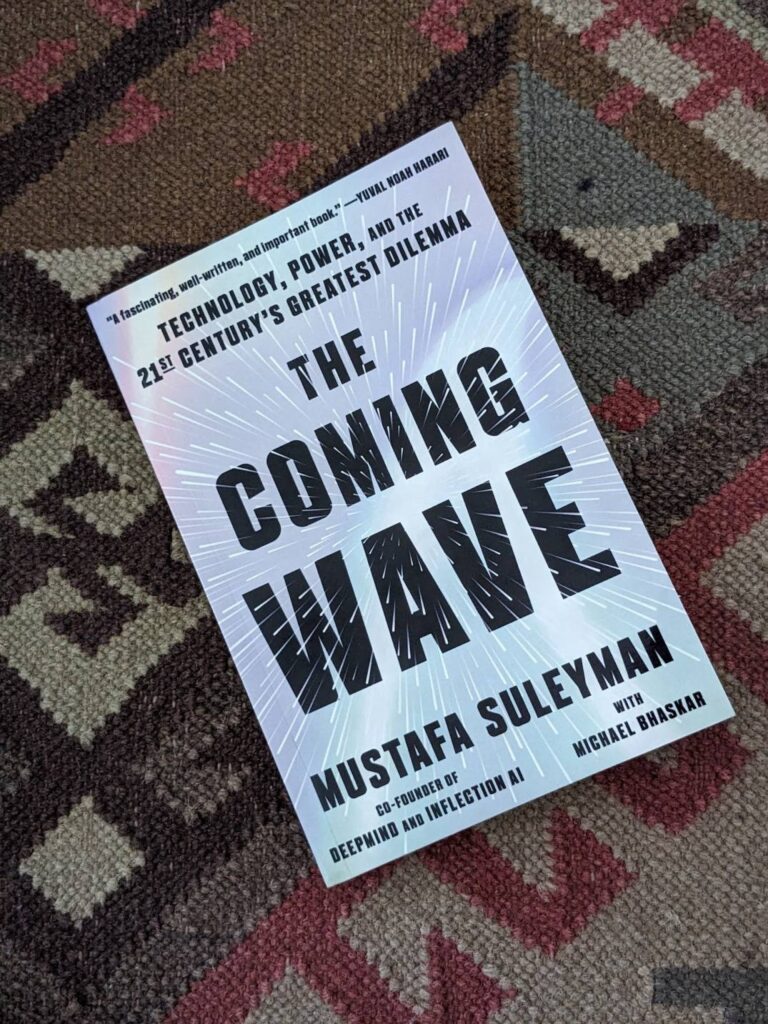
    Mustafa Suleyman, Michael Bhaskar

    Co-founder of first DeepMind (the company behind a couple of massive leaps in AI – AlphaGo, AlphaFold, acquired by Google), then Inflection AI and now (before the book published, I think) CEO of Microsoft AI, I think there are few better people than Mustafa Suleyman to write about AI. And I suspect there will be few better moments than now. The Coming Wave was a book I was looking forward to reading, and it didn’t disappoint.

    The book is divided into four sections. The first looks at the history of technology and how it spreads. The second gets into the detailing of the coming wave – two general purpose technologies – AI and synthetic biology, and associated technologies like robotics and quantum computing. This section also goes into the features and incentives that drive them. Part 3 takes a side step into the political implications of this on the nation state, the only institution that can temper the wave. The last section looks at what is the ‘containment problem’ – a wave of technology is near impossible to contain, history has ample proof, but can we still take a shot at it.

    In the first section of The Coming Wave, Suleyman shows how technology has a clear, inevitable trajectory: mass diffusion in great rolling waves. New discoveries are used by people to make cheaper food, better goods, more efficient transport etc. As demand grows, competition increases, the technology becomes better and cheaper, and easier to use. From farming to the internet, history has enough examples. A big challenge is that the inventor has no way of knowing the nth order consequence (the ‘revenge effects’ of technology – fridge makers didn’t start out with the intent to punch a hole in the ozone later), and once a technology is out there, there is very little we can do to contain it. From fossil fuel emissions to opioid abuse to space junk, this is the story. The only partial exception is nuclear weapons.

    There is a fascinating story in the beginning of the second section on DQN, an algorithm the DeepMind team created to play the game Breakout, and it discovered a strategy that most humans didn’t think of. The trailer for AlphaGo. The section also goes deep into synthetic biology and robotics. Apparently, one can buy a benchtop DNA synthesiser for $25k.

    But this section is even more important because it brings out the four intrinsic features of this wave that compound the containment problem. One, it has a hugely asymmetric impact. Which this has happened before (cannon vs a large set of people) it has been scaled massively with the internet and now AI (a single algorithm can hold massive systems to ransom). Two, they are developing fast – hyper-evolution – providing very little time to react, let alone regulate ((look at cars vs the frequency of the versions of GPT). Third, they are omni-use (AI can be applied in multiple domains, and can come up with compounds for cure or as poison). And fourth, its degree of autonomy is beyond any previous technology.

    Add to that the incentives and the containment problem just gets magnified. Geopolitics and the power involved, a global research system that has rituals rewarding open publication – curiosity and the pursuit of new ideas, financial gains, and the the most human one of all – ego.

    The third section of The Coming Wave is on the impact of all this on the nation state. He calls out that technology is not value-neutral, and quotes Langdon Winner, “Technology in its various manifestations is a significant part of the human world. Its structures, processes and alterations enter into and become part of the structures, processes and alterations of human consciousness, society and politics.” From the printing press to weapons, tech has helped build the nation state. My favourite chapter in this is ‘Fragility Amplifiers’ – from robots with guns to lab leaks to 3d printing everything, even people with good intent can cause things to go wrong. “What does the social contract look like if a select group of ‘post humans’ engineer themselves to some unreachable intellectual or physical plane?”Add to it massive job displacement, and other social issues and the nation state faces challenges far beyond the standard issues of the day. The possibilities are a continuum from an extremely powerful nation state to completely decentralised groups of individuals.

    In the last section, he looks at nine ways, working in cohesion to provide some sort of containment. Technical safety, audits, using choke points, maker responsibility to build in controls from the start, aligning business incentives with containment, helping governments build tech to regulate tech, international alliances for regulation and mitigation, a culture of sharing errors and learning from them, public input to make this all accountable. The tenth point he makes is that there is no silver bullet that will take us to any permanent solution. It is a narrow path which humanity must walk on. That probably is the biggest lesson.

    I found The Coming Wave full of great insights and perspectives, and written in a way that makes it accessible to those outside tech. An important book for everyone to read since it’s a pragmatic look at what the future holds for the species. Part of my 2024 favourites list.

    Notes
    1. (Life + Intelligence) x Energy = Civilisation
    2. Liverpool’s MP William Huskisson was killed under the wheels of the locomotive during the opening of the Liverpool – Manchester line, the first passenger railway because the crowd had no idea of the machine’s power!
    4. How the stirrup changed everything. Fused the rider to the horse, and the ability to power through. It became a leading offense strategy, and changed Europe. Horses – church land for rearing- ties to the kingdom – feudalism.
    3. Today, no matter how wealthy you are, you simply cannot buy a more powerful smartphone than is available to billions of people
    4. Primum non nocere – “first, do no harm”. (Hippocratic Oath)

    The Coming Wave
  • You Will Own Nothing: Your War with a New Financial World Order and How to Fight Back

    Carol Roth

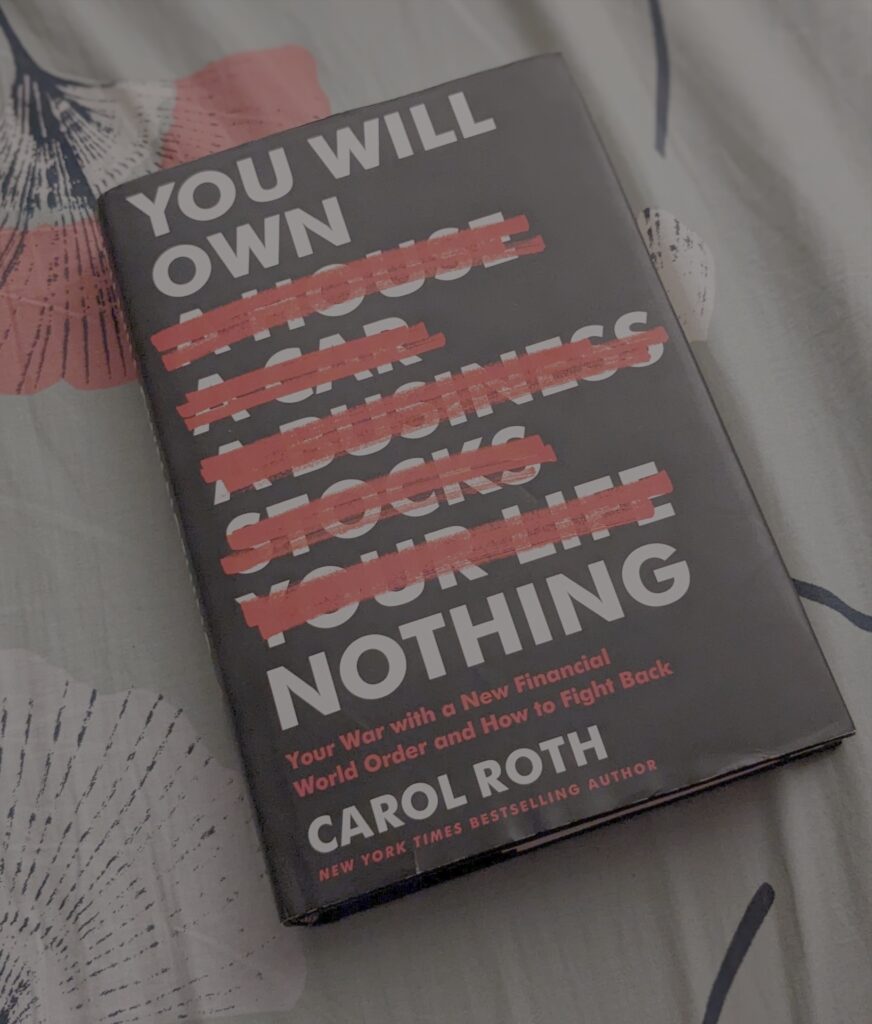
    Carol Roth does a great job of using the title to shock the reader, but once you read the book, you might agree that it is justified. It was at the World Economic Forum that she first heard the prediction that in less than a decade, private ownership would be dead. The book is her research on “You will own nothing and be happy“.

    She calls this a war where three kinds of forces – government and government-related forces, elite power-grabbers and bad actors, and Big Tech are colluding to ensure that they remain on top for the new financial order that will come up. Owning wealth and power.

    She begins with how frontline forces who risked their lives during the pandemic were punished, their livelihoods taken away, for non-compliance with a vaccine mandate. Moving quickly from social acceptance to social credit. Judged by public approval than a court of law. In China, they have already gone quite deep into the Social Credit System, where you’re watched and rewarded (red list)/penalised (black list).

    She uses the history of empires to show the cycles of rise and fall, and how war is usually a catalyst for change and a new financial order. The US began its ascent after WW2, and according to Roth (and data), we are now seeing a decline in the US financial system, which is likely to lead to a shift in power, and or economic and geopolitical chaos. And if we go by GoT, “Chaos is a ladder”.

    She also discusses Peter Thiel’s framework of how good ideas cause bad outcomes through a believers (idea)- racketeers (ROI) – Useful Idiots (ROE, e for ego). Think of climate change and read it as genuine activists – ESG sellers – regular people pandering to their desire for validation and ego by sharing posts/emojis/slogans without really understanding the discourse.

    The next chapters expand on the debasing of the dollar (some insightful charts on its decreasing purchasing power) and the huge concerns on turning it digital – CBDC (central bank digital currency) and how it can be used against the common person’s rights and freedoms. This allows a neat segue into Big Tech and how they have made us dependent, and infringed on our basic rights. Think of getting locked out of mail, social media, payments etc with no easy means of recourse. Most of us don’t really own anything digitally, it’s all on a company’s servers. They would serve as great allies of the government, possibly even overshadowing them with their technical superiority. Wars are almost more cyber than real, after all.

    She then does a deep dive on the various power and money grab mechanisms already underway. ESG, (thanks BlackRock!) for instance, played a crucial role in tanking Sri Lanka’s economy. The increasingly unattainable home ownership in US thanks to corporations, who are helped by cheap capital enabled by the Fed, competing against the common man for real estate. And city administrations who are happy to go along with AirBnB because they pay taxes. Add to this billionaires like Gates and institutions like Harvard (enabled by endowments) buying up farmland, including things like water rights. Now think about it, why wouldn’t private investors start moving water to say, nearest cities, because they think it’s the most efficient use of water?

    Another example is the crazy cost of education and the increasing lack of ROI, thereby creating a population that is always in debt. And guess who’s the one providing these loans – the government! And despite their ‘loan forgiveness’, ultimately it’s the taxpayer footing the bill! A transfer of money from the working class to the college-educated class.

    The final chapter is on how the common man (in the US context) can fight back against all this. While the context is the US, the ideology of capitalism and the alliance of government-corporations-BigTech is a global phenomenon, soon coming to a country near you.

    What was super insightful to me is the nuance of arguments. I had broadly supported the vaccine mandate, Biden, and was not fond of Joe Rogan, but I was forced to think deeply on all this. This is a fantastic read, and I absolutely recommend it.

    Quotes
    “When a social moral code replaces a legal code and gains acceptance it is only a matter of time before those in power want to leverage that dynamic to secure more power for themselves”
    ‘We hang the petty thieves and appoint the great ones to public office’ ~ Aesop

    You Will Own Nothing
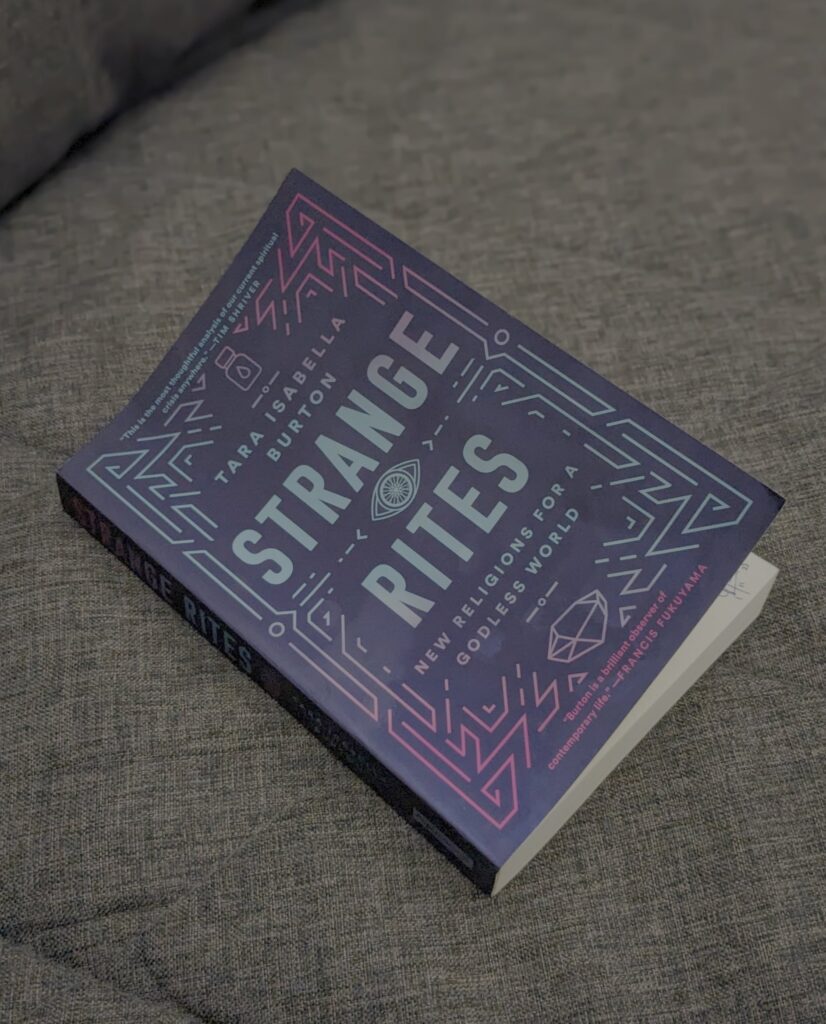
  • Strange Rites: New Religions for a Godless World

    Tara Isabella Burton

    Strange Rites is another book I discovered only thanks to a podcast. I found it a fascinating exploration of how the (almost) post-religion United States is evolving. Folks who call themselves Christians have been steadily decreasing, and ‘Nones’ who claim no affiliation to any organised religion is the fastest growing group. One-third of millennials (and one fourth of all adults) have no affinity to religion. Tara Isabella Burton tries to find out who (or what) is filling the God-sized hole.

    She begins with her personal experience at the McKittrick Hotel, home to the British theatre company Punchdrunk’s production – Sleep No More, an experiential phenomenon that she describes as “equal parts video-game, voyeurism and religious pilgrimage”. It’s a retelling of Macbeth but every part of it is subject to interpretation by the performers and the audience, with the latter also having the option to be part of the ‘play’.

    This serves as a preview of the world of SoulCycle, Korean beauty routines, Gwyneth Paltrow’s juice cleanse, Crossfit, Internet fan fiction, Headspace, and so on. A long list of options from which people can mix their own religious cocktail of spiritual, philosophical, aesthetic and experiential dimensions. It influences not just individual lifestyle but societal politics too.

    The author broadly classifies the non-affiliated into SBNRs (Spiritual but not religious), Faithful Nones (who hunger for something larger than themselves) and Religious Hybrids (who practice a portion of their religion, and supplement it with things outside it). All of them (and us) are looking for what religion originally delivered – meaning, purpose, community, and ritual.

    She then spends a chapter on the war that has been fought on religion within America – the institutional (centred around Church and society) vs the intuitional (centred around the person). And that progression and the heterogenous mixes that happened reflects in the changes in culture and mindset within society during the 60s, 70s and so on.

    And thus, while the new forms of religion aren’t new, the author cites three factors that makes this era different and likely to stick around – the absence of wider demographic pressure, the power of consumer capitalism, and the rise of the internet. While millennials are caught between their lack of belief in their parents’ religion and the political conservatism on societal issues, capitalism finds a way in, helping them create identities and tribes. It will sell us meaning, brand our purpose, custom-produce community, tailor-make rituals and commodify our humanity. That includes a spiritual entrepreneurship course at the Columbia Business School!

    This new age version of religion (spiritualism) has an interesting parallel – the role that the printing press and the spread of mass literacy played for Protestantism is what the internet is doing today for new age movements. From Yahoo Groups for The X Files and Xena to Harry Potter and World of Warcraft, people were no longer bound to their geography to find their tribe. Fan fiction boomed. The author cites two watershed moments which show how ‘fans’ started taking ownership – the call for Rowling to step away from the Harry Potter universe after her fall from grace, and Gamergate, when there was a backlash against a section of gamers who wanted video games to address the interests and concerns of minority players. Though it wasn’t the first of its kind, the movement was the first to get into a large cultural conversation. Many of the players on the reactionary side (against the demand) would later become alt-right/alt-lite celebs.

    Another evident phenomenon is wellness culture, which focuses on self improvement and commoditises self care. It has the fandom and the ‘theology’ of purpose and meaning to back it. The philosophy of SoulCycle, Goop etc have their roots in New Thought, one of America’s earliest spiritual traditions that blended liberal Christianity with Transcendentalism, and the path includes folks like Norman Vincent Peale (The Power of Positive Thinking), and the discourse in the contemporary era even included self care as a revolutionary act against Trump’s America! The other phenomenon that the author brings up is the revival and rise of witchcraft. The number of adherents are over a million. Here too, Trump served as a nemesis, with the larger narrative connecting the rituals of witchcraft to a higher social and spiritual purpose – dismantling toxic and oppressive structures associated with patriarchy, white supremacy and other unjust hierarchies.

    Another massive shift is in social-sexual identities. Though swapping, kink etc existed in the 1900s, many interests and groups were in the closet are now lifestyles accepted by the mainstream. A key role was played by the internet in transforming the modes and rituals of these communities too, accelerating access and consumption. Simultaneously monogamy is receiving a pushback. The 1970s and 80s were the peak time for divorces in the US, that means children growing up then have a fairly dismal view of marriage.

    74% of American millennials now say that “whatever is right for your life or works best for you is the only truth you can know”. While fandom, wellness, witchcraft, sexual utopias all play out, are there organising thoughts that can take the place of religion? The author works out three of them. The first is ‘social justice culture’ – a progressive mix of self care, moral determination through lived experience, and a fight against racism, sexism and other forms of bigotry and injustice. The second is a Silicon Valley based version who work towards an optimised self. Libertarian techno-utopians, rewriting biology and society through ‘hacking’. Despite their cosmetic differences, both groups have much in common. They both have a disdain towards society’s mores, maxims and rules. And both seek self actualisation. And yes, both are viable consumer categories for capitalism. Wokeness, self care and more!

    However it is the third that the author considers the most viable contender, and the most dangerous. Authoritarian, reactionary, materialist, and one that valourises submission to a higher political or biological truth. They find spiritual and moral meaning in primal, masculine images of heroes past. Yes, mostly white. They believe that biological determinism, gender binary, and natural hierarchies are what leads to progress. Not progressivism and political correctness. Jordan Peterson is one of the high priests, and r/TheRedPill forum is an active shrine of the movement. They provide a sense of brotherhood. Meme magic in 4chan, Pepe and Kekism all were connected to the Donald Trump campaign. Many mass shootings and other acts of violence are by graduates of this school of thought.

    Religion and politics have been connected throughout history, but is remarkable to watch the narrative in the contemporary era unfold as the author connects the pieces and lights up the path that got us to where we are. But then again, to learn of something and to learn from something are two different things. In my favourite reads of 2023, and highly recommended if you have any interest in modern society and/or religion/ and/or culture.

    Notes
    1. In 1890, a businessman Elijah Bond patented a “talking board” for mass use. That’s the Ouija board.
    2. Apparently Fifty Shades of Grey started out as fan fiction – based on Twilight’s lead characters!

    Strange Rites
  • God, Human, Animal, Machine: Technology, Metaphor, and the Search for Meaning

    Meghan O’Gieblyn

    It is difficult to slot God, Human, Animal, Machine: Technology, Metaphor, and the Search for Meaning. Meghan O’Gieblyn sets us off on a thought-provoking exploration of the intersection of faith, technology, and the human experience, and traverses many interesting paths to understand what makes us human, and our search for meaning. Descartes started us on the path to the Enlightenment by ‘separating’ the material world and our ‘soul. From then, we took pride in using scientific temperament and technology to systematically solve nature’s puzzles. And now, when the same toolkit has created machines whose learning and thinking models are increasingly ‘black boxes’, there is fear, uncertainty and probably a bit of ego.

    Through chapters that are at once seamless and disparate, she navigates philosophy, technology, and theology and our different ways of understanding God, ourselves, and the world we are creating through technology. The metaphors of our time are built around technology, and AI and tech are raising questions that have for long been asked by philosophers – free will, immortality, the relationship between mind and body. Science by definition requires an objective perspective, and consciousness can only be felt, and measured inside. I can never know what it feels like to be another person. While there are many hypotheses, this is an area which science has been unable to really crack.

    In ‘Pattern’ it is interesting to see the many parallels between the Bible and the belief systems of technologists, despite many of the latter being atheists. Transcendence through the Singularity and trans-humanism, just as through the Book of Revelation, the resurrection and rapture, for instance. I really liked Kurzweil’s idea of consciousness as a pattern of information that persists over time. Essentially like a stream that rushes past the rocks in its path. The actual molecules of water change, but the stream remains the ‘same’. In a letter to the author, he shares a wonderful insight that “the difference between so-called atheists and people who believe in ‘God’ is a matter of the choice of metaphor, and we could not get through our lives without having to choose metaphors for transcendent questions.” From (divine) clockmakers to computers.

    In the chapter ‘Network’, the idea of emergence is discussed in the context of consciousness, and so is the work of many scientists to recreate that – experimenting with robots to see if they evolve complex behaviour from simple rules. It hasn’t really worked thus far, but I did wonder about the amount of time evolution took to ‘produce’ us.

    In ‘Paradox’, there is mention of the parallels between quantum mechanics and eastern mysticism, and the idea of us being in a simulation, and/or a multiverse. It is interesting to note that all paths require a reasonable dose of faith! There is a very intriguing part that uses video games to illustrate how the first-person view makes it look like a world that is always complete as things appear when you move. But were they around when the player was not looking? Does the world “only render that which is being observed”?

    ‘Metonymy’ moves into materialism (science and its ability to reduce everything to causal mechanisms), dualism (mind-body), panpsychism (all things have a mind-like quality) and finally idealism (the physical world is wholly constituted by consciousness). The mind serving as a microcosm of the world’s macroscopic consciousness reminded me of Aham Brahmasmi. Towards the end of this chapter, she quotes Hannah Arendt, who wrote about scientists who believed that computers can do what a human brain cannot comprehend.

    That paves the way for ‘Algorithm’, which begins with Chris Anderson’s 2008 view that data deluge has made our scientific method obsolete. It has now gotten to a state where we will accept the algorithm’s perspective probably more than our own mind’s! But as Nick Bostrom has pointed out, there is no reason for a super intelligence to share our values including benevolent concern for others. The algorithm does not necessarily worry about downstream consequences or collateral damage. And yet, even as algorithms are plagued by errors and the biases we have fed it, ‘dataism’, as Yuval Noah Harari states, is the new ideology. That if we have enough data, we can know everything, thereby increasing surveillance and tracking.

    The end of this chapter has a chilling, and yet fascinating observation – “What we are abdicating, in the end, is our duty to create meaning from our empirical observations — to define for ourselves what constitutes justice, and morality, and quality of life — a task we forfeit each time we forget that meaning is an implicitly human category that cannot be reduced to quantification. To forget this truth is to use our tools to thwart our own interests, to build machines in our image that do nothing but dehumanize us.”
    In ‘Virality’, the final chapter, she discusses how in the digital domain, quantitative measures of success like clicks and likes have overtaken the virtue or validity of the content. There is also the funny (and yet quite true) part of how, when we treat Trump as an algorithm which has mastered social media, it all makes sense!

    God Human Animal Machine is intensely thought-provoking, and O’Gieblyn manages to balance curiosity and a healthy skepticism, distilling thoughts from various streams and thinkers, to provide a coherent narrative that fuels more thinking. For all of this, the book is also deeply personal and extremely accessible. Highly recommended.

    God Human Animal Machine
    Screenshot
  • Broad Band: The Untold Story of the Women Who Made the Internet

    Claire L. Evans

    I had a sense of deja vu while reading this, and later realised that it was thanks to Maria Popova’s Figuring. The books are very different in terms of scope, but are connected by the women-oriented narrative, the idea of intellectual successors, and the presence of what one could call a ‘crossover character’ – Maria Mitchell.

    When we think about the internet’s history, and its current pantheon, the names that pop up are all, or at least mostly, male. But Claire Evans points out that the origin stories are actually mostly female. Their contributions are practically invisible both in the public eye, and while we use the web.

    (more…)