Category: Favourites

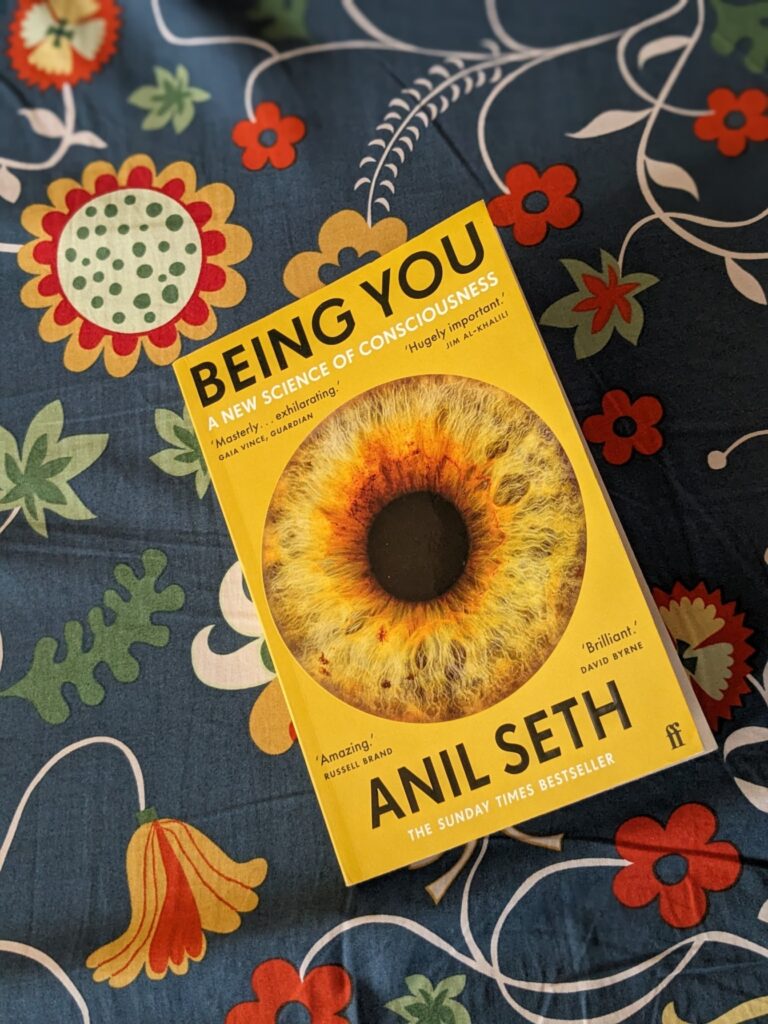
  • Being You: A New Science of Consciousness

    Anil Seth

    I have to confess, I will need to read this again. I also want to. For two reasons. First, the subject is something I feel is important – understanding consciousness through the lens of a scientific method. Second, grasping all of the material in Anil Seth’s fascinating exploration, I feel, is impossible with a single read. Having said that, the first read of Being You is indeed enlightening.

    Being ourselves is not something we are always conscious of.* Anil Seth sets out to explore how billions of neurons within the brain end up creating a conscious experience – a uniquely personal, first person experience. Being You is divided into four sections – defining the ‘problem’ and showing the approach to the scientific exploration of consciousness, looking at it through how it relates to ‘content’ and external phenomena, and then going inwards to the experiences of conscious selfhood, and finally applying the learning to non-human entities – animals and AI.

    In the first section, Seth brings up the ‘hard’ and ‘real’ problems of consciousness. The first (David Chalmers) is focused on how consciousness happens, how it is related to our biophysical machinery and how it is connected to the universe at large. On the other hand, the ‘real’ problem is how the ‘primary goals of consciousness science is to explain, predict and control the phenomenological properties of conscious experience.’ i.e. why is a particular experience the way it is, and what is its relation with what is happening with the brain and body. In other words, deeply understanding the connection between mind and matter. The latter approach would need measurement.

    This begins with understanding ‘conscious levels’ – complete absence (e.g. coma) to light sleep to waking states. Conscious content is what we are conscious of – sights, smells, emotions, moods, thoughts, beliefs – all sorts of perception. There is a very interesting part on how psychedelic states are at a conscious level well above waking state, and have the maximum algorithmic complexity (a measure of the diversity of signals). Another interesting proposal is how all conscious experiences are informative and integrated, (red ball vs red and ball separately) leading to the integrated information theory (IIT) of consciousness, an axiomatic approach that starts with theories and use them to support claims on what properties the mechanisms underlying the experiences will have.

    The next section is about conscious content and then the experience of a conscious self. Here’s where the idea of perception gets upturned. Perception is a ‘controlled hallucination’ (phrase by Chris Frith), an active construction as opposed to a passive registering of an external reality. The brain constantly makes predictions about the causes of its sensory signals through a Bayesian process in which the sensory signals (also) continuously rein in the brain’s various hypotheses. Perception is a continual process of prediction error minimisation (reducing the difference between what the brain expects and what the signal provides).

    Reality is an interpretation, and the entire process is not optimised for accuracy, it is designed for utility. ‘We perceive the world not as it is, but as it is useful to us.’ A mechanism of making it seem real so we respond to it. Not to know the world, but to survive it! There is the fascinating part on colour – an object is not objectively ‘red’, redness is just the way in which it reflects light, and how the brain perceives it. And this applies to all of our perceptions. Mind effing bending! A great distinction here (John Locke) is on why that train is not just a perception and you shouldn’t jump in front of it. Objects have primary qualities that exist independently of an observer (e.g. space it occupies, movement, solidity), and secondary qualities that depend on the observer (e.g. colour)

    The self, as shown in the next section, is also a perception, a controlled hallucination. To begin with, selfhood is divided into an embodied (being a body), perspectival (having a first-person perspective), volitional (having ‘free will’) and narrative (personal identity and deep emotions), social (how I perceive others perceiving me). The link between perception and the body and its physiological processes exist in all these forms. When we flip the learning from the previous section inwards, we understand that we do not perceive ourselves to know ourselves, we do it in order to control ourselves’. The entire panorama of experience and the mental life and thus its perceptions and cognitions stems from a deep-seated biological drive to stay alive.

    I found the part on why we think we are stable and unchanging over time, very interesting. Perceptual inference is about finding out things about the outside world. Interoceptive inference is about controlling things – physiological regulation. In the latter, the prediction error minimisation happens by acting to fulfil top-down predictions of the brain. The brain, for survival, desires predicted ranges of physiological viability and thus the need for strong, precise and self-fulfilling predictions. And if it comes to that, the brain will (and does) systematically misperceive.

    The end of the section also brings in the complex but fascinating FEP (free energy principle) and specifically how it applies to living systems and consciousness. In this context, it boils down to this – being alive means being in a condition of low entropy. Any living system, to resist entropy, must occupy states which it expects to be in. Free energy here approximates sensory entropy, and apparently, it amounts to the same thing as prediction error. Broadly, that connection with physics and the universe, and the brain’s regulation of the perception of the worlds outside and inside! Appealing, but they’re still ironing out many wrinkles.

    I found the last parts – free will, and consciousness in animals and AI to be areas which are still under much (more) debate, and therefore more descriptive than insightful. That is not to say that it does not merit a read! It is just that the 200+ pages before were so rich and intense that on a purely relative scale, this seemed less so.

    As I said, Being You is most definitely not an easy book, but it does such a fantastic job of providing that glimpse and promise that we might actually get answers to our most basic and profound questions that one automatically cheers for the understanding that each chapter provides. Also the kind of book that makes me wish I were smarter – to really grasp the entirety of it! It also made me think of how science and spirituality seem to converge – the latter’s approach to reducing wants and desires, and increasing mindfulness as a means to prediction error minimisation. 🙂

    This was part of my Bibliofiles 2024 list, and in fact, my favourite read of the year.

    Notes and Quotes
    “The essence of selfhood is neither a rational mind nor an immaterial soul. It is a deeply embodied biological process..”
    “Wherever there is experience, there is phenomenology, wherever there is phenomenology there is consciousness.”
    Deductive (reaching conclusions by logic), inductive (extrapolating from a series of observations) and abductive reasoning (the best explanation from a series of observations)

    *now that I have read the book, I am analysing this sentence!

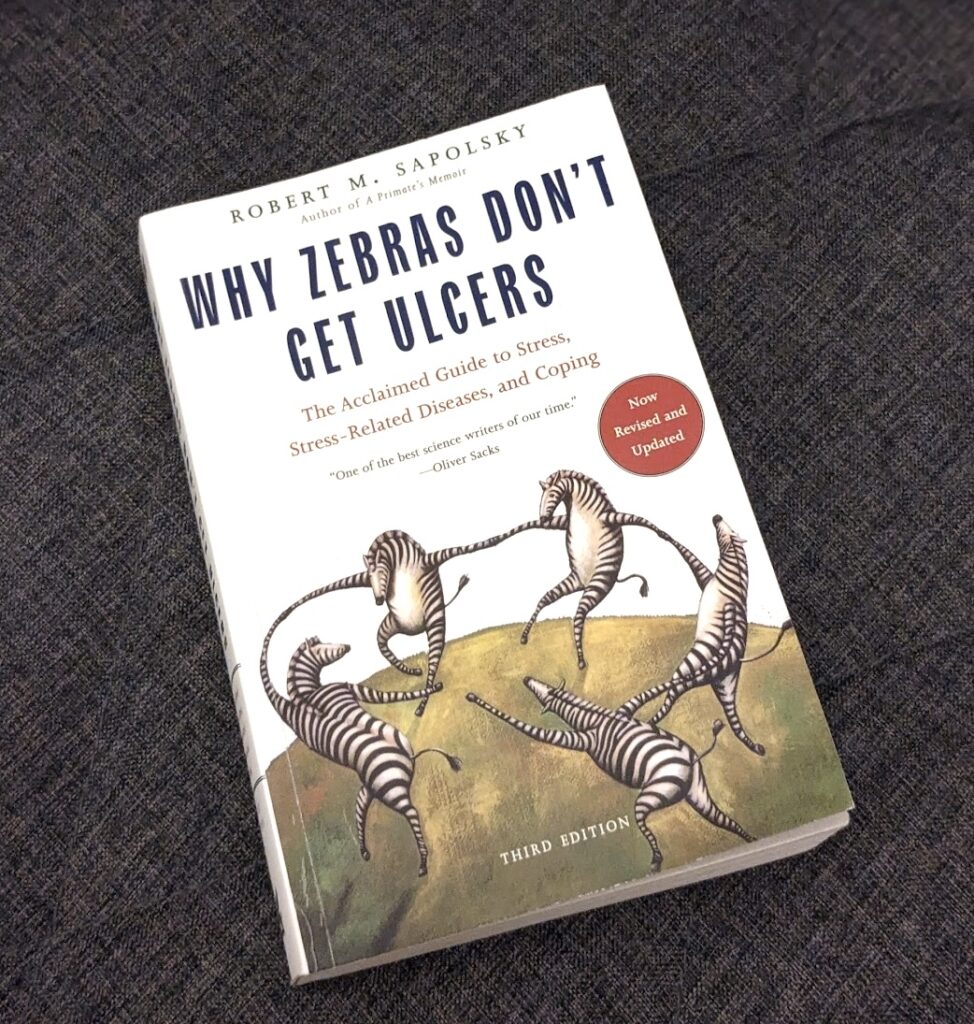
  • Why Zebras Don’t Get Ulcers

    Robert M. Sapolsky

    Sapolsky’s ‘Behave‘ was in my list of favourites back in 2021. So when I got to know about Why Zebras Don’t Get Ulcers, it became a must-read, and that title really helped. The book was originally written in 1994, and is now in its third edition, so things continue to be updated.

    He gets the title out of the way very quickly, and this is perhaps the underlying premise of the book – zebras, and the lions who chase them both are stressed, and their bodies are brilliantly adapted to handle these emergencies – fear of life and fear of starvation respectively. Go up to the apex predator – humans, and it can even handle things like drought, famine, pests. But when we include psychological and social disruptions – from finding a parking spot to an unpleasant conversation with a manager/spouse etc – and start worrying about them, we turn on the same physiological responses.

    When this is chronic (and it is – think about the things you get stressed about daily), the stress response itself becomes harmful to the body, sometimes even more than the stressor itself. Because they were not meant to do this all the while, they were only for emergencies!

    The early pages of Why Zebras Don’t Get Ulcers also draw out a significant difference – between homeostasis and allostasis. ‘The brain seeks homeostasis’, but the concept itself is now modernised because there is no single optimal level (e.g. it can’t be the same when sleeping vs skiing) and because we now understand that the point cannot always be reached by a local regulatory mechanism, it requires ‘the brain coordinating body-wide changes, often including changes in behaviour’. And this tinkering has its own second-order consequences. Even more complicated because in allostatic thinking, there can be changes made in anticipation of a level going awry. When it is stressed for ’emergencies’, the body goes for homeostasis, with consequences in the long run.

    The book then traces out the working of the brain – and the regulation of glands and hormones (and how it is different in males and females), before getting into specific areas that stress specialises in! This includes physiological things cardiovascular health, ulcers and IBS, (oh, if only I knew this 3 years ago, I would have been better equipped to deal with idiot doctors) pregnancy and parenting, sex and reproduction, pain, immunity and diseases, memory, sleep, cancer (the jury is still out on this) and aging and death, as well as psychological domains like addiction, depression. It also looks at how temperament and personality can either assist or resist stress.

    In the personality section, Sapolsky practically described my (former) Type A personality down to a behavioural “time-pressuredness” (research by Meyer Friedman and colleagues), default hostility, and a persistent sense of insecurity, the last being a predictor of cardiovascular problems. Add to it disciplined, discomfort with ambiguity, and (formerly) repressive in terms of emotional expression, and you have my profile! Damn!

    Towards the end of Why Zebras Don’t Get Ulcers, there is also a very interesting section (and studies) on how socio-economic-status (SES) can affect stress. The poor have more chronic daily stressors, and feeling poor (not the same as being poor) in our socioeconomic world (digital media expands ‘our’ from friends, family and neighbours to anyone on Insta) predicts poor health. Income inequality predicts mortality rates across all ages in the US.

    The last chapter is on managing stress – exercise, meditation, increasing control and predictability, social support, finding outlets for frustration. And building coping mechanisms around fixed rules and flexible strategies – when stress management is not working, instead of trying extra hard on our preferred strategy – problem solving/emotional/social support – switch the approach.

    I was expecting a fair amount of trudging and it turned out to be that way. But Why Zebras Don’t Get Ulcers is definitely fascinating to see the stress fingerprint in so many of our ailments – ranging from very visible to almost invisible. Great book, if you have the interest and patience for it. 🙂

    Notes from Why Zebras Don’t Get Ulcers

    1. Water shortage in California. Homeostatic solution: mandate smaller water tanks. Allostatic: smaller toilet tanks, convince people to conserve water, buy rice from SE Asia instead of doing water-intensive farming in a semi-arid state.

    2. When stressed, the sympathetic nervous system is activated, the parasympathetic nervous system is turned down, the heart shifts into a higher gear, glucocorticoids enter the play enhancing the effects of epinephrine and norepinephrine. As a result blood pressure goes up, the blood sent to nonessential areas like digestive tract and kidneys go down (fascinating how we wet our pants in fear though the kidney function is kept low – basically to remove excess water quickly from the bladder). Chronic use of this mechanism promotes plaque formation in arteries by increasing the chances of blood vessels being damaged and inflamed and the likelihood of platelets, fat, cholesterol sticking to those areas.

    3. Also when stressed, the contractions in the colon increase to get rid of the ‘dead weight’. See how IBS and diarrhoea works!

    4. In a British Victorian family, the mother’s favourite son David dies and she takes to bed, ignoring her 6 year old son. And when the boy comes to the darkened room, she asks ‘David, is that you?’, before saying ‘Oh, it’s only you’. The younger boy stops growing, because this is the only way he seems to get some chance of affection. He is J M Barrie, the author of Peter Pan!

    5. Stress-induced analgesia (not feeling pain during strenuous activities – from war to exercise) and stress- induced hyperalgesia (feeling more pain, e.g. waiting for a dentist) Both are emotional reactivity to pain and do not involve pain receptors or the spinal cord.

    6. Personality style can lead to stress-related disease – either due to a mismatch between the magnitude of stressors and respective stress responses, or even reacting to a situation that is not a stressor

    7. How does social capital turn into better health throughout the community? Less social isolation. More rapid diffusion of health information. Potentially social constraints on publicly unhealthy behaviour. Less psychological stress. Better organised groups demanding better public services.

    8. If you want to improve health and quality of life, and decrease the stress, for the average person in a society, you do so by spending money on public goods – better public transit, safer streets, cleaner water, better public schools, universal health care. The bigger the income inequality is in a society, the greater the financial distance between the wealthy and the average. The bigger the distance between the wealthy and the average, the less benefit the wealthy will feel from expenditures on the public good. Instead they would derive much more benefit by spending the same (taxed) money on their private good – a better chauffeur, a gated community, bottled water, private schools, private health insurance. As (Robert) Evans writes, “The more unequal are incomes in a society, the more pronounced will be its disadvantages to its better-off members from public expenditure, and the more resources will those members have (available to them) to mount effective political opposition.” He notes how this “secession of the wealthy” pushes toward “private affluence and public squalor”. And more public squalor means more of the daily stressors and allostatic load that drives down health for everyone. For the wealthy, this is because of the costs of walling themselves off from the rest of society, and for the rest of the society because they have to live in it.

    8. Heaven, we are told, consists of spending all of eternity in the study of the holy books. In contrast, hell consists of spending all of eternity in the study of the holy books. 😀

    9. In a diagnosis that helps explain the confusing and contradictory aspects of the cosmos that have baffled philosophers, theologians, and other students of the human condition for millennia, God, creator of the universe and longtime deity to billions of followers, was found Monday to suffer from bipolar disorder. ~ The Onion

    Why Zebras Don't Get Ulcers
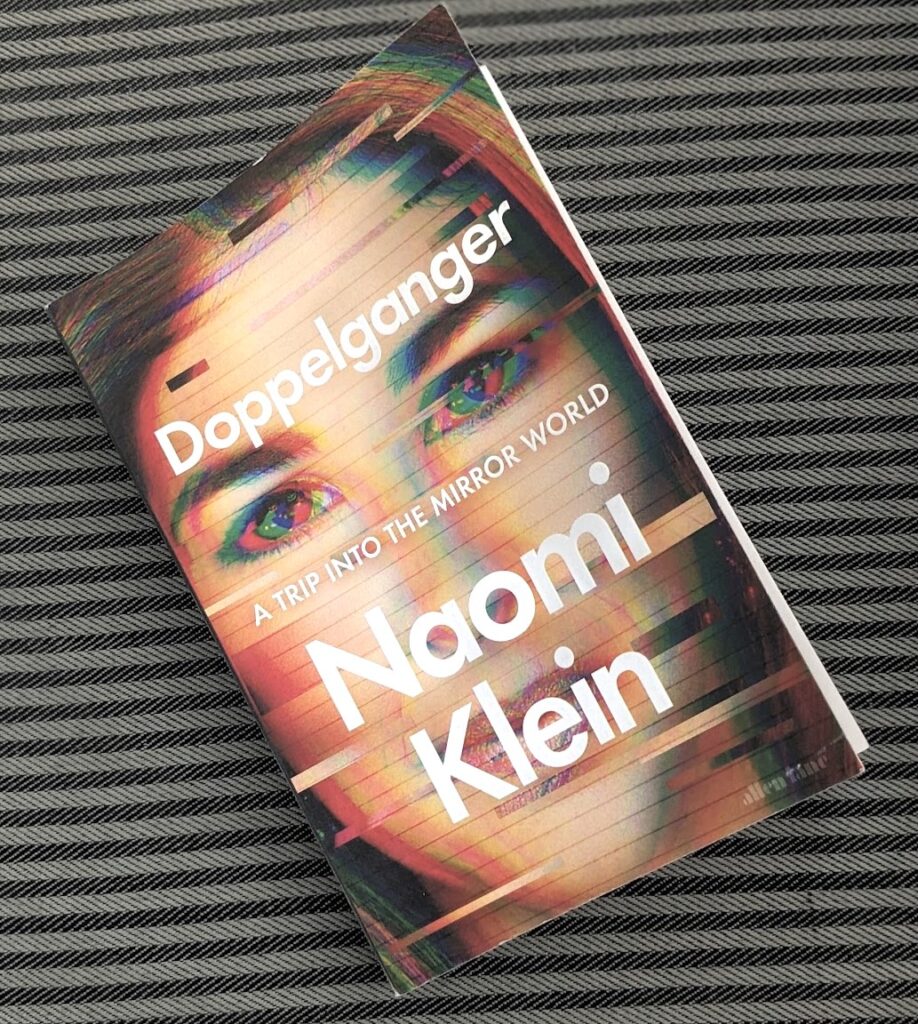
  • Doppelganger

    Naomi Klein

    Quite eerie that I read this immediately after I read Carol Roth’s “You will own nothing”. Here’s why. Doppelganger’s starting premise is how the author (Naomi Klein) gets confused for Naomi Wolf, both being ‘white Jewish women’, increasingly helped by the overlap in the subjects they comment on. The former is a left-leaning writer and social activist while the latter is a third wave feminist who turned from centre-left to becoming a right wing conspiracist. It is fascinating how Roth’s views largely align with Klein (Davos, Big Tech) but also agree with Wolf in others (Canadian truckers, for instance)

    In her new avatar, Wolf’s argument – with a full endorsement from none other than Steven Bannon (once Trump’s chief strategist) – during Covid was that vaccines and public health measures were a conspiracy by a global cabal to sterilise, and in general, undermine the constitution. People increasingly began believing that these were Klein’s views. At one point, after it goes beyond being just a joke, Klein decides to dive into the rabbit hole of the universe that Wolf inhabits – the Mirror World is how Klein describes it.

    While this is where the book starts, and also spends pages drawing out the different worldviews, approaches etc, the narrative then expands its scope to cover the title – Doppelgangers – in general. Not just at an individual level but a societal level. For instance, today the simplistic left vs right categorisation is almost devoid of meaning. Even the horseshoe theory of left and right being similar the extremes isn’t nuanced enough. With big tech, Covid lockdowns, and a plethora of social media influencers, most people have very little trust in anything mainstream media, or what politicians say or do. The difference is only in their own perspectives of who is lying and for what. Wolf and Klein, for example, agree on Bill Gates being a force for evil. While the former goes on about tracking people, the latter is against how he sided with big drug company patents on life-saving Covid medicines.

    Klein decodes how issues remain the same but how Bannon & Co spin it to stoke common underlying tensions and use it to further their agenda. For example, blue collar workers who felt betrayed by Democrats when the latter signed trade deals that accelerated factory closures, Bannon pitched Trump as a radically different Republican who promised to make the rich pay. This modus operandi was an echo of what I had read in Peter Pomerantsev’s ‘This is not propaganda’, in which he pointed out how Trump and his ilk could create coalitions of people who agreed on some topics, while the left/liberals would argue on the tiniest of nuances. There is a name for the former – diagonalism.

    There is also an interesting section on how our personal brands are our doppelgangers – what happens to our self when we create for social media? What is real, and what is for camera? “Which of our opinions is genuine, and which are for show? Which friendships are rooted in love, and which are co-branding collabs? Which collaborations don’t happen that should because individual brands are pitted against one another?” What doesn’t ever get said, or shared, because it’s off-brand?” What does it do to our capacity for internal dialogue and deliberation?

    The focus on doppelgangers allows Klein to apply it to diverse contexts – wellness influencers who became anti-vaccine propagandists, parents of autistic children (and their belief that this was something that had to be cured instead of accepting the child and its unique ways), to Nazis (and the fascinating view that European colonists had been on genocide sprees long before Hitler, and that it was only the scale and more importantly, that it happened in Europe that shocked the West into retaliating; also how the Australian Aborigines League saw this coming way back in 1938 and wrote a protest letter against persecution and handed it to the German Consulate) to Israel (and how the Palestinians had become the victims’ victims).

    Towards the end of the book, the narrative switches back to personal, with lovely anecdotes on how Klein was originally inspired by Wolf, and also how today, with Wolf uttering all sorts of things in public, Klein believes she is freed from her own public self and how it’s an “unconventional Buddhist exercise in annihilating the ego”.

    This is a fascinating read which prompts us to look within ourselves and at the society we inhabit, forcing us to acknowledge the doppelganger within us at both levels.

    Quotes
    “Ms. Wolf is the moral equivalent of an Armani T-shirt, because Mr. Gore has obscenely overpaid for something basic” ~ Maureen Dowd

    “The accelerated need for growth has made our economic lives more precarious, leading to the drive to brand and commodify our identities, to optimise our selves, our bodies, and our kids” Naomi Klein

    “In the Mirror World, they… rile up anger about the Davos elites, At Big Tech and Big Pharma – but the rage never seems to reach those targets. Instead it gets diverted into culture wars about ant-racist education, all-gender bathrooms, and Great Replacement panic directed at Black people, nonwhite immigrants and Jews.” Naomi Klein

    Doppelganger
  • You Will Own Nothing: Your War with a New Financial World Order and How to Fight Back

    Carol Roth

    Carol Roth does a great job of using the title to shock the reader, but once you read the book, you might agree that it is justified. It was at the World Economic Forum that she first heard the prediction that in less than a decade, private ownership would be dead. The book is her research on “You will own nothing and be happy“.

    She calls this a war where three kinds of forces – government and government-related forces, elite power-grabbers and bad actors, and Big Tech are colluding to ensure that they remain on top for the new financial order that will come up. Owning wealth and power.

    She begins with how frontline forces who risked their lives during the pandemic were punished, their livelihoods taken away, for non-compliance with a vaccine mandate. Moving quickly from social acceptance to social credit. Judged by public approval than a court of law. In China, they have already gone quite deep into the Social Credit System, where you’re watched and rewarded (red list)/penalised (black list).

    She uses the history of empires to show the cycles of rise and fall, and how war is usually a catalyst for change and a new financial order. The US began its ascent after WW2, and according to Roth (and data), we are now seeing a decline in the US financial system, which is likely to lead to a shift in power, and or economic and geopolitical chaos. And if we go by GoT, “Chaos is a ladder”.

    She also discusses Peter Thiel’s framework of how good ideas cause bad outcomes through a believers (idea)- racketeers (ROI) – Useful Idiots (ROE, e for ego). Think of climate change and read it as genuine activists – ESG sellers – regular people pandering to their desire for validation and ego by sharing posts/emojis/slogans without really understanding the discourse.

    The next chapters expand on the debasing of the dollar (some insightful charts on its decreasing purchasing power) and the huge concerns on turning it digital – CBDC (central bank digital currency) and how it can be used against the common person’s rights and freedoms. This allows a neat segue into Big Tech and how they have made us dependent, and infringed on our basic rights. Think of getting locked out of mail, social media, payments etc with no easy means of recourse. Most of us don’t really own anything digitally, it’s all on a company’s servers. They would serve as great allies of the government, possibly even overshadowing them with their technical superiority. Wars are almost more cyber than real, after all.

    She then does a deep dive on the various power and money grab mechanisms already underway. ESG, (thanks BlackRock!) for instance, played a crucial role in tanking Sri Lanka’s economy. The increasingly unattainable home ownership in US thanks to corporations, who are helped by cheap capital enabled by the Fed, competing against the common man for real estate. And city administrations who are happy to go along with AirBnB because they pay taxes. Add to this billionaires like Gates and institutions like Harvard (enabled by endowments) buying up farmland, including things like water rights. Now think about it, why wouldn’t private investors start moving water to say, nearest cities, because they think it’s the most efficient use of water?

    Another example is the crazy cost of education and the increasing lack of ROI, thereby creating a population that is always in debt. And guess who’s the one providing these loans – the government! And despite their ‘loan forgiveness’, ultimately it’s the taxpayer footing the bill! A transfer of money from the working class to the college-educated class.

    The final chapter is on how the common man (in the US context) can fight back against all this. While the context is the US, the ideology of capitalism and the alliance of government-corporations-BigTech is a global phenomenon, soon coming to a country near you.

    What was super insightful to me is the nuance of arguments. I had broadly supported the vaccine mandate, Biden, and was not fond of Joe Rogan, but I was forced to think deeply on all this. This is a fantastic read, and I absolutely recommend it.

    Quotes
    “When a social moral code replaces a legal code and gains acceptance it is only a matter of time before those in power want to leverage that dynamic to secure more power for themselves”
    ‘We hang the petty thieves and appoint the great ones to public office’ ~ Aesop

    You Will Own Nothing
  • The Lost Pianos of Siberia

    Sophy Roberts

    In the epilogue of The Lost Pianos of Siberia, Sophy Roberts quotes Fyodor Tyutchev – “You cannot fathom Russia with the mind… You can only believe in it.” Once you really pay attention to the map and figure that it has Finland and Ukraine on its western borders and China and Japan in the south/east, it is easy to nod in agreement. For a lark, I tried to calculate the distance/time taken from Moscow to Vladivostok, and gave up on any dreams – 7 days, 7 time zones, 30 cities and almost 10000km!

    Sophy Roberts’ Siberian journey is the hunt for a piano for her friend Odgerel in Mongolia, but for a reader if offers far more – a fantastic trip through time and space in one of the remotest parts of the world. The book is divided into three portions – 1762-1917 (from Catherine’s the Great’s ascension to the February revolution when Tsar Nicholas II abdicated and was taken to Siberia with his family), 1917-1991 (when the Soviet became the Russian federation) and 1991 – present. We see the region not just through the political changes, but primarily through the lens of music and culture. In fact, the music remains the constant.

    Siberia is 1/11th of the world’s landmass, with the Urals, the Pacific, the Arctic Circle and Mongolia serving as its borders. The Tsars made it a penal colony early on, and it played host to a variety of famous folks – politicians to writers to artists. But it was also home to pianos, starting from the nineteenth century, thanks to Catherine the Great’s penchant for collecting new technologies. Chasing these lost pianos, we go across Siberia from Tobolsk and Irkutsk and Tomsk to Sakhalin, Harbin (now in China, but with a very Russian past), the Dead Road (one of Stalin’s crazy projects where the track was being built in temperatures 50 degrees below zero and where people’s hair froze on to their neighbour’s skin when they slept close for warmth), Kolyma, Akademgorodok and Kamchatka, Kurils and Khabarovsk. Names on a map, but now rich in my mind with character.

    But what makes this all come to life are the people and their poignant stories. A family that retreated into the Siberian taiga in 1945 , living in total isolation in the Sayan Mountains, until someone discovered them in the 70s. They only possessed a spinning wheel and a bible and refused to believe the moon landing. Dmitri Girev, who had accompanied Robert Scott to the South Pole. The ordinary yet moving story of Lidiya in Duė Post, where the infamous coal mines used to be. Anatoly Lunacharsky whose efforts made sure pianos weren’t completely lost during the Revolution, the last days of the Romanov dynasty, the 2500 year old Ukok princess’ mummy in the Atlai mountains.

    Leonid Kalsohin, an Aeroflot navigator who gave up that life to settle in a remote village called Ust-Koksa, where he is trying to build a concert hall. “The world is very remote. We are at the centre“, he says with a twinkle in his eye. The stunning concert during the Leningrad siege, when people braved the cold and the enemy fire just for the music. The Lomatchenko family in Novosibirisk, whose room in the basement of the Opera House contained musical treasures (‘It’s not much“, said Igor, ‘but it is my life.’) Mary, the 80-year-old birder, whom Sophy meets on a cruise to Commander Islands (‘neither of us had come for the certainties, but for the outside possibility that a little marvel might appear‘).

    You don’t need to enjoy music to love The Lost Pianos of Siberia. Because this is about places and people, who even in this hyperconnected world are outside the radar of most of us. Sophy Roberts’ prose is vivid and deeply moving, and takes us on a fantastic tour of a unique part of the world.

    The Lost Pianos of Siberia