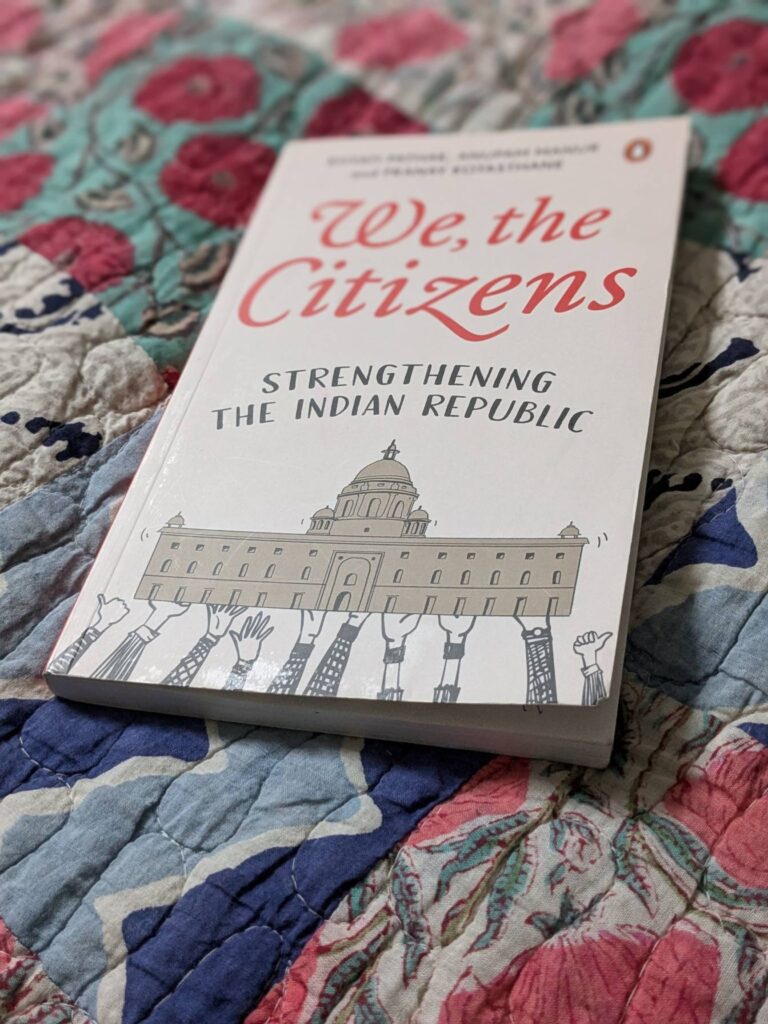
Every day we look around and blame the government for not doing the things they are supposed to do, and for being overbearing on things like taxation. We The Citizens is a wonderful little book (176 pages) that explains why things are the way they are. Full of wit and wisdom on subjects we don’t think about enough, but are important. I think the authors have done a great job of making the complex interplay of state, market, and society understandable, and that includes the illustrations that elevate the narrative many a times. A graphic narrative that decodes how public policy works (and could work) in the Indian context.
The state is good at employing force, but isn’t very efficient. The market is good at driving efficiency, but is not concerned with ensuring equity. Society is best suited to deal with behavioural changes, but it is prone to majoritarianism. The entire system is a maze of checks and balances to achieve progress while not allowing any of the elements to go out of control. The book delves into how each of these function, and should function.
The state, for instance has a toolkit of at least eight things from doing nothing to nudging to playing umpire to marginally/drastically changing incentives and so on but doesn’t always employ the right one. Munger’s “Show me the incentives and I’ll show you the outcome” brilliantly manifests in these explorations. The book provides an excellent framework to think about this based on axes of extent of intervention and state capacity. The government can fail in many ways, and the taxpayer pays for these mistakes. The best part about the book is how it uses examples to (literally) illustrate these mistakes, and how they can be avoided. All delivered with some fantastic humour.
Why are we a democratic republic and not just a democracy? Because while democracy gives the state legitimacy on coercion, the republic (constitution) guarantees the rule of law. What is the difference between a nation, state and government? The nation is an imagined community, where people don’t know each other but are still willing to sacrifice for. On the other hand, a state is a political entity. The government is the temporary manager of the state. What are public and common goods? Public goods are goods that are non-excludable and non-rival. (e.g. a lighthouse which everyone can use and its usage by one person doesn’t mean another cannot use it) On the other hand, common goods are non-excludable but rival (e.g. fish in the sea). This is why only the government produces public goods. These are the kind of significant nuances that the We The Citizens uncovers.
I cannot stress how accessible this book is. Plain English, relatable examples, and frameworks that can be applied even in other contexts. Like many good things in life, I discovered We The Citizens courtesy the better half. I’d highly recommend this to anyone even remotely curious about how the ‘system’ works. If you’re not, this can actually get you interested.
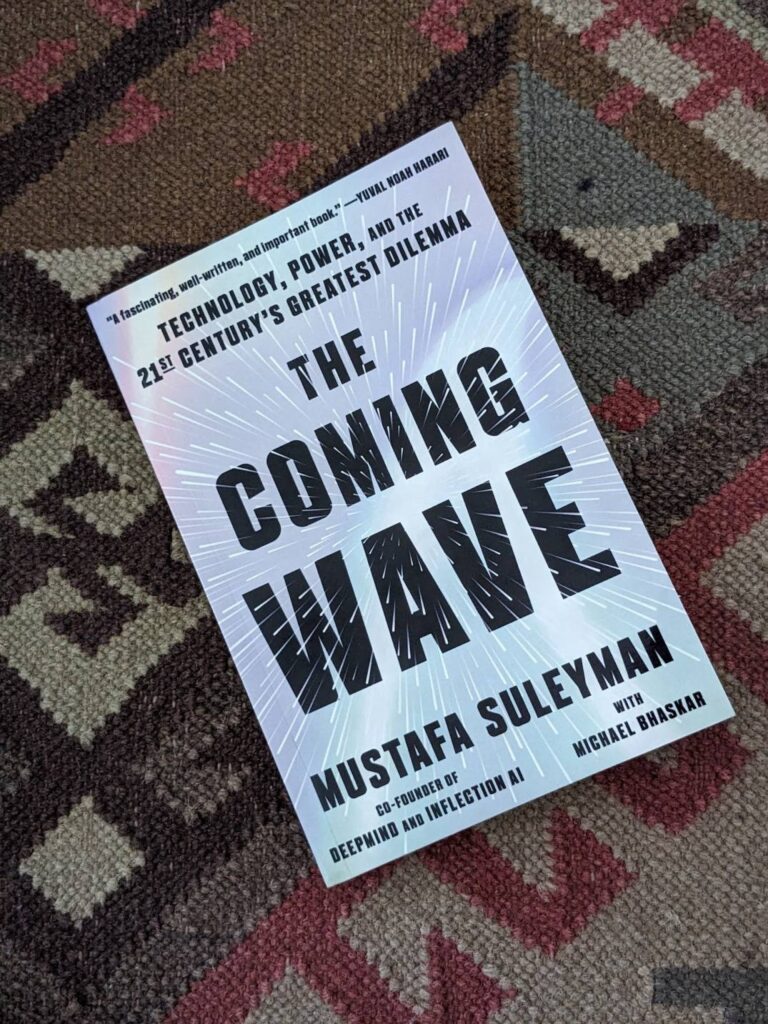
Co-founder of first DeepMind (the company behind a couple of massive leaps in AI – AlphaGo, AlphaFold, acquired by Google), then Inflection AI and now (before the book published, I think) CEO of Microsoft AI, I think there are few better people than Mustafa Suleyman to write about AI. And I suspect there will be few better moments than now. The Coming Wave was a book I was looking forward to reading, and it didn’t disappoint.
The book is divided into four sections. The first looks at the history of technology and how it spreads. The second gets into the detailing of the coming wave – two general purpose technologies – AI and synthetic biology, and associated technologies like robotics and quantum computing. This section also goes into the features and incentives that drive them. Part 3 takes a side step into the political implications of this on the nation state, the only institution that can temper the wave. The last section looks at what is the ‘containment problem’ – a wave of technology is near impossible to contain, history has ample proof, but can we still take a shot at it.
In the first section of The Coming Wave, Suleyman shows how technology has a clear, inevitable trajectory: mass diffusion in great rolling waves. New discoveries are used by people to make cheaper food, better goods, more efficient transport etc. As demand grows, competition increases, the technology becomes better and cheaper, and easier to use. From farming to the internet, history has enough examples. A big challenge is that the inventor has no way of knowing the nth order consequence (the ‘revenge effects’ of technology – fridge makers didn’t start out with the intent to punch a hole in the ozone later), and once a technology is out there, there is very little we can do to contain it. From fossil fuel emissions to opioid abuse to space junk, this is the story. The only partial exception is nuclear weapons.
There is a fascinating story in the beginning of the second section on DQN, an algorithm the DeepMind team created to play the game Breakout, and it discovered a strategy that most humans didn’t think of. The trailer for AlphaGo. The section also goes deep into synthetic biology and robotics. Apparently, one can buy a benchtop DNA synthesiser for $25k.
But this section is even more important because it brings out the four intrinsic features of this wave that compound the containment problem. One, it has a hugely asymmetric impact. Which this has happened before (cannon vs a large set of people) it has been scaled massively with the internet and now AI (a single algorithm can hold massive systems to ransom). Two, they are developing fast – hyper-evolution – providing very little time to react, let alone regulate ((look at cars vs the frequency of the versions of GPT). Third, they are omni-use (AI can be applied in multiple domains, and can come up with compounds for cure or as poison). And fourth, its degree of autonomy is beyond any previous technology.
Add to that the incentives and the containment problem just gets magnified. Geopolitics and the power involved, a global research system that has rituals rewarding open publication – curiosity and the pursuit of new ideas, financial gains, and the the most human one of all – ego.
The third section of The Coming Wave is on the impact of all this on the nation state. He calls out that technology is not value-neutral, and quotes Langdon Winner, “Technology in its various manifestations is a significant part of the human world. Its structures, processes and alterations enter into and become part of the structures, processes and alterations of human consciousness, society and politics.” From the printing press to weapons, tech has helped build the nation state. My favourite chapter in this is ‘Fragility Amplifiers’ – from robots with guns to lab leaks to 3d printing everything, even people with good intent can cause things to go wrong. “What does the social contract look like if a select group of ‘post humans’ engineer themselves to some unreachable intellectual or physical plane?”Add to it massive job displacement, and other social issues and the nation state faces challenges far beyond the standard issues of the day. The possibilities are a continuum from an extremely powerful nation state to completely decentralised groups of individuals.
In the last section, he looks at nine ways, working in cohesion to provide some sort of containment. Technical safety, audits, using choke points, maker responsibility to build in controls from the start, aligning business incentives with containment, helping governments build tech to regulate tech, international alliances for regulation and mitigation, a culture of sharing errors and learning from them, public input to make this all accountable. The tenth point he makes is that there is no silver bullet that will take us to any permanent solution. It is a narrow path which humanity must walk on. That probably is the biggest lesson.
I found The Coming Wave full of great insights and perspectives, and written in a way that makes it accessible to those outside tech. An important book for everyone to read since it’s a pragmatic look at what the future holds for the species. Part of my 2024 favourites list.
Notes 1. (Life + Intelligence) x Energy = Civilisation 2. Liverpool’s MP William Huskisson was killed under the wheels of the locomotive during the opening of the Liverpool – Manchester line, the first passenger railway because the crowd had no idea of the machine’s power! 4. How the stirrup changed everything. Fused the rider to the horse, and the ability to power through. It became a leading offense strategy, and changed Europe. Horses – church land for rearing- ties to the kingdom – feudalism. 3. Today, no matter how wealthy you are, you simply cannot buy a more powerful smartphone than is available to billions of people 4. Primum non nocere – “first, do no harm”. (Hippocratic Oath)
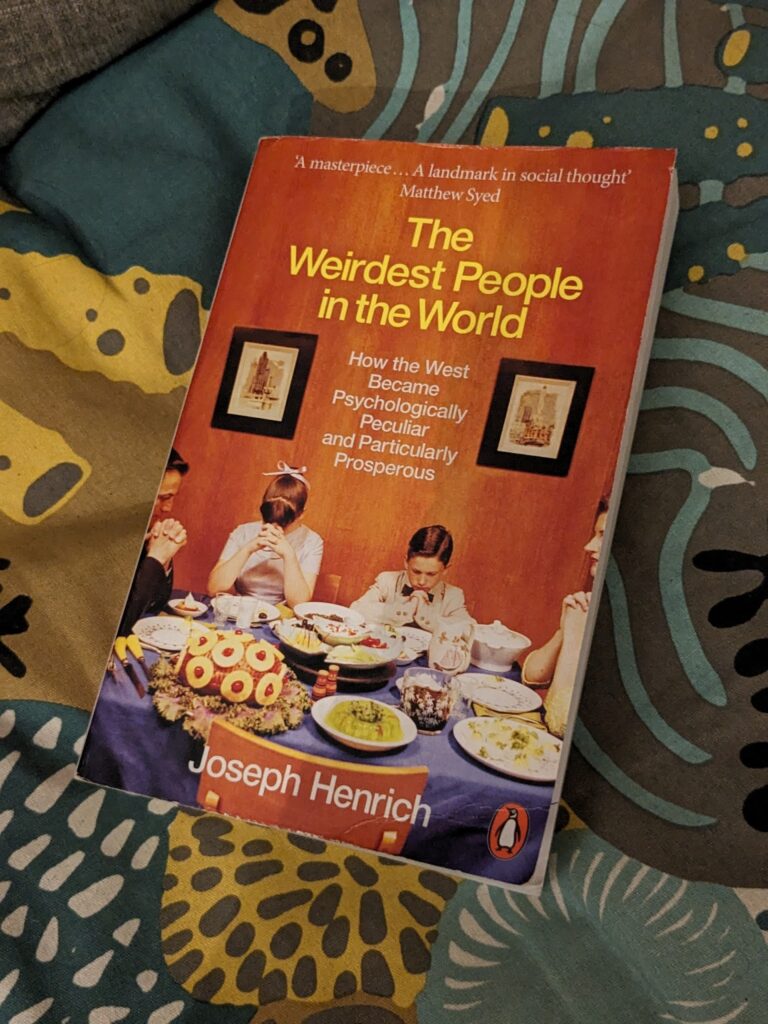
As an anthropologist, Joseph Henrich realised that much of the published work (and hence commentary) on human psychology (and social sciences at large) were based on work with experimental subjects who were based in or around Western universities. And when attempts were made to replicate these results with people in Africa/Asia, some of them even elites, it came to light that the subject pool was biased. They were WEIRD – Western, educated, industrialised, rich, democratic – and though only a small part of the species, are disproportionately represented in culture and thinking. How did this happen? That’s what The Weirdest People in the World is all about.
He sets the stage with the influence of Protestantism in this. Its credo of the individual’s personal relationship with God spurred the belief that a person should read the Bible (sola scriptura), increasing literacy in the process. But beyond this, he points out that religious convictions shape decision-making, psychology, society and culture at large.
But what is the WEIRD psychology? Broadly individualism and personal motivation (self focus, guilt over shame, dispositional thinking – based on intent not context, low conformity, self regulation and control and patience, time thrift, value of labour, desire for control and choice); impersonal pro-sociality (impartial principles, trust, honesty and cooperation with strangers and impersonal institutions, emphasising mental states in moral judgment, not revengeful but willing to punish third parties for not sticking to principles, reduced in-group favouritism, free will, belief in moral truths like physics principles, linear time), and perceptual and cognitive abilities and biases (analytical over holistic thinking, attention to foreground and not surroundings, endowment effect, overconfidence on own abilities)
To understand how people became WEIRD, he brings up the importance of cultural learning in evolutionary psychology. “Unlike other animals, we have evolved genetically to rely on learning from others to acquire an immense amount of behavioural information, including motivations, heuristics, and beliefs that are central to our survival and reproduction.” From our own motor patterns to projectile technology and food processing to grammar and social norms. Cultural learning adaptively rewires our brains and biology to calibrate them for navigating our culturally constructed worlds. This is cumulative cultural evolution.
It started off with kinship altruism, which other primates too possess, and extended to pair bonding and marriage, which is the most primeval of the institutions we have created. Preferred sexual access and a guarantee of paternity in return for protection and providing for the family. This paternity certainty and norms to cement it is where we start differing from most other primates. This also creates in-laws (affines) forming connections with more people who are not genetically related. From there on, basic communal rituals like dance, drills etc also bind people together with “mind hacks” through mimicry and a suggestion that others are like us and have an affection for us.
The next big shift was agriculture, which necessitated securing and holding lands. This needed co-operation and gave an edge to those communities with more social norms – rituals, beliefs etc. Fierce competition between groups generated a coevolutionary interaction between agriculture and societal complexity. And so, though farming was less productive and even less nutritious than hunting and gathering at an individual level, between sedentism and productivity of the unskilled (young) labour, farmer communities just reproduced more quickly and removed/assimilated hunter-gatherers.
Further inter-group competition led to clans which were kin-based institutions. These then became chiefdoms and premodern states. Built on norms and beliefs. And then non-kin based institutions developed between the elites and others to create stratified societies. e.g armies, tax collection. In the meanwhile, religion, based on our supernatural beliefs and worldviews, started scaling cultural evolution by creating ‘doctrinal’ rituals – prayers, hymns, parables etc and being transmitted by successful people – prophets and community leaders. These gave people a sense of unified commitment (conforming) and further evolved with identity markers- dresses, ornaments, taboos etc. By powerfully shaping behaviour and psychology, religion played a key role in forming higher-level political and economic institutions.
Thus begins another central point in the book – the role of the Church (and its MFP – Marriage and Family Program) in creating WEIRD people. The Church systematically started breaking the foundational kin-based societies using prohibitions and canon laws (marriage, adoption, divorce, polygamy, wills etc) over many centuries in Europe, ‘threatening’ people with divine retribution (in the afterlife) and excommunication (immediate). By allowing rich patrons to ‘pay’ with money and church-building, the Church continued to grow at the expense of the kin networks.
With more and more people marrying and working outside the kin network, cultural evolution started favouring a psychology that was more individualistic, analytically-oriented, guilt-ridden (as opposed to shame – guilt depends on one’s own standards and self-evaluation while shame depends on societal standards and public judgement) and intention focused (in judging others) as opposed to being bound by tradition, elder authority, and general conformity.
An important part is how monogamy became a norm though logically polygynous works for both men and women (because women could be second wife to the best hunter rather than only wife to an average hunter). It evolved because it can give religious groups and societies an advantage in intergroup competition. By suppressing male-male competition an altering family structure, monogamous marriage shifts men’s psychology in ways that tend to reduce crime, violence, and zero-sum thinking while promoting broader trust, long term investments and steady economic accumulation. Basically a testosterone-suppression system to reduce intra group competition. Between this and suppressed fertility (increased age of marriage, no pressure from kin, education for women) nuclear families started to focus on investing in their child – nutrition and education.
These changes also led to urbanisation as people travelled to places where they could find mates, vocation etc and expanded impersonal networks (trust in strangers as opposed to interpersonal kin networks) based on interests and worldviews, leading to universities, guilds and charter towns, who competed with each other to attract people. A pre cursor to the transition to political parties in later centuries. Another factor at play was wars. Though intuitively, one might think it derails progress, it actually builds intra group bonding and spurs technological advancements.
A rising middle class started demanding more rights, freedoms and privileges, leading to refinement of ideas, and acceptance of concepts like ownership and laws. Between this, impersonal networks and commerce, attributes like patience, time thrift (fascinating how clocks developed and changed the notion of time – wages per hour, need for efficiency, common market hours, contracts), self-regulation and positive-sum thinking (everyone can gain by advancements, I don’t need to be selfish or envious) began being appreciated as qualities one would want in self and other people, in order to distinguish themselves and prosper. These mindsets explains the kind of representative governments, laws, and the innovation and economic growth since then. The Industrial Revolution, for example, was fuelled by the expanding size and interconnectedness of Europe’s collective brain. In the political sphere, Protestantism, also a part of the larger religious cultural evolution, encouraged democratic institutions. Unlike the hierarchical Church, it requires communities to develop self-governing religious organisations using democratic principles. The cultural evolution can also explain things like patent concentration (in countries and regions) and economic characteristics at large in the contemporary era.
I can now easily see how the same principles apply to even India in the last say, five decades – better connectivity, educational institutions, urbanisation, reduction of kin bonds, and how that makes the 1% in the country closer to WEIRD than their own ancestors. This is a fascinating book supported by a ton of data and studies, and my only complaint is that like many other academics, Henrich too succumbs to the tendency of extensive usage of the latter at the risk of the narrative flow (instead of an appendix). But I’d still recommend it and between this, “Being You” (reality as a controlled hallucination and the brain only seeking to survive/control), and “The Master and His Emissary” (the hijacking of the narrative by the left brain especially since the Industrial Revolution), there emerges a phenomenally insightful view of the brain, its motivations and the interaction with cultural evolution. I really must repeat all these three soonest!
The Weirdest People in the World is a fascinating read and is in my favourite reads of 2024.
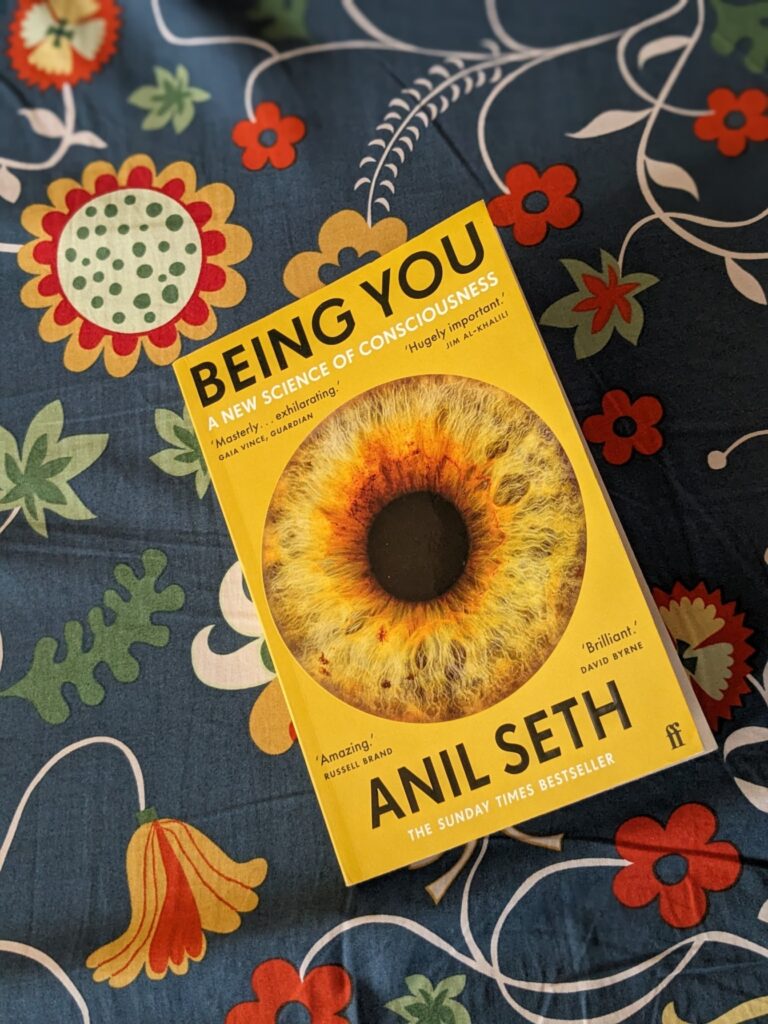
I have to confess, I will need to read this again. I also want to. For two reasons. First, the subject is something I feel is important – understanding consciousness through the lens of a scientific method. Second, grasping all of the material in Anil Seth’s fascinating exploration, I feel, is impossible with a single read. Having said that, the first read of Being You is indeed enlightening.
Being ourselves is not something we are always conscious of.* Anil Seth sets out to explore how billions of neurons within the brain end up creating a conscious experience – a uniquely personal, first person experience. Being You is divided into four sections – defining the ‘problem’ and showing the approach to the scientific exploration of consciousness, looking at it through how it relates to ‘content’ and external phenomena, and then going inwards to the experiences of conscious selfhood, and finally applying the learning to non-human entities – animals and AI.
In the first section, Seth brings up the ‘hard’ and ‘real’ problems of consciousness. The first (David Chalmers) is focused on how consciousness happens, how it is related to our biophysical machinery and how it is connected to the universe at large. On the other hand, the ‘real’ problem is how the ‘primary goals of consciousness science is to explain, predict and control the phenomenological properties of conscious experience.’ i.e. why is a particular experience the way it is, and what is its relation with what is happening with the brain and body. In other words, deeply understanding the connection between mind and matter. The latter approach would need measurement.
This begins with understanding ‘conscious levels’ – complete absence (e.g. coma) to light sleep to waking states. Conscious content is what we are conscious of – sights, smells, emotions, moods, thoughts, beliefs – all sorts of perception. There is a very interesting part on how psychedelic states are at a conscious level well above waking state, and have the maximum algorithmic complexity (a measure of the diversity of signals). Another interesting proposal is how all conscious experiences are informative and integrated, (red ball vs red and ball separately) leading to the integrated information theory (IIT) of consciousness, an axiomatic approach that starts with theories and use them to support claims on what properties the mechanisms underlying the experiences will have.
The next section is about conscious content and then the experience of a conscious self. Here’s where the idea of perception gets upturned. Perception is a ‘controlled hallucination’ (phrase by Chris Frith), an active construction as opposed to a passive registering of an external reality. The brain constantly makes predictions about the causes of its sensory signals through a Bayesian process in which the sensory signals (also) continuously rein in the brain’s various hypotheses. Perception is a continual process of prediction error minimisation (reducing the difference between what the brain expects and what the signal provides).
Reality is an interpretation, and the entire process is not optimised for accuracy, it is designed for utility. ‘We perceive the world not as it is, but as it is useful to us.’ A mechanism of making it seem real so we respond to it. Not to know the world, but to survive it! There is the fascinating part on colour – an object is not objectively ‘red’, redness is just the way in which it reflects light, and how the brain perceives it. And this applies to all of our perceptions. Mind effing bending! A great distinction here (John Locke) is on why that train is not just a perception and you shouldn’t jump in front of it. Objects have primary qualities that exist independently of an observer (e.g. space it occupies, movement, solidity), and secondary qualities that depend on the observer (e.g. colour)
The self, as shown in the next section, is also a perception, a controlled hallucination. To begin with, selfhood is divided into an embodied (being a body), perspectival (having a first-person perspective), volitional (having ‘free will’) and narrative (personal identity and deep emotions), social (how I perceive others perceiving me). The link between perception and the body and its physiological processes exist in all these forms. When we flip the learning from the previous section inwards, we understand that we do not perceive ourselves to know ourselves, we do it in order to control ourselves’. The entire panorama of experience and the mental life and thus its perceptions and cognitions stems from a deep-seated biological drive to stay alive.
I found the part on why we think we are stable and unchanging over time, very interesting. Perceptual inference is about finding out things about the outside world. Interoceptive inference is about controlling things – physiological regulation. In the latter, the prediction error minimisation happens by acting to fulfil top-down predictions of the brain. The brain, for survival, desires predicted ranges of physiological viability and thus the need for strong, precise and self-fulfilling predictions. And if it comes to that, the brain will (and does) systematically misperceive.
The end of the section also brings in the complex but fascinating FEP (free energy principle) and specifically how it applies to living systems and consciousness. In this context, it boils down to this – being alive means being in a condition of low entropy. Any living system, to resist entropy, must occupy states which it expects to be in. Free energy here approximates sensory entropy, and apparently, it amounts to the same thing as prediction error. Broadly, that connection with physics and the universe, and the brain’s regulation of the perception of the worlds outside and inside! Appealing, but they’re still ironing out many wrinkles.
I found the last parts – free will, and consciousness in animals and AI to be areas which are still under much (more) debate, and therefore more descriptive than insightful. That is not to say that it does not merit a read! It is just that the 200+ pages before were so rich and intense that on a purely relative scale, this seemed less so.
As I said, Being You is most definitely not an easy book, but it does such a fantastic job of providing that glimpse and promise that we might actually get answers to our most basic and profound questions that one automatically cheers for the understanding that each chapter provides. Also the kind of book that makes me wish I were smarter – to really grasp the entirety of it! It also made me think of how science and spirituality seem to converge – the latter’s approach to reducing wants and desires, and increasing mindfulness as a means to prediction error minimisation. 🙂
This was part of my Bibliofiles 2024 list, and in fact, my favourite read of the year.
Notes and Quotes “The essence of selfhood is neither a rational mind nor an immaterial soul. It is a deeply embodied biological process..” “Wherever there is experience, there is phenomenology, wherever there is phenomenology there is consciousness.” Deductive (reaching conclusions by logic), inductive (extrapolating from a series of observations) and abductive reasoning (the best explanation from a series of observations)
*now that I have read the book, I am analysing this sentence!
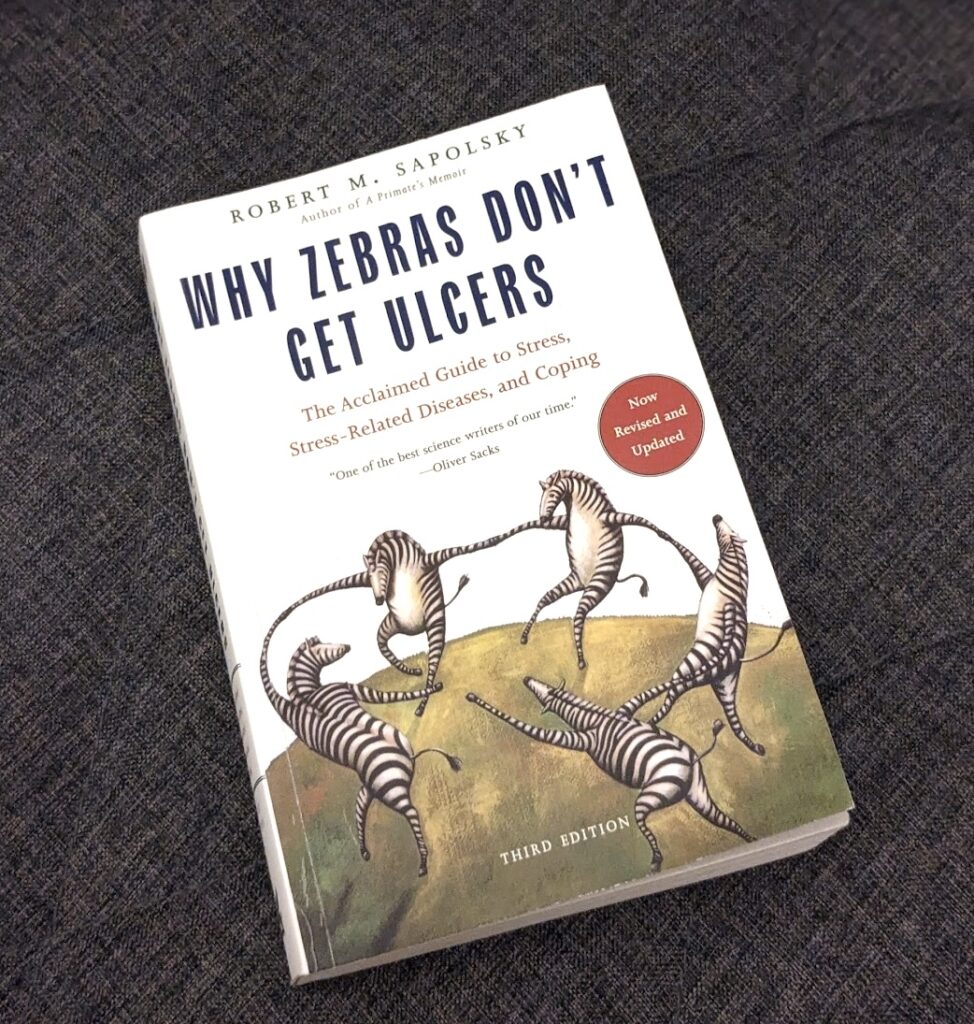
Sapolsky’s ‘Behave‘ was in my list of favourites back in 2021. So when I got to know about Why Zebras Don’t Get Ulcers, it became a must-read, and that title really helped. The book was originally written in 1994, and is now in its third edition, so things continue to be updated.
He gets the title out of the way very quickly, and this is perhaps the underlying premise of the book – zebras, and the lions who chase them both are stressed, and their bodies are brilliantly adapted to handle these emergencies – fear of life and fear of starvation respectively. Go up to the apex predator – humans, and it can even handle things like drought, famine, pests. But when we include psychological and social disruptions – from finding a parking spot to an unpleasant conversation with a manager/spouse etc – and start worrying about them, we turn on the same physiological responses.
When this is chronic (and it is – think about the things you get stressed about daily), the stress response itself becomes harmful to the body, sometimes even more than the stressor itself. Because they were not meant to do this all the while, they were only for emergencies!
The early pages of Why Zebras Don’t Get Ulcers also draw out a significant difference – between homeostasis and allostasis. ‘The brain seeks homeostasis’, but the concept itself is now modernised because there is no single optimal level (e.g. it can’t be the same when sleeping vs skiing) and because we now understand that the point cannot always be reached by a local regulatory mechanism, it requires ‘the brain coordinating body-wide changes, often including changes in behaviour’. And this tinkering has its own second-order consequences. Even more complicated because in allostatic thinking, there can be changes made in anticipation of a level going awry. When it is stressed for ’emergencies’, the body goes for homeostasis, with consequences in the long run.
The book then traces out the working of the brain – and the regulation of glands and hormones (and how it is different in males and females), before getting into specific areas that stress specialises in! This includes physiological things cardiovascular health, ulcers and IBS, (oh, if only I knew this 3 years ago, I would have been better equipped to deal with idiot doctors) pregnancy and parenting, sex and reproduction, pain, immunity and diseases, memory, sleep, cancer (the jury is still out on this) and aging and death, as well as psychological domains like addiction, depression. It also looks at how temperament and personality can either assist or resist stress.
In the personality section, Sapolsky practically described my (former) Type A personality down to a behavioural “time-pressuredness” (research by Meyer Friedman and colleagues), default hostility, and a persistent sense of insecurity, the last being a predictor of cardiovascular problems. Add to it disciplined, discomfort with ambiguity, and (formerly) repressive in terms of emotional expression, and you have my profile! Damn!
Towards the end of Why Zebras Don’t Get Ulcers, there is also a very interesting section (and studies) on how socio-economic-status (SES) can affect stress. The poor have more chronic daily stressors, and feeling poor (not the same as being poor) in our socioeconomic world (digital media expands ‘our’ from friends, family and neighbours to anyone on Insta) predicts poor health. Income inequality predicts mortality rates across all ages in the US.
The last chapter is on managing stress – exercise, meditation, increasing control and predictability, social support, finding outlets for frustration. And building coping mechanisms around fixed rules and flexible strategies – when stress management is not working, instead of trying extra hard on our preferred strategy – problem solving/emotional/social support – switch the approach.
I was expecting a fair amount of trudging and it turned out to be that way. But Why Zebras Don’t Get Ulcers is definitely fascinating to see the stress fingerprint in so many of our ailments – ranging from very visible to almost invisible. Great book, if you have the interest and patience for it. 🙂
Notes from Why Zebras Don’t Get Ulcers
1. Water shortage in California. Homeostatic solution: mandate smaller water tanks. Allostatic: smaller toilet tanks, convince people to conserve water, buy rice from SE Asia instead of doing water-intensive farming in a semi-arid state.
2. When stressed, the sympathetic nervous system is activated, the parasympathetic nervous system is turned down, the heart shifts into a higher gear, glucocorticoids enter the play enhancing the effects of epinephrine and norepinephrine. As a result blood pressure goes up, the blood sent to nonessential areas like digestive tract and kidneys go down (fascinating how we wet our pants in fear though the kidney function is kept low – basically to remove excess water quickly from the bladder). Chronic use of this mechanism promotes plaque formation in arteries by increasing the chances of blood vessels being damaged and inflamed and the likelihood of platelets, fat, cholesterol sticking to those areas.
3. Also when stressed, the contractions in the colon increase to get rid of the ‘dead weight’. See how IBS and diarrhoea works!
4. In a British Victorian family, the mother’s favourite son David dies and she takes to bed, ignoring her 6 year old son. And when the boy comes to the darkened room, she asks ‘David, is that you?’, before saying ‘Oh, it’s only you’. The younger boy stops growing, because this is the only way he seems to get some chance of affection. He is J M Barrie, the author of Peter Pan!
5. Stress-induced analgesia (not feeling pain during strenuous activities – from war to exercise) and stress- induced hyperalgesia (feeling more pain, e.g. waiting for a dentist) Both are emotional reactivity to pain and do not involve pain receptors or the spinal cord.
6. Personality style can lead to stress-related disease – either due to a mismatch between the magnitude of stressors and respective stress responses, or even reacting to a situation that is not a stressor
7. How does social capital turn into better health throughout the community? Less social isolation. More rapid diffusion of health information. Potentially social constraints on publicly unhealthy behaviour. Less psychological stress. Better organised groups demanding better public services.
8. If you want to improve health and quality of life, and decrease the stress, for the average person in a society, you do so by spending money on public goods – better public transit, safer streets, cleaner water, better public schools, universal health care. The bigger the income inequality is in a society, the greater the financial distance between the wealthy and the average. The bigger the distance between the wealthy and the average, the less benefit the wealthy will feel from expenditures on the public good. Instead they would derive much more benefit by spending the same (taxed) money on their private good – a better chauffeur, a gated community, bottled water, private schools, private health insurance. As (Robert) Evans writes, “The more unequal are incomes in a society, the more pronounced will be its disadvantages to its better-off members from public expenditure, and the more resources will those members have (available to them) to mount effective political opposition.” He notes how this “secession of the wealthy” pushes toward “private affluence and public squalor”. And more public squalor means more of the daily stressors and allostatic load that drives down health for everyone. For the wealthy, this is because of the costs of walling themselves off from the rest of society, and for the rest of the society because they have to live in it.
8. Heaven, we are told, consists of spending all of eternity in the study of the holy books. In contrast, hell consists of spending all of eternity in the study of the holy books. 😀
9. In a diagnosis that helps explain the confusing and contradictory aspects of the cosmos that have baffled philosophers, theologians, and other students of the human condition for millennia, God, creator of the universe and longtime deity to billions of followers, was found Monday to suffer from bipolar disorder. ~ The Onion