Category: Favourites

  • The Evolution of Everything

    Matt Ridley

    For a while now, I have believed that Darwin’s theory of evolution is the most paradigm-shifting idea to have emerged from a human mind. On a related thought journey, I have also shifted from determinism to free will and back to determinism, all in a few years. This book connects both these thoughts, and is fundamentally an argument for evolution and against creationism. It argues that change is incremental and emergent and has a momentum all of its own, as opposed to the idea that it is directed by a person or a metaphysical force like God. (more…)

  • The Paper Menagerie

    Ken Liu

    What is with these Chinese (/origin) writers? Ted Chiang’s “Stories of Your Life and Others” was the best collection of speculative fiction I had read. Then there was Liu Cixin’s “The Three Body Problem” trilogy that had a fantastic story arc even while retaining scientific accuracy. And now, Ken Liu, who had translated Liu Cixin’s work into English, and has also credited Ted Chiang as an inspiration for the last story in this book.

    All fiction, the author says in the preface, is about prizing the logic of metaphors over reality, which is irreducibly random and senseless. This is what I would call the DNA of the book, and teasing out the metaphors in some of the stories is what I considered the most exciting part of reading this book. Also mentioned in the preface is the author’s perspective that he does not pay attention to the distinction between fantasy and science fiction or genres in general, and a few stories serve as excellent examples. Good Hunting could be steampunk and fantasy, The Waves would be science fiction and fantasy, The Man who ended history could be historical fiction and science fiction. The genre is rendered irrelevant in the larger scheme of things. Everything is speculative fiction. (more…)

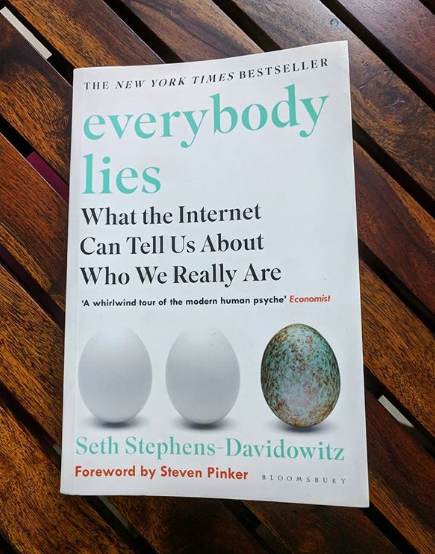
  • Everybody Lies

    Seth Stephens-Davidowitz

    I’m a huge fan of Asimov’s Foundation series. Hari Seldon, the seminal character in the series, develops psychohistory, an algorithmic science that helps him predict the future of large populations, (not individuals) though in terms of probability. As I read this book, I began to wonder if data would actually help us get to that level at some point.

    The premise of the book is that though everybody lies – to their friends, spouse, colleagues and most definitely to themselves, many of their actions – what they search for, what they click on etc – reveal their true nature. With the sheer amount if data that is being generated, data scientists are able to gather insights on our thinking, and potentially use that for the welfare of humanity.

    The book uses a bunch of examples early to show how data can help distinguish between what people say and what they actually do. Trivia: India gets called out early enough for being #1 in people who search for “may husband wants me to breastfeed him”! A large section of the first half is full of p*rn data. Reveals much!

    I not only got some validations about human behaviour, but also realised that some of my perspectives were not really true. For instance, I had thought that the web was now largely getting segregated into filter bubbles. Data shows otherwise! It also shows the clear possibility that many of our core beliefs and attitudes could be explained by the random year of our birth and what was going on the key years of our upbringing. One observation I could not really agree with was “it does not matter which school you go to.” While one study does show that, I can see it play differently around me, and perhaps there are psychological effects that does not come out in a study. Or it could be affected by “the curse of dimensionality” that the author brings up – if you test enough variables, one, by random chance, will be statistically significant.

    The last portion of the book offers a counter balance to the case made for data thus far in the book. The overemphasis on what is measurable, the limits of data, and the ethics of data usage – by private companies or the government.

    But the potential of data to cause a social sciences revolution remains well argued. However, just having data is not really enough, one needs to be curious (what data needs to be looked at) and creative (what’s the best way to frame the data or sets of data, build hypotheses) to make the best use of it. Some of what the author has done in the book is precisely that. Can data be misused? Yes, it can, but that’s the risk with every new science. That doesn’t take away from the exciting possibilities it has to offer.

  • Guns Germs & Steel

    Jared Diamond

    One of my favourite books in recent times has been Sapiens – it did a fantastic job of showing how the species ascended to the apex position in evolutionary biology. A vertical journey, so to speak. But why didn’t all humans, spread across various continents, develop equally in terms of civilisation and technology? To use the book’s blurb, “why has human history unfolded so differently across the globe?” In the modern world, why does an Africa or even a large part of Asia have to work hard to catch up with the western world? That’s what the book seeks to answer.

    It does that by asking very interesting questions. For instance, why is it that the Spanish conquered South American empires, and not the other way? The book doesn’t stop at the proximate answers – horses, weapons, germs etc- but keeps asking a series of questions for the answers that come up. Even beyond the time that recorded human history begins. To when the species first made their appearance on the planet – in Africa- and how slowly they made their way to different parts of the globe.

    Primarily, four factors have ultimately caused the disparity in the fortunes of various peoples- how early they started, the difference in the environment and biogeography of the areas they populated (what plants and animals there could be domesticated to scale up food production and create the surplus needed for new skills and ideas to develop), the spread of ideas (the fascinating aspect of how the axis of the continent – except for Eurasia, all continents have a north south axis – plays a large role in why a large number of major civilisations and developments occurred in this part of the world), and the densities of population that allowed competing societies within continents to come up with radical ideas.

    In addition, there are also related interesting ideas. For example, how invention is actually the mother of necessity (examples of how some inventions had been made before, but are credited to the person/s who made the right tweak at the right time for others to adopt it in large numbers) and how some non-intuitive solutions have endured (e.g. the QWERTY keyboard).

    All of this make for a fascinating, if not easy read. Even though it was published a couple of decades ago, I think it is an important book for this time because it shows how evolutionary determinism is not just about genes, but the environment as well.

    P.S. I do wish he had spent some pages on how the British could conquer India. The only clue he does drop is how India’s environment might have created a caste system which prevented the creation and proliferation of ideas it otherwise might have had.

  • A Man Called Ove


    Fredrik Backman

    This was a book selected by D (my much better half) as part of our once-in-two-months book shopping. So naturally, I couldn’t just read it, I had to read into it. The message was simple, I had a lot of character similarities with Ove. It was less to do with his literally hands-on approach to fixing things and more to do with “right has to be right”, but the similarities in personality were obvious enough right from the beginning for me to LOL.

    This is probably the only book that has made me go from smile to laugh to moist eyes in a span of 30 pages. Smile because I understood Ove’s perspective and why he does the things he does. As it turns out, Ove isn’t bitter. “He just didn’t go around grinning the whole time!” Laugh because the insults and reactions are hilarious and creatively sharp. And cry because. Oh wait, that’d be a spoiler, so no.

    The slow reveal of Ove’s not-so-typical heart of gold, as people keep popping into his life, is really done well. And it’s not just Ove, the other characters, especially Parvaneh, have been written very well. In general, the main reason the book worked for me, outside of the excellent humour, was its solid understanding of its protagonist’s condition, and its commentary of the changing nature of society and its mores. There is something profound that is being delivered here – on life, youth and aging, death – but with a gentle touch. That’s probably what makes the book so heartwarming and such a pleasure to read.