Once upon a time, humans moved around in bands. Then there were tribes, and then there were states. States and the societies that make up its population have developed a bunch of institutions (defined as “stable, valued, recurring patterns of behaviour”), some of which are uniformly present across the globe, and some not. How did this variation happen?
Why is every country not a democracy, which is largely accepted as the best trade-off for all concerned? How did different countries reach their current form? That’s what this book is all about – how did different countries develop institutions that currently make up their current society and state?
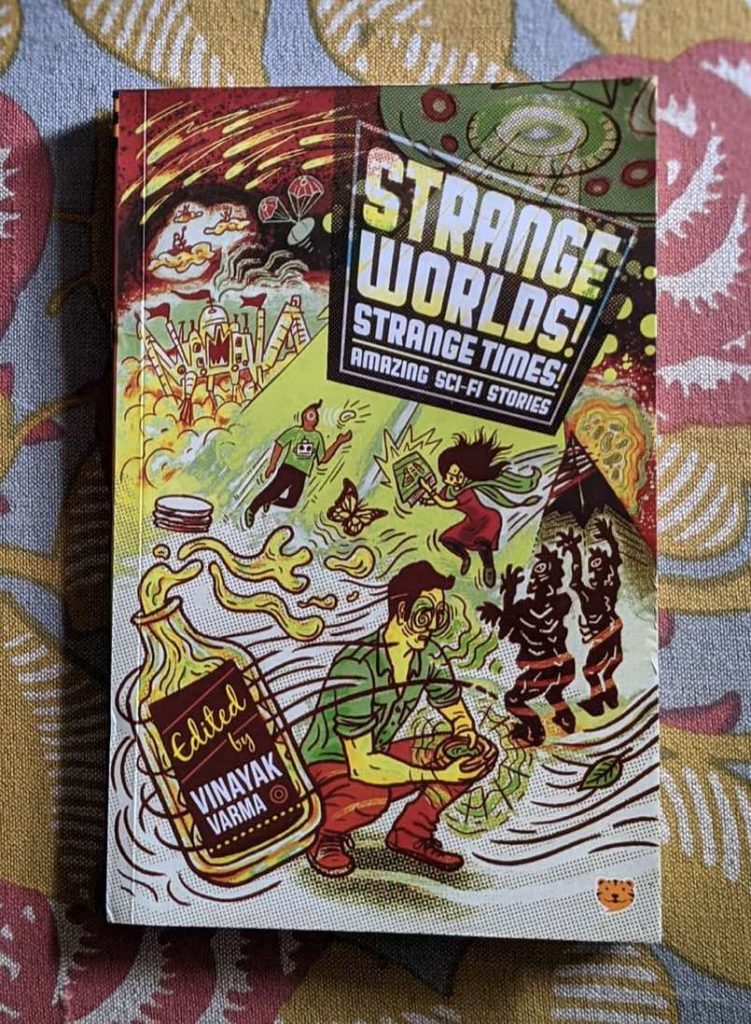
I think I’ll just gush, because this, I guess, is what the entire “kid in a candy store” feeling is like! But to begin with, I have to confess I didn’t read the first 20 pages! It was quite a coincidence that a book with this title mysteriously arrived without them. That meant that I missed the Manjula Padmanabhan story, and dove haphazardly into the Srinath Perur one. Jerry Pinto made me gaze up at the stars again with a delightfully profound take on “outer space and inner space” – a phrase that Vandana Singh uses in the last story in the book.
Zac O’Yeah manages to catch Bluru’s little idiosyncrasies superbly and had me cackling away for quite a while. And then Rashmi Ruth Devadasan does the same to Chennai (?) with a dose of zombies. Vinayak Varma, who needs to be thanked separately for stitching this all up together, does a neat border town story with sniper shots at saffron and creation!
And there’s a (translated) J.C Bose story. Oh yes, the very same, and a fascinating back story (actually stories) on how this work came to be. I have never been much into comics (though recently Kavalier & Clay did make me think deeply on the subject) but Sunando C’s few pages of work were fascinating! A walking Taj Mahal, and telekinesis – Indrapramit Das’ imagination is evident. Shalini Srinivasan gives us a dose of reality – a parallel one, that is. And to end it all, Vandana Singh writes a brilliant story involving dimensionality (I was reminded of Liu Cixin’s sophons)
What made me love the book was the sheer diversity of texture and context. All the stories have an equal grounding in some part/aspect of India as they do in science/speculative fiction. And it’s almost as if the writers have let themselves go at it in total abandon. Delightful and amazing indeed! P.S. Loved it so much that I sent it to three unsuspecting folks!
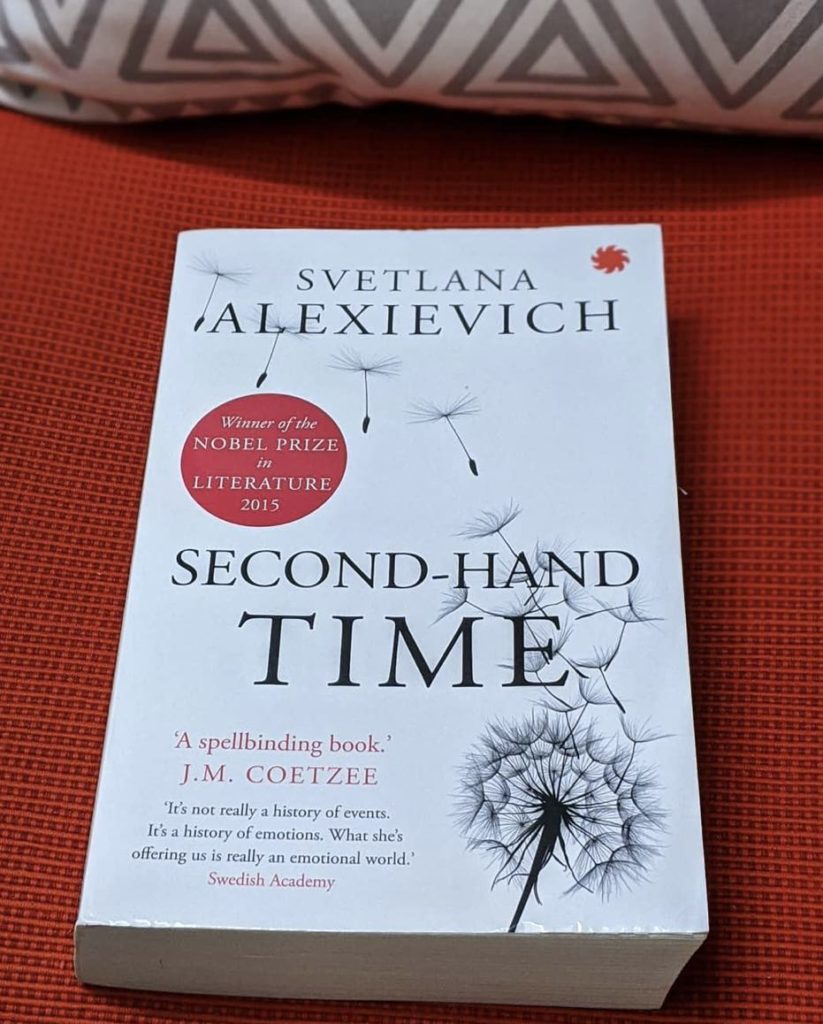
As I was reading the book, I wished it were fiction. But unfortunately, it’s contemporary history – lives lived by people, and events that impacted their life. To think that millions of lives have been spent in ways that one could not even endure for days – conditions that are not just physically gruelling, but mentally debilitating. Ordinary citizens of the former USSR and current Russia, whose belief systems, values and hopes went through upheavals as the country’s political system experienced two decades of turmoil after the fall of the USSR.
Different generations whose worldview has been shaped by leaders from Stalin to Putin. Housewives, small traders, ordinary soldiers, students and staunch party workers, no one was really spared as the political, economic and social systems went through multiple changes upending millions of lives. Savings, livelihoods, lives, all lost, thanks to the whims and fancies of the powers that be. At an individual level, relationships with parents, siblings and friends were affected as the state created paranoia. Everyone was a potential informant, after all.
The author documents the atrocities of Stalin as told by folks who lived before, during, and after the era. Many acknowledge that the system could not have been this ruthless if there weren’t people to operationalise it. Was it by choice? Between making great history, and leading a banal existence. Many also believe that the Soviet became great because of him, and what he did was justified. Khrushchev opened up the system, and people even started making jokes about Communism (“A communist is someone who’s read Marx, and anti-communist is someone who’s understood him”).
Brezhnev brought in stability, and some success in foreign policy, but corruption, inefficiency and a widening technological gap with the West was the trade-off. It was hoped that Gorbachev would bring in the “happily ever after”, but glasnost and perestroika didn’t lead to better socialism, it paved the way for capitalism. The dissatisfaction and a foiled coup led to Yeltsin, and the rise of oligarchy. And then came Putin, in whose regime, there are confrontations between different ethnic factions. And at full circle, there are now many voices who hope for a return to Stalinism. In all of this, even as ordinary people suffered hardships, the pride for the purity of thought, and belief in the power of a united country persisted for many. Ideas and idealism stayed alive. But for most others, the only desire was to escape the system.
It is quite a brutal read, and I found it depressing, but these are stories that must be told.
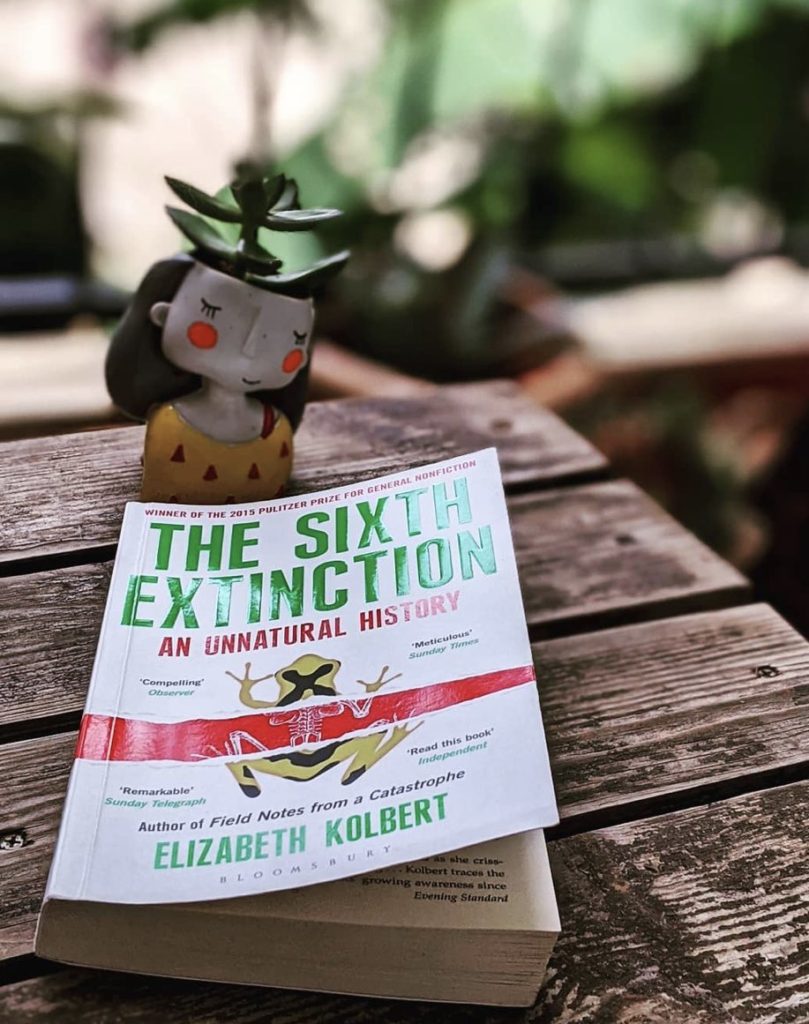
A pandemic is probably the best time to read a book on mass extinctions. Or not, depending on taste.
But this is a book I thoroughly enjoyed, even though I am not really a big fan of nature – plants or animals or for that matter, some humans either! Some of it is because of the many, many things I learned, and some of it is the accessible narrative style of the author – it evoked the sense of curiosity that I had for science in general as a child, and I confess, infused that sense of romanticism in science that I haven’t seen in a long time.
It is scientifically interesting to see how concerned we are about the pandemic, when, earlier this century, a species of Chytrid fungi (a genus had to be created for it, and it is called Bd for short) systematically started killing of frogs across continents. Making many of them endangered species. Or the Geomyces destructans, that killed off bats to the tune of 6 million!
Until the end of the 18th century, the idea of extinction did not exist. It then moved to a “uniformist” view that each species struggled and vanished. Then the discovery of the asteroid impact happened. The current version accommodates both lines of thought- long periods of nothing happening and then one cataclysmic event. It involves oceans, rising and falling, tectonic shifts, global warming and cooling etc and yes, an asteroid too. On a related note, there is also a small parallel narrative on Darwin, The Origin of Species and how it weighed in on the extinction debate.
The last 500 million years are divided into three eras, and a lot more periods. While there have been extinctions, in isolation and clusters, and mass extinctions occur every 26 -30 million years, the short list contains only the “big five”. The most famous one is the one that features the asteroid. That was the last one, which happened 66 million years ago, in the End Cretaceous period, leading to the extinction of 75% of species. The ones before were 201 million years ago -that led to the dominance of the dinosaurs, but killed 75% of species that existed then, 252 million years ago – the biggest one that knocked off 96% of all species, 375-360 million years ago – killing 70% of species, and 450-440 million years ago – 60-70% again. The sizes and descriptions of both the tiny organisms and the megafauna that lived, co-existed, and died is fascinating.
The name of the book, as you might have guessed, comes from the possibility of the sixth event that could be added to the big 5. From all the evidence so far, humans will most likely be the cause, but the twist is that we could be the victims too. In the context of the larger lifespan of earth, a short while ago, a species created a way to go beyond only the genetic code to store and distribute information. Language. They then found ways to communicate and collective think about and solve “problems”. And we’re here now.
The book gives a lot of food for thought, but more importantly, at least to me, invokes a sense of curiosity and awe. A lot thanks to science, and some because of the variety of places she visited to write this book. The moment she narrates, while on a tiny island at the edge of the Great Barrier reef under a starry sky – For a brief moment I felt I understood what it must have been like for an explorer like Cook to arrive at such a place, at the edge of the known world – sums up the effect of the book very well.
I picked the book up thanks to a post on “backstage” based on it – the stage is where we present ourselves to the world, and backstage is where we allow our true selves to just be. The context was how “social media” was shrinking the backstage area because we are always on show.
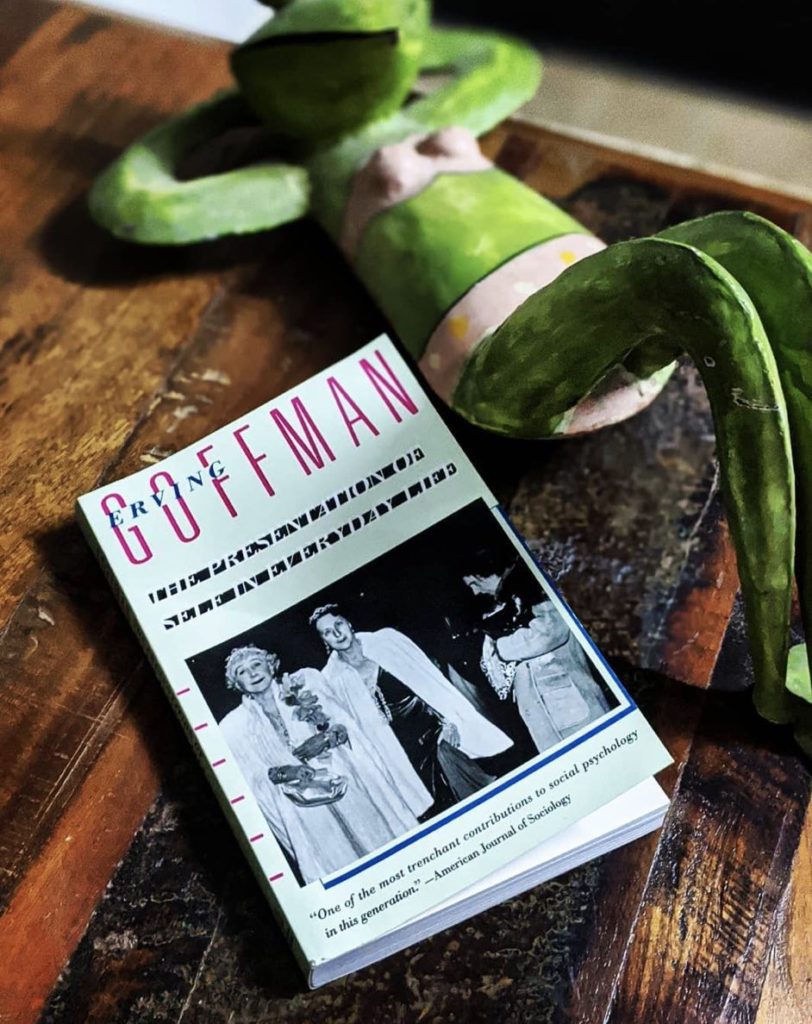
I wondered how a 250-page book could be written on the subject of “presentation of self”, but realised the depths as soon as I had read a few pages of The Presentation of Self in Everyday Life. How we behave in the presence of others is indeed a fascinating subject. Goffman uses the metaphor of a theatrical performance to explore the nuances and interplay that occur in practically every interaction we have. A dramaturgical analysis. This interaction need not even be with another specific person but just with the world at large. For instance, he uses an example of how we present ourselves when stepping out on to a beach – our facial expression, the book we carry (or not), whether we go for a swim (or not). Just as an actor uses techniques to present a character, we give performances in everyday life to guide others’ impression of us. The expressions we “give” and the impressions we “give off”. Many stages (contexts), many props (subjects we talk about, clothes we wear, attitudes, beliefs etc) for many audiences. I realised that some are so ingrained that I have to really “step outside” to catch it.
It gets even more interesting when we consider that others are also doing the same thing. This leads to intriguing dynamics. It not only means we have to sometimes co-opt them, but that we also play a role in their performance. Teamwork, which involves many rules – in performances within and without- that we must conform to, if we want to stay a part of the team. Familiarity, solidarity and a working consensus on individual roles and interplay all lead to the creation of the team’s “mythology”. The audience is also a part of the performance and without their tacit agreement, the show would fall apart. There is also a “definition of situation” that all constituents must agree on. This not only plays out in social gatherings, but in society at large, which expects its performers to play a role.
“Impression management” is a very useful takeaway from The Presentation of Self in Everyday Life. Reality and perception not necessarily being the same. Not that we aren’t doing it already, but the nuances, and perspectives on the tool-kits we should make for ourselves. The “expressive control” for instance, the lack of which might give away a the believability of a performance. While The Presentation of Self in Everyday Life has been written more than half a century ago and social interactions have changed a lot since then, including the explosion of non face-to-face forms like the internet, there is a lot it offers in terms of perspective, lessons and actionable insights. It is not an easy read, and I have had to re-read paragraphs and pages a few times, but it is definitely worth the effort.