Author: manu prasad

  • Wavering

    My twitter stream over the last weekend and to a certain extent this week too, was dominated by Wave. People asking for invites, writing about their first impressions, cracking one liners and so on. The entire activity reminded me of how brand custodians try to create ‘virals’. From making ‘viral’ a part of the strategy, to announcing on the day of the release that they have ‘launched’ a viral, there are stories and stories. For me ‘Wave’ was a viral. Google has done this before with GMail. This time too, there was hardly any advertising. It was banking on the brand and product equity of Google, and the (potential) awesomeness of the product. It made me think on both fronts.

    Google’s brand identity has been dominated by search. For most people, it is their starting point on the web. But its not just that. From the iconic, simplistic, patented home page and the doodles it exhibits there, to its attempts to disrupt the real time conversation domain that is dominated by Facebook and Twitter with Wave, Google is many things. GMail, Orkut, Picasa, Blogger, YouTube, Maps, all operating on different domains, and brands in their own right. And they only make up one part of what Google is today. (link to an informative analysis of Google) Currently valued at $100 billion, and rising. Though wary of it, the brand has my respect, and for me, Google has been awesome.

    Awesomeness. Umair Haque had an extremely interesting post about awesomeness recently. He wrote that innovation is passe, that it is ‘what is commercially novel’, doesn’t create anything fundamentally new, and that awesomeness is the new innovation. He lists ethical production, insanely great stuff, love, and thick value as the four pillars of awesomeness. Arguable, right from a semantics/ new buzzword premise. But I tend to agree, especially when I see the stuff being passed around as innovation.

    Now, some of you might be aware of this, but for those who don’t, Google has a ten point corporate philosophy. An extremely interesting set of things, which you must take a look at.#10, I thought, was related to awesomeness. It goes “Great just isn’t good enough.” Google believes that great is just a starting point, and their “constant dissatisfaction with the way things are becomes the driving force behind everything we do.”

    They obviously felt that the entire domain of real time communication, search, sharing and collaborating could do with some disruption, that would explain Wave. And from the time I saw the video, I’ve thought that it would be a game changer, and wrote as much. But the feedback so far has been less than encouraging. From productivity killer to RSS, The sequel, it has been called quite a few things. The opinions are from guys who know what they’re talking about.From the little I have tried it out, I’ve to admit it can totally knock off productivity, but then again so can Twitter. Its less fun if there aren’t many around. Twitter in 2007, for me. Most are still learning, because it IS quite different. Seth Godin called Twitter a protocol (yes I keep saying that because its absolutely apt), I still figure that Wave has the potential that it showed in the video, the potential to create its own protocol. After all, there must be a reason why they call it a preview.

    But it did make me wonder about Google and awesomeness. Is Wave awesome, as opposed to an innovation? What if the idea is too advanced/difficult to provide ‘thick value’ now, does it still deserve to fail? Does that mean that sometimes innovation is better than awesomeness? How does ‘failure’ feature in the awesomeness manifesto? What does this do to the overall brand equity of Google? Or is brand equity an excuse/surrogate for thin value, and exist only in theory, or until the last good product?  But maybe Mitch is right when he says that we’re killing it before it begins. More after I play more with it.

    until next time, a wave new world

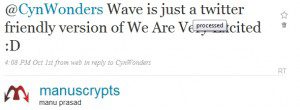
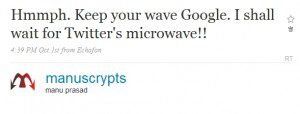
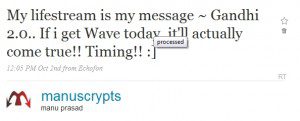
    PS: a few of my Wave tweets below 😉

    Clipboard02Clipboard03Clipboard04

  • Brand Chats – Google & Godin

    Last week, Seth Godin’s company Squidoo launched “Brands in Public” (BIP from now), a  service which creates pages -‘public-facing dashboards’ that aggregate conversations about brands on Twitter, YouTube and blogs, in addition to news, videos, images etc. BIP will create the pages anyway, but for a fee, brands can develop this page. Brands then get control of the left column on the page, and can respond to the content, highlight certain content, run contests etc. (example) In Seth Godin’s own words, brands “can respond, lead and organize.”As Godin himself states, there are many monitoring tools online (found an excellent wiki by Ken Burbary) which can be used to ‘listen’ to the conversation, but this service allows brands to respond publicly.

    I saw a couple of posts which asked an interesting question – whether by creating pages ‘anyway’, Godin was brandjacking. Godin had clarified that if a brand requested him to take a page off, he would do so. And in a later update (to clear the air) he took off the 200 sample pages that had been put up. Bravo! Not that there was anything technically wrong with it – after all, like one of the articles states, Google does something similar- sell ads next to contextually relevant others- generated content (search, ad sense on sites), but the non-paid for brand pages just didn’t sound right.

    But it made me wonder again about the location of brand-consumer conversations. Before we get to that, another interesting news item in context, albeit a bit tangentially. Last week, Google launched Sidewiki, “which allows you to contribute helpful information next to any webpage. Google Sidewiki appears as a browser sidebar, where you can read and write entries along the side of the page.” The entries which are shown, are selected not by recency, but an algorithm that has among other things – the contributor’s previous entries and the feedback on the entry. Moreover the entry will also be used on sites with the same content. Users will have to be logged into Google for leaving comments and rating.

    As Jason Falls notes in his post about Sidewiki, this adds another layer for brands to keep in touch with, because users may not even have to search for information about the website (or the product/service sold there). If they have the toolbar downloaded, they can see the information as they browse the site. He also rightly remarks (IMO) that we should expect ads (even that of competitors) in the wiki soon. Meanwhile, like any good social product, there is no control that a brand can exert on this content, as it exists on Google’s servers. Jeremiah Owyang  also has a post on the same subject, which offers several great insights and advice. Apparently, the comments a user leaves will also be displayed on his Google profile. The web as one giant social network, he’s right, that’s what Google’s after. There is also the option of sharing it on Facebook/Twitter. It’d be interesting to see a Facebook version of this whenever it happens – a play with Facebook Connect, the website, and perhaps, Facebook fan pages. The Facebook newsfeed means that it can bring the conversation back to Facebook. That’s something Google can’t do..yet.

    Now, back to the location. Attempts are being made to aggregate these conversations, and in BIP’s case make it a conversation involving the brand itself. My problem was not with brandjacking, the conversations are happening anyway, and brands are free to create their own ways of aggregation and response, I was more concerned with two other things. One, the creation of a destination point , a ‘middle man’ whose only context connecting its users was the brand itself. Like a subject popping up while chatting over coffee vs a focus group – they both have their uses, but for me, the former is more social media, simply because of the difference in intent. To be fair, I’ve always thought aggregation was inevitable, but Chris Brogan wrote recently about ‘Feeling the Community‘, where he talks about how “we don’t join communities because we  happen to like a product or service. We gather around people who feel what we feel, and we share passion for things that bring us some sense of pleasure or joy, or even healing.” I can completely relate to that, it is the reason I’m not a fan of many things on FB, and was/am not an active member of the groups I’d joined. Now, I talk about all these things (whose group/fan page I am part of) on Twitter. I follow blogs and use these as conversation points there, on Twitter and offline, whenever I feel there is a context, and whenever I can identify with what’s being said on the subject.  What I’m trying to say is that the objects (brands) or even the platforms are not the important context, the people are. Even though the brand has an identity and a personality, different people associate to the same brand differently, and my conversations happen with people who I feel can relate to what I’m saying. Also, the aggregation may not really show the context in which a comment was made. (esp. Twitter). For that, the brand has to be present on Twitter. I’m not sure whether an aggregation point would have the same effect. Woods, trees, and mistakes.

    The second issue I have is whether such destination points would tend to become band-aid fixes for a larger problem. Would brands approach the issues with a short term tactical mindset – highlight the issues that they’re able to solve, gloss over the ones they can’t? In essence, see this a point where they can control the conversations? Shouldn’t the greater priority for organisations be changing their internal processes and structures to adapt to social media, than having a dashboard responding to comments? I’m just not very sure it can work in parallel.

    So, conversations on the brand website, on its side, and on some other site..actually everywhere. At some point, all data would have to become portable, and depending on context (and perhaps other parameters) I would choose the platform/service/location for interaction. For now, world wild web indeed. 🙂

    until next time, a website with a sidekick 😉

  • Flipping news models

    Google’s Fast Flip has been receiving quite a lot of attention these days. Based on the Google News model of aggregation and categorisation, Google has partnered with quite  few sources including BBC, BusinessWeek, Washington Post, New York time, to name a few, which shows previews of their pages on Fast Flip, but looks exactly like they would on the source site, almost. We’ll come to that in a bit. The stories can be accessed basis sources, sections and the other parameters we are used to – recent, most viewed, recommended etc. Oh, yes, much of it is the user interface, that lets you ‘flip’ through the content, ‘like’ stories, and you can click through to the source site, if you want to read the full story. It has its rough edges, and is far from being any sort of killer to anyone, but its a damn good start, much better than any interface that any publication has brought out so far. On the revenue front, there are contextual ads on Fast Flip itself, and Google will be sharing revenue with newspapers. It is interesting to note that the previews of the source sites do not include ads. So if I am able to read a story completely in the preview, (which in many cases I am), I wouldn’t go to the source site, nor would I see/click the ads there. This is potentially an area of conflict, since the (shared) revenue from the one ad that’s displayed on Fast Flip cannot compare with the revenue from the source site. Meanwhile, I’m looking forward to a time when perhaps, Google Reader will have a similar interface. 😉

    In the last few weeks, this is the second instance of Google engaging with publications and ‘helping’ them create a revenue stream. The first instance was Google sending a proposal for micropayments, in response to a request for paid content proposals from the Newspaper Association of America. As per an NYTimes blog, this would be an extension of Google Checkout. Google is only one of the companies that have sent a proposal, and the list includes Oracle, IBM, and Microsoft. The system is of course in its early planning stages, and the business model has a 30-70 split (Google-publisher). Though Google still doesn’t believe that paying for content will be the remedy for newspapers’ woes, it  still has a vision of a premium content ecosystem, which includes five key features that combine the Google’s e-commerce, search, and advertising platforms.

    While Google is described by many as the single largest threat to newspapers, its definitely not the only one. From new hyperlocal community sites (eg. Patch) to remnants of old giants (AOL’s Digital City, Yahoo Local) and from new age media entities like Huffington Post to new and varied kinds of aggregators (Guzzle.it, OurSignal, MeeHive, Thoora) different services are catering to the different needs that newspapers used to satisfy. The important aspect is that the new entities are well versed in leveraging the latest tools and collaborating with those who can add to their utility value. A good example would be the tie up between Huffington Post and Facebook for HuffPost Social News. Social sharing, real time are changing the way news is being consumed. I recently read about The Twitter Times, which creates a customised ‘newspaper’ by checking the links from people you follow, and the popularity of those links. Even while massive changes are happening online, and affecting the lifestyle of individuals and society at large, newspapers are still grappling with how to evolve new business models. (a good, albeit dated read on battle plans)

    There was a short but interesting discussion on Twitter a few days back, where Surekha brought up the example of PressDisplay’s business model (aggregation of various newspapers and consumers pay for access) to ask whether a DTH kind of model would work for newspapers. I didn’t think it would. The only other distribution network for television content is the local cable guy (ignoring the web for now). But ‘news’ and even the ‘features’ content can find its way to the consumer through multiple sources and media – TV, web, mobile, and multiple sources within that.  The entry barriers have fallen drastically. Scarcity model vs Abundance model. Keeping in mind the cost that newspapers incur in creating the content and the incremental value that they give the consumer, how much would a consumer pay a newspaper aggregator, and how much would the newspapers get out of that. Yes, Press Display will make money, but ask newspapers to survive only on that revenue or even that plus web advertising, and it would be a tough task. This is why newspapers are finding it hard to negotiate this transition stage (discussed earlier) because its not one answer and its definitely not a common answer. Again, as I’ve discussed here earlier, there are inherent differences between news gathering processes in the print and online space – batch processing vs real time processing. It calls for a (albeit cliched) leaner meaner structure, not just for operations’ sake, but also perhaps from a profitability perspective.

    The more I think about it, the more I realise that its not just processes, there is a cultural angle to this. As Terry Heaton points out in “The Web’s widening stream“, the knack of creating and facing disruptive innovations. We’ve discussed David and Goliath before, David becomes version 1.0, 2.0, 3.0 faster and faster, each version better than the other (because he fixes the bugs in 1.1, 2.5 etc) while Goliath reels because it can’t even figure out the answer to 1.0.  His strength has become his weakness – scale, and he doesn’t have a culture that encourages moving fast, learning from mistakes, being open to changes amongst other things. In fact, newspapers have been lazy and guilty of doing the exact thing that Seth Godin warns about in “Flipping abundance and scarcity” – putting free on top of a business model, and now rapidly trying to change it.

    I don’t think India is impervious to these changes, the time frame will vary because of several factors – technology adoption delays, vernacular content to name a couple, but as I keep repeating, its no time to be complacent. From Rediff and Instablogs which have evolved their own news collection systems to hyperlocal players of different kinds – governance based like Praja, Citizen Matters, local businesses review based like Burrp, and several other niches, the different domains of newspapers are being challenged. More importantly we’re increasingly getting used to ‘streams’ – FB, Twitter etc. The principal revenue model of newspapers has been advertising (as opposed to circulation), they have been the medium to reach audiences, with the most basic of audience filtering. The radical change (as Heaton points out) is that advertisers can be part of the stream themselves, with such filtration techniques that they can target an individual if necessary. So, for newspapers, if the advertiser won’t pay, the reader has to. The reader , meanwhile has figured out that on the web, he has an abundance of choices.

    until next time, stop press?

  • Social deluxe

    Sometime back, Mashable had an interesting post on luxury brands and social media. While a few points were raised on the challenges, the one that interested me most was how the facet of  ‘exclusivity’ could be balanced with the relatively open nature of social media, especially Facebook and Twitter. The post also highlights a couple of examples – the aspiration based FB fanpage of Gucci and the invite-only closed social network of Mercedes Benz – GenerationBenz.com. The examples were interesting because they were two different approaches – of how luxury brands can use social media. On a related note, Jeremiah Owyang wrote a post a few days back – 5 ways luxury brands can overcome the conundrum of social marketing.

    Before we discuss the specific usage on social media, how exactly do brands become classified as luxury? According to the post above, “When linked to brands, it is characterized by a recognizable style, strong identity, high awareness, and enhanced emotional and symbolic associations. It evokes uniqueness and exclusivity, and is interpreted in products through high quality, controlled distribution and premium pricing”. I assume the above takes into the account the parameter of service – not just in the case of say, hospitality or other service luxury brands, but even regular luxury brands, since the overall experience (from the retail experience of shopping for the brand to post purchase service) is key to earning the tag of a luxury brand.

    With regards to social media, I’d say that social media has this way of stripping the veneer, of removing the fluff around entities so that its reputation is made/broken basis its performance on the core value it provides. In fact, sometimes even the cost of ‘production’ is not taken into account, the audience expects things for free and the crowd makes its own sense of value for the product. (yes, I am referring to the interesting free vs paid debate) Wired has an excellent article titled ‘The Good Enough Revolution‘, where it takes examples from various sectors to show how, with advancing technology, consumers’ expectations from their purchases are changing drastically – the rise of the ‘good enough’ tools. While it is essentially attributed to the busy lives we lead now, the fact that it is also ideal for recessionary times is highlighted. From the article,

    We now favor flexibility over high fidelity, convenience over features, quick and dirty over slow and polished. Having it here and now is more important than having it perfect. These changes run so deep and wide, they’re actually altering what we mean when we describe a product as “high-quality.”

    Of course, there still is an audience that doesn’t live by these credos, but that’s perhaps not really a large number. One could argue that this was the only audience that mattered to luxury brands anyway, but If this trend catches on, then the entire premise of luxury branding becomes wobbly. PSFK has an interesting note on a Louis Vuitton Calabash – on mixing the notions of utility and luxury, and how the addition of a designer label on a commonplace item raises a question on the value of things. A lot of the luxury brand’s aura is through maintaining a perception among the audience, and keeping itself as an aspiration among potential consumers – couching utility in intangibles. This is not taking away anything from the quality of the product per se, but the entire concept of ‘brand’ is usually seen as a way to distinguish the product from similar products and take it to a level  above that of a commodity. A lot of communication these days is about the aura/show off value of the luxury brand than anything to do with the product superiority. In a way, its quite logical (and obvious) because if luxury brands focus on the utilitarian value of their product, they really wouldn’t get ahead. The counter point to this would be that the premium charged by the luxury brand is for the emotional high of using the brand, in addition to the (hopefully) superior quality that it provides. Does it mean that luxury brands would have to relook at the premiums they charge?

    But having said all that, there are quite a few things that seem to point towards potential synergy between luxury brands and social media. One of the points that Jeremiah mentioned in his post is the usage of celebrity associations. Celebrities are now running rampant on social networks, and luxury brands have a good means of weaving themselves into the conversation, and increasing their aspiration value. Usage by a celebrity also gives them a context to kickstart conversations. Also, social media is about emotional connect and sharing. If much of a luxury brand’s aura is built on the emotional appeal, then it can use social media very well to its advantage. After all, what other medium offers such easy methods to spread some ‘show off’ value? 🙂 I thought the Mercedes Benz idea of a closed network would be great if they allowed users at least partial portability of data to other networks. (to, rather than from) The ‘share’ aspect of social media will also help identify potential customers via existing ones. But most importantly, I feel the biggest use of social media (actually the web in general) for luxury brands is the audience data that is being generated on a regular basis, real time. It offers better segmenting and targeting opportunities, and while this is applicable to all brands, it is all the more important for luxury brands. This can be used for gaining more insights, encouraging sampling and so on.

    It is definitely an interesting conundrum, but the web, thankfully has space for all kinds, I think. Will appreciate your thoughts. 🙂

    until next time, the luxury of real time? 😉