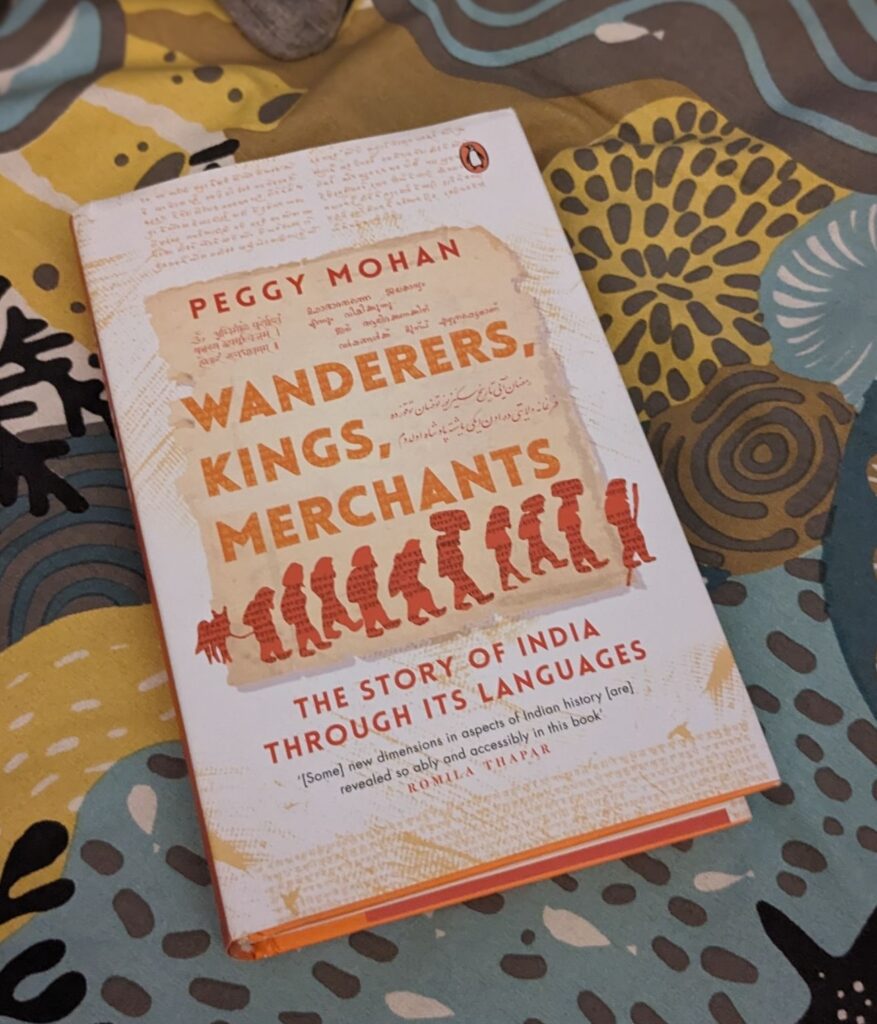
Peggy Mohan
For a while, I have been fascinated by the similarity in words across languages – from the simple biradar-brother to the slightly more elaborate Agni-ignite. I even started a Twitter thread to keep track of these ‘discoveries’. Linguistics per se, the theory of it though, is less of a fascination. I started reading it with the notion that it would be this, but was pleasantly surprised. I love history and that’s what Peggy Mohan has actually done using language(s) and their evolution as her tool in Wanderers Kings Merchants.
She gives us a quick introduction with Creoles in the Caribbean, and points out the appearance of the vocabulary layer, which is influenced by the more powerful group (usually male), and the more intrinsic sound and grammar, which is the maternal side of the story – mother tongue. With this background she brings the narrative to India and creates a storyline using different languages.
She begins with the presence of sounds of Dravidian origin in the recitation of the Rig Veda, and with supporting historical & DNA evidence of a male-driven migration about 3500 year ago when the Harappan civilisation was in decline, traces the Vedic male – local wife combination which led to the Dravidian sounds in the Rig Veda. To be noted that this didn’t happen in the beginning when they were orally preserved and transferred, but around 700 years later when they were formally compiled, edited and written down, reflecting a Sanskrit which by then had vernacular sounds. This was also when the Kuru super-tribe spread east and south, from Kabul to Andhra, taking Sanskrit along. This Sanskrit then mixed with the language of the elite in these regions and created the first versions of Prakrit. As the language trickled down from the elite to the masses, or rather, locals moved up in lifestyles and hence words used, the influence of the latter’s native tongue became stronger and around 1000 CE marked the beginning of the Indo Aryan languages, first as dialects in small areas, and then gradually expanding their domain.
Meanwhile, in my little state of Kerala, around 800 CE, brahmins relocated from the north – Namboodiris, at the behest of local kings. As with the story up north, male-driven migration + local women and an elite happened. The brahmins’ original Apabhramsa language (a ‘corrupted form of Sanskrit that didn’t follow Paninian rules) faded because they had to pick up Malayalam in the long-term, and centuries later, a new language Manipravalam emerged – Sanskrit nouns in (erstwhile) Malayalam sentences. Interesting that a sociopolitical tumult also happened here around the same time – the rise of the Second Chera Empire and the beginning of a strong Malayali identity distinct from Tamil/Cholas. In parallel, a resurgence of Hinduism at the expense of Buddhism and the re-emergence of Brahminical Hinduism.
Similarly, the Central Asian influx into the north (Delhi Sultanate, Mughals) brought with it Uzbek, which quickly vanished as the Central Asians started using the dialect in the region (Hindi) as their vernacular. It was only in the late 1700s that they moved from using Persian as the official language and started writing in Hindi – then renamed Urdu, with an infusion of Persian nouns.
She then takes us to the contemporary example of Nagamese – the grammar of Assamese and a small portion of Naga. It grows even as the both Assamese and the Naga languages continue to exist. The flashback on Assamese is Ahom, courtesy migrants from Burma. This itself is a later episode of the SE Asia + Munda people of the Magadha region. This combination, and the presence of the Vratyas, a pre-Vedic Arya group, is what makes the Magadha languages different from Dravidian.
The most recent play- British and English. The British not only created a Hindi-Urdu divide which hadn’t existed before, but also, thanks to having Indian employees, got the latter to pick up English, though mostly in ‘Prakrit English’ form in the beginning. Ironically, English really spread only after Independence, because the elites wanted to retain their hold on power using language as an access point, and were helped by the fact that no single language had the heft to cover the entire country. And that’s where we are now. ‘What had started as a code to identify the elite snowballed into something set to replace our older languages and cultures as it trickled down, forging a new homogeneity.’
I have to admit I glazed over some of the parts where she decided to go a little deep (by my standards) on technicality of language, but I found the book to be mostly accessible, and definitely fascinating. If you’re even vaguely interested in history, this is a must-read.
Interesting points
Cows as a metaphor for women in the Rig Veda.
The uncanny resemblance between Panini, and the Phoenicians (Poeni in Latin)
Ditto Turkic Ordu (army) and horde
Urdu got its name in the Deccan in 1780, and in its later usage was practically the same as Hindi, both belonging to Hindus and Muslims, until the British decided to cause a split by trying to create a shudh Sanskritised version of Hindi, and in addition the use of Devanagari script. The idea being that they wanted to undermine Urdu, written in Persian script, because it was associated with the Mughal empire.